Japan Is Losing One of Its Quietest Lifelines
For 50 years, a ferry quietly connected Honshu and Shikoku. In 2028, it will disappear — and almost no one is paying attention.
Japan Is Losing One of Its Quietest Lifelines
For 50 years, a ferry quietly connected Honshu and Shikoku. In 2028, it will disappear — and almost no one is paying attention.
Not because it isn’t needed, but because it can no longer be supported.
A route that simply fades away

Nankai Ferry Route from Nankai Ferry
The Nankai Ferry route between Wakayama and Tokushima has operated since 1975. For decades, it carried passengers, vehicles, and freight across the Kii Channel — linking Kansai with Shikoku in a direct, simple way in 2 hours 20 minutes, 24/7.
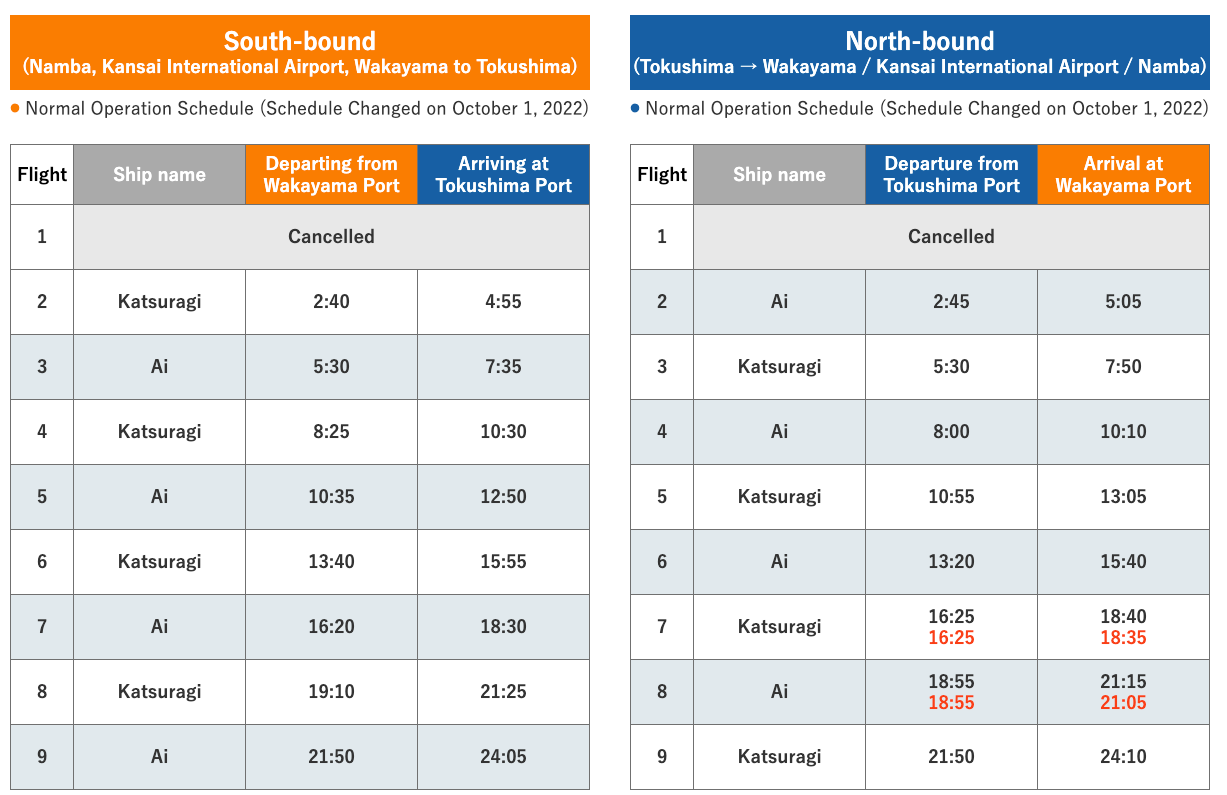
Schedule of Nankai Ferry from Nankai Ferry
But after years of declining ridership, rising fuel costs, and aging vessels, the company has announced it will cease operations by 2028.
On paper, the explanation is straightforward: fewer users, higher costs, and no viable path forward.
But that explanation misses something important.
The route still solves a geographic problem
Even today, this ferry remains the fastest way to reach Shikoku from Wakayama and southern Osaka.
Land routes exist — but they require long detours via major bridges, adding both time and distance. From the Kii Peninsula in particular, the ferry is not just convenient — it is direct.
And it wasn’t just a standalone service.
At Wakayama Port Station, trains arrive almost at the water’s edge. The station sits directly next to the ferry terminal, a reminder that this route was once part of a deliberately designed, seamless corridor between rail and sea.
In fact, it represents something even rarer today:
One of the last direct rail-to-ferry connections in Japan.
A system where you could step off a train and onto a ship without friction — something that has largely disappeared as bridges and tunnels were built.

Nankai Railway’s flagship Limited Express “Southern” and Nankai Ferry at Wakayama Port Station from Wikimedia Commons
The users you don’t see
When a route like this disappears, most people assume alternatives exist.
And for many, they do.
But not for everyone.
Riders of small motorbikes — especially scooters under 125cc — depend on ferries like this to cross between Honshu and Shikoku. Unlike cars, they cannot simply take highways over long bridge routes.
When the ferry closes, these riders will be forced to reroute through more distant ports such as Osaka Port or Kobe Port.
The journey becomes longer, more complex, and more expensive.
It’s a small group of users — but that’s exactly the point.
The people most affected are often the ones least visible in the data.
When the system changed
The decline of ferry routes like this didn’t happen in isolation.
In 1998, the opening of the Akashi Kaikyo Bridge fundamentally reshaped how people and goods moved between Honshu and Shikoku.
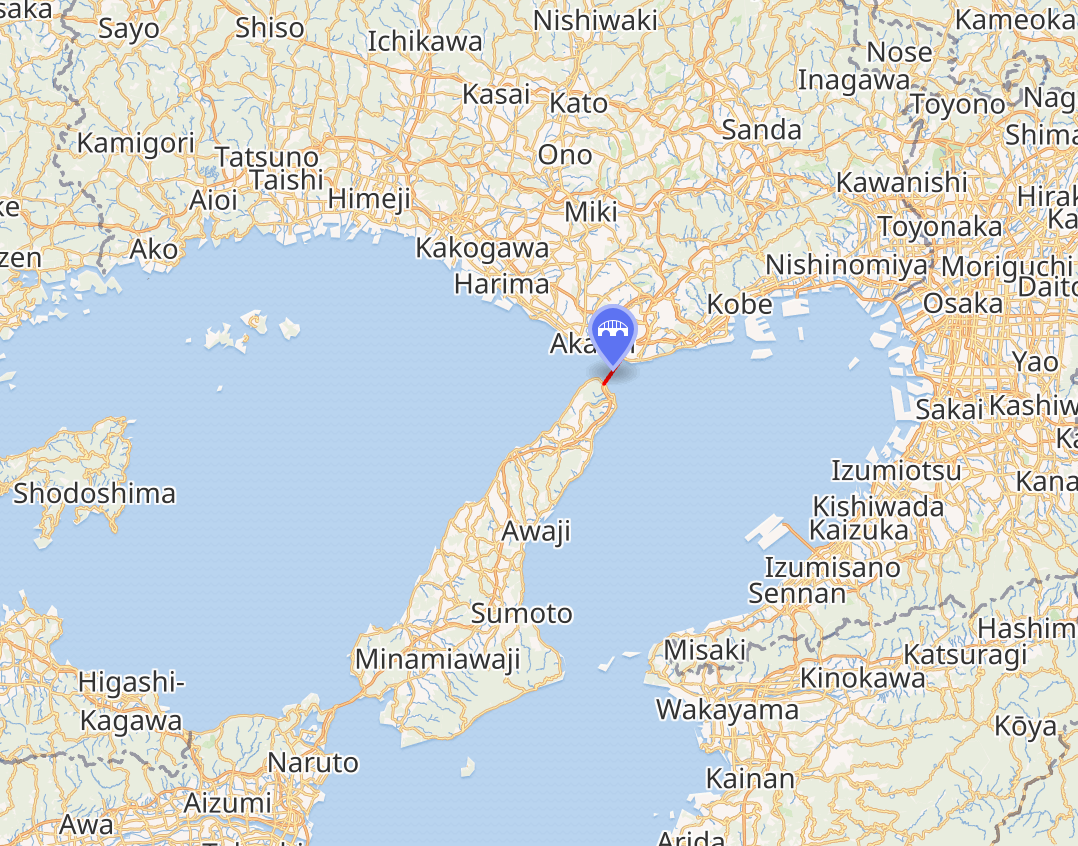
The location of the Akashi Kaikyo Bridge from Open Street Maps
Road infrastructure became dominant. Marine routes became secondary.
Ferries didn’t suddenly stop working — they were simply outcompeted by a system increasingly optimized for cars and trucks.
Over time, what was once essential became optional.
When it mattered most
Ferries like this have proven their value not in everyday convenience — but in moments of crisis.
In 1995, after the Great Hanshin Earthquake, large parts of the transport network were paralyzed. Roads were damaged, and bridges could not be relied upon.
In that moment, maritime routes became literal lifelines.
People, supplies, and emergency support moved across the water when land routes failed.
This is the role ferries quietly play: not always visible, not always heavily used — but critical when the system is under stress.
It tried to survive
This is not a story of sudden collapse.
Before deciding to withdraw, the company sought financial support from local governments in Tokushima and Wakayama. The route’s importance was understood.
But the cost of sustaining it — particularly replacing aging vessels, reported at a cost of 4 billion Yen (approx 250 million USD)— was simply too high.
The support required went beyond what local authorities could justify.
Even when recognized as necessary, the route could not be saved.
What ferries actually provide
It’s easy to view ferries as outdated or redundant in a country defined by efficiency.
But they serve roles that are easy to overlook.
They provide redundancy — alternative routes when roads are disrupted by disasters. They offer geographic efficiency — direct crossings that land transport cannot replicate. And they preserve something increasingly rare:
A fully integrated, multi-modal connection between rail and sea.
When these routes disappear, the system becomes simpler.
But it also becomes thinner.
The quiet trade-off
The closure of this ferry reveals a deeper shift.
Infrastructure today is judged primarily by usage and profitability.
If fewer people rely on it, it becomes harder to justify.
If it costs too much to maintain, it becomes expendable.
But necessity doesn’t always show up in daily numbers.
Sometimes, it only becomes visible when the option is gone.
What remains after it disappears
When the ferry stops running, most people will still reach Shikoku.
They will take longer routes. They will drive across bridges. They will adapt.
But something will still be lost.
A direct connection. A layer of resilience. A transport model that once allowed seamless movement between rail and sea.
The ferry didn’t disappear because no one needed it.
It disappeared because keeping it alive cost more than anyone was willing — or able — to pay.
And with it goes one of the last direct rail-and-ferry links in Japan.
메타데이터
- post_id
- 3cfa1a616953
- slug
- japan-is-losing-one-of-its-quietest-lifelines-3cfa1a616953
- url
- https://medium.com/@satoshiashkanemura/japan-is-losing-one-of-its-quietest-lifelines-3cfa1a616953
- canonical_url
- https://medium.com/@satoshiashkanemura/japan-is-losing-one-of-its-quietest-lifelines-3cfa1a616953
- author_url
- https://medium.com/@satoshiashkanemura
- status
- ok
- fetched_at
- 2026-06-23 17:05:31