The Statue of Daniel: America’s Top-Heavy Economy and the Fragility of Civilizations
Summary Statement: America’s economic model has evolved into a modern version of Daniel’s statue — brilliant at the top, brittle at the…
The Statue of Daniel: America’s Top-Heavy Economy and the Fragility of Civilizations

The Statue of Daniel: America’s Top-Heavy Economy and the Fragility of Civilizations
Summary Statement: America’s economic model has evolved into a modern version of Daniel’s statue — brilliant at the top, brittle at the foundation. Concentrated prosperity in AI and technology sits atop weakened industrial, agricultural, and infrastructural bases, creating a civilization that appears powerful yet is structurally vulnerable to shocks. History shows that systems collapse not because their apex falters, but because their foundations crack.
I. Introduction
Civilizations often reveal their trajectory not through their brightest achievements, but through the stability of the structures that support them. In the Book of Daniel, Nebuchadnezzar’s statue stands as a metaphor for empires built on unequal layers of strength: a golden head resting ultimately on feet made of iron mixed with clay. The entire sculpture collapses when a stone strikes the most fragile part — the unstable foundation.
Today, America’s economic architecture mirrors that ancient imagery. The nation possesses a dazzling apex of technological innovation, symbolized by companies like Nvidia, Microsoft, Apple, and the broader AI complex. Yet beneath this brilliance lies a foundation showing signs of erosion: fragile supply chains, hollowed industrial capacity, mounting debt, weakened agricultural independence, and deepening social fractures.
The central question is not whether America’s technological elite is strong — it undeniably is. Rather: Can a civilization endure when its foundations weaken while its apex grows heavier?

Nvidia-vs.-Magnificent-Seven-Weights
II. The Modern “Head of Gold”: AI, Nvidia, and Technocratic Concentration
If the U.S. economy were a statue, the head of gold would unquestionably be the AI sector. Nvidia, now carrying a record-breaking weight in the S&P 500, has become a singular pillar upon which vast amounts of capital depend. Its valuation rivals entire nations’ stock markets. Its chips power a global race for artificial intelligence supremacy. Its upward momentum sustains not just the NASDAQ, but pension funds, 401(k)s, sovereign wealth portfolios, and the broad confidence of American markets.
This level of concentration is historically unprecedented. The technology sector is no longer one component of the U.S. economy — it is the economy in terms of financial weight, narrative dominance, and investor psychology. Nvidia itself has become the leverage point of the entire U.S. equity structure.
Yet brilliance at the top does not guarantee stability below. A system where one company and one sector carry disproportionate weight becomes vulnerable not because the gold is weak, but because its presence masks the fragility of the base.

Nvidia-vs.-S&P-500-Sector-Weights
III. The Collapse of Diversification: How the U.S. Narrowed Its Economy
Over decades, America transitioned from a broad industrial powerhouse to a narrow post-industrial economy centered on intellectual labor, software, finance, and digital technology. The Rust Belt stands as a physical reminder of the industries lost — automotive, steel, machinery, textiles, and manufacturing capacity that once employed millions.
Agriculture, once a symbol of American self-sufficiency, has been undermined by reliance on foreign buyers like China. Manufacturing has been outsourced to Asia. Pharmaceuticals, energy inputs, and rare earth minerals increasingly come from geopolitical competitors. Wall Street incentives favored outsourcing, cost-cutting, and financial engineering over domestic production and long-term resilience.
The result is a narrowing of the economic base. A civilization becomes fragile when diversity gives way to specialization without redundancy. The economy now behaves like a single-engine aircraft — powerful, but with no backup systems.
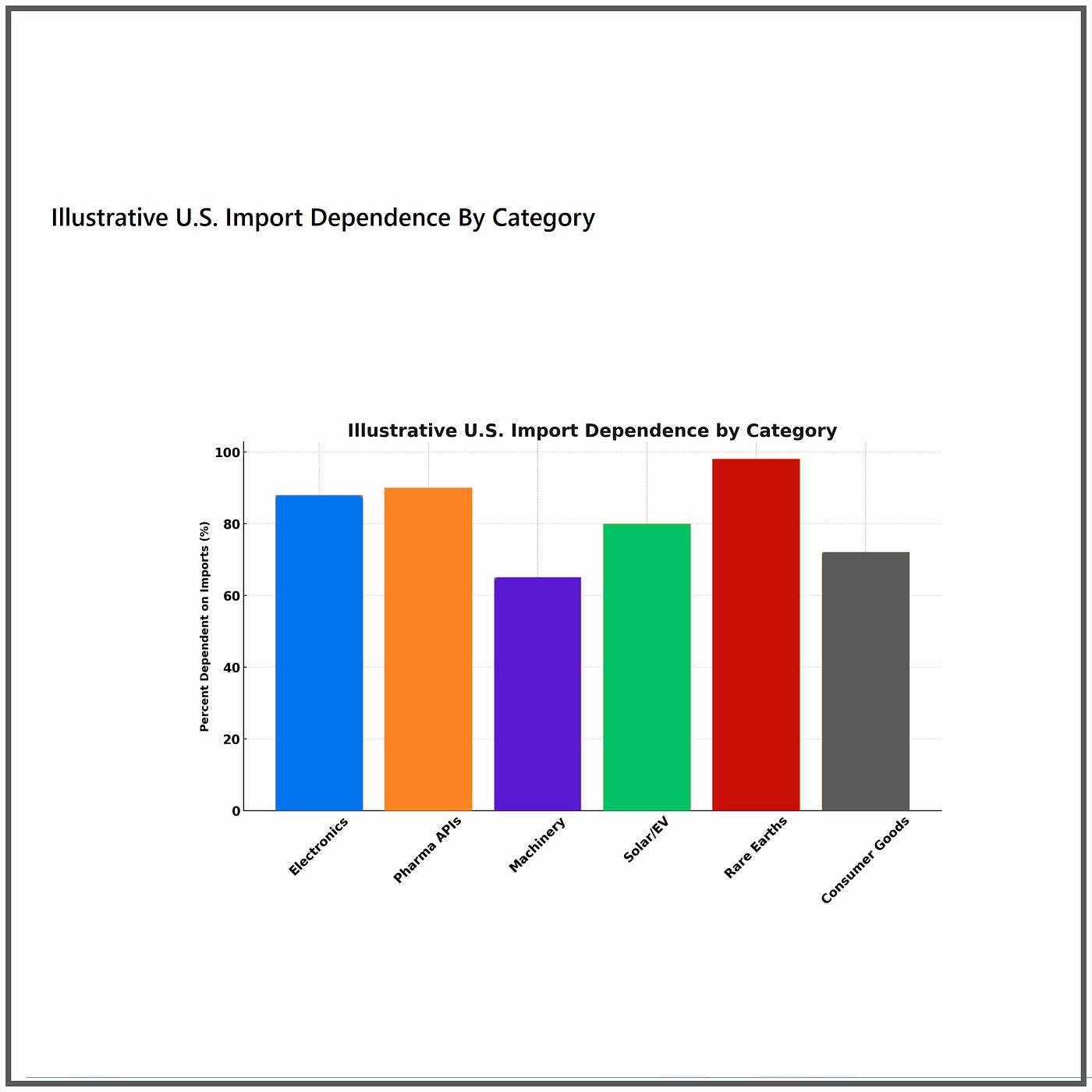
U.S.-Manufacturing-Import-Dependence-by-Category
IV. The Brittle Foundations: “Feet of Iron and Clay”
Below the golden head lies America’s fractured foundation. The metaphorical “feet of iron and clay” represent sectors that should be stable but are weakened by foreign dependence and internal neglect:
- Supply chains dependent on Taiwan, China, and Southeast Asia for critical components.
- Energy infrastructure hampered by political gridlock, underinvestment, and inconsistent policy.
- Agriculture pressured by competitive producers, falling global demand, and geopolitical capture.
- Federal debt climbing uncontrollably, with interest expense now outpacing defense spending.
- Industrial capacity insufficient for national security needs without foreign imports.
- Social cohesion strained by worsening inequality and declining opportunity.
- Infrastructure aging, underfunded, and increasingly unreliable.
Clay mixed with iron looks strong but behaves unpredictably under stress. The same is true of America’s foundation — visually impressive, functionally compromised.

U.S.-Supply-Chain-Dependence-on-China,-Asia
V. The Stone That Strikes: Potential Shock Triggers
A top-heavy system rarely falls slowly; it tips suddenly when a shock hits the weakest point. Several potential “stones” could strike America’s economic foundation:
- A technological breakthrough that bypasses GPUs — optical compute, neuromorphic chips, or a new AI architecture.
- A geopolitical rupture that disrupts semiconductor supply chains.
- A sovereign debt crisis that destabilizes the Treasury market.
- A resource embargo or BRICS alignment that restricts critical minerals or agricultural imports.
- Domestic unrest triggered by structural unemployment and inequality.
- An energy supply failure due to aging grids or global market disruptions.
The vulnerability lies not in Nvidia’s strength but in the system’s inability to withstand the failure of its foundational layers.
VI. Historical Parallels: Civilizations That Fell from the Base Up
History offers clear warnings. Rome collapsed not at the height of its intellectual or military prowess, but when its agricultural and fiscal foundations broke. The British Empire declined as financialization overtook industrial renewal. The Qing and Ottoman empires fractured when their bureaucratic apex could no longer compensate for structural decay at the base.
In every case, collapse began at the bottom. Civilizations fall when their foundational capacities — food, production, resources, stability — lose coherence while the apex remains unaware of its dependence.

Share-of-U.S.-GDP-by-Sector-(1960–2025)
VII. Rebuilding the Foundation: What a Resilient Economy Requires
A durable civilization is not defined by the brilliance of its apex, but by the strength of its base. For the U.S. to regain resilience, it must pursue:
- Domestic supply chain sovereignty
- Energy independence through stable baseload power
- Agricultural revitalization and protection
- Reindustrialization and advanced manufacturing capacity
- A balanced technological ecosystem, not a single point of failure
- Fiscal discipline that reduces systemic fragility
- Social inclusion in the technological economy
The challenge is not to diminish the head of gold — but to rebuild the legs of iron and the stability of the foundation.
VIII. Conclusion
The imagery of Daniel’s statue endures because it reflects a fundamental truth: Civilizations do not collapse when their apex falters. They collapse when their foundations crack.
America’s technological elite is unmatched in creativity, scale, and economic power. But brilliance at the top cannot compensate for vulnerability at the base. The nation’s future will be determined not by the strength of its golden head but by the resilience of the feet on which it stands.
Until America rebuilds its foundational pillars — industry, agriculture, supply chains, energy, and social cohesion — it will remain a towering statue with clay beneath its weight.
The warning is ancient. The relevance is modern. The choice is ours.
메타데이터
- post_id
- 3cffd13e28d3
- slug
- the-statue-of-daniel-americas-top-heavy-economy-and-the-fragility-of-civilizations-3cffd13e28d3
- url
- https://medium.com/@BobbyGiggz/the-statue-of-daniel-americas-top-heavy-economy-and-the-fragility-of-civilizations-3cffd13e28d3
- canonical_url
- https://medium.com/@BobbyGiggz/the-statue-of-daniel-americas-top-heavy-economy-and-the-fragility-of-civilizations-3cffd13e28d3
- author_url
- https://medium.com/@BobbyGiggz
- status
- ok
- fetched_at
- 2026-06-09 15:37:30