Hope through the Dissonance
When the Chord Won’t Resolve
Hope through the Dissonance
When the Chord Won’t Resolve
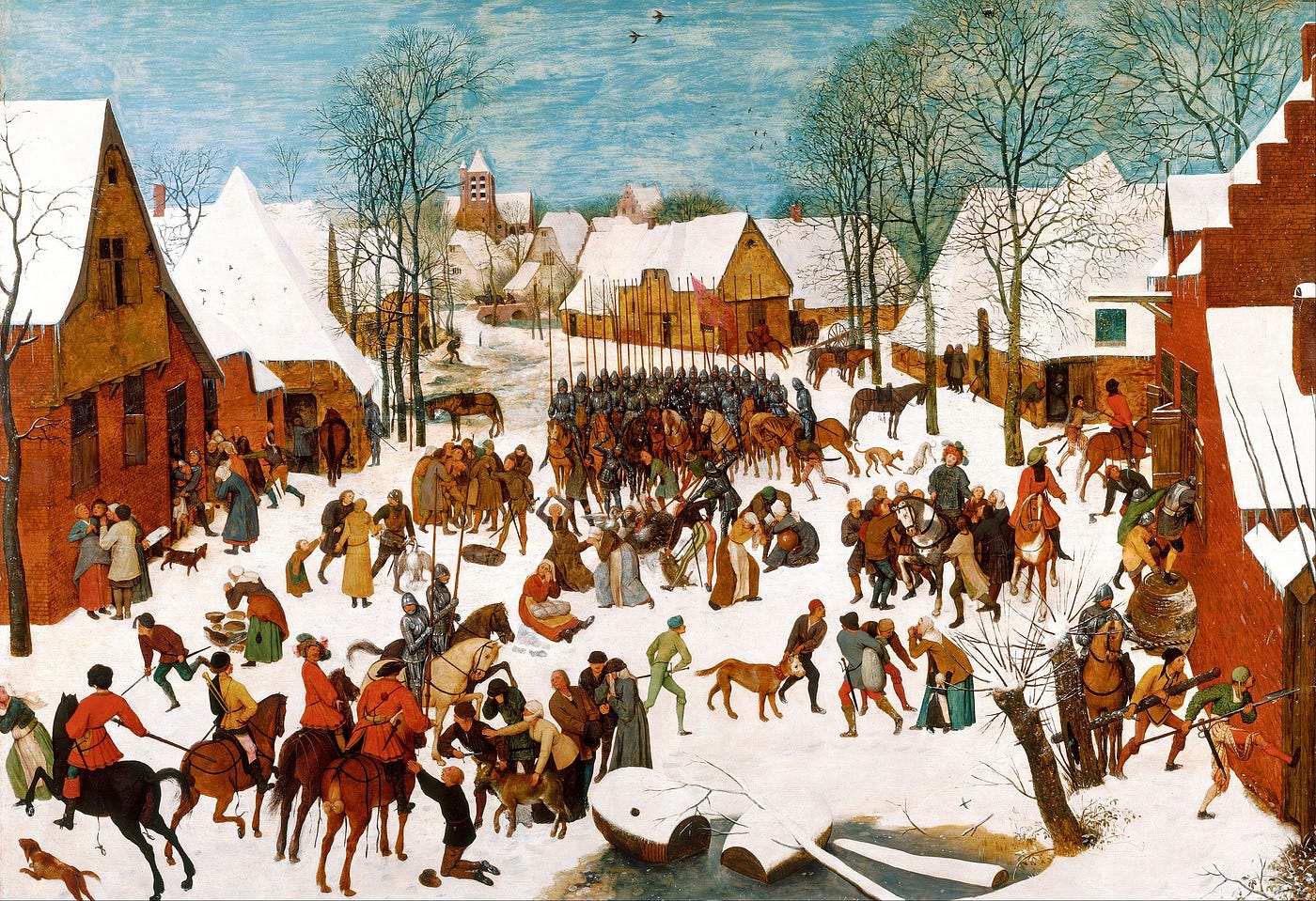
(“Massacre of the Innocents,” Pieter Bruegel the Elder)
December 28, 2025 First Sunday after Christmas, Year A St. Stephen’s UMC, Burke, VA Matthew 2:12–23 (NRSVue)
Promise vs. Reality
Jesus is born. Messiah. Emmanuel. The King who saves. The one who unsettles Herod. The one the magi cross deserts to honor. The one whose life fulfills the prophets is finally here.
And yet human tragedy continues. Evil does not simply stop.
This is a tough scripture right after Christmas. We proclaim, “A Savior is born.” But Matthew shows us what happens next: just like there was no room in the inn, soon there was no room in Bethlehem. Jesus and his parents had to flee to Egypt — while other families with boys under two suffered unspeakable tragedy at the hands of an insecure king.
And if we are honest, we feel that dissonance in our own lives, too. We wish that during this holiday season, evil and injustice would take a pause. At least for a moment, we yearn for the chorus of angels to sing louder than the voices of insecure leaders who cling to power. We hope that all our talk of peace and love might grant the world — and our hearts — a little relief from suffering. But the gap between God’s promise and human reality can feel wide, and this dissonance can push us toward skepticism, even cynicism.
If the Savior is born, why does God still allow evil?
Why does God allow the suffering of the innocent in the world — and why in my life?
“Dissonance”
The word dissonance describes the tension when two things clash, and it originally comes from music. It describes what happens when notes rub against each other — when the sound feels tense, unsettled, even “wrong” to our ears. It creates uneasiness, a kind of musical ache. But dissonance is rarely the destination; it’s a tool for movement. It pushes the music forward. It makes you lean in, waiting for what comes next. Dissonance builds tension so that it can travel somewhere — so that it can finally resolve into a chord that feels stable, like coming home.
If we’re stuck in dissonance, we do what we always do: we avoid it, numb it, or drown it out. But if we can stay with it for a moment — and remember it isn’t the destination — we start to lean forward. We begin to hope for resolution, to listen for the next movement, and to believe the song is still going somewhere that we cannot yet imagine.
I remember the first few months after our children were born. Even with all the joy and celebration, the sleepless nights, the loud cries, and all the unknowns were brutal. Everyone was happy for us, yet my wife and I were barely holding it together — physically, emotionally, and mentally. Life wasn’t pretty and yet we persevered — because we were told by others, and we ourselves slowly learned that infancy is just a season. We weren’t quite sure what it would look like next, but even in dissonance, we leaned forward with hope toward what comes next.
Mystery of Faith
That’s what faith does in dissonance — faith shaped by scripture, tradition, experience, and reason. It doesn’t deny the tension; it endures it and gives rise to hope, trusting the story is still moving. That’s why Matthew doesn’t shy away from telling the tragedy in Bethlehem. He refuses to sentimentalize Jesus’ birth. Instead, he tells the truth about the world Jesus entered — and he tells it with the confidence knowing that evil will not have the final word.
Matthew’s first listeners, the Jewish Christian community, would have heard an older story underneath this one. They remembered Pharaoh — another insecure king — who slaughtered Hebrew baby boys in Egypt. And even that horror was not the end. God made a way where there was no way: deliverance, freedom, a new beginning. Now Matthew is hinting that Jesus is a new Moses — not for one people only, but for all people. The same God who delivered then is still delivering now.
So yes, there is dissonance between God’s promise and our lived experience. Even as churches pour their energy into proclaiming Jesus’ birth this season, the most vulnerable in our world — especially babies and children — are still being separated, exposed, and harmed by violence. And still, we can hope — because our scripture trains us to listen. Memory becomes promise: God is still at work. This is not the end — because in the resurrection of Jesus, God has already shown us where the story is headed. The cross was not the last word. The tomb was not the final destination.
And, precisely for this reason, we remember the first Advent each year — God coming near in a manger — not as a sentimental tale, but as the opening movement of a larger song. The dissonance we hear now is not the final chord. God’s love, shown through the mystery of the incarnation, is still moving us toward the mystery of faith we proclaim: Christ has died, Christ is risen, Christ will come again. Christmas is not just celebration; it is also holy remembering and holy waiting — until the second Advent, when Christ comes in final victory, and we feast at his heavenly banquet.
Genunine Hope
This week, I stumbled upon a story of Palestinian Christians in Gaza, who gathered to celebrate Christmas for the first time in three years. And I had to wonder. After all they have gone through and their future still unresolved, they nonetheless gathered in the fragile space of a ceasefire to celebrate the birth of Jesus with hope and joy.

The story of their humble Christmas celebration reminded me of a quote from German theologian Jürgen Moltmann,
“Genuine hope is not blind optimism. It is hope with open eyes, which sees the suffering and yet believes in the future.”
If 2025 was a song, it had plenty of dissonance. And yet we are here. You are still here. Because God’s song does not end in the unresolved chord. It continues. With us.
So as we look forward to 2026, I pray that God’s song will continue to carry us forward. May the clashing sounds of our life not confine us to cynicism but draw us into genuine hope. I pray for perseverance. I pray for the willingness to listen. I pray for the discipline to remember. And I pray for the courage to keep dreaming — toward the future our faith has taught us to anticipate:
One with Christ, one with each other, and one in ministry to all the world, until Christ comes in final victory and we feast at his heavenly banquet.
In the name of the Father, of the Son, and of the Holy Spirit. Amen.

Rev. Minoo Kim is an ordained elder in the United Methodist Church, currently serving in the Virginia Annual Conference. Follow his Medium publication to receive his latest sermons or check out his website minoowkim.com for his latest content. Peace!
메타데이터
- post_id
- 3d1df1c03e9f
- slug
- hope-through-the-dissonance-3d1df1c03e9f
- url
- https://medium.com/minoowkim/hope-through-the-dissonance-3d1df1c03e9f
- canonical_url
- https://medium.com/minoowkim/hope-through-the-dissonance-3d1df1c03e9f
- author_url
- https://medium.com/@minoowkim
- status
- ok
- fetched_at
- 2026-06-09 15:37:30