From Chaos to Control: The Game-Changing Impact of ISO 20000–1 on IT Providers
A management system is not an IT service desk on a bunch of spreadsheets, undocumented escalation paths, and the tribal knowledge of two…
From Chaos to Control: The Game-Changing Impact of ISO 20000–1 on IT Providers
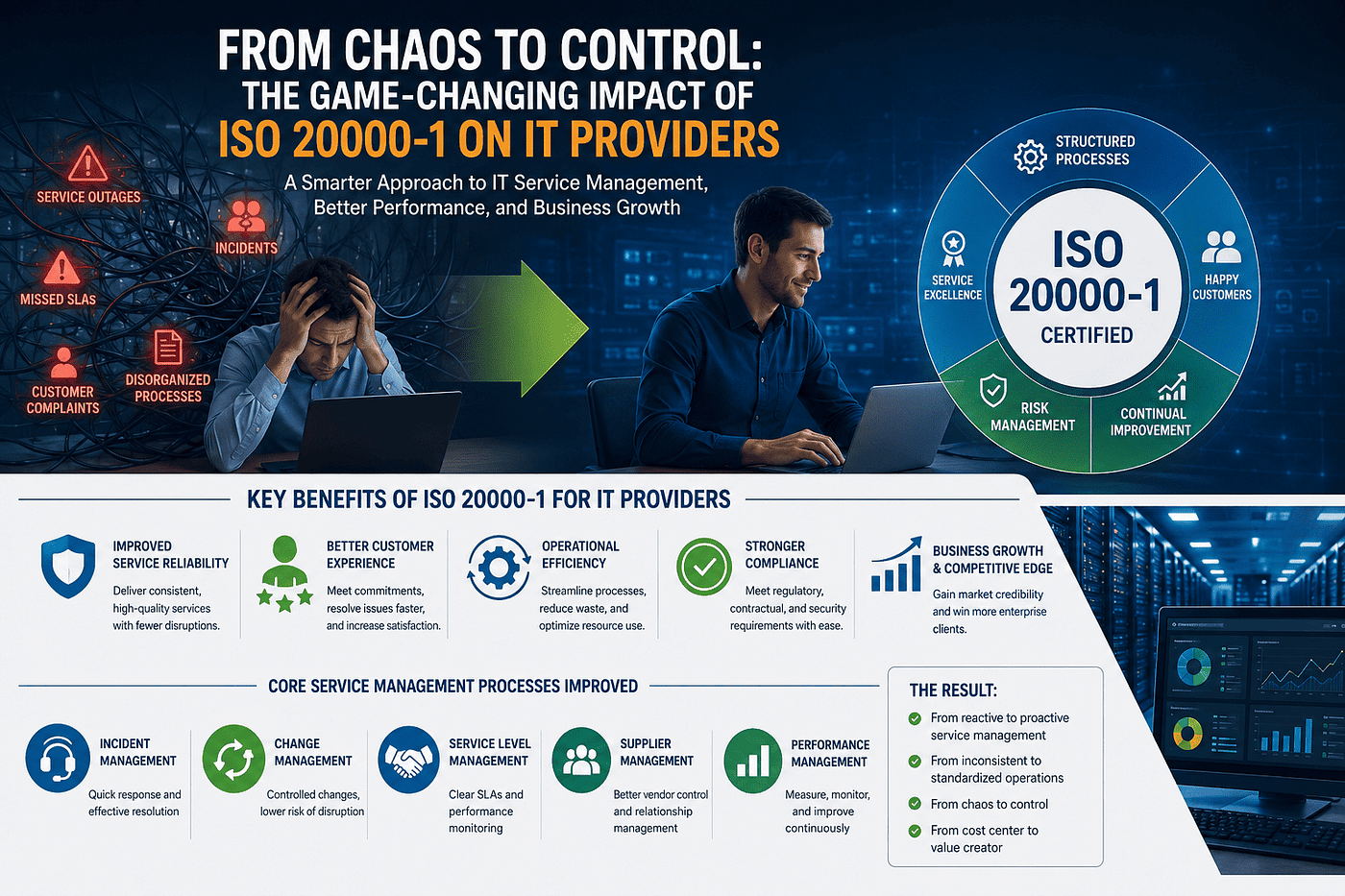
ISO 20000–1 certification is becoming essential proof that a provider delivers governed, auditable IT services
A management system is not an IT service desk on a bunch of spreadsheets, undocumented escalation paths, and the tribal knowledge of two senior engineers. It’s a time bomb looking for a bad week.
The ISO 20000–1 standard exists to replace that chaos with a structured, auditable way of planning, delivering, and improving IT services, and it’s becoming one of the fastest-growing certifications in the ISO family for exactly that reason.
What Is the ISO 20000–1 Standard?
“Information Technology Service Management: Service management system requirements” is the formal name for ISO/IEC 20000–1:2018, which outlines what an organization needs to do to set up, implement, maintain, and continually improve a service management system, or SMS. The summary of ISO’s own standard says it covers the entire service lifecycle planning, design, transition, delivery, and improvement with the explicit aim of meeting service requirements and delivering value to customers.
With the 2018 update, the standard migrated to ISO’s High-Level Structure, the same framework that underpins ISO 9001 and ISO 27001. This means that an IT provider already certified to one of those standards can integrate ISO 20000–1 implementation into an existing management system, rather than building a parallel one from scratch.
The standard is built on the same Plan-Do-Check-Act cycle used throughout ISO management systems and is intended to work with service frameworks such as ITIL 4, not against them.
Why ISO 20000–1 on IT Providers Matters? Right Now?
The certification numbers are self-explanatory. The ISO Survey of Management System Standard Certifications shows worldwide ISO 20000–1 certificates jumped from 3,670 in 2023 to 27,332 in 2024, a leap the CASCO-published survey says is due as much to improved data collection through the IAF CertSearch database as to new adoption. But that still reflects a standard moving from niche to mainstream inside IT and managed services.
That spike is in line with what’s happening in the underlying market. Market research firm UnivDatos has pegged the value of India’s IT and BPO services sector at USD 62.29 billion in 2025, with a CAGR of close to 11.49% till 2034, fueled by the adoption of cloud, AI, and analytics.
The global managed services market size was USD 330.4 billion in 2025. The market is expected to grow from USD 350.8 billion in 2026 to USD 1,118.2 billion in 2034 at a CAGR of 15.4% during the forecast period. With more IT work being outsourced to third-party providers, the pressure on those providers to show that they can operate a governed, auditable service operation is only increasing. ISO 20000–1 certification is increasingly becoming the answer to that pressure directly.
Why Many IT Providers Struggle?
Many IT organizations grow quickly, without the benefit of formal service management processes. “Once you have more customers, you can see the operational problems.
Typical problems include the following:
- Multiple service disruptions
- Unspecified duties
- Inconsistent incident management
- Bad change control
- No visibility of services
- Increasing customer complaints
- Misallocation of resources
Service quality often varies when processes are heavily dependent on individual employees, not documented systems. That poses a risk for the provider and its customers.
The increasing relevance of ISO 20000–1 for IT providers is that it replaces inconsistent practices with repeatable and controlled processes.
From Chaos to Control: What Changes After Implementation
Clauses 4 to 10 are the core requirements of ISO 20000–1, and they are mapped directly to the operational gaps that give IT providers grief. Clause 4 requires an organization to determine the scope of its SMS and know who it is serving. Clause 5 puts service management policy and accountability on a named owner, rather than diffusely.
Compliant Ltd. published a detailed breakdown of the standard’s clauses, which states that the standard then requires documented processes for incident management, problem management, change management, capacity and availability planning, service level management, and supplier management.
And that is the practical shift that ISO 20000–1 implementation forces. Incidents get logged and tracked to resolution against defined targets instead of being solved ad hoc and forgotten. Instead of being pushed straight into production, changes now go through an approval and risk assessment process. Capacity planning is a scheduled activity, not a panic response to an outage.
This is not, in any of it, a theoretical process for its own sake. It’s the documented trail that takes “we think our service desk works” to “we can prove our service desk works,” which is exactly what clients, auditors, and procurement teams are asking to see.
Real-World Areas Improved Through ISO 20000–1
Incident Handling
A formal incident management process ensures that issues are consistently identified, prioritized, escalated, and resolved.
This reduces downtime and boosts customer confidence.
Managing Change
Uncontrolled changes are still a major source of service disruption.
The standard requires procedures to formally assess, approve, test, and implement changes.
Service Level Management
Organizations define, monitor, and review service commitments to meet customer expectations.
Vendor Management
Third-party providers often play important roles in service delivery.
ISO 20000–1 provides controls to manage supplier performance and the related risks.
Capacity and Availability Management
Service providers gain more insight into resource requirements and system performance trends.
Such operational improvements are the reason so many organizations are adopting ISO 20000–1 for ITSM initiatives.
How to Approach ISO 20000–1 Certification?
A structured pathway to certification usually includes five steps.
- First, a gap analysis is conducted to compare the existing service management practices with the requirements of clauses 4 to 10 of the standard.
- Second, the SMS is documented. Policy, process definitions, roles, and the service catalog.
- Third, training is given to staff and service desk teams about the new processes, especially incident, change, and problem management, as these are the workflows that people interact with on a daily basis.
- Fourth, an internal audit determines whether the documented system is being followed at all before an external body ever sees it.
- Fifth is the external certification audit, which is carried out in two phases: a review of the documentation and then an on-site audit of the SMS in operation.
Organizations already using ISO 9001 or ISO 27001 tend to find this easier, since the Harmonized Structure allows them to use their existing document control, internal audit, and management review processes rather than duplicating them for ISO 20000–1.
The Critical Role of ISO 20000–1 Implementation
The successful implementation of ISO 20000–1 is the first step to successful certification.
Certification audits are more than just a paper review. Auditors assess if processes are working well and producing the intended results.
A typical implementation project involves:
- Gap Analysis: Assess existing service management practices against standard requirements.
- Design of Service Management System: Policies, objectives, procedures, and controls are established.
- Process Development: Organizations strengthen processes like incident management, service reporting, and change management.
- Training of Employees: Teams are trained on awareness and the operations to enable adoption.
- Internal Audit: Internal reviews ensure compliance with standards and identify areas for improvement.
- Management Review: Leadership assesses system operations and allocates resources as appropriate.
Organizations that invest in a structured ISO 20000–1 implementation program tend to have smoother certification outcomes and stronger long-term performance.
ISO 20000–1 for ITSM Teams: A Practical Checklist
Turning ISO 20000–1 for ITSM into daily practice from theory starts with an honest inventory of what’s documented vs. what lives only in someone’s head. If an ITSM team is considering readiness for a certification project, the following are worth confirming prior to starting:
- One documented service catalogue that accurately reflects what is being delivered to clients
- Processes for incident and problem management with defined severity levels and resolution targets
- A formal process for change management, including risk assessment and approval steps
- Scheduled capacity & availability monitoring, pro-active not re-active
- SMS requirements management throughout supply chain for supplier and subcontractors
- A regular internal audit and management review cycle on a set schedule, not just in the run-up to a certification renewal
Most of these boxes are usually checked by providers within months, not years, from certification.
Get Started Here!!
It’s clear where the direction of travel is: as more IT delivery moves to third-party and managed service providers, ISO 20000–1 certification is moving from a differentiator to an expectation. Ascent WORLD partners with IT providers across India and the GCC to help them transition from a fragmented service desk to a certified, auditable service management system, without compromising delivery speed.
메타데이터
- post_id
- 3d2c33ce5730
- slug
- from-chaos-to-control-the-game-changing-impact-of-iso-20000-1-on-it-providers-3d2c33ce5730
- url
- https://medium.com/@contents_63436/from-chaos-to-control-the-game-changing-impact-of-iso-20000-1-on-it-providers-3d2c33ce5730
- canonical_url
- https://medium.com/@contents_63436/from-chaos-to-control-the-game-changing-impact-of-iso-20000-1-on-it-providers-3d2c33ce5730
- author_url
- https://medium.com/@contents_63436
- status
- ok
- fetched_at
- 2026-08-02 10:51:37




