“The Sound of the Silence.”
Alfred Hitchcock’s film “The Birds” exemplifies the Apocalyptic Grammar of Unreason.
dvdsreleasedates.com
“The Sound of the Silence.”
Alfred Hitchcock’s film “The Birds” exemplifies the Apocalyptic Grammar of Unreason.
Alfred Hitchcock’s The Birds (1963) is a monument of cinematic dread. More than sixty years after it came out, it still has a scary power that goes beyond being just a monster feature or horror movie. This movie was out just after Psycho (1960), which changed the way the “Master of Suspense” made films. Instead of clean psychological riddles and obvious moral lines, he made an almost existential encounter with chaos. Hitchcock’s adaptation of a short story by Daphne du Maurier omits everything except the most horrifying aspects of the story: the sudden breakdown of the natural order and the ensuing collapse of human civilisation. In the past, thrillers used complicated plots and carefully planned music to make people feel scared. In The Birds, however, the sound design is revolutionary, a creepy electronic tapestry made up of squawks, wingbeats, and deliberate, unsettling silence. The film starts as a fragile romantic comedy set against the deceptively calm backdrop of Bodega Bay, California. However, this lightness is quickly broken by a series of attacks from gulls, crows, and other birds that have no reason, no warning, and no end.
The film’s brilliance lies in how it is radically unclear. It changes the movie from a normal monster movie into a powerful metaphor for the nuclear era, showing how people are afraid of random catastrophe and losing control over the environment. Hitchcock carefully shows how people go from being comfortable in the city to being scared in the country via the story of Melanie Daniels (Tippi Hedren), a sophisticated socialite who goes from San Francisco to Bodega Bay to see lawyer Mitch Brenner (Rod Taylor). This critique’s main point is that The Birds is more than just a good suspense movie; it’s a deeply disturbing look at human complacency, societal anxiety in the nuclear age, and the terrifying fragility of civilisation. It was made with a masterful, unconventional cinematic precision that changed the horror genre and is still one of Hitchcock’s most complex and lasting statements on the nature of fear itself. This review will look at the film’s story structure and the many problems with its characters, as well as its technical innovations, especially its groundbreaking soundscape. Finally, it will look at its strong themes as an apocalyptic warning from the quietest parts of the American coast.
Britannica.
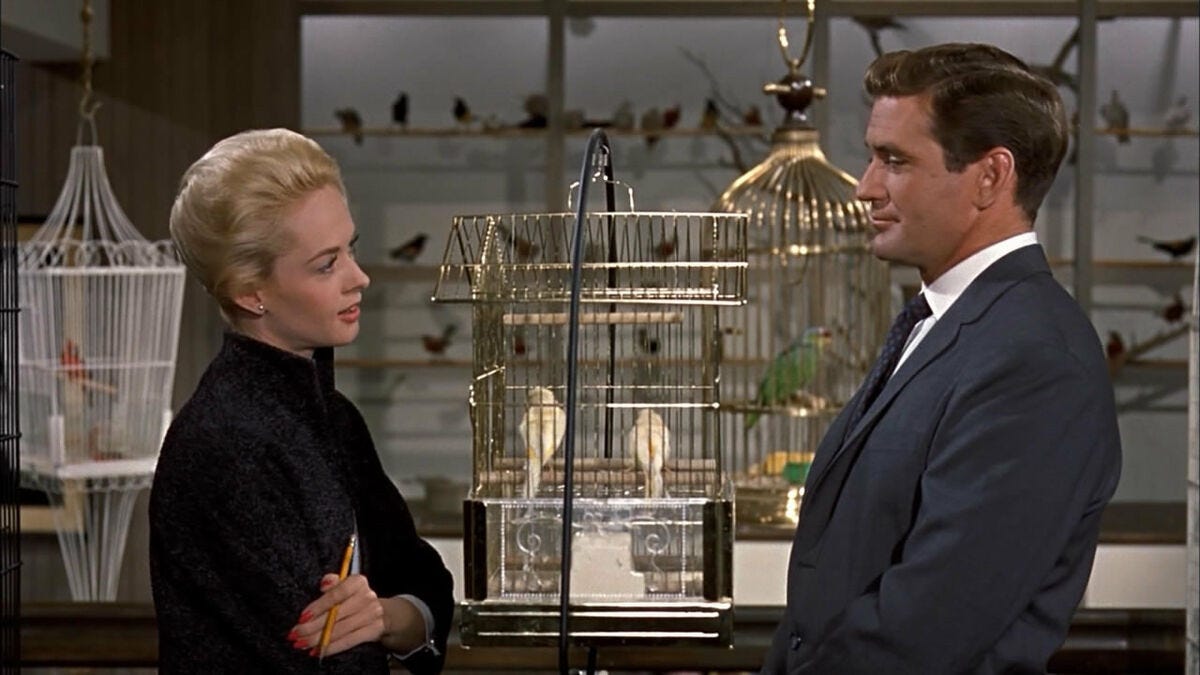
The story structure of The Birds is brilliant because it deliberately goes against what people anticipate. The movie doesn’t start with blood or danger right away. Instead, it starts with a lovely meet-cute in a San Francisco pet store. This scene sets up Melanie Daniels as a beautiful, somewhat frivolous character, a privileged “wild bird” herself, known for her gossip column headlines and her reputation for risky conduct. Her choice to follow Mitch Brenner to his little coastal town of Bodega Bay while pretending to bring a couple of lovebirds starts the conflict not as terror, but as a domestic intrusion. The incident sets the tone for a drama where the animal assaults make already-tight human relationships even worse.
Melanie’s character development is the most important way for us to see the end of the world. The change from being a clever intruder to a distraught victim is demanding on her body and mind. Hitchcock uses Melanie’s beauty and initial distance to look at themes of judgment and redemption. The townspeople, especially Mitch’s controlling mother, Lydia, see Melanie as the cause of the trouble at first, which hints at a strange Puritanical strain in the town’s reaction, as if the disaster is a direct punishment for her perceived immorality or independence. Casting the relatively unknown Tippi Hedren helped with the characterisation by letting the viewers see her spiral into terror without the baggage of a well-known celebrity persona. The script made her agony seem real and urgent.
The disaster’s goal is to break apart the Brenner family. Mitch Brenner (Rod Taylor) is the strong, moral heart of the story, but his connection with his widowed mother, Lydia (Jessica Tandy), is what really defines him. Lydia is perhaps the most complex human character in the movie. She is a lady whose dread of being left alone and her strong, almost unhealthy devotion to her kid characterise her. The bird assaults are a horrible way for her to show how scared she is within. The movie is a psychological drama before it turns into a horror movie. Lydia’s crushing sadness and anxiety are only temporarily replaced by the real menace of the birds, which then come back in terrifying scenes, such as when the farmer Dan Fawcett’s body is found. The most significant change in the whole situation is when she quietly accepts Melanie into the family’s protective circle. The film shows that fear leads to a solution to their home dilemma, bringing the survivors together in their common weakness.
aiptcomics.com
The secondary characters, such as the kind but doomed Annie Hayworth (Suzanne Pleshette), the schoolteacher, and the condescending ornithologist at the restaurant, are all important parts of how people react to the crisis. Annie is a terrible, unselfish sacrifice, and her life is a sombre contrast to Melanie’s dazzling one. The restaurant scene, on the other hand, when the people in the town are in frenzied denial, moralising, and scientifically dismissive, is perhaps the best example of how society falls apart when it is under stress. This scenario criticises how complacent people can be, illustrating how easily reason breaks down when anything happens that goes against what we already know. Each individual embodies a distinct phase of terror, denial, or despair, making the tale a comprehensive field study of a society confronting an unfathomable, existential peril.
The Absence of Music: Technical Brilliance and the Sound of Dread: If Psycho showed that Hitchcock was ready to murder his star in the first act, The Birds showed that he was willing to kill the whole score. The film’s technical excellence is closely related to its groundbreaking approach to sound, which is probably the most powerful and the most unusual part of its artistic execution. Hitchcock famously turned down a conventional musical soundtrack and instead used solely natural noises, conversation, and electronic sound effects made by German experimental composers Oskar Sala and Bernard Herrmann (the latter was simply acknowledged as a “sound consultant”).
This intricate sound design serves as the film's "unseen hero." Sala’s work, made on the Trautonium, an early electronic instrument, produced synthetic bird cries, squawks, and strange rhythmic pulsations that are far stranger and more disturbing than any genuine sound that has been recorded. This intentional decision to create the dread makes the movie seem more like a nightmare made by technology than like a terrible nature documentary. Because there are no standard orchestral cues, the audience doesn’t receive the customary emotional signposts. No music builds up to warn or soothe us. The quiet, which is only broken by the noises of everyday life (the clang of the teacup, the crackling radio), becomes heavy and full of expectation.
gatewayfilmcenter.org
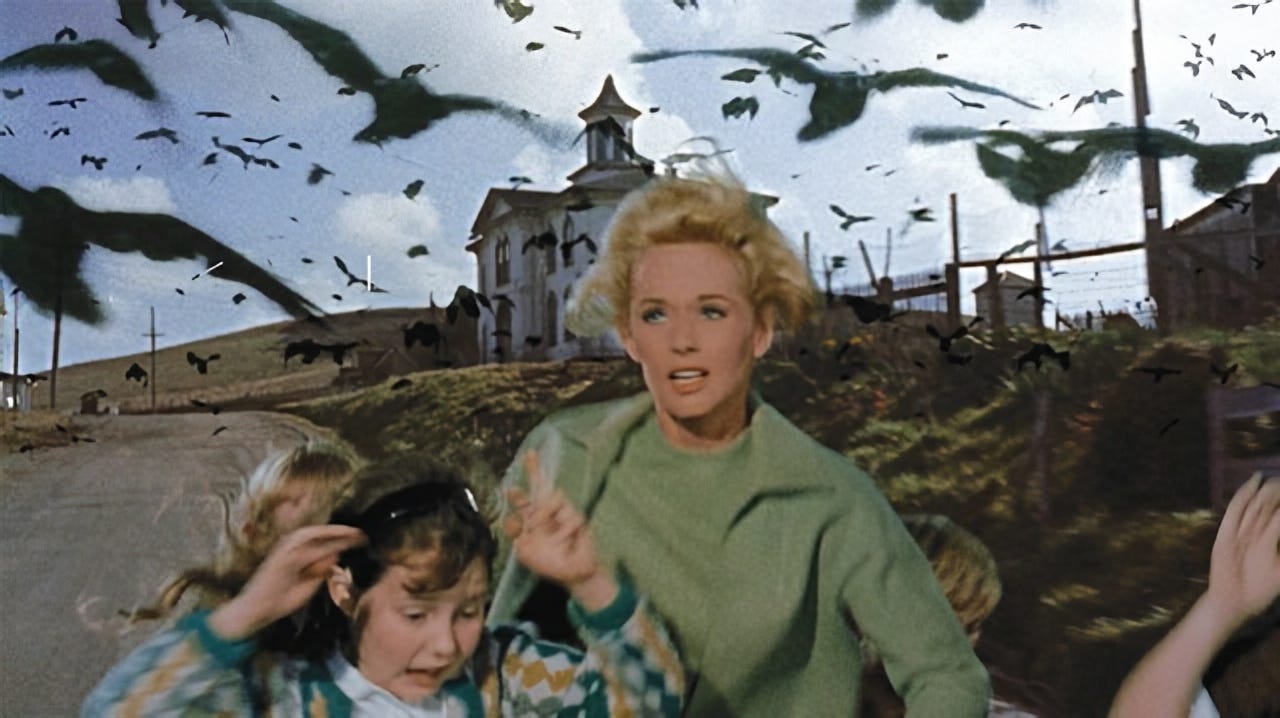
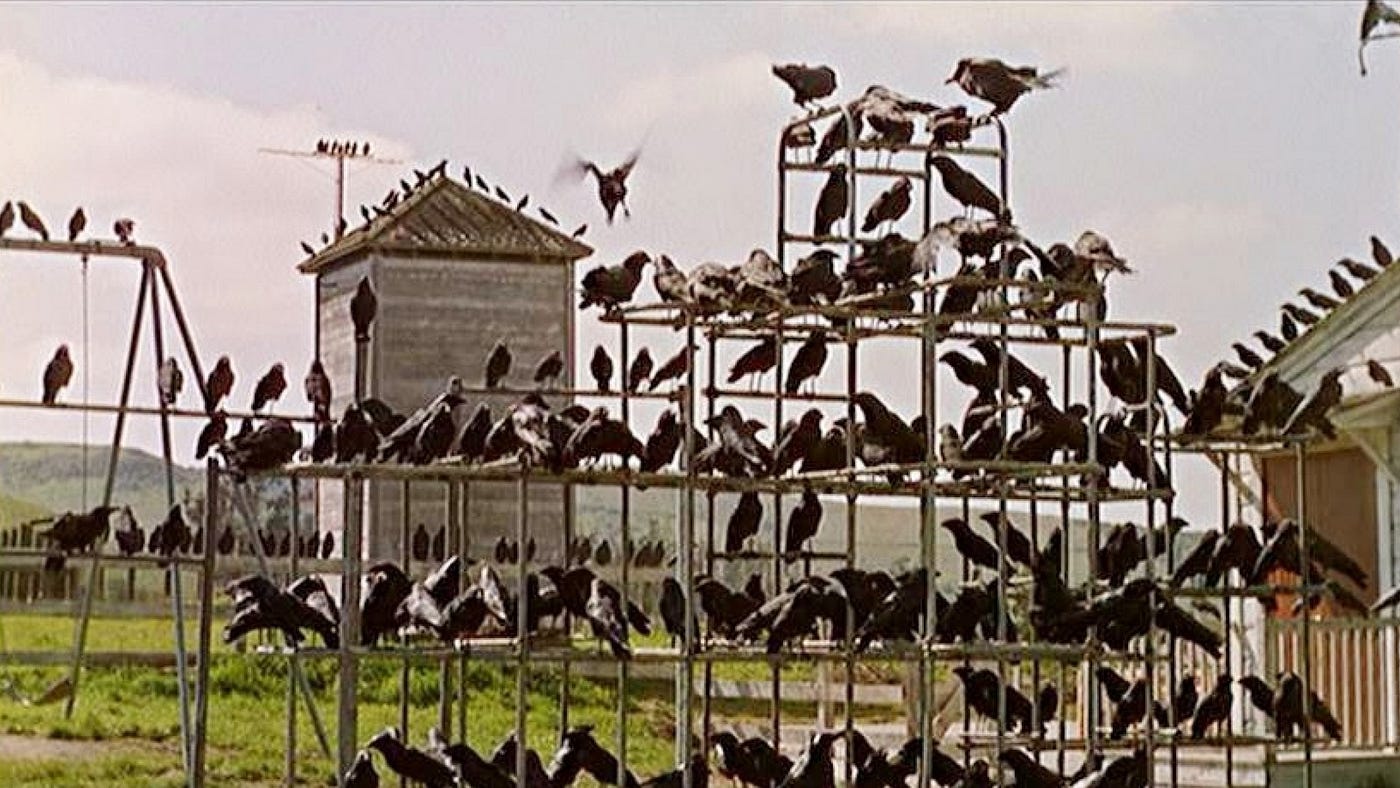
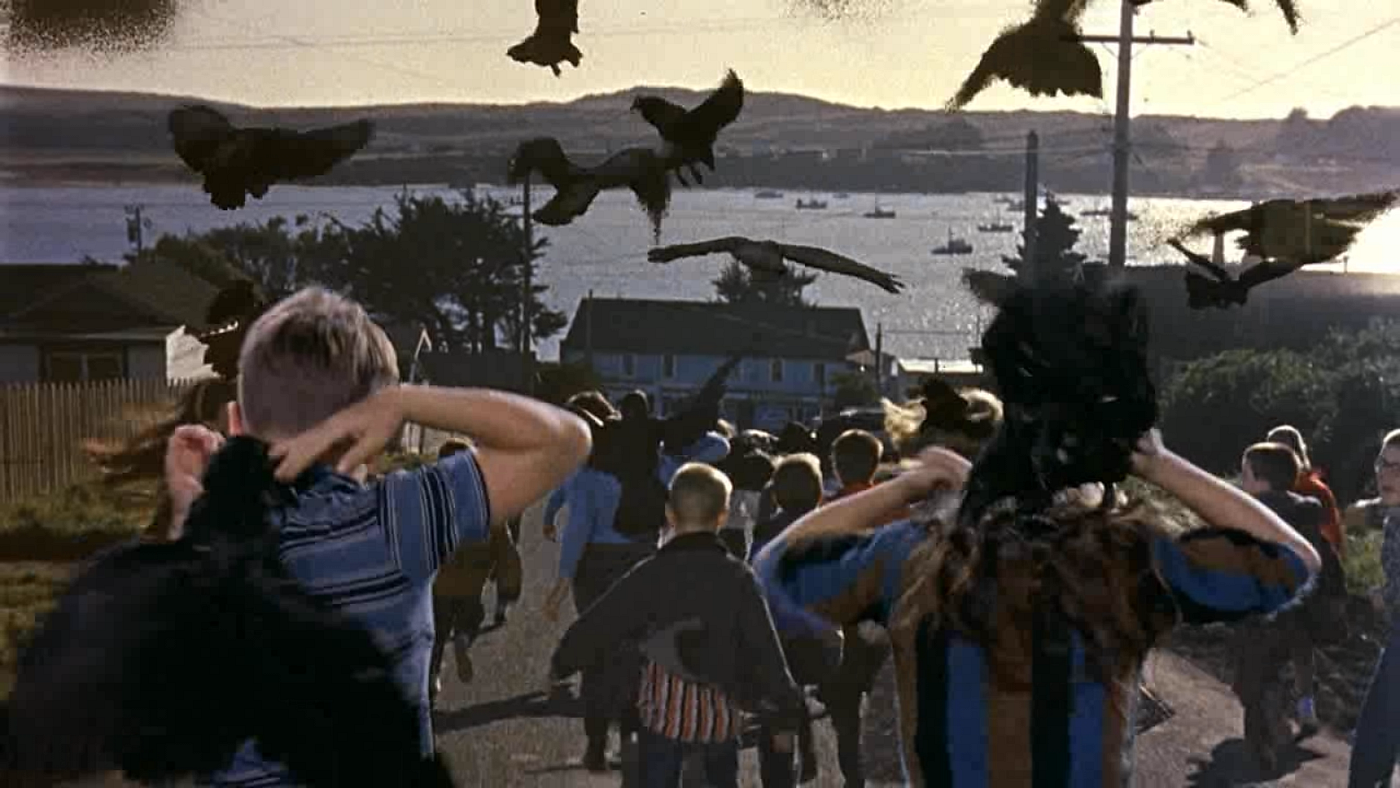
Hitchcock’s visual storytelling is just as effective, as he uses composition and editing to make the fear even worse. He often uses long takes and wide angles to put the people in front of the enormous, intimidating scenery of Bodega Bay. The well-known scene outside the schoolhouse, when Melanie sits quietly on a seat while the blackbirds gather behind her, is a perfect illustration of static tension. The camera stays still, letting the audience’s eyes roam as they slowly notice the rising, quiet menace. This technique is quite different from the fast-paced, visceral editing of the assaults, like the phone booth scene and, most importantly, the long-lasting trauma in the attic.
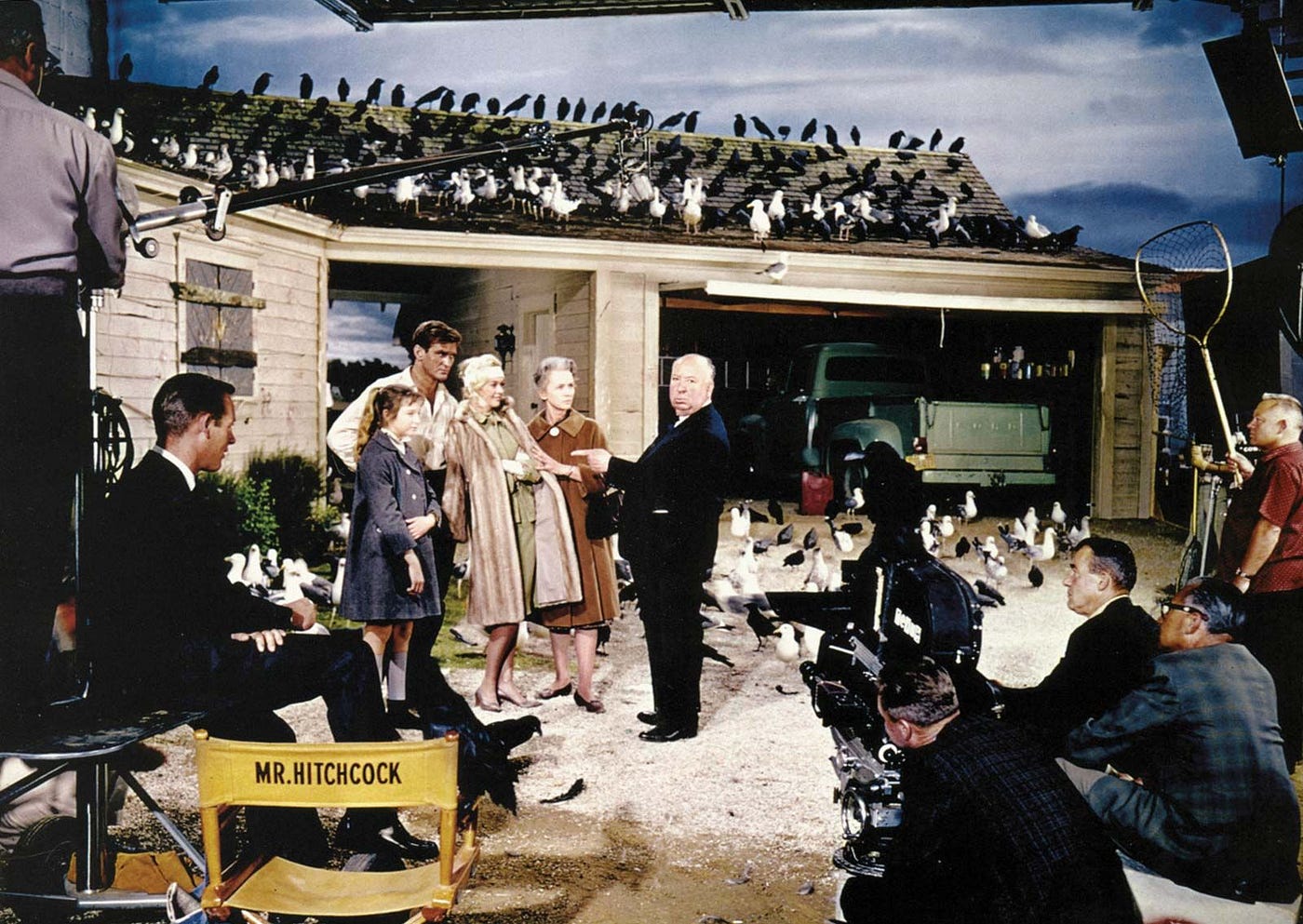
The attic assault is a subjective masterclass: it is shot in a narrow frame, in low light, and relies solely on the frenzied physicality of the attack and the horrible sound mix to show the savagery and Melanie’s deep bewilderment and hurt. The visual effects often show how limited 1960s technology was (especially the use of composite images, back projection, and superimposition), yet they add to the film’s bizarre, nightmarish feel. The combination of actual, trained birds, animatronics, and matte paintings produces a disturbing mix of the hyper-real and the blatantly artificial. The combination gives the mass assaults on the town and the home an apocalyptic grandeur. These many styles come together to provide a single, clear picture of global chaos, which is a sign of Hitchcock’s skill.
The Birds has a lasting impact because it skillfully and purposefully doesn’t provide a reason for the birds’ anger. The birds aren’t creatures that have been changed by radiation, and they aren’t commanded by an evil scientist. They only assault, which leaves a blank canvas for unlimited thematic interpretation, making the terror timeless and universal. Hitchcock has the spectator face the scarier “What If” and the deeper issue of how weak people are by not answering the “Why.”
One common way to look at the movie is as a powerful metaphor for fears about the Cold War and nuclear weapons. The bird assaults serve as a metaphor for atomic fallout, since they were released at a time when the fear of quick, random, and utter destruction was very real. The threat is abrupt, overpowering, and impossible to avoid. It affects everyone, young and old, innocent and guilty. The unpredictability is a lot like the political tensions of the time.
slashfilm.com
Another strong interpretation sees the movie as a criticism of how people are too comfortable and how they exploit nature. The assaults may be interpreted as “Nature’s Revenge,” a sudden and devastating punishment for how arrogant people are and how they think the natural world is just there to be used or enjoyed (a motif that was gently established in the pet store). This environmental reading is very relevant now, much more so than it was in 1963. The birds, who are usually thought of as harmless, suddenly turn on their human masters, making us feel deeply betrayed by the society we live in.
The most lasting interpretation, however, looks at how the movie changed the genre and added psychological terror. The Birds helped start the “apocalyptic nature run amok” subgenre, which has had an effect on everything from Jaws to present eco-horror. But unlike other monster movies, the main emphasis of this one is on how the survivors’ minds are slowly breaking down. The actual horror isn’t the pecking; it’s the trauma, the disintegration of social order, and the shocking revelation that safety is a lie. The birds take away everything from society’s comforts and lies, leaving the protagonists naked and scared.
This technique is what makes the finale of the movie so famous and so disturbing. The last scene, in which the survivors slowly drive away in their vehicle as hundreds of birds sit calmly on every surface, gives neither solace nor resolve. Melanie Daniels is now in a catatonic condition, both physically and mentally shattered by what happened. The birds don’t chase them; they just watch. This picture doesn’t mean escape; it means a break, or maybe the horrifying awareness that the local incident is part of a bigger, worldwide disaster. The birds have taken back the earth, and people are just allowed to live in it. The last photo is perhaps the scariest: the assault has ended, but the danger is still there, which suggests that genuine horror is the permanent loss of safety.
pinterest.com
Legacy and Final Assessment: The Birds is one of Alfred Hitchcock’s last films, along with Psycho, that looks at the boundaries of human endurance and the dark, illogical forces that control the universe. It is the work of a great filmmaker at the height of his technical prowess but ready to completely break with the rules he helped create. It has had a tremendous impact on current horror language by showing that the worst dangers are frequently the ones that are inexplicable, uncontrollable, and very personal.
Some modern reviewers have trouble with its open-endedness and heavy use of special effects, but its critical reputation has only improved. It is now known for its innovative use of sound, its careful pacing, and its deep thematic depth. The Birds doesn’t make you feel better; it scares you. It is a timeless work of art that shows how arrogant people can be by showing how fragile civilisation is. It reminds us that when nature decides to take back its territory, our carefully built world can be destroyed not by a monster, but by the most ordinary of creatures, delivered with a chilling electronic screech. It is a must-see, a warning that will always be there, spoken from the quiet roofs of Bodega Bay.
Upon its release in 1963, Alfred Hitchcock’s The Birds confounded critics and audiences with its refusal to offer comfort, explanation, or resolution 🎬. Departing from conventional horror logic, the film presents nature itself as an implacable force, attacking without motive or warning ⚡. Tippi Hedren’s composed yet increasingly fragile performance anchors the film’s mounting dread, while Hitchcock’s austere direction strips away musical cues, replacing them with silence and the harsh sounds of wings and screams. The episodic structure and escalating assaults transform familiar coastal spaces into zones of siege 🎞️. Over time, The Birds has been recognised as one of Hitchcock’s most unsettling works, its open-ended terror anticipating modern apocalyptic cinema and environmental anxieties 🌍. Its power lies not in answers, but in sustained, inescapable unease 🏆. Star Rating: ★★★★½ (4.5/5) 🌟
Enjoyed what you just read? 😊 Then don’t miss what’s coming next. Hit “Subscribe” and have my future stories sent straight to your inbox, no spam, no fluff, just thoughtful writing on classic cinema, legendary icons, and the hidden corners of Hollywood history. Let’s keep the conversation going and stay connected through a shared love of film. 🎬
faroutmagazine.co.uk
메타데이터
- post_id
- 3d35afa7da46
- slug
- the-sound-of-the-silence-3d35afa7da46
- url
- https://medium.com/@rinoingenito04/the-sound-of-the-silence-3d35afa7da46
- canonical_url
- https://medium.com/@rinoingenito04/the-sound-of-the-silence-3d35afa7da46
- author_url
- https://medium.com/@rinoingenito04
- status
- ok
- fetched_at
- 2026-07-19 08:19:59