The Cost of Thinking: How Reasoning Models Just Changed the Economics of AI
Consider two interactions with an AI system. In the first, you ask a chatbot to summarize an email. The model responds in under a second…
The Cost of Thinking: How Reasoning Models Just Changed the Economics of AI
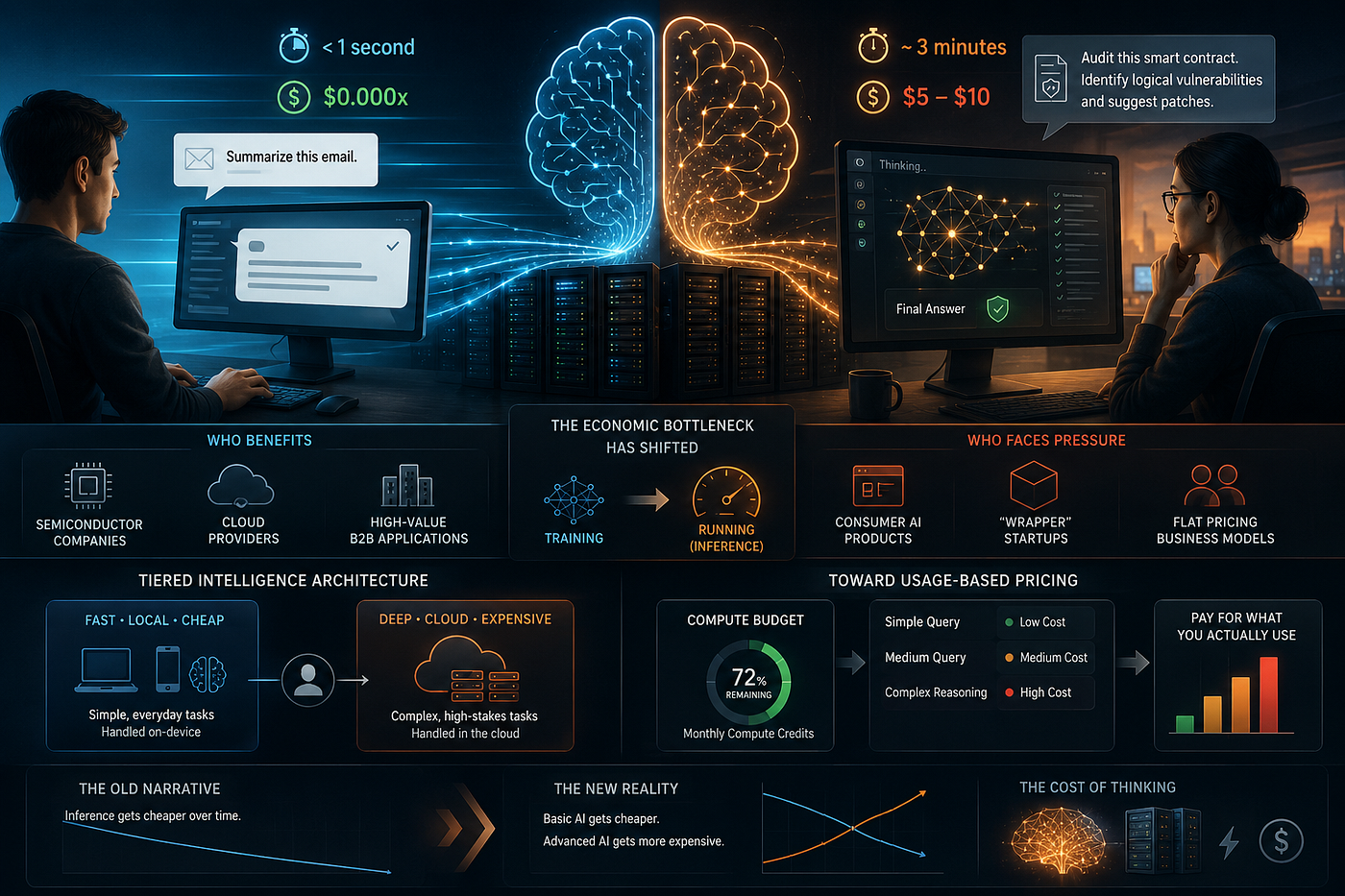
Consider two interactions with an AI system. In the first, you ask a chatbot to summarize an email. The model responds in under a second. The cost to the provider: a fraction of a cent. In the second, you ask an AI agent to audit a complex smart contract, identify logical vulnerabilities, and suggest patches. The model takes three minutes to respond. The cost is somewhere between $5 and $10 for a single query. Same category of tool but completely different economics.
For years, the narrative around AI was that it would follow the same cost curve as other compute technologies: over time, inference would become steadily cheaper. That view is still partly true, but it misses a key shift. As AI systems become more capable, they can also become more expensive to run. A new class of models built around extended reasoning has introduced a cost structure that breaks from everything that came before. The economic bottleneck of AI has now shifted from training models to running them.
From Training to Inference: A Paradigm Shift
Until recently, the dominant cost in AI was training. Building a frontier model like GPT-4 or Claude 3 required hundreds of millions of dollars in compute; massive clusters of GPUs running for months, ingesting enormous datasets, adjusting billions of parameters across thousands of iterations. It was an enormous up-front investment. But once the training run was complete, the model itself was relatively cheap to use. Running inference — generating a response to a user’s query — was fast, efficient, and relatively inexpensive. Once trained, the model could quickly predict the most likely next words based on the input it received. This made AI systems highly scalable and cost-effective to operate
This is what researchers sometimes call System 1 thinking. The idea is borrowed from the cognitive science framework popularized by Daniel Kahneman. The type of thinking is fast, automatic, and requires little deliberate effort. Early language models operated almost entirely in this mode. Ask the model a question; it fires back the most probable answer.
Reasoning models operate differently. They engage in something closer to System 2 thinking, which is deliberate, analytical, and effortful. Instead of generating an answer immediately, they spend more time working through a problem before responding. These models generate an extended internal monologue before producing a final answer. They consider the problem, explore intermediate steps, test hypotheses, backtrack when something does not work, and refine their thinking iteratively. This process is called chain-of-thought reasoning, and the compute that powers it happens at inference time, not during training.
A useful way to think about the difference is that a traditional LLM is like a quiz show contestant who gives the first answer that comes to mind. It is fast, often correct, and highly fluent. A reasoning model is more like a scientist who handed the same question, locks themselves in a room for three days with a whiteboard. Instead of responding immediately, it works through the problem step by step, evaluates alternatives, and checks its reasoning before arriving at an answer. The result is often higher-quality output, but it comes at a higher computational cost.
The New Economics of Test-Time Compute
The concept at the center of this shift is test-time compute: the idea that a model can improve the quality of its output by spending more compute at the moment of inference, rather than relying purely on what it learned during training.
OpenAI introduced this approach publicly with its o1 series in late 2024. DeepSeek followed with R1, a model that demonstrated comparable reasoning capabilities at a significantly lower price point. The result was not just a new model family but a new pricing reality. When you submit a query to a reasoning model, you are not just paying for input tokens and output tokens. You are also paying for thinking tokens; the internal chain-of-thought steps the model generates before it produces a visible response.
This changes the cost structure in a fundamental way. In traditional models, the cost to answer “What is the capital of France?” and the cost to answer a complex multi-step logic problem were roughly the same. Both required similar amounts of compute. Cost was essentially flat across query complexity. In reasoning models, cost scales directly with complexity. A simple factual question still costs almost nothing. But a question that requires the model to reason across multiple domains, verify intermediate conclusions, and synthesize a structured answer can consume 10,000 or more internal tokens before producing a 500-word response.
The gap is significant. For every 100 words you read in the final output, the model may have generated 10,000 words of hidden reasoning. You are paying for all of it.
This has real implications for infrastructure. The AI industry has spent the past five years fixated on GPU scarcity as a training problem. The focus was on acquiring enough H100s to run the next large training run. That bottleneck has not disappeared, but a new one has emerged alongside it. Reasoning models require massive, sustained compute just to serve users in real time. Data centers built for inference at scale must now account for queries that hold GPU resources for minutes rather than milliseconds. Power consumption, thermal management, and latency budgets all change. The GPU shortage that everyone thought was a training problem is increasingly becoming an inference problem.
Who Wins and Who Loses
The economic disruption created by reasoning models does not distribute evenly across the industry. Some companies stand to benefit significantly, while others may face increasing economic pressure.
The most obvious winners are cloud providers and semiconductor companies. If each complex query consumes minutes of GPU time, the total demand for compute expands significantly. Companies like NVIDIA and AMD, along with their broader supply chains, benefit from sustained demand that is no longer tied only to periodic training runs. Cloud providers such as Microsoft Azure, Amazon Web Services, and Google Cloud also gain from the same shift. More compute per query translates into higher revenue per user, independent of subscription pricing. For hardware and infrastructure players, reasoning models act as a clear accelerant.
High-value B2B applications also stand to benefit. The cost calculus for enterprise buyers is straightforward: if an AI agent can analyze a contract in three minutes for $10 and save a legal team four hours of billable work at $400 per hour, the economics are overwhelmingly favorable. The same logic applies to financial modeling, drug discovery, software auditing, and complex technical analysis. In these contexts, the absolute cost of inference matters far less than the value of the output. A $50 query that prevents a $500,000 compliance error is not expensive by any rational measure.
The pressure falls most heavily on consumer-facing AI products and the “wrapper” startup ecosystem. Many of these companies built their business models on the assumption that inference was cheap and getting cheaper. They offered unlimited AI features for $20 per month by aggregating large numbers of light users and subsidizing the product with simple queries. Reasoning models break this model. A product that routes complex user requests through a reasoning engine can easily spend more than its monthly subscription revenue on a single power user’s session. The margin compression is severe, and the business model requires fundamental rethinking.
There is also a subtle but real shift in user expectations. Much of what made consumer AI products appealing was speed. Answers arrived in seconds, and the experience felt immediate and frictionless. Reasoning models change that. Users may now wait 30, 60, or even 90 seconds for a response. For professional users, that is an acceptable trade-off for higher-quality output. But for consumer applications built around daily engagement, this added friction will influence product design and user retention in ways the industry is only beginning to understand.
The Future: Tiered Intelligence
The most likely outcome is not that reasoning models replace fast models. It is that the two coexist, with intelligent routing determining which one handles each task.
Operating systems, development environments, and enterprise platforms are already beginning to implement this architecture. Simple, high-frequency tasks like drafting a short email, summarizing a document, and answering a factual question can be handled by small, fast, on-device models that run locally and cost almost nothing. Complex, high-stakes tasks like financial modeling, legal analysis, code security review, multi-step research synthesis can be handled using reasoning engines in the cloud. The intelligence is tiered, and the cost is proportional to the actual cognitive load of the task.
This tiered architecture has a natural extension into pricing. The flat monthly subscription model, which has dominated AI consumer products since 2022, is not well suited to a world where query costs vary by three orders of magnitude. A more rational structure is emerging: compute budgets. Rather than paying a fixed monthly fee for unlimited access, users and enterprises will increasingly pay for a monthly allocation of compute credits. Simple tasks consume small amounts; complex reasoning tasks consume large amounts. When the budget runs out, users either wait for the next cycle or purchase more. This is not a fundamentally new idea; it mirrors how cloud computing has always been sold to developers. However, it represents a significant departure from how AI has been marketed to end users.
The transition will not be easy. Users accustomed to flat pricing are likely to resist, and many companies will struggle to explain the difference in value between a $0.01 query and a $5.00 one. But the underlying economics are unavoidable. Reasoning consumes compute, and compute costs money. Eventually, pricing models will have to reflect that reality.
The Real Price of Intelligence
There is a tempting narrative in which the AI industry follows the same cost curve as every other compute technology. Processing power becomes cheaper. Storage gets cheaper. Inference gets cheaper. Eventually everything becomes negligible.
What reasoning models reveal is that the frontier of AI capability is not static. As the cheapest capabilities become commoditized, the leading edge moves toward tasks that require genuine deliberation, multi-step logic, and sustained reasoning. Those capabilities are more expensive to run, not less. The cost of basic AI may continue to fall, but the cost of advanced AI is rising and that is where the most important work is happening.
True intelligence, even the artificial kind, is not a commodity. It is a resource with a real utility bill attached. For decades, we focused on the question of whether machines could think. We have made extraordinary progress on that question. The challenge that is now arriving is figuring out who is going to pay for it.
메타데이터
- post_id
- 3d3d28aa4e29
- slug
- the-cost-of-thinking-how-reasoning-models-just-changed-the-economics-of-ai-3d3d28aa4e29
- url
- https://medium.com/@dr.tehsin.zia/the-cost-of-thinking-how-reasoning-models-just-changed-the-economics-of-ai-3d3d28aa4e29
- canonical_url
- https://medium.com/@dr.tehsin.zia/the-cost-of-thinking-how-reasoning-models-just-changed-the-economics-of-ai-3d3d28aa4e29
- author_url
- https://medium.com/@dr.tehsin.zia
- status
- ok
- fetched_at
- 2026-06-23 03:48:11