Why Smart Investors Are Quietly Buying Agricultural Land Near Mathura in 2026
For years, Mathura was a name people associated with temples, not term sheets. That’s changing fast.
Why Smart Investors Are Quietly Buying Agricultural Land Near Mathura in 2026
For years, Mathura was a name people associated with temples, not term sheets. That’s changing fast.
Over the last few years, the Mathura–Vrindavan belt has turned into one of Uttar Pradesh’s more closely watched land markets — and not just among local buyers. Delhi-NCR professionals, NRIs maintaining ties to India, and long-term investors looking outside the saturated Noida-Gurugram corridor are all circling the same stretch of land along NH-19.
Here’s what’s actually driving the interest, and what to watch out for if you’re considering it yourself.

The Case for Mathura
Three things are converging at once:
Connectivity. Mathura sits roughly 145 km from Delhi on NH-19, and improved expressway links now put it within a 2.5-hour drive of Noida and Faridabad. That’s a meaningful shift for a market that used to feel remote.
Institutional development. The Mathura–Vrindavan Development Authority has been steadily upgrading roads, drainage, and civic infrastructure across the district — the kind of unglamorous groundwork that tends to precede a real estate cycle rather than follow it.
Demand that isn’t purely financial. A large share of buyers here aren’t underwriting an IRR — they’re buying into Braj itself, a region sacred to millions of Hindus. That emotional anchor tends to make this demand pool stickier than a typical speculative land market, which has its own implications for price stability.
The result: agricultural land along key corridors has been appreciating steadily, and the buyers who got in early are sitting on meaningfully better entry prices than those arriving now.
What Land Actually Costs Right Now
Pricing varies a lot depending on exact location and road access, but as a rough 2026 benchmark:
- Near Mathura city (within 5 km): ₹25–60 lakh per bigha
- Kosi Kalan–Mathura corridor: ₹8–20 lakh per bigha
- Near Vrindavan (premium zones): ₹20–50 lakh per bigha
- Highway-adjacent plots: ₹15–35 lakh per bigha
The spread is wide because the variables that move price are wide too: distance from the city centre, the width of the adjoining road, whether it’s a corner or interior plot, and — critically — whether the title is genuinely clean.
The Diligence Checklist Most Buyers Skip
Agricultural land in UP is not a flat-in-a-tower transaction. It demands real homework:
- Title verification. Pull the Khasra and Khatauni records and have a local advocate confirm the seller’s name matches what’s on file with the government.
- Conversion status. Raw agricultural land generally can’t be built on without approval — if a farmhouse is the end goal, confirm conversion eligibility upfront.
- Encumbrance certificate. This is your check against hidden loans, liens, or disputes attached to the land.
- Recorded road access. Verbal assurances about access mean nothing on resale. It needs to be documented.
- Water availability. Borewell condition, canal proximity, water table depth — all of it matters for both farming and future construction.
- Bank approval status. If the project or seller is bank-approved, that’s a useful proxy for legal clarity, and it opens up financing.
Skip any of these and you’re not investing — you’re gambling with extra steps.
One Project Worth Knowing About
If you’d rather not run this diligence process solo, it’s worth looking at how Brij Vrinda, a project by Maxpine Group, has structured things on the Kosi–Mathura road in Shergarh.
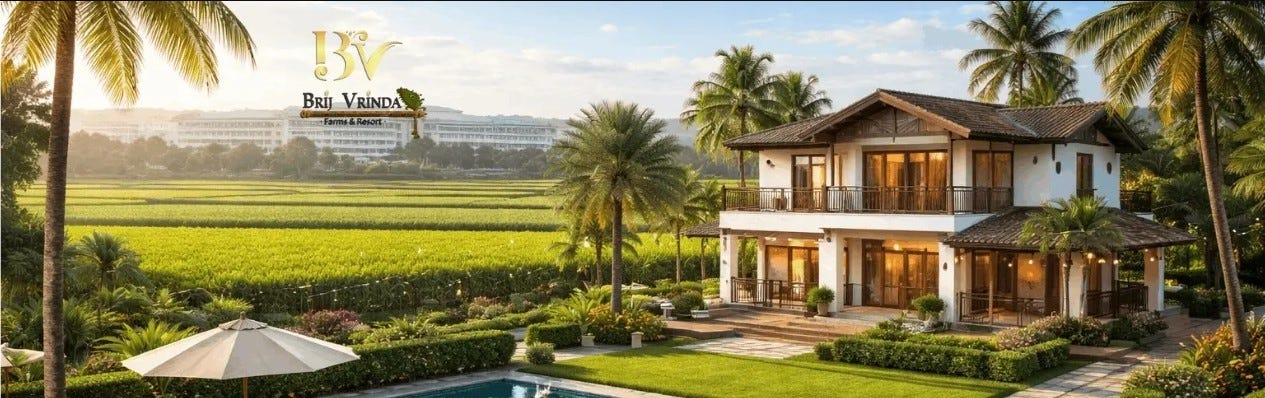
The plots come with clear titles and bank approval already in place, 40–50 ft internal roads, gated security, and on-site infrastructure that includes a resort, wellness centre, Gaushala, temple, and a Sanskar school. There’s also a sandalwood farming component — a government-backed cultivation model that lets the land generate income while it appreciates.
I went deeper on the pricing breakdown, the legal checklist, and the full project details in this guide: Agriculture Land for Sale in Mathura.
Who This Actually Makes Sense For
In practice, three buyer profiles show up repeatedly in this market: people with a genuine spiritual connection to Braj who want a long-term foothold near Vrindavan, NCR professionals looking for a weekend retreat that doubles as an investment, and NRIs trying to maintain financial and emotional roots in India (worth noting: NRIs can’t directly purchase agricultural land under current RBI/FEMA rules, though inheritance and gifting are permitted — talk to a legal advisor if this applies to you).
If you fit one of those profiles, this is a market worth understanding properly before prices move further.
메타데이터
- post_id
- 3d3e40a4cbfe
- slug
- why-smart-investors-are-quietly-buying-agricultural-land-near-mathura-in-2026-3d3e40a4cbfe
- url
- https://medium.com/@brijvrinda87/why-smart-investors-are-quietly-buying-agricultural-land-near-mathura-in-2026-3d3e40a4cbfe
- canonical_url
- https://medium.com/@brijvrinda87/why-smart-investors-are-quietly-buying-agricultural-land-near-mathura-in-2026-3d3e40a4cbfe
- author_url
- https://medium.com/@brijvrinda87
- status
- ok
- fetched_at
- 2026-06-21 21:05:38