Jakarta Is Sinking. And We’re Running Out of Excuses
Indonesia has the resources, the neighbours, and the global playbook to fix this. What we’re missing is harder to build than any seawall.
Jakarta Is Sinking. And We’re Running Out of Excuses
Indonesia has the resources, the neighbours, and the global playbook to fix this. What we’re missing is harder to build than any seawall.
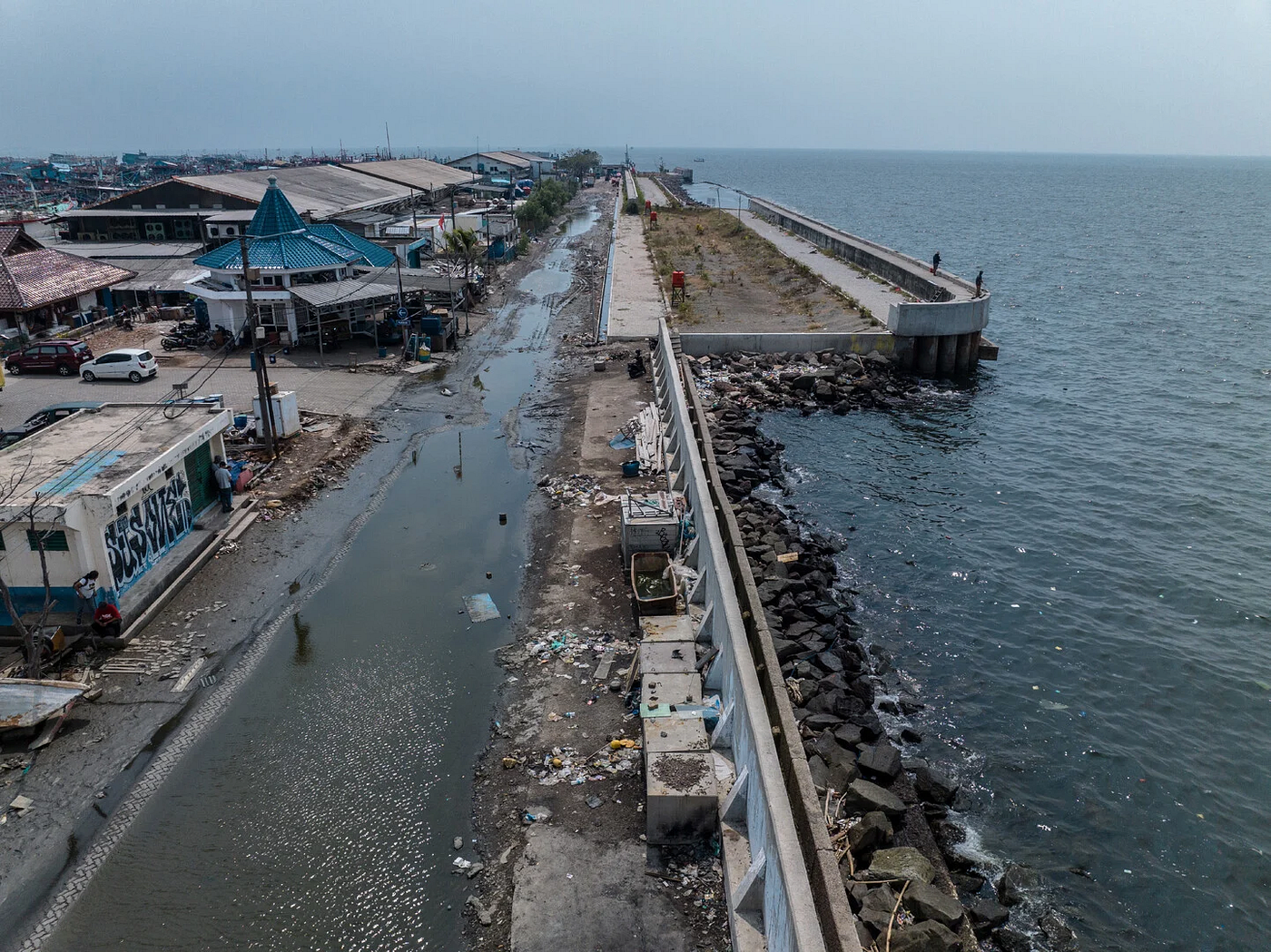
Seawall at Pantai Mutiara, Credit: Film Freeway Jakarta Sinking, Directed by: Andreas Bülow Hansen

Note on the 75× figure: Parts of North Jakarta sink up to 25cm/year. Venice sinks 1–2mm/year. That is 125–250× faster, not 10×. The ‘75×’ figure refers to the city average vs global coastal average.

THE CRISIS
Every Rainy Season, the Same Images
Every rainy season, the same images flood our feeds: submerged streets, stranded cars, families wading through murky brown water carrying whatever they could save. We share, we comment, we scroll on. And then it happens again.
But here is what most people still don’t fully grasp: Jakarta isn’t just flooding. It’s sinking. Parts of North Jakarta are subsiding up to 25 centimetres every single year — making it the fastest-sinking megacity on earth. For context: Venice, the world’s most famous sinking city, sinks at just 1 to 2 millimetres per year. Today, 40% of the city already sits below sea level. North Jakarta alone has dropped 2.5 metres in the last decade. If nothing changes, models suggest 95% of North Jakarta could be underwater by 2050. Within our lifetimes.
And the main culprit isn’t the sea, or even climate change. It’s what’s happening underground.
The Ground Itself Was Always Wrong
Before we talk about seawalls, pipes, or floating cities, we need to talk about something even more fundamental: the ground Jakarta was built on.
Jakarta sits on tanah aluvial — alluvial sediment deposited by 13 rivers over thousands of years. Soft silt, loose clay, waterlogged sand. It stretches more than 50 metres deep beneath the city. This is not stable ground for a megacity. It was never geologically meant to carry one.
A Dutch engineer working on the Jakarta problem put it plainly in a now-widely-shared documentary: they built this city in the wrong place. The Dutch VOC knew this in 1619. They built here anyway because the port location was strategically perfect — the maritime crossroads of Southeast Asia, fed by rivers, facing a sheltered bay. Good for trade. Catastrophic for long-term habitation at scale.
WHAT IS ALLUVIAL SEDIMENT? (TANAH ALUVIAL)
Alluvial soil is soft, unconsolidated material deposited by rivers over centuries. Unlike bedrock or compacted clay, alluvial sediment compresses permanently under weight. Every skyscraper, every road, every building presses down on ground that was never geologically stable. Add groundwater extraction — which empties the water that keeps sediment particles pushed apart — and the compression accelerates dramatically. This process is called consolidation subsidence. It is irreversible. You cannot re-inflate ground that has already compressed.
This is why stopping groundwater extraction does not reverse the sinking — it only stops future sinking. Tokyo faced the same geology and the same crisis in the 1960s. When Japan enforced extraction bans and completed its pipe network, Tokyo’s subsidence halted within five to ten years. Not reversed — halted. That window is still open for Jakarta. But it is closing.

A hand pump that has been planted for a long time has come to the surface, which is an evidence of the phenomenon of land subsidence in Japan. (JICA) — pic from Antara news

Rainwater harvesting for residential level in Japan. (JICA) — pic from Antara News
THE ROOT CAUSE
The Real Villain Is Underground
Before we talk about seawalls and floating cities, we need to talk about wells. Sumur. Because until this gets fixed, nothing else matters.
Only about a quarter of Jakarta households are connected to the city’s formal piped water network, PAM Jaya. To extend pipes to the rest of the city would require 7,800 kilometres of new infrastructure — enough to run the entire length of Java eight times over. That pipe network was never built. So millions of households, businesses, hotels, malls, and offices did the only rational thing available to them: they drilled wells and pumped groundwater for free.
The result? The aquifers that hold the earth together are being slowly emptied. The ground compresses. The city sinks. Groundwater extraction alone is responsible for making Jakarta sink around 130 times faster than sea level rise. This is not a climate change story. This is a missing pipes story.
THE GOVERNMENT EXEMPTION — THE PART THAT SHOULD MAKE EVERY TAXPAYER FURIOUS
Government buildings are exempt from the groundwater extraction law. Hotels, hospitals, ministries, public offices — many are legally permitted to extract as much groundwater as they want, for free, even when they have access to piped water. The government that debates billion-dollar seawalls is simultaneously one of the biggest groundwater extractors in the city. This must be abolished on Day 1 — before any masterplan, before any budget, before any press conference.
Jakarta’s water privatisation history makes this worse. In the 1990s, under World Bank advice, Jakarta’s water supply rights were handed to Thames Water and Suez. When the Suharto government collapsed, executives from both companies fled — leaving the city with only three days’ worth of water treatment chemicals. The private market experiment failed. The pipes never got built. The wells filled the gap. And the city started sinking faster.
The seawall addresses the flooding — but not the extraction. The ground keeps dropping regardless of what walls you build around it.
— Prof. Christophe Girot, Swiss Federal Institute of Technology, to National Geographic
FAILED ATTEMPT
Sumur Resapan: The Right Diagnosis, the Wrong Delivery

Pekerja sedang menyelesaikan pengerjaan sumur resapan di Jalan Mataram Raya, Kebayoran Baru, Jakarta, Selasa (12/10/2021). Pemerintah Provinsi (Pemprov) DKI Jakarta tengah mempercepat pembangunan sumur resapan yang ditargetkan terbangun di 22.292 titik. (Liputan6.com/Herman Zakharia)

Sumur resapan. (Marteen Ronaldo/detikcom)

Infiltration Wells at housing area, credit: Kemenkes Info Krisis Kesehatan

Illustration of Infiltration Wells, Credit: DIH Jabar

Infiltration Wells Rainfalls, Credit: Antara News 2021 during Governor DKI Jkt Anies Baswadean
Someone in Jakarta’s government actually understood the water problem — at least partially. During his tenure as Governor, Anies Baswedan launched a mass programme of sumur resapan: vertical infiltration wells drilled into the ground so rainwater seeps down into the earth instead of flooding the streets. The concept was right. Water needs to go into the ground, not just get pushed out to sea.
The execution, however, was a disaster. Rp 400 billion was allocated in 2021 alone. By early that year, only 3,964 titik had been built out of a stated need of 1.8 million. Some wells were installed directly beside Banjir Kanal Timur — where critics rightly asked: what exactly is supposed to seep in there? Others were placed on concrete pavements over compacted clay soil in North Jakarta, where the ground is too waterlogged and dense to absorb anything.
Resapan anggaran, bukan resapan air. Absorbing the budget, not the water.
The lesson is not that sumur resapan doesn’t work. It’s that a micro-solution deployed without a macro-system is just an expensive hole in the ground. Infiltration wells only function where the soil can absorb, where the water table isn’t already saturated, and where they’re part of a connected network of wetlands, permeable surfaces, and restored drainage.THE BRIDGE TO SPONGE CITY
What Anies attempted at the household scale, sponge city design does at the city scale — systematically, with the right locations, the right soil conditions, and the right supporting infrastructure. The diagnosis was right. The dosage was wrong, and the delivery was scattered. Sponge city is sumur resapan done properly: not as 3,964 isolated holes, but as a connected system of wetlands, permeable streets, river corridors, and restored aquifer recharge zones across the whole city.
THE ANSWER CHINA ALREADY BUILT
Sponge Cities: Stop Fighting Water. Absorb It.

Sanya Mangrove Park is just one of many “sponge” projects in China, a way to work with water instead of fighting it. Courtesy of The Cultural Landscape Foundation

In Bangkok, Turenscape, alongside the Thai military and local firm Arsomsilp Community and Environmental Architect, transformed the concrete ground of a former tobacco factory into a man-made wetland with mini islands. Pic from CNN Sytle
The concept was pioneered by landscape architect Kongjian Yu of Peking University, whose firm Turenscape has worked on over 200 cities globally — including in Indonesia. Instead of grey concrete to push water away, a sponge city uses wetlands, restored rivers, permeable pavements, parks, and green roofs to slow rainwater, absorb it, and recharge underground aquifers naturally.
For Jakarta specifically, the sponge city approach is more relevant than any other solution. The city sits on 13 rivers, receives some of the world’s heaviest monsoon rainfall, and was originally built on a swamp. Centuries of concrete have destroyed its natural absorption capacity. Sponge city design is essentially about restoring what was always there.

Liangjiang Innovation Zone Chongqing | The new central lake, Credit: Chaphman Taylor, Yichun Xu

Xichong, Nan’ao, Dapeng New District in Shenzhen | Coastal wetlands and fishponds, Credit: Chaphman Taylor

Xiong’an masterplan development, a seven-tier central park will form the basis of our sponge city strategy. Credit: Chaphman Taylor, Yichun Xu

The Chinese Government is investing heavily in sponge cities and it is now a core element of urban design schemes across the country. Credit: Chaphman Taylor, Yichun Xu
For Jakarta specifically, sponge city is actually MORE relevant than a floating city because:
- Jakarta’s 13 rivers + monsoon rains = massive rainwater that currently floods streets instead of recharging aquifers
- Sponge city design — wetland parks, permeable pavements, restored mangroves — would recharge the underground aquifers that are being emptied
- It directly attacks the wells problem that we identified as the root cause
- It’s affordable enough to implement city-wide, not just for the wealthy
- China has a 25-year track record proving it works

THE SEAWALL BUYS TIME. TIME IS NOT A PLAN.

Photo from QZ
THE SEAWALL DEBATE
The Seawall Buys Time. Time Is Not a Plan.
The National Capital Integrated Coastal Development (NCICD) — the so-called Giant Sea Wall or ‘Garuda Seawall’ — has been debated, partially funded, and repeatedly stalled for over ten years. What has been built offers some protection against coastal flooding. But here is what its own proponents rarely say out loud: the seawall cannot stop Jakarta from sinking.
If groundwater extraction continues, the ground beneath the seawall keeps dropping. The wall holds the sea back while the city behind it slowly descends. Eventually the math stops working. One expert involved in the project put it plainly: stop deep groundwater use and the sinking will stop within five to ten years. Then you do not need a closed Jakarta Bay. You do not need a giant seawall.
THE SEAWALL IN NUMBERS
Estimated full project cost: $40 billion USD. Projected lifespan before reassessment: 30–50 years. Problems it cannot fix: groundwater extraction, alluvial subsidence, inland flooding from the 13 rivers. Cheaper alternative: complete the pipe network, stop extraction, deploy polder systems in North Jakarta. The seawall is an enormously expensive solution to a problem that has a cheaper, more effective one — if the political will existed to enforce it.
GLOBAL EXAMPLES
What New York Actually Did — and What Korea Is Doing Next

2019 conceptual design of OCEANIX’s storm-proof, self-sufficient floating city. (Courtesy OCEANIX/BIG)
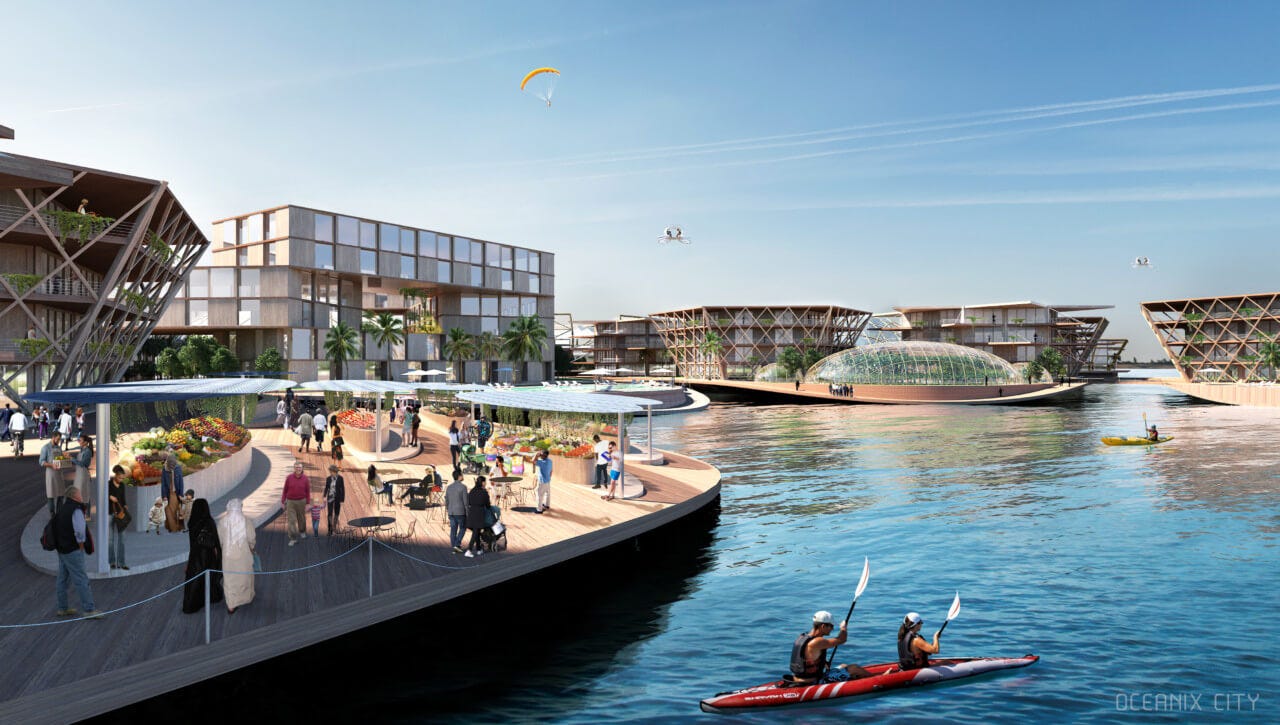
Oceanix Busan, Credit: BIG

Oceanix Busan, Credit: BIG

Oceanix Busan, Credit: BIG

Oceanix Busan, Credit: BIG

Oceanix Busan, Credit: BIG
In October 2012, Hurricane Sandy devastated Lower Manhattan. New York’s response is worth studying closely. Rather than just rebuilding what was lost, the city launched a design competition called Rebuild by Design, challenging architects and engineers worldwide to rethink coastal resilience from scratch.
The winner was Danish architect Bjarke Ingels Group, whose proposal — called the BIG U — reimagined flood protection as a continuous 10-mile horseshoe of raised parklands, floodwalls, berms, and movable floodgates surrounding Lower Manhattan. The first major phase, the East Side Coastal Resiliency project, reached completion in 2024 with a $1.45 billion budget, designed for a 100-year lifespan. It protects over 110,000 residents while creating beautiful new public spaces — parks, basketball courts, amphitheatres — that New Yorkers actually use every day.
Now take that same architect and look at what he’s designing in South Korea. Oceanix Busan is the world’s first prototype sustainable floating city, built in partnership with the city of Busan and UN-Habitat. It doesn’t reclaim land from the sea. It floats above it — on platforms engineered to rise with sea levels, built from biorock three times stronger than standard concrete. Designed for 12,000 initial residents, generating its own energy, food, and fresh water. This is not science fiction. It is being built right now.
“Flood infrastructure doesn’t have to be ugly walls. It can be the city itself, rebuilt smarter.”
Now take that same architect — Bjarke Ingels — and look at what he’s designing in South Korea. Oceanix Busan is a radically different concept: the world’s first prototype sustainable floating city, built in partnership with the city of Busan and UN-Habitat. It doesn’t reclaim land from the sea. It doesn’t build a wall against the water. It floats above it — on platforms engineered to physically rise with sea levels, anchored flexibly to the seabed, built from biorock that is three times stronger than standard concrete and self-healing. Designed for 12,000 initial residents, it generates its own energy, food, and fresh water in a closed-loop system with zero waste.
This is not science fiction. It is being built right now.
— -
But Wait — Are Floating Cities Actually the Answer For Indonesia?

Floating City at Dogen City, Credit: N-ARK JP Dogen City

Floating City at Dogen City, Credit: N-ARK JP Dogen City
Before Indonesia gets too excited about floating cities as the solution, it’s worth slowing down. Architect and urbanist Dami Lee has documented the uncomfortable reality behind the concept — and it applies directly to Jakarta’s situation.
They don’t fix root causes. If Jakarta’s crisis is driven by illegal groundwater extraction, missing pipes, and crumbling drainage — a floating platform doesn’t address any of that. At best, it’s a parallel solution for the future. At worst, a glamorous distraction from the unglamorous work that actually needs doing right now.
They inevitably become escape pods for the wealthy. The history of floating city projects — from the Seasteading Institute’s libertarian experiments to various “sea villages” pitched to investors — shows a consistent pattern: vision starts utopian, price tag ends up exclusionary. The people most vulnerable to Jakarta’s flooding are the ones who can least afford a berth on a floating platform. Building one while neglecting the city below isn’t a climate solution. It’s a gated community with a better view.
Marine ecosystems pay the price. Anchoring large platforms to the seabed, disrupting tidal flows, and shading coral and seagrass can cause serious environmental damage — particularly dangerous for an archipelago nation whose fisheries and coastal livelihoods depend on healthy marine habitats.
Nobody knows who actually governs them. Legal jurisdiction, taxation, civil rights, emergency services — when a floating city sits in ambiguous waters, none of these are settled. Oceanix Busan sidesteps this by staying close to shore under Korean law. Any Indonesian equivalent would face enormous legal and political complexity before a single platform gets built.
The conclusion isn’t that floating cities are worthless — Korea’s Oceanix is a responsible, UN-backed version worth watching. But for Indonesia, floating cities are a chapter for 2040, not a substitute for fixing the pipes in 2025.

— -
THE DUTCH SOLUTION
The Polder System: Already Working at PIK — For the Wrong People

When people see coastal development, they often point to Dubai’s Palm Islands as the gold standard. But the Palm Islands are land reclamation — hundreds of millions of cubic metres of sand dredged from the Gulf floor to create new ground. They were built for luxury tourism, not climate resilience.
PIK — Pantai Indah Kapuk — falls in the same land reclamation category. Both cleared natural coastline. Neither is a floating city. But the comparison ends there, and not in PIK’s favour. Dubai built with enormous oil wealth, disciplined urban governance, and a long-term master plan. PIK cleared hundreds of hectares of mangrove forest — Jakarta’s natural coastal barriers — to build upscale property, then left the people it displaced more vulnerable than before.
The consequences became undeniable in early 2025: flooding near PIK2 paralysed the Sedyatmo toll road — the main artery to Soekarno-Hatta International Airport. The communities forcibly displaced to make way for PIK2’s luxury estates? Their relocation land flooded too. And in January 2026, even PIK’s own premium apartments weren’t spared — cars were submerged in basement parking of a development marketed as a flood-free zone.
What a Polder Actually Is

How the Dutch made Polder System, Credit: Readly

Channels for irrigation in ancient summer, Credit: Erik Engheim

The Polder System Illustration, credit: Erik Engheim
Here is the technology that makes PIK different from every surrounding kampung: a Dutch-designed polder system.
A polder is a low-lying tract of land enclosed by embankments and kept dry through a coordinated system of canals, retention basins, sluices, and pumping stations. The water table inside the polder is actively managed — water that enters (from rain, seepage, or rivers) is collected in canals and pumped out to a higher-level channel, then eventually to the sea.
The Dutch didn’t invent this to be clever. They invented it to survive. The Netherlands sits largely below sea level — in some places, nearly 7 metres below. Without polders, two-thirds of the country would flood regularly. This is their present-day reality, managed 24 hours a day, 365 days a year, by 21 regional water boards (waterschappen) that have existed in various forms since the 13th century.
PIK2’s polder system includes: perimeter embankments (tanggul) separating the development from surrounding lower ground; an internal canal network collecting all stormwater; retention ponds that buffer peak rainfall; and electric pump stations (rumah pompa) that continuously move water out to the sea. When it rains heavily over PIK, water flows through the canal network into retention ponds, then gets pumped out within hours.
This is why PIK drains in two hours while neighbouring kampung flood for two months.


2026: Kawasan PIK terendam banjir buat publik heboh /Foto : Dok. Instagram @infopik.id

2025: Kawasan PIK 2 tetap aman dari banjir berkat penerapan teknologi Polder System ala Belanda yang membentengi garis pantai dan mengatur tata air secara canggih.(Dok. Agung Sedayu Group)


Polder System at PIK, Credit: Inilah.com & AGS Group
The Injustice Embedded in the Infrastructure
The polder system is not expensive by Jakarta standards. Its cost is a fraction of the annual flood damage Jakarta absorbs — and far less than one year of the sumur resapan programme. It is not being done because land consolidation is politically difficult, because pump stations require operational budgets nobody wants to own, and because the communities that need it most have no political leverage.
THE SOLUTION ALREADY EXISTS. THE QUESTION IS WHO IT WORKS FOR.
The technology that drains luxury condominiums in two hours is operating right now — 500 metres from families who flood for months. The people displaced to build PIK2 live in the rightmost bar of that chart. The people inside PIK2 live in the leftmost bar. The engineering is proven. What is missing is the political will to deploy it for everyone.
The Delta Works: What a 44-Year Commitment Actually Looks Like
After the catastrophic North Sea Flood of 1953–1,836 people killed, 9% of Dutch farmland inundated overnight — the Netherlands committed to something extraordinary: a 30-year, nationally funded programme to close every vulnerable tidal estuary in the southwest delta.
They created the Deltacommissie — an independent commission with legal standing, able to plan across multiple governments without being dismantled by elections. What followed was 44 years of continuous construction, across multiple prime ministers and economic crises: from the first emergency barrier in 1958 to the Maeslantkering in 1997 — two steel arms the size of the Eiffel Tower laid sideways, computer-operated, closing in under one hour.

The Delta Works: 44 years from the 1953 North Sea Flood to final Maeslantkering completion
The Deltacommissie model is exactly what Jakarta needs. Not a presidential decree that dies with the next administration. A legally independent institution with a 30-year mandate, its own funding mechanism, and authority that cannot be dismantled by elections. Jakarta has been documenting its water crisis since at least 1990. That is 35 years of reports, committees, and pilot projects — but no Deltacommissie. No binding 30-year plan. No multi-administration commitment. — -
STREET-LEVEL REALITY
The Gorong-Gorong Problem: What Every Jakarta Resident Sees Daily
There is a smaller failure that signals the larger one. Walk any Jakarta street: exposed sumur gorong-gorong of random sizes, cracked covers, open holes in footpaths, water pooling around drainage inlets that lead nowhere. Different diameters on the same block because each was installed by a different contractor in a different year with no reference to any master plan.
Compare this to Japan — every cover flush-mounted, cast iron, identically sized, part of a digital network maintained quarterly. Or Singapore, where PUB tracks every inlet and pipe in a unified system. Or even Surabaya, where Governor Tri Rismaharini ran a systematic drainage overhaul from 2018: standardising covers, integrating drainage into pedestrian planning, scheduling river dredging proactively instead of reactively.

THE HARD TRUTH
Rich Country, Poor Decisions
This is the part that needs to be said plainly.
Jakarta is not flooding because Indonesia lacks the means to save it. Indonesia is, on paper, an extraordinarily wealthy nation. Vast natural resources. Fertile land across thousands of islands. One of the largest archipelagos on earth, sitting at the crossroads of global trade. By every measure of natural endowment, this should be one of the most prosperous countries in Asia.
And yet we import things we should be producing ourselves. Our infrastructure lags behind neighbors with a fraction of our natural endowment. The resources that could fix our cities flow outward — extracted, sold cheap, often at terms that benefit the buyer far more than us.
The hard truth is that natural resources without strong human capital and governance are not wealth. They are an invitation. Other nations come in, take what they need at bargain prices, and leave. The money doesn’t stay. The knowledge doesn’t transfer. The infrastructure doesn’t get built. And the poorest communities — the ones with no ability to reclaim or relocate — are left on the ground that keeps sinking.
Jakarta is not flooding because Indonesia lacks the means to save it. Jakarta is flooding because for too long, the people entrusted with those means have not treated this as the emergency it is. And until the quality of education, governance, and public accountability improves, no amount of resources will change that equation.
— -
THE RELOCATION THAT ISN’T A SOLUTION
IKN: Moving the Address Doesn’t Fix the Plumbing
The decision to build Nusantara in Borneo was supposed to signal a new chapter. Around 2,000 civil servants have relocated — a tiny fraction of the 1.2 million targeted by 2030. State funding has been cut by more than half. Private investment has fallen billions short. Almost nobody wants to go.
More fundamentally: thirty million people remain in Jakarta. Moving the seat of government doesn’t make their crisis disappear. The pipes still need to be built. The aquifers are still being emptied. The streets still flood every January. IKN is not a solution to Jakarta’s water problem — it is relocating the government’s mailing address while the original city continues to sink.
THE REFRAME
IKN doesn’t need to be abandoned — but it cannot be used as a reason to deprioritise Jakarta. Thirty million people need dry ground, functioning drainage, and a government that treats their survival as a priority. That work must happen regardless of where the Presidential Palace is located.
— -
THE PLAYBOOK EXISTS
The Partners. The Technology. The Knowledge. All Available.
The Netherlands has formally offered help — their government designed PIK’s polder system. Japan’s JICA is already involved in Jakarta’s flood governance. Singapore runs one of the most disciplined urban drainage systems in the world. China’s Turenscape has already worked in Indonesia. South Korea is pioneering floating city technology with UN-Habitat backing.
Lee Kuan Yew didn’t just give speeches about Singapore’s drainage. He funded the engineers. He built the systems across decades. He treated infrastructure as national survival. That is the calibre of commitment Jakarta needs — not for speeches, but for pipes, wetlands, river parks, and polders in the right order.

All 6 flood solutions compared across 7 dimensions — cost, equity, timeline, and root-cause impact
— -
THE PLAN
So What Does Indonesia Actually Need to Do?
Four things. In sequence. The unglamorous work first. The visible transformation second. The long-term resilience third. Governance running in parallel from Day 1.


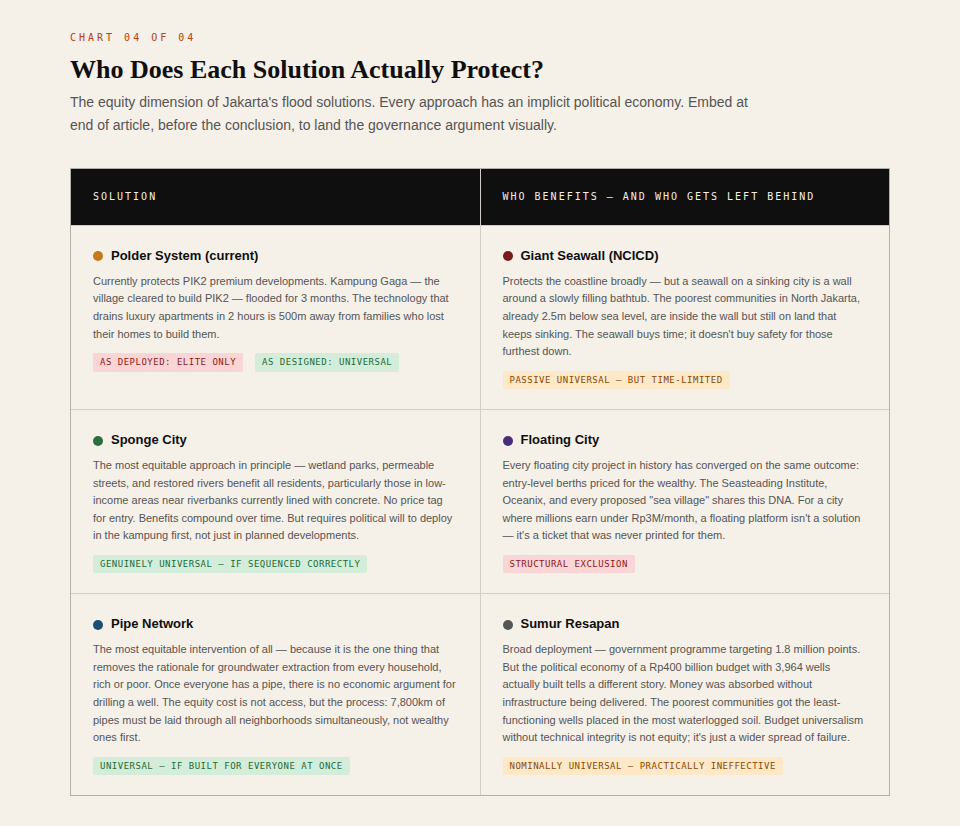
The equity dimension: who does each solution actually protect — and who gets left behind
CLOSING
We Don’t Need Noah’s Ark
We don’t need Noah’s Ark. We cannot put thirty million people on a boat. We don’t need a floating city escape pod for the wealthy while the rest sink. We don’t need a seawall protecting a city whose foundations are still being hollowed out underground.
What we need, in order, is: pipes, polders, rivers, mangroves, governance, and time.
The answer to ‘where do we start?’ is simple. Start in the north. Start at the rivers. Start by removing the government’s own exemption on free groundwater — today, before any masterplan is drafted. That one act would signal, for the first time in a long time, that someone in power is actually serious.
Jakarta is not a lost cause. It is a test. A test of whether Indonesia is finally, genuinely, serious about its own future — not just the shiny version of it, but the wet, difficult, necessary one.
The ground is still dropping. The clock is still running. But for the first time, the playbook is complete. We just need someone to pick it up.
===============================================================
REFERENCES:
Liputan 6: Jakarta Sinking 10 cm per year Tempo: **Giant Sea Wall Controversy Bangkok Post: [Giant Sea Wall](https://www.bangkokpost.com/world/1720435/sinking-jakarta-needs-giant-sea-wall-indonesia-president) The Guardian: [The Great Garuda](https://www.theguardian.com/cities/2016/nov/22/jakarta-great-garuda-seawall-sinking) The Jakarta Post: [To rescue or abandon Java](https://www.thejakartapost.com/opinion/2025/07/02/to-rescue-or-abandon-java.html) Quartz:[ Jakarta is building one of the Biggest Sea Walls on Earth](https://qz.com/571810/to-save-itself-jakarta-is-building-one-of-the-biggest-sea-walls-on-earth) Film Freeway: Jakarta Sinking ARTE.tv Documentary: Jakarta is Sinking**
Kompas: **Sudah Dua Hari Kampung Samping PIK 2 Terendam Banjir Tangerang Daily: [Tiga Bulan Banjir Kampung Gaga Tak Surut Disebabkan Dampak Pembangunan PIK 3](https://tangerangdaily.id/tiga-bulan-banjir-kampung-gaga-tak-surut-disebabkan-dampak-pembangunan-pik-3/) Berita Satu: [Banjir di PIK & PIK2 Kering dalam 2 Jam, Kok Bisa?](https://www.youtube.com/watch?v=qDAFZN4ac-E) TV One News: [Teknologi Belanda Sistem Polder](https://www.youtube.com/watch?v=2k0qzRu84Io) Kompas: [Teknologi Belanda yang Lindungi PIK 2 dari Banjir Jakarta](https://www.kompas.com/properti/read/2025/07/13/082312921/mengintip-teknologi-belanda-yang-lindungi-pik-2-dari-banjir-jakarta.) Delta Works: [Keajaiban Teknik yang Menyelamatkan Belanda dari Banjir Laut dan Tsunami](https://www.youtube.com/watch?v=QyaE3_l3qeo) Agung Sedayu Group: Concept & Benefits Polder System Erik Engheim Substack : [How Climate & Geography Shaped](https://erikexamines.substack.com/p/how-climate-and-geography-shaped) Arch Daily: [Could The Netherland’s Polder System work in theUS?](https://www.archdaily.com/977124/sea-level-rise-could-the-netherlands-polder-system-work-in-the)**
Liputan 6: **Polemik Sumur Resapan Detik News: [Digadang Cegah Banjir-Serap Air](https://news.detik.com/berita/d-5854957/spesifikasi-sumur-resapan-jakarta-digadang-cegah-banjir-serap-air.) Antara News: [Sumur Resapan Air Hujan](https://www.antaranews.com/infografik/2580853/sumur-resapan-air-hujan) Kemenkes: [Membuat Sumur Resapan, Solusi Atasi Banjir](https://pusatkrisis.kemkes.go.id/membuat-sumur-resapan-solusi-atasi-banjir-di-lingkungan-rumah) Antara News: [Learn from Tokyo to address land subsidence in Jakarta](https://en.antaranews.com/news/141970/cues-taken-from-tokyo-to-address-land-subsidence-in-jakarta) ISEAS: The Nusantara Project In Project — Risk & Challenge**
Watersnood Museum: **The History of The Delta Works The Netherlands’ Delta Works: [Engineering Marvels Against the Sea](https://www.youtube.com/watch?v=tG86tx9NtRU) The B1M: [Jakarta is sinking 75x Faster than Venice](https://www.youtube.com/watch?v=B7PHRVQgTKM&t=200s) TED-ED: [Why isn’t Netherlands Underwater?](https://www.youtube.com/watch?v=25LW_PG2ZuI) Invoice Indonesia: [Is the Dutch build Jakarta in a wrong place?](https://www.youtube.com/watch?v=jogrlzz_srM) Professor Poldergeist: [Climate Futures of Jakarta & the Netherlands](https://www.youtube.com/watch?v=sV2879YFIIQ)**
TED: **Floating Cities, The Lego House and other architectural forms of the future | Bjarke Ingels BIG: [East Side Coastal Resiliency](https://big.dk/projects/east-side-coastal-resiliency-4993) BIG : [Oceanix Busan](https://big.dk/projects/oceanix-busan-4711) NYC: [The East Side Coastal Resiliency Project](https://www.nyc.gov/site/escr/index.page) NYC DDC: [East Side Coastal Resiliency Floodwall Installation Complete](https://www.youtube.com/watch?v=5jV1MF62Y1A) N-Ark : [Dogen City](https://www.n-ark.jp/en/dogen-city) The B1M: [$19BN Plan to Save NY’s Worst Airport](https://www.youtube.com/watch?v=3roesY4BJR8) The Impossible Build: [Busan Floating City $200M city on water!](https://www.youtube.com/watch?v=ZdR-WwO_elI) Design Boom: [Floating City Oceanix](https://www.designboom.com/architecture/bjarke-ingels-big-floating-city-oceanix-04-04-2019/) Dami Lee: [The real problem with Floating Cities](https://www.youtube.com/watch?v=vJP7I_QMXY0) The Guardian: [Seasteading — a vanity project for the rich or the future of humanity?](https://www.theguardian.com/environment/2020/jun/24/seasteading-a-vanity-project-for-the-rich-or-the-future-of-humanity)**
Bloomberg Originals: **Singapore is trying to build a Climate-Proof City VOX: [How China is designing flood-resistant cities](https://www.youtube.com/watch?v=nf-Yy3EuZi0)**
Wired: **The Designer Who’s Trying to Transform Your City Into a Sponge Turenscape: [Sponge City Theory & Practice by Kongjian Yu & Team](https://www.turenscape.com/topic/en/spongecity/index.html) Design Boom: [Kongjian Yu’s pioneering Sponge Cities show how Urban Design can adapt to Climate Change](https://www.designboom.com/architecture/kongjian-yu-pioneering-sponge-cities-urban-design-climate-change-turenscape-09-26-2025/) WEF: [Sponge Cities can help protect against flooding](https://www.weforum.org/stories/2025/08/flood-climate-change-sponge-cities/) The City Sponge: [Let’s Absorb, Ways NYC Can Get Spongier](https://www.thecitysponge.com/p/lets-absorb-ways-nyc-can-get-spongier) Arch Daily: [Brooklyn to Transform Canal Into “Sponge Park”](https://www.archdaily.com/417816/brooklyn-to-restore-health-to-gowanus-canal-with-sponge-park) Arch Paper: [On the road to Sponge Planet](https://www.archpaper.com/2024/11/kongjian-yu-sponge-city/) One Architecture NYC x Amsterdam : [Toward A Rainproof NYC, Turning the concrete jungle into a sponge](https://rebuildbydesign.org/wp-content/uploads/2022/08/Rainproof-NYC-Turning-the-Concrete-Jungle-into-a-Sponge-Compressed.pdf) TEDXBoston: [Sponge City & Sponge Planet by Kongjian Yu](https://www.youtube.com/watch?v=4YH6ZFvKzeE) CNN Style: [Why turning cities into ‘sponges’ could help fight flooding](https://edition.cnn.com/2024/08/13/style/china-sponge-cities-kongjian-yu-hnk-intl) China Daily: [Sponge City](https://www.chinadailyhk.com/hk/article/245365) Chapman Taylor: [Sponge cities and the future of urban design](https://www.chapmantaylor.com/insights/what-are-sponge-cities-and-why-are-they-the-future-of-urban-design)**
메타데이터
- post_id
- 3d4abbea383f
- slug
- jakarta-is-sinking-and-were-running-out-of-excuses-3d4abbea383f
- url
- https://medium.com/@anita.ateliery/jakarta-is-sinking-and-were-running-out-of-excuses-3d4abbea383f
- canonical_url
- https://medium.com/@anita.ateliery/jakarta-is-sinking-and-were-running-out-of-excuses-3d4abbea383f
- author_url
- https://medium.com/@anita.ateliery
- status
- ok
- fetched_at
- 2026-07-06 19:50:18




