Can AI Personalize a University Degree Better Than a Standard Curriculum?
Why adaptive learning may become the next major shift in online higher education
Can AI Personalize a University Degree Better Than a Standard Curriculum?
Why adaptive learning may become the next major shift in online higher education
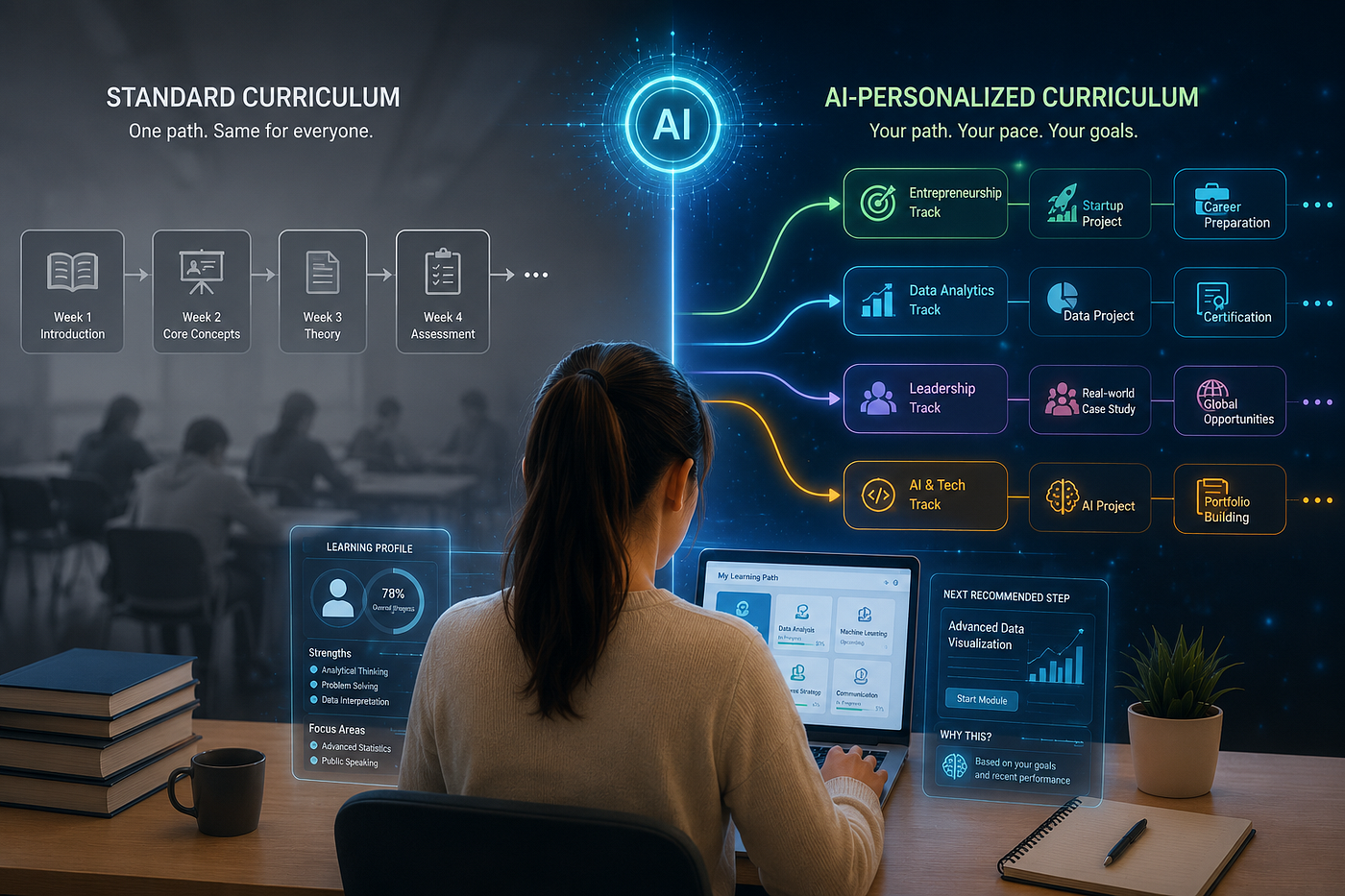
Most university programs are built around a standard curriculum.
The logic is simple: every student follows the same course structure, studies the same materials, completes the same assignments, and moves through the same academic pathway.
This model is familiar. It is also easier to manage.
But it has one major weakness.
Students are not standard.
They have different backgrounds, different levels of preparation, different career goals, different learning speeds, and different reasons for studying.
One student may already have work experience but need a formal degree. Another may be entering higher education for the first time. Another may be changing careers. Another may be preparing for international employment. Another may want to launch a business.
When all of these students receive the same learning experience, some move too slowly, some move too quickly, and some never fully connect the content to their real goals.
This is one of the reasons SITE Geneva is building an AI-native online education model.
The question is not whether AI can replace universities.
The better question is whether AI can help universities become more personal, more responsive, and more useful for each student.
The problem with one-size-fits-all education
Traditional curriculum design usually assumes that students move through knowledge in the same order and at the same pace.
In reality, they do not.
- Some students need more explanation.
- Some need more practice.
- Some need more advanced tasks.
- Some need career examples.
- Some need language support.
- Some need help connecting theory to real business situations.
- Some already understand the basics and want to move faster.
In a physical classroom, an experienced professor can sometimes adjust the lesson based on the room. But in large-scale online education, personalization is harder.
A standard online platform often gives every student the same videos, same readings, same quizzes, and same deadlines.
That is efficient for delivery.
But it is not always effective for learning.
Content access is no longer enough
For years, online education focused heavily on access.
- Could students watch lectures online?
- Could they download materials?
- Could they complete tests remotely?
- Could they study from another country?
These were important questions, and online education solved many of them.
But the next stage is different.
Access is no longer the main innovation. Personalization is.
Students do not only need digital content. They need the right content, at the right moment, in the right format, with the right level of difficulty and the right connection to their goals.
This is where AI can change the learning experience.
An AI-supported curriculum can help identify what a student already understands, what they are struggling with, and what kind of support they may need next.
What AI personalization means in a university context
AI personalization does not mean that every student studies a completely different degree.
Academic standards still matter. Accreditation still matters. Core learning outcomes still matter.
A business student still needs to understand management, marketing, finance, strategy, operations, leadership, and entrepreneurship. An MBA student still needs a serious academic and practical foundation.
The difference is in how the student moves through the journey.
AI can help personalize the path around the core curriculum.
That may include:
- Different explanations for the same concept.
- Additional examples based on the student’s career interests.
- Practice tasks adapted to the student’s level.
- Review materials when the student struggles.
- More advanced challenges when the student is ready.
- Career-oriented projects connected to the student’s goals.
- Feedback that helps the student understand what to improve next.
The curriculum remains structured. But the learning experience becomes more responsive.
Personalization by pace
Pace is one of the simplest but most important forms of personalization.
Some students can understand a topic quickly and want to move forward.
Others need more time, more examples, and more repetition.
In a standard system, both students often receive the same experience.
This creates frustration.
The advanced student may feel bored. The struggling student may feel lost.
AI can help by identifying learning patterns and recommending the next step.
If a student consistently performs well, the system can suggest more challenging materials, deeper case studies, or additional projects.
If a student struggles, the system can recommend review content, simpler explanations, examples, or practice tasks.
This kind of personalization does not remove academic discipline. It supports it.
The goal is not to make the degree easier.
The goal is to help each student keep moving.
Personalization by level
Students enter online degree programs with very different levels of preparation.
In international education, this difference becomes even stronger.
- Some students may have strong professional experience but weak academic writing skills.
- Some may understand theory but lack practical examples.
- Some may be confident in business but less confident with technology.
- Some may have strong motivation but limited English-language academic experience.
A good AI-supported learning platform can help detect these differences earlier.
Instead of waiting for a student to fail an assignment, the system can identify patterns and suggest support before the problem becomes serious.
For example, a student struggling with financial analysis may need additional practice in interpreting numbers. A student struggling with strategic writing may need examples of stronger business arguments. A student struggling with presentation may need templates and feedback.
Personalization by level helps students build confidence without lowering expectations.
Personalization by career goal
This may be the most important type of personalization for modern higher education.
Students do not study only to pass exams. They study because they want a different future.
That future may be a job, promotion, business, international opportunity, career change, or stronger professional identity.
A standard curriculum often treats career goals as something separate from academic content.
An AI-native university can connect them.
For example, two students may study the same marketing module. One wants to work in digital marketing. Another wants to build a startup. Another wants to manage a traditional business. Another wants to enter consulting.
The core theory may be the same, but the examples, projects, and portfolio outputs can be different.
- The digital marketing student may work on campaign strategy.
- The startup founder may work on market validation.
- The manager may work on customer segmentation.
- The consulting-oriented student may work on a structured case analysis.
This does not fragment the degree. It makes the learning more meaningful.
AI-generated content should be used carefully
AI content generation is a powerful tool, but it must be used responsibly.
The goal should not be to flood students with endless automatically generated materials.
More content does not always mean better learning.
Good AI-generated education should be structured, reviewed, and connected to clear academic outcomes.
AI can help create examples, practice questions, case variations, summaries, explanations, and personalized study tasks. But universities still need academic oversight, quality control, and a clear curriculum framework.
In other words, AI can help generate and adapt learning materials, but it should not remove responsibility from the institution.
The university still needs to define what students must learn, why it matters, how it will be assessed, and how quality will be maintained.
Why personalization matters for motivation
Personalization is not only about academic performance.
It is also about motivation.
Students stay more engaged when they feel that the learning journey is relevant to them.
- If a student sees how a module connects to their career goal, they are more likely to continue.
- If feedback feels specific, they are more likely to improve.
- If examples reflect their interests, they are more likely to understand.
- If progress is visible, they are more likely to stay committed.
This is especially important in online education, where students often study independently.
A personalized learning journey can make the student feel less alone.
It can create the feeling that the system understands where they are and what they need next.
AI personalization and gamification work together
Personalization becomes even stronger when combined with gamification.
Gamification helps students see progress.
AI personalization helps decide what progress should look like for each student.
Together, they can create a more dynamic learning experience.
For example, a student might complete a module and unlock a new project based on their career goal. Another student might receive a review path because the system detected a weak area. Another might earn a milestone for completing a portfolio-ready assignment.
This creates a learning journey that is structured but not rigid.
Students still follow an academic program, but the experience feels more adaptive, more motivating, and more connected to personal development.
AI personalization and career matching
AI personalization also connects naturally with career matching.
If a student wants to move toward a certain profession, the curriculum can help support that path.
A career matching engine can identify possible roles, skill gaps, and relevant opportunities.
An adaptive curriculum can then help the student build the missing skills.
This is an important shift.
Career support is no longer something that happens only after graduation. It can influence the learning journey while the student is still studying.
- A student who wants to work in business analytics may need more data-oriented projects.
- A student who wants to work in entrepreneurship may need more startup-oriented assignments.
- A student who wants to work in international management may need more cross-cultural business cases.
This makes education more connected to the real world.
The role of teachers in an AI-personalized university
AI does not make teachers less important.
It may make their role more important.
When AI handles some parts of personalization, teachers can focus more on higher-value work: mentorship, discussion, feedback, judgment, and real-world interpretation.
A professor should not spend all their time repeating the same basic explanation if AI can help students review it individually.
Instead, the professor can spend more time helping students think critically, apply knowledge, challenge assumptions, and connect theory to practice.
AI can support the learning process.
Teachers give it depth.
What students should expect from the future of online degrees
The future online degree may feel different from the old model.
Students may not simply log in, watch videos, and take tests.
They may enter a digital learning environment that understands their profile, tracks their progress, adapts support, connects modules to career goals, and helps them build a portfolio over time.
The degree may become less like a static content archive and more like a guided development system.
This does not mean education becomes easier or less serious.
In fact, it may become more demanding because students can no longer hide behind passive participation. A personalized system can show more clearly where they are progressing and where they need to improve.
The risk of overpromising AI
It is important not to exaggerate what AI can do.
- AI will not magically solve every problem in higher education.
- It will not replace effort.
- It will not guarantee career success.
- It will not make difficult subjects effortless.
- It will not remove the need for academic standards, discipline, and human support.
But AI can help solve one of the oldest problems in education: the fact that every student is different.
If used carefully, AI can make learning more responsive, more personal, and more connected to real outcomes.
That is a meaningful shift.
The bigger opportunity
For universities, the opportunity is not just to add AI features.
The opportunity is to rethink the student journey.
- What if every student had a clearer path?
- What if every module connected to practical goals?
- What if feedback arrived earlier?
- What if students could see how their projects support their career direction?
- What if the curriculum could adapt without losing academic structure?
- What if online education felt less like a library and more like a personal academic roadmap?
These are the questions shaping the next generation of higher education.
At SITE Geneva, this is the direction we are working toward: an AI-native university model where content, personalization, gamification, career matching, and international opportunities are part of one connected learning experience.
The future of online education will not be defined only by access.
It will be defined by relevance.
And relevance begins when the learning journey becomes personal.
About SITE
SITE is an AI-native online university registered in Geneva, Switzerland. We offer accredited BBA and MBA programs powered by a proprietary AI career matching engine, gamified learning platform, AI-driven content personalization, and access to an international exchange network across 20+ partner institutions. Accredited by QAHE and EQAC, ISO 21001:2018 certified, CEEMAN and ECBE member. 1,200+ students enrolled from 20+ countries since September 2024.
sitegeneva.com · info@sitegeneva.com · Chemin Louis-Hubert 2, 1213 Petit-Lancy, Geneva, Switzerland
메타데이터
- post_id
- 3d53cf0f168a
- slug
- can-ai-personalize-a-university-degree-better-than-a-standard-curriculum-3d53cf0f168a
- url
- https://medium.com/@abaigozha/can-ai-personalize-a-university-degree-better-than-a-standard-curriculum-3d53cf0f168a
- canonical_url
- https://medium.com/@abaigozha/can-ai-personalize-a-university-degree-better-than-a-standard-curriculum-3d53cf0f168a
- author_url
- https://medium.com/@abaigozha
- status
- ok
- fetched_at
- 2026-07-13 21:27:59