The Tiny Asteroid That Changed an Entire Space Mission
One blurry photograph changed years of careful planning
SCIENCE|TECHNOLOGY
The Tiny Asteroid That Changed an Entire Space Mission
One blurry photograph changed years of careful planning
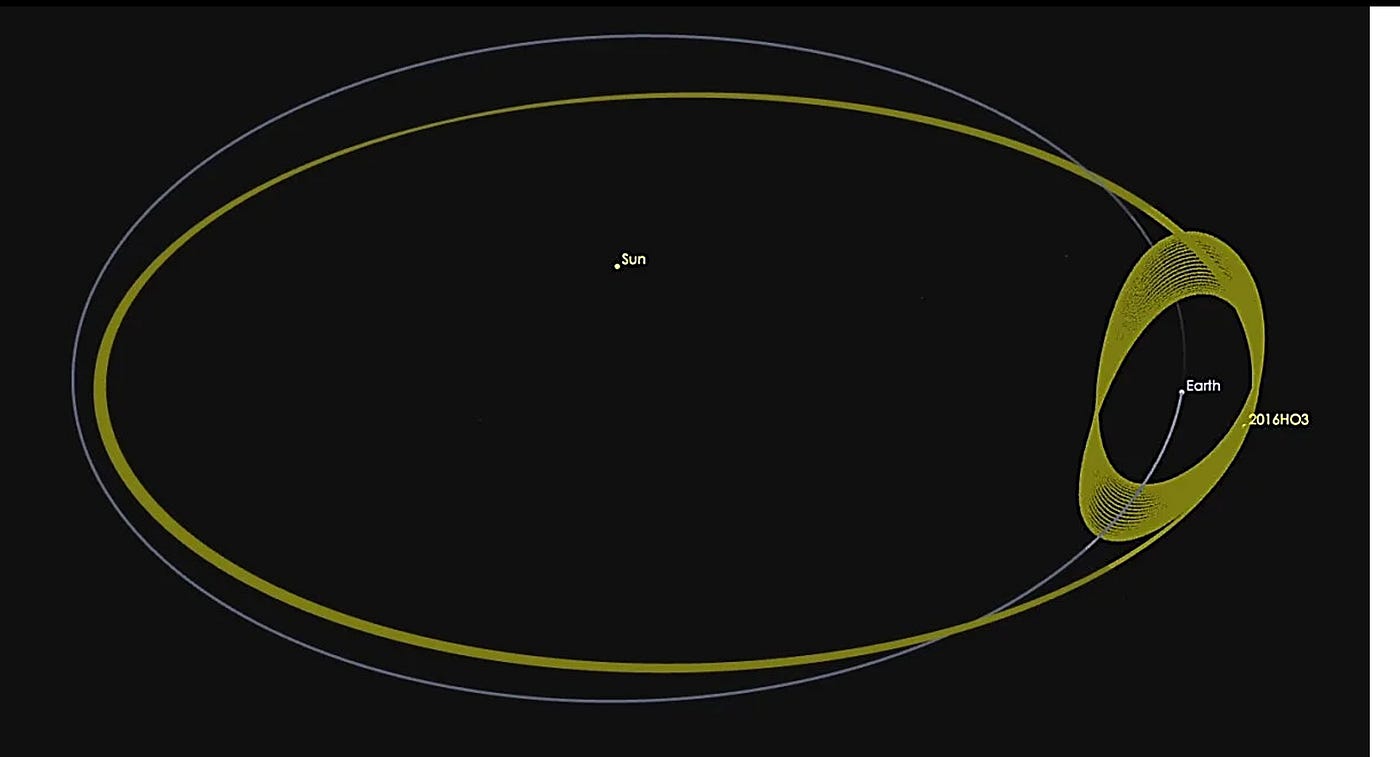
Orbit of 469219 Kamo’oalewa Earth’s orbit around the Sun (blue) contrasted with that of its quasi-moon 469219 Kamo’oalewa (yellow, labeled with its provisional designation 2016 HO3). The large yellow circle traces just one of the quasi-moon’s orbits around the Sun; over many orbits, it also traces the series of loops around Earth shown to the right.Image: NASA / JPL-Caltech
We like to believe that learning makes us more certain. Sometimes the exact opposite happens.
That’s what I discovered after reading a story about a tiny asteroid called 469219 Kamoʻoalewa. At first, I assumed it was just another routine space story. China’s National Space Administration (CNSA) had finally reached a small asteroid traveling alongside Earth. Interesting, perhaps, but hardly a headline I expected to remember.
Then I read one sentence that made me stop. The mission had been planned for years. One blurry photograph may have changed everything.
The Plan Looked Almost Perfect
For years, scientists designed this mission around one critical assumption about the asteroid they were about to visit. Then Tianwen-2 finally arrived and transmitted the first close-up photograph ever taken of Kamoʻoalewa.
And that single image may have upended years of careful planning. Instead of confirming what scientists hoped to find, it forced them to rethink how they would collect samples from the asteroid’s surface.
The more I read, the less this felt like a story about space. It felt like a story about what happens when reality refuses to cooperate with our assumptions.
China’s Tianwen-2 spacecraft traveled more than one million kilometers to reach Kamoʻoalewa, one of only a handful of known “quasi-moons.” These unusual objects orbit the Sun alongside Earth, making them appear to travel with our planet even though they aren’t actually orbiting Earth like our Moon.
On paper, the mission sounded almost simple: fly to the asteroid, land on its surface, collect samples and bring them back to Earth. To make that possible, engineers equipped Tianwen-2 with specialized hardware designed to anchor securely into solid rock before drilling into the surface.
Everything depended on one critical assumption. That when the spacecraft finally arrived, there would be solid rock waiting beneath it. But there wasn’t.
Then They Finally Saw It Up Close
The first close-up photograph wasn’t spectacular or crystal clear. It certainly wasn’t the kind of image that belongs on a magazine cover. But it contained exactly what scientists needed to see.
The blurry photograph revealed something scientists couldn’t have known from more than a million kilometers away. The asteroid wasn’t the solid chunk of rock many researchers had hoped to find. Instead, it appears to be what’s known as a rubble-pile asteroid or a loose collection of boulders, gravel and dust held together by surprisingly weak gravity.
Imagine trying to land on a spinning pile of loose rubble instead of a concrete sidewalk. Suddenly, the mission becomes much more complicated. The spacecraft was designed to anchor itself to solid rock before drilling into the surface.
But if that “rock” is really a fragile pile of debris, every step of the mission becomes riskier. The asteroid’s uneven terrain, delicate structure and rapid spin could make collecting samples far more difficult than scientists originally expected.
That’s when it hit me.
Years of engineering, planning and preparation had all been built around an assumption that one blurry photograph called into question.
Reality Doesn’t Always Match the Blueprint
That’s when I realized this wasn’t really a story about an asteroid. It was a story about how knowledge actually works. Most of us think science is a steady march toward certainty. We imagine each new discovery simply adds another piece to the puzzle. But that’s rarely how it happens.
Scientists make the best predictions they can using the evidence available at the time. Then they gather new evidence, and sometimes it overturns what they thought they knew. That’s not a flaw in science. It’s the entire point.
That blurry photograph didn’t expose a failed mission. It exposed the limits of what anyone could have known before the spacecraft finally arrived. In other words, the mission wasn’t proving scientists wrong. It was giving them the chance to discover where they had been incomplete all along.
We Do This Constantly
The more I thought about it, the more this stopped feeling like a story about space. It felt like a story about us.
We make some of the biggest decisions of our lives long before we have all the information we’d like.
Companies spend years developing products before customers tell them what they actually want. Doctors begin treatment before every answer is available, investors build strategies around economic forecasts that can change overnight and entrepreneurs write business plans based on assumptions about markets that don’t exist yet.
Even in our personal lives, we make life-changing decisions without knowing what tomorrow will bring. We fall in love, get married, buy homes, change careers and raise children with incomplete information.
That’s not carelessness. It’s the human condition. Most of the time, we don’t discover what’s missing until we’re already moving forward. Just like Tianwen-2, sometimes we have to arrive before we can finally see what was there all along.
The Asteroid May Hold Another Surprise
Scientists still hope Tianwen-2 will collect samples from Kamoʻoalewa and return them to Earth in 2027. If it succeeds, those tiny fragments could answer a mystery that has fascinated astronomers for years. What if this isn’t just another asteroid?
Some researchers believe Kamoʻoalewa may actually be a fragment of Earth’s Moon, blasted into space by a colossal impact millions, or perhaps even billions, of years ago.
Think about that for a moment. A small piece of our own Moon may have spent unimaginable stretches of time silently circling the Sun alongside Earth, unnoticed until astronomers finally discovered it in 2016.
If Tianwen-2 brings those samples home, scientists won’t just be studying an asteroid. They may be holding a long-lost piece of our own cosmic history.
The Lesson That Stayed With Me
I expected this story to teach me something about asteroids. Instead, it reminded me how often we mistake confidence for certainty. No matter how much we study, calculate or prepare, there comes a point when reality gets the final vote.
Sometimes it’s one conversation. Sometimes it’s one medical test. Sometimes it’s one customer review. And sometimes it’s one blurry photograph of an asteroid taken millions of kilometers from home.
Maybe that’s the real lesson hidden inside this mission. We spend our lives trying to eliminate uncertainty. But sometimes the closer we get to reality, the more complicated reality becomes.
That’s not failure. That’s discovery.
메타데이터
- post_id
- 3d620a8e9719
- slug
- the-tiny-asteroid-that-changed-an-entire-space-mission-3d620a8e9719
- url
- https://medium.com/bouncin-and-behavin-blogs/the-tiny-asteroid-that-changed-an-entire-space-mission-3d620a8e9719
- canonical_url
- https://medium.com/bouncin-and-behavin-blogs/the-tiny-asteroid-that-changed-an-entire-space-mission-3d620a8e9719
- author_url
- https://medium.com/@kelly.carmichael
- status
- ok
- fetched_at
- 2026-07-13 06:23:13