120 Users, 65 Product Submissions, and Very Little Traffic: What I Learned
Lifto reached 120 users and 65 product submissions, but traffic stayed low. Here is what that taught me about growth, distribution, and…
120 Users, 65 Product Submissions, and Very Little Traffic: What I Learned
Lifto reached 120 users and 65 product submissions, but traffic stayed low. Here is what that taught me about growth, distribution, and focus.
Quick answer
Lifto reached around 120 registered users and 65 product submissions, but traffic remained very small. The biggest lesson was simple: signups and product inventory are not the same as distribution. I had built something founders were willing to submit to, but I had not yet built a repeatable system that brought enough people back to discover those products.
At first, the numbers felt encouraging. Then I looked at the traffic and realized they were telling two different stories.
The numbers looked better than the reality
At the time of writing, Lifto had:
- Around 120 registered users
- 65 product submissions
- A growing set of product reels and pages
- Very little consistent traffic
Sixty-five submissions for 120 registered users is roughly one submission for every two users. That is a meaningful signal: founders understand the idea and are willing to put their products on the platform.
But it is only a supply-side signal.
It does not mean enough people are arriving to browse. It does not mean they are returning every week. It does not mean founders are receiving meaningful exposure yet.
I was looking at registrations and submissions as proof of growth. What I really had was proof that one part of the product made sense.
The lesson: always separate product activity from audience growth.
For Lifto, the useful funnel is not just:
-
Visitor signs up
-
Visitor submits a product
It is:
-
Someone discovers Lifto
-
They find a relevant product or useful article
-
They browse more than one page or reel
-
They sign up or subscribe
-
A founder submits a product
-
That founder shares the product page
-
New visitors arrive
-
Some of those visitors return
The first funnel creates database rows. The second can create a growth loop.
Product submissions are inventory, not distribution
A product discovery platform needs products. Without them, there is nothing to discover. So reaching 65 submissions matters.
But inventory does not distribute itself.
This is the marketplace cold-start problem in a very practical form:
- Founders submit because they want attention.
- Visitors return only if the products are useful and fresh.
- Founders receive attention only when enough visitors arrive.
- The platform grows only when both sides create value for each other.
I had concentrated heavily on making the founder side work: submission, product reels, product pages, images, profiles, and community features. That work improved Lifto after someone arrived.
It did not answer the harder question: why would a new person arrive today?
That question needs a different kind of work:
- Publishing genuinely useful content
- Sharing individual products consistently
- Building relationships with founders
- Creating launch assets that founders want to repost
- Earning relevant backlinks from real sites
- Showing up repeatedly in the communities where early adopters already spend time
The lesson: a full feed is an asset, but it is not an acquisition channel.
More features did not automatically create more traffic
I kept improving Lifto because many improvements were clearly useful. Founders can now add carousel images alongside demos. Product pages are cleaner. Daily quests reward participation. Trending demos, active discussions, and category exploration make discovery easier. The blog and newsletter create a place for longer-form content.
Those features improve activation and retention. They give an existing visitor more reasons to explore and return.
But a feature cannot retain a user who never arrives.
This distinction changed how I think about the roadmap:
- Acquisition work brings the right person to Lifto.
- Activation work helps that person quickly understand the value.
- Retention work gives them a reason to come back.
- Monetization work captures value after the other parts are working.
When traffic is very low, acquisition is the constraint. Shipping another internal feature can feel productive because it is concrete and controllable. Distribution is slower, less predictable, and sometimes uncomfortable. It still has to become the priority.
The lesson: build enough product to deliver the promise, then spend serious time delivering the product to people.
Domain rating and backlinks were a distraction
I also spent time looking at domain-rating tools and backlink counts. Lifto appeared to have hundreds of backlinks, but most came from low-quality or spammy sites. The headline number looked large while the actual authority was close to zero.
That taught me not to chase backlink quantity.
A useful backlink has at least one of these qualities:
- It comes from a real product, founder, publication, or community.
- A relevant person might actually click it.
- It gives context about why Lifto is worth visiting.
- It points to a useful product page, guide, or original resource.
Ten relevant mentions can be more valuable than hundreds of automated links.
The better strategy is slower but clearer:
-
Feature good products.
-
Tell the founders they were featured.
-
Give them a clean page or badge they can share.
-
Publish original data and honest lessons worth referencing.
-
Submit Lifto only to reputable directories with a real audience.
The lesson: traffic and trust come from relevance, not from a backlink counter.
What I am changing now
The next stage of Lifto is less about adding everything and more about building repeatable distribution.
1. Turn every product into a distribution opportunity
When a product is approved, I can create a small launch package:
- The Lifto product-page link
- A ready-to-post social caption
- A shareable image
- A Featured on Lifto badge
The goal is not to pressure founders into promoting Lifto. The goal is to make sharing their own feature useful and effortless.
2. Publish original founder stories
Generic startup advice is everywhere. Lifto can publish material based on real work:
- What happened after 65 submissions
- Which outreach messages received replies
- What generated actual visits
- What failed
- How product videos affect engagement
Specific experience is more credible than recycled advice, and it gives search engines and founders something distinct to find.
3. Share products, not only platform announcements
Most people do not wake up wanting to visit another platform. They may want to discover a useful AI tool, a better workflow, or an interesting founder story.
That means the social strategy should spotlight the products:
- One product demo
- One clear benefit
- One founder mention
- One direct link
Lifto grows when its products become the content.
4. Focus on a narrower initial audience
Trying to reach every startup, app, founder, and early adopter at once makes distribution vague. Lifto already has a natural starting point: indie founders launching SaaS, AI, developer, and productivity products.
A narrower audience makes the message clearer, outreach easier, and content more relevant.
5. Measure the complete loop
I need to know more than total users and total submissions. Each week, the useful questions are:
- Which source brought visitors?
- Which pages did they land on?
- Did they watch another reel?
- Did they sign up, subscribe, or submit?
- Did a founder share their page?
- Did visitors return?
The numbers should help identify the next bottleneck, not just make the dashboard look active.
Where Lifto fits in
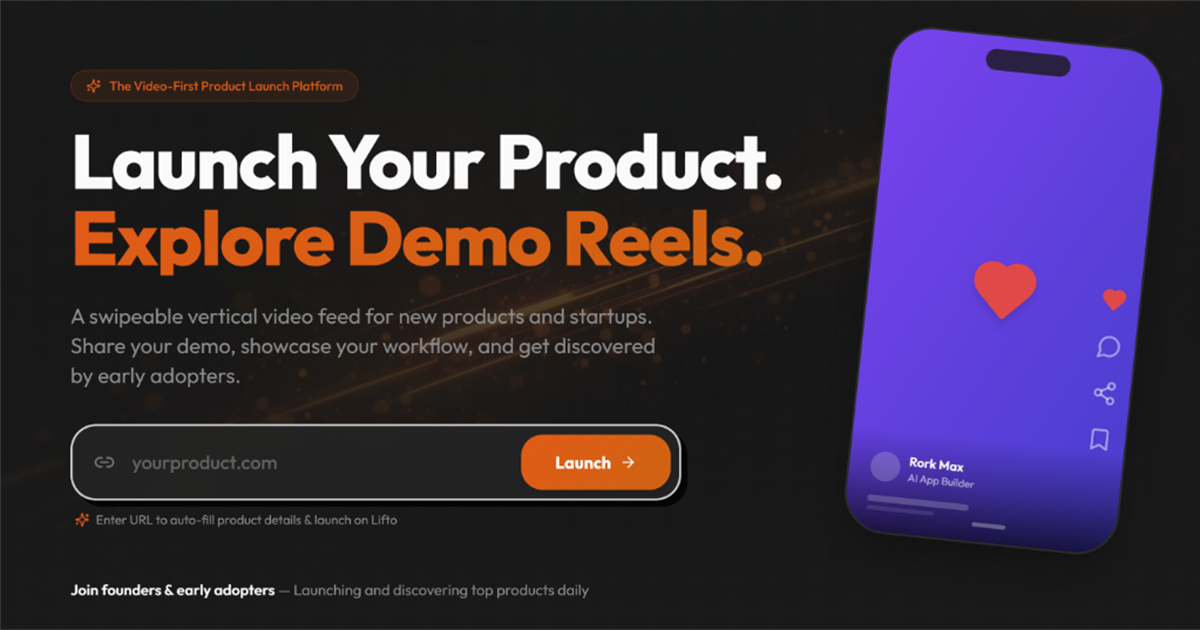
Lifto is still early, and that is exactly why these lessons matter. It is a place where founders can present a product through a short demo, images, a richer product page, and community discussion instead of relying on a single launch-day spike. If you are building something, you can submit your product to Lifto for free. The goal now is to make every good submission easier for the right people to discover.
FAQ
Is 120 users good for a new startup?
It depends on what those users do and whether they return. For Lifto, 120 users proved that founders were willing to register, but the more important questions were how they discovered the platform, whether they explored products, and whether they came back.
Why can a platform have product submissions but very little traffic?
Submitting a product and browsing products are different motivations. Founders actively search for places to promote their work, so the supply side can grow before the discovery audience. The platform still needs independent channels that bring visitors who want to browse.
Should I keep building features when traffic is low?
Build the features required to deliver the core promise and fix obvious activation problems. After that, if very few relevant people are arriving, distribution is probably the constraint. More features will not solve an empty top of the funnel.
How should an early startup increase traffic?
Choose a narrow audience, publish specific useful content, manually distribute it where that audience already gathers, and measure which channels bring engaged visitors. Repeat the channels that lead to browsing, signups, shares, or returns rather than chasing impressions alone.
Do backlinks automatically increase startup traffic?
No. Low-quality or automated backlinks may increase a tool’s backlink count without bringing visitors or trust. Relevant links from founders, real products, communities, directories, and publications are much more valuable.
Takeaway
The 120 users and 65 submissions were not a failure. They were an early signal that founders understood part of Lifto’s value, followed by a clear reminder that product activity does not replace distribution. My next goal is not to ship the most features; it is to build a repeatable path from discovery to browsing, sharing, and returning.
메타데이터
- post_id
- 3d75502fad9d
- slug
- 120-users-65-product-submissions-and-very-little-traffic-what-i-learned-3d75502fad9d
- url
- https://medium.com/@riyad.bv50/120-users-65-product-submissions-and-very-little-traffic-what-i-learned-3d75502fad9d
- canonical_url
- https://medium.com/@riyad.bv50/120-users-65-product-submissions-and-very-little-traffic-what-i-learned-3d75502fad9d
- author_url
- https://medium.com/@riyad.bv50
- status
- ok
- fetched_at
- 2026-07-29 21:39:07