Dive Watch Myths Recap: Sapphire, Water Resistance, Movement
One week, three myths, real money at stake. Here’s the full recap of what’s true, what expired decades ago, and the checks that make you…
Dive Watch Myths Recap: Sapphire, Water Resistance, Movement
One week, three myths, real money at stake. Here’s the full recap of what’s true, what expired decades ago, and the checks that make you immune.
Dive watches. Built with purpose.
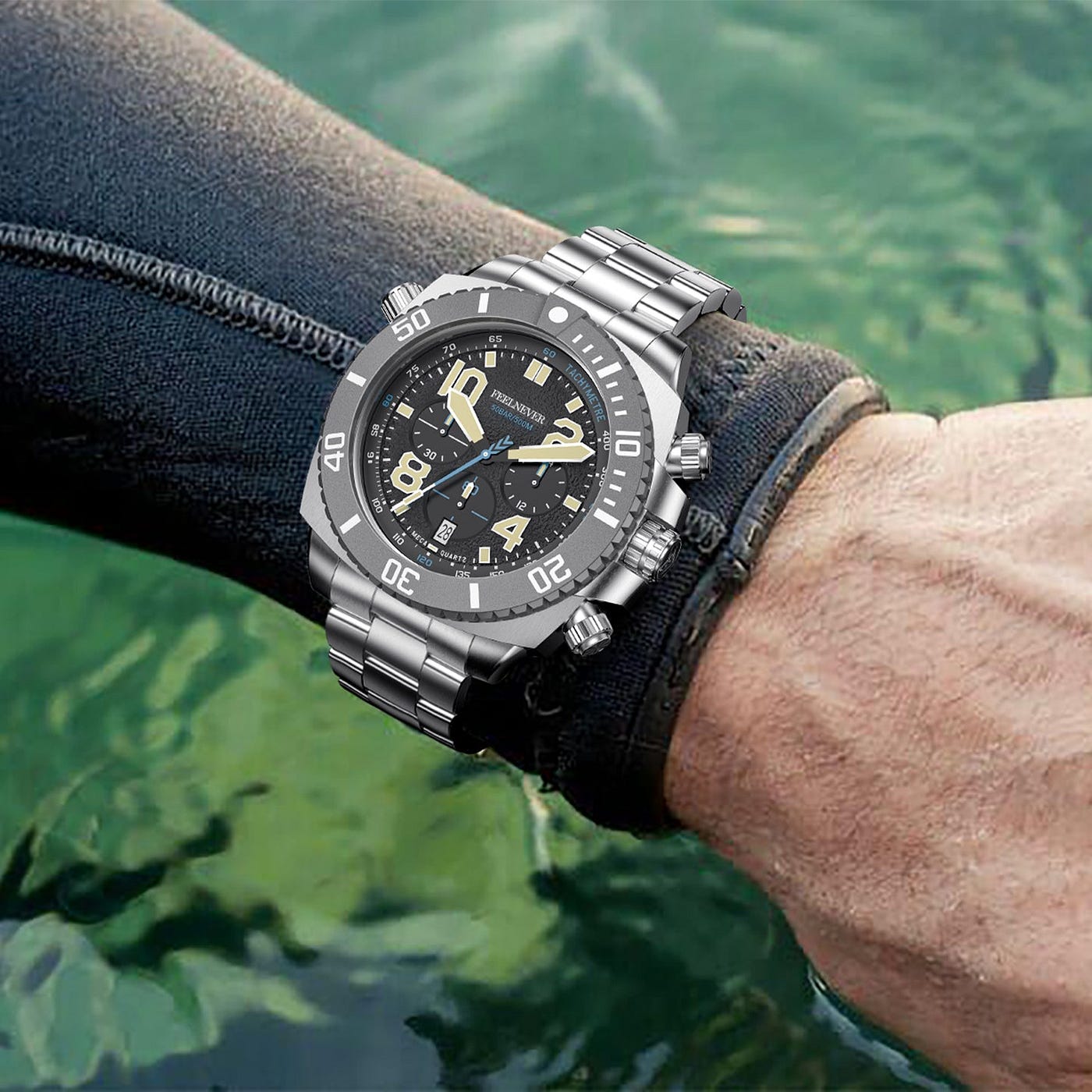
AbyssHeritage 500M laid over a spec sheet with three items circled: crystal, rating, movement. Caption: “The three lines on a spec sheet where buyers lose the most money.”)
Every product category has folklore. Dive watches have more than most, because the things that separate a good one from a prop — gasket quality, crystal material, movement architecture — are invisible in a product photo. Where buyers can’t see, myths move in.
This week we took the three most expensive ones apart, one by one. This is the recap: all three myths, all three truths, and the spec-sheet checks that make you permanently hard to fool. If you read nothing else we publish this month, read this one — it’s the week’s education in a single sitting, and the plan is simple:
- Myth 1: the crystal doesn’t matter
- Myth 2: water resistance ratings are marketing
- Myth 3: automatics keep better time than quartz
- Then: the five-check immune system for every future purchase
Why Dive Watches Attract More Myths Than Any Other Category
It’s worth pausing on the pattern, because it inoculates you beyond this week’s three.
Dive watches are sold on invisible qualities. A dress watch’s value is on its face — finishing, proportions, dial work you can judge in a photo. A dive watch’s value is in its gaskets, its pressure testing, its crystal chemistry, its movement architecture: none of it photographs, all of it costs money, and every dollar of it can be skipped without changing how the watch looks online.
That gap between what you can see and what you’re paying for is where every myth in this recap was born. Folklore fills the space that spec sheets leave empty — and it always fills it in favor of whoever writes the vaguest listing. Which is why the cure is never “trust the right brand.” It’s making the invisible parts visible: named materials, stated ratings, identified calibers. A myth cannot survive a specific sentence.
Myth 1: “The Crystal Doesn’t Matter”
The crystal is the only component you look through every single day, and it’s the first place cheap builds cut corners — precisely because the corner is invisible at purchase. Mineral glass and sapphire are indistinguishable in the box. A year of keys, desks, and doorframes tells them apart permanently: mineral scratches and stays scratched, while sapphire — rating 9 on the Mohs scale — shrugs off everything short of diamond.
The truth has one honest footnote: sapphire is harder but more brittle, which is why some extreme-impact tool builds choose reinforced mineral on purpose. That’s a stated engineering trade-off, not a corner cut — and the difference between the two is whether the brand tells you. The check: find the crystal named on the spec sheet. “Hardened glass” or silence means mineral, and the price should reflect it.
Myth 2: “Water Resistance Ratings Are Marketing”
This myth is really three tangled together, so here’s the untangling.
The rating is real — but it measures static lab pressure, not adventure plans. Diving into a pool, swimming strokes, and hot-to-cold shocks all spike stress beyond your actual depth. That’s why serious ratings look “excessive”: the number is a stress budget, and margin is the product.
Pushers don’t ruin it — unsealed pushers do. Screw-down pushers lock into a static seal, caseback-grade. The folklore about chronographs and water expired with pump pushers decades ago.
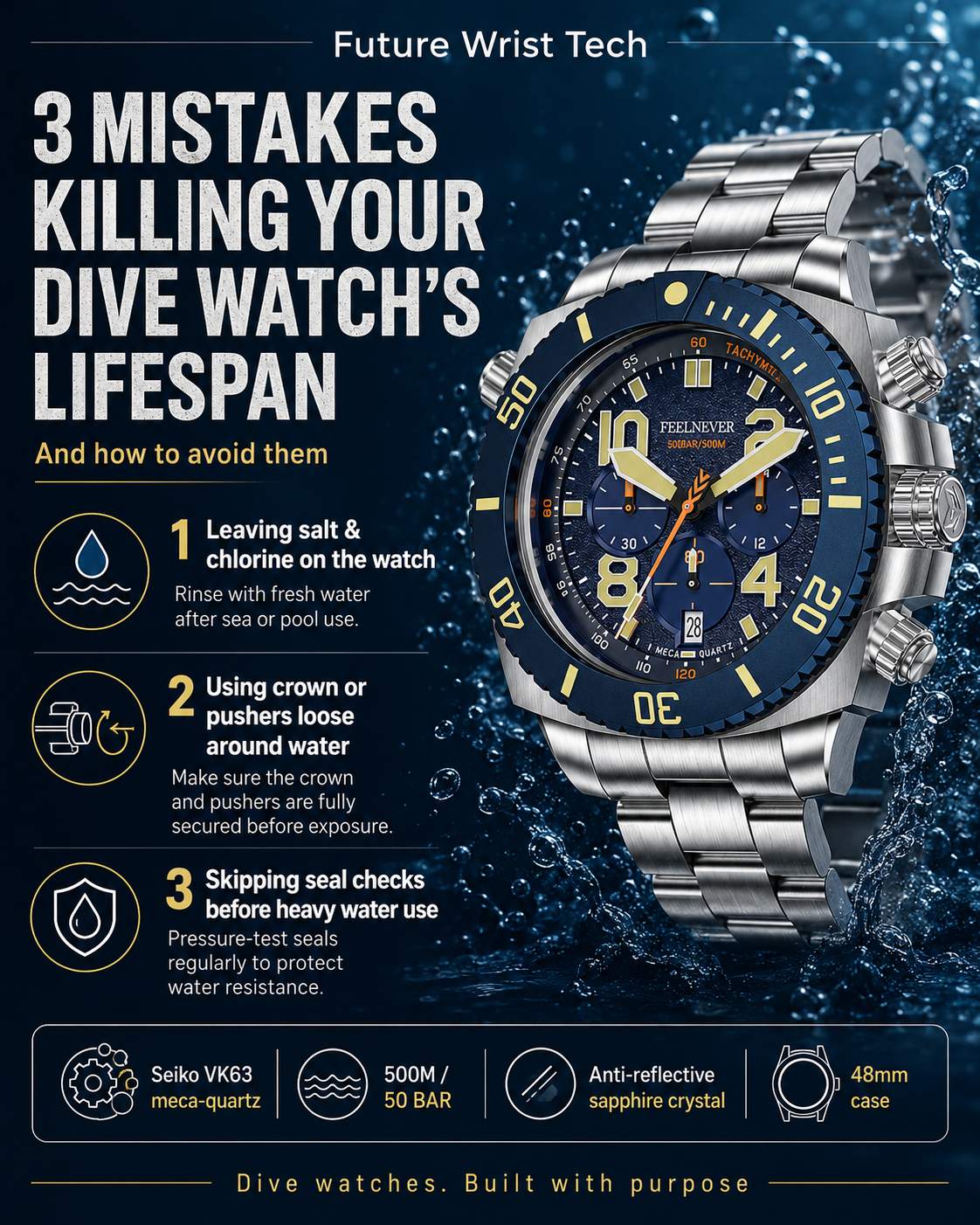
And no rating survives neglect. The whole system lives in rubber gaskets: rinse after salt, screw everything down before water, pressure-test every two to three years. A 500M case with a dead gasket is a 0M case. The check: rating stated in BAR, seals named, usage guidance published. Brands that expect the watch to get wet tell you how to keep it that way.
Myth 3: “Automatics Keep Better Time Than Quartz”
The most repeated myth in watches, and the units settle it instantly: automatic movements are specced in seconds per day, quartz in seconds per month. A crystal vibrating 32,768 times a second beats a spring-driven balance wheel every time — physics, not quality.
What the automatic’s premium actually buys is the machine: self-winding off your wrist, no battery ever, and a movement a watchmaker can rebuild for decades. Those are real reasons — the AbyssHeritage runs a Japanese mechanical automatic with perpetual auto-date and chrono function for exactly them. The check: buy quartz for precision, mechanical for independence, and walk away from anyone selling the automatic as the “accurate” choice.
The One-Watch Test
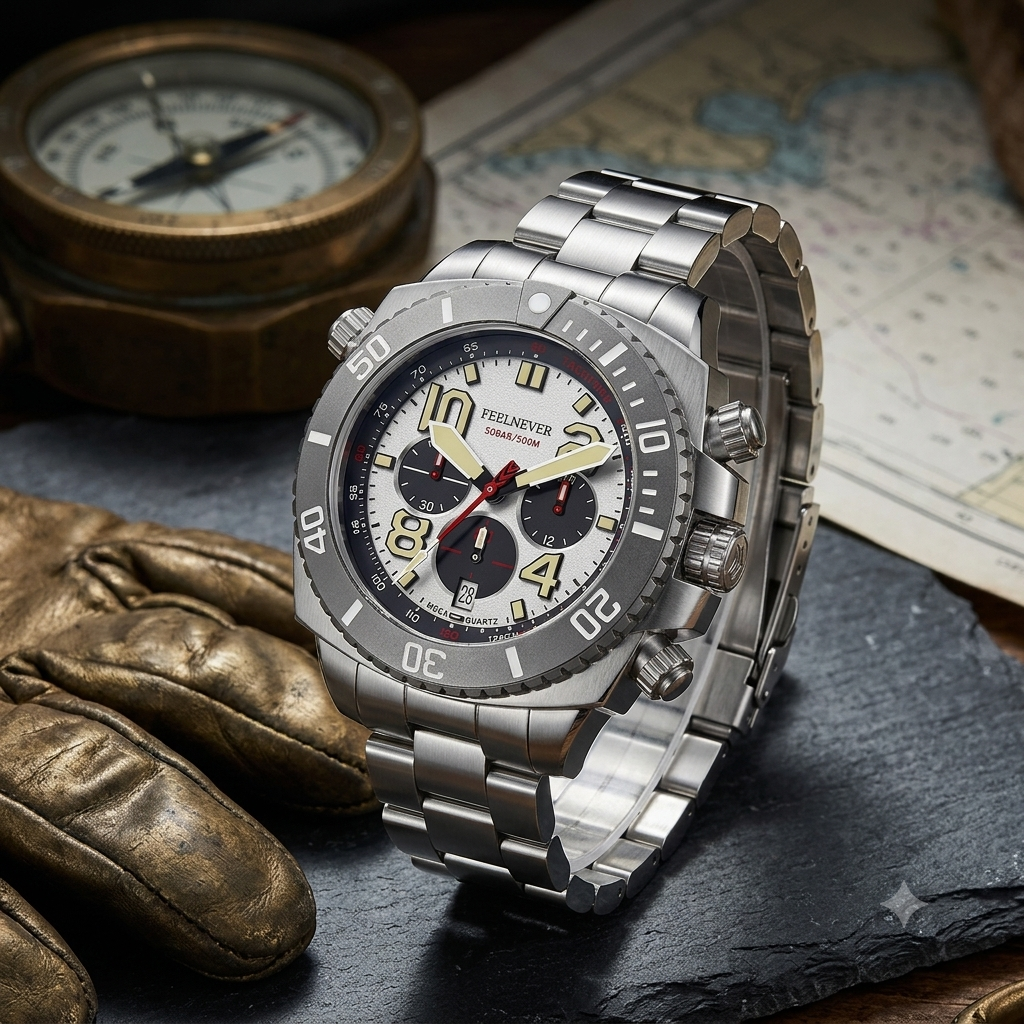
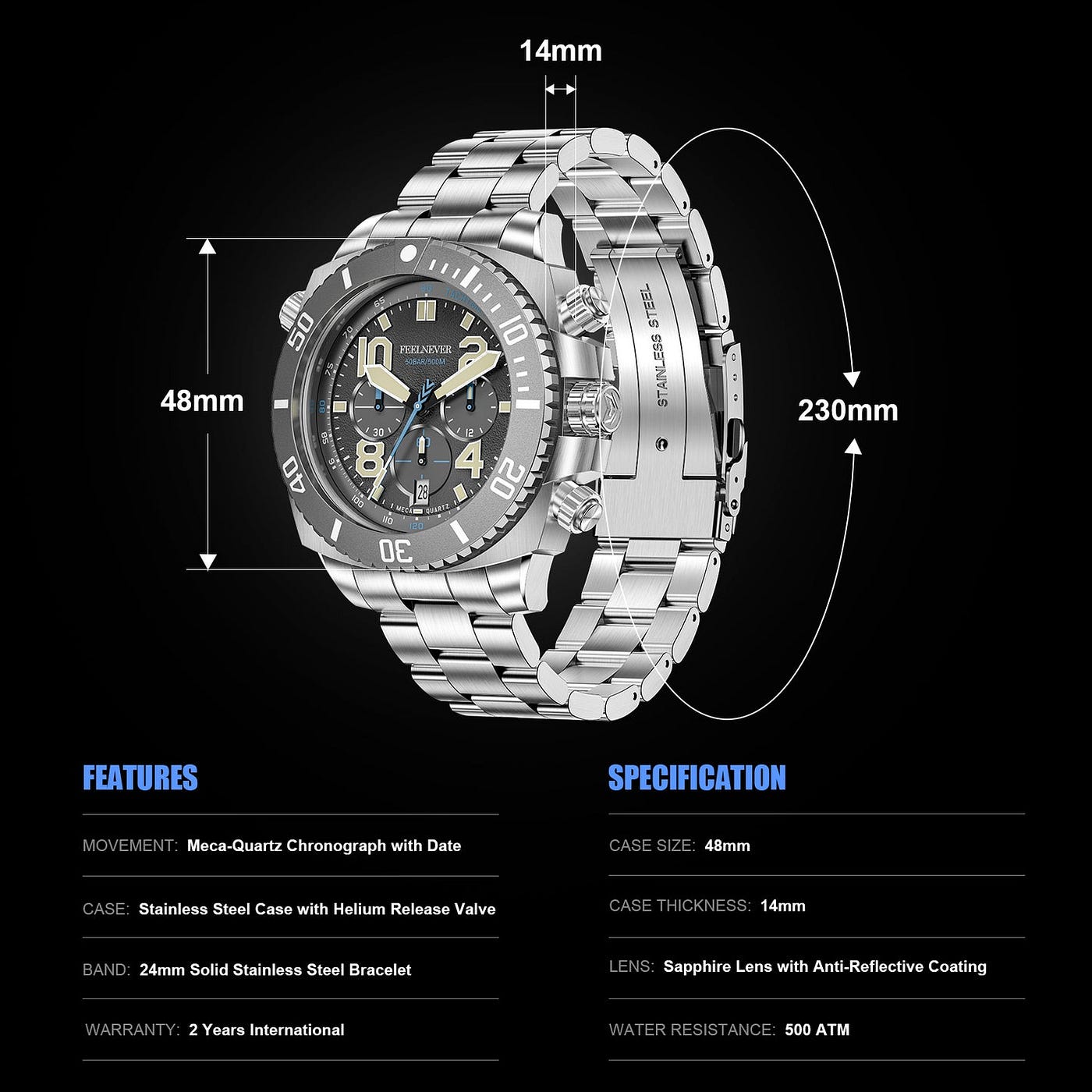
A recap earns its keep when you can hold it in one hand, so here’s all three truths in a single case. The AbyssHeritage 500M: sapphire crystal (myth one, answered on the spec sheet), a tested 500M rating in 47.5mm of 316L steel at 541 grams — the heaviest watch we make, with the gasket architecture to back the number (myth two), and a Japanese mechanical automatic sold for what it is: no battery, decades of service life, and honesty about the accuracy trade (myth three).
Not every buyer needs this watch. Every buyer needs a watch that can pass this reading.
What This Week Should Change About How You Shop
Recaps are only useful if something sticks, so here’s the behavioral version of everything above.
Before this week, the reasonable default was trusting signals: brand names, price points, diver styling, forum consensus. After it, your default is the document — the spec sheet — read with five specific questions. That shift sounds small. In practice it reorders the entire market in front of you: watches that looked equal separate instantly, some famous names get quieter, and a few unknown ones get very loud.
It also changes what your money rewards. Every spec-literate purchase tells the market that named calibers, stated ratings, and honest trade-offs are what sell — and that vagueness isn’t. Buyers built this category’s myths one credulous purchase at a time. They can unbuild them the same way.
The Five-Check Immune System
Run these on any dive watch listing, in order, sixty seconds total:
- Crystal named? Sapphire stated plainly, or mineral acknowledged with a reason.
- Rating in BAR or tested meters? “Water resistant” alone is a costume.
- Penetrations sealed? Screw-down crown always; screw-down pushers if it’s a chronograph.
- Movement identified by caliber? A named Japanese or Swiss caliber is checkable; “premium movement” is not.
- Care guidance published? Brands that explain rinsing and gasket service expect the watch to be used. Silence expects it to be photographed.
Five yeses and the myths have nothing left to grab. Any silence is your answer too.
Key Takeaways
- The crystal is checkable in one word on a spec sheet — and it’s where cheap builds hide their biggest cut
- Water resistance is a stress budget: real, margin-based, and alive only as long as the gaskets are
- Quartz wins accuracy always; mechanical wins independence and longevity — buy each for what it is
- Trade-offs stated plainly are engineering; trade-offs hidden are the myth’s home address
- Sixty seconds of spec-sheet literacy beats every piece of folklore in the category
Myths survive on invisible parts and silent listings — and after this week, neither works on you. To see this checklist run against real watches, our Top 6 Tested roundup of the best dive watches under $200 applies every check above, watch by watch: futurewristtech.com/blogs/news/best-dive-watches-under-200
And to read the full AbyssHeritage 500M sheet — sapphire, 500M, mechanical automatic, 541 grams of proof — click link in bio.
메타데이터
- post_id
- 3d77bc2a08f8
- slug
- dive-watch-myths-recap-sapphire-water-resistance-movement-3d77bc2a08f8
- url
- https://medium.com/@futurewristtech123/dive-watch-myths-recap-sapphire-water-resistance-movement-3d77bc2a08f8
- canonical_url
- https://medium.com/@futurewristtech123/dive-watch-myths-recap-sapphire-water-resistance-movement-3d77bc2a08f8
- author_url
- https://medium.com/@futurewristtech123
- status
- ok
- fetched_at
- 2026-07-16 19:47:57