AI Debt Recovery for Telecom & Utilities: How I Automated Customer Collections Workflows
A practical breakdown of how we designed an AI-powered debt recovery workflow to improve follow-up consistency, automate repetitive…
AI Debt Recovery for Telecom & Utilities: How I Automated Customer Collections Workflows
A practical breakdown of how we designed an AI-powered debt recovery workflow to improve follow-up consistency, automate repetitive outreach, and support telecom-style collections operations.
Debt recovery is usually treated as a calling problem.
But after working closely with telecom and utility-style recovery operations, one thing became clear:
The real challenge is consistency.
Most overdue customer payments are not lost because internal teams are not working hard enough.
They are lost because follow-up becomes inconsistent.
- Calls are missed.
- Customers become difficult to reach.
- Payment reminders happen too late.
- Internal teams become overloaded.
And eventually, recovery shifts from being proactive to reactive.
This operational challenge exists across telecom providers, utility companies, subscription businesses, and many customer-facing organizations managing recurring payments.
The bigger the customer base becomes, the harder it gets to maintain consistent outreach without endlessly increasing internal workload.
That raised an important question:
Could the debt recovery process itself be redesigned?
Not to remove human teams.
But to reduce repetitive work, improve follow-up consistency, and create a better operational workflow.
Recently, at Absolute Intelligence UK, we worked with a telecom / utility-style recovery operation to design and deploy an AI-powered debt recovery system focused on improving consistency across the recovery process.
The objective was straightforward:
- Reduce repetitive work
- Improve outreach consistency
- Help teams recover payments more efficiently
Most importantly:
This was never about replacing people.
It was about helping teams operate more effectively.
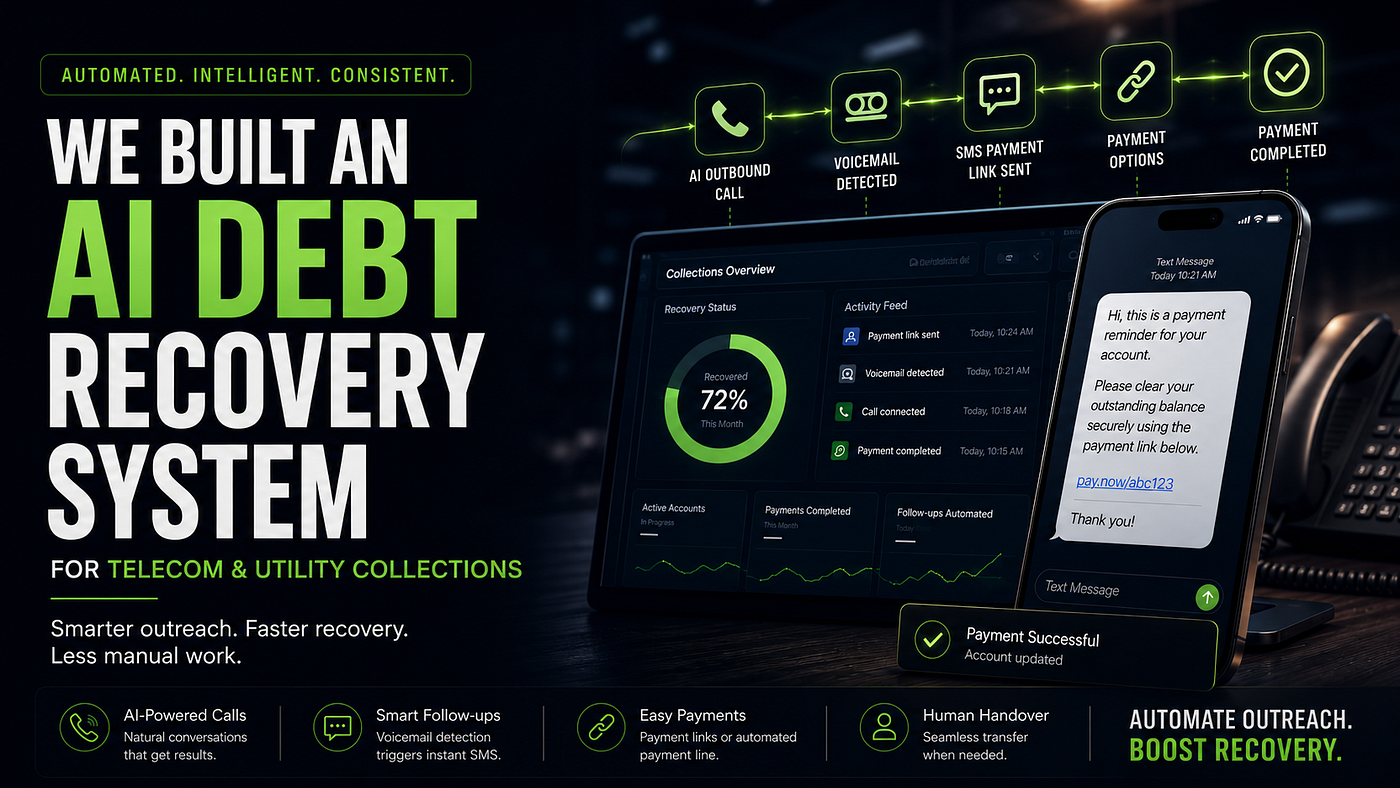
AI Debt Recovery for Telecom & Utilities
Why Traditional Debt Recovery Workflows Break Down
Many collections workflows still rely heavily on manual processes.
- Accounts become overdue.
- Teams export lists.
- Agents manually work through call queues.
- Customers miss calls.
- Voicemails go nowhere.
- Someone tries again later.
- Sometimes much later.
Over time, the problem compounds.
Even highly capable collections teams can only manage a limited number of meaningful outreach attempts each day.
But overdue balances continue growing regardless.
And this is where many recovery operations struggle.
The problem is not effort.
The problem is consistency.
Because when follow-up becomes inconsistent, recovery performance becomes inconsistent too.
A customer who misses a payment reminder today might not receive another meaningful touchpoint for days.
An unanswered call often becomes a delayed process.
Internal teams spend valuable time repeatedly chasing unreachable customers instead of focusing on cases that actually require human involvement.

For telecom and utility providers especially, this creates operational friction quickly.
- More accounts.
- More manual admin.
- More missed interactions.
- More pressure on internal teams.
Instead of simply asking:
“How do we make more recovery calls?”
We started asking:
“How do we redesign the recovery workflow itself?”
That became the foundation for the system.
What We Actually Built
Instead of building another disconnected collections tool, we designed a complete debt recovery workflow system.
The objective was simple:
Create a structured and repeatable recovery process while keeping human teams involved where they matter most.
At a high level, the system works like this:
- Overdue accounts enter the workflow
- Recovery outreach begins automatically
- Customer outcomes are understood and logged
- Missed calls trigger the next best action
- Customers are guided toward resolution
- Internal teams gain better visibility into recovery progress
The key idea was simple:
Recovery should not stop because a customer missed a call.
And repetitive outreach should not consume valuable internal resources.

How the AI Debt Recovery Workflow Works
Step 1: Overdue Accounts Enter the System
The process begins when overdue accounts enter the recovery workflow.
This can happen through existing billing systems, internal databases, or CRM environments.
Instead of teams manually assigning outreach, the workflow begins automatically.
This immediately reduces repetitive operational work.
No spreadsheets.
No manually assigning outreach lists.
No waiting for the next available agent.
The system begins the recovery process consistently.
Step 2: Recovery Outreach Begins
Customers receive a payment reminder interaction designed specifically for telecom and utility-style recovery communication.
This is an important distinction.
Debt recovery communication should not feel aggressive or robotic.
Customers may be:
- Confused about a bill
- Dealing with service-related concerns
- Experiencing financial difficulty
- Simply forgetting to make payment
The objective is not pressure.
The objective is resolution.
Communication is designed to feel:
- Professional
- Respectful
- Clear
- Resolution-focused
Customers are informed about outstanding balances and given straightforward next steps.
Step 3: The System Understands Outcomes
This is where the workflow becomes much more operationally useful.
Instead of simply making outreach attempts, the system understands what actually happened during the interaction.
For example, it can identify situations such as:
- Customer answered
- No answer detected
- Voicemail reached
- Wrong number
- Payment already completed
- Promise to pay later
- Billing issue or support request
- Human escalation required
Rather than requiring internal teams to manually update notes and decide what happens next, the workflow continues automatically.
Every outcome determines the next action.
And importantly:
- Every interaction becomes visible internally.
- No chasing updates.
- No disconnected systems.
- No uncertainty around customer status.
What Happens When Customers Do Not Answer?
One of the biggest weaknesses in traditional debt recovery workflows is what happens after a missed call.
Usually?
Nothing.
The customer misses the call.
Someone tries again later.
Or the account sits untouched until another manual outreach attempt happens.
We wanted to remove that friction.
So we designed the workflow to continue automatically.
If voicemail or no answer is detected, the process does not stop.
Instead, the system triggers the next best action automatically.
That could include:
- An SMS payment reminder
- A secure payment link
- Additional follow-up attempts
- A route toward support if needed
This small operational change has a much larger impact than it sounds.
Because missed calls are no longer dead ends.
The recovery process continues without relying entirely on manual follow-up.
For telecom and utility collections, this becomes particularly valuable.
Customer outreach improves.
Follow-up becomes more consistent.
And internal teams spend less time repeatedly attempting the same manual process.
Giving Customers More Ways To Resolve Payments
Another important decision we made:
We intentionally avoided over-automation.
Debt recovery is sensitive.
Customers are not always ready to pay immediately.
Some need clarification.
Some have billing disputes.
Some simply prefer different payment methods.
And some situations genuinely require human support.
So instead of forcing customers down a single path, we built flexibility into the workflow.
Depending on the situation, customers can choose between different resolution options.
1. Secure SMS Payment Links
For customers ready to pay immediately, the system can send a secure payment link directly to their phone.
Simple.
Low friction.
Fast resolution.
No waiting in call queues.
No unnecessary delays.
2. Automated Payment Line
Some customers prefer resolving payment directly over the phone.
For those situations, the workflow can route customers into an automated payment experience.
This helps reduce friction while allowing customers to complete the process in a way that feels familiar.
3. Human Collections or Support Teams
And importantly:
Humans remain part of the process.
If a customer:
- Has a dispute
- Needs account clarification
- Wants support
- Requires escalation
The workflow routes them to the appropriate internal team.
Because not every interaction should be automated.
The repetitive work?
Yes.
Sensitive situations?
Not always.
That balance turned out to be one of the most important parts of the deployment.
Better Operational Visibility Without More Admin Work
One of the less obvious benefits came internally.
Collections teams often spend a surprising amount of time updating notes, tracking customer outcomes, and understanding account status.
We wanted to reduce that operational overhead.
So recovery interactions can be connected back into CRM systems, dashboards, and internal reporting environments.
That gives teams visibility into:
- Call outcomes
- Payment progress
- Promise-to-pay responses
- Escalations
- Customer support requests
- Follow-up actions
Without teams manually chasing information across multiple systems.
The result is straightforward:
Less repetitive admin.
Better visibility.
More operational clarity.
The Operational Impact of Automating Recovery Workflows
The biggest operational improvement was consistency.
Instead of internal teams manually chasing overdue accounts throughout the day, outreach becomes structured and repeatable.
And operationally, that changes quite a lot.
The result:
✅ Faster follow-ups ✅ More consistent outreach ✅ Fewer missed recovery opportunities ✅ Reduced repetitive admin work ✅ Better visibility into customer outcomes ✅ Human teams focused on meaningful conversations instead of repetitive chasing

The outcome was not simply more outreach.
It was more consistent recovery without endlessly increasing operational overhead.
And for businesses managing large volumes of customer accounts, that difference matters.
Where This Recovery Model Works Beyond Telecom & Utilities
Although we designed this for a telecom / utility-style recovery operation, the same operational challenge exists across many industries.
For example:
- Utilities providers
- Broadband companies
- Subscription businesses
- Membership organizations
- Financial service providers
- Insurance businesses
- Debt recovery agencies
Anywhere customer follow-up becomes repetitive, difficult to scale, or operationally heavy.
Because eventually, every business faces the same question:
How do you improve consistency without endlessly increasing internal workload?
That is where systems like this become interesting.
Not because they replace people.
But because they help teams operate better.
Final Thoughts
One thing this project reinforced for me:
Most operational problems are not people problems.
They are process problems.
And in collections, consistency matters.
The challenge is not simply making more calls.
It is creating a system that follows up reliably, handles missed interactions properly, gives customers clear next steps, and allows internal teams to focus where human conversations actually matter.
That is what we set out to build here.
Not another disconnected tool.
A practical operational system designed around real recovery environments.
The companies seeing the biggest gains from automation are not replacing people.
They are redesigning repetitive operational workflows.
And debt recovery is one area where that shift is becoming increasingly difficult to ignore.
Interested in Building Something Similar?
This was built as a real operational deployment — not a demo.
If you are exploring ways to improve customer recovery, automate repetitive outreach, or redesign operational workflows, I’m always happy to talk through your use case and share what we have learned building systems like this.
📧 **bishal@absoluteintelligenceuk.com**
📋 Project Assessment / Discovery Call https://portal.absoluteintelligenceuk.com/onboarding
메타데이터
- post_id
- 3d892e6f112f
- slug
- ai-debt-recovery-for-telecom-utilities-how-i-automated-customer-collections-workflows-3d892e6f112f
- url
- https://medium.com/@bishal_paul_/ai-debt-recovery-for-telecom-utilities-how-i-automated-customer-collections-workflows-3d892e6f112f
- canonical_url
- https://medium.com/@bishal_paul_/ai-debt-recovery-for-telecom-utilities-how-i-automated-customer-collections-workflows-3d892e6f112f
- author_url
- https://medium.com/@bishal_paul_
- status
- ok
- fetched_at
- 2026-06-17 13:50:26





