The Omega-3 Mistake a Lot of “Plant-Based” Articles Still Make
If you want to understand vegan omega-3s, algae oil, DHA, and EPA without the usual confusion, start here.
The Omega-3 Mistake a Lot of “Plant-Based” Articles Still Make
If you want to understand vegan omega-3s, algae oil, DHA, and EPA without the usual confusion, start here.
A lot of omega-3 advice sounds clear until you try to use it.
You read that flax is a good source of omega-3s. You hear that chia seeds matter. Then you see people talking about DHA, EPA, fish oil, algae oil, brain health, eye health, and “plant-based omega-3s” like it is all one conversation.
It is not.
That is the mistake.
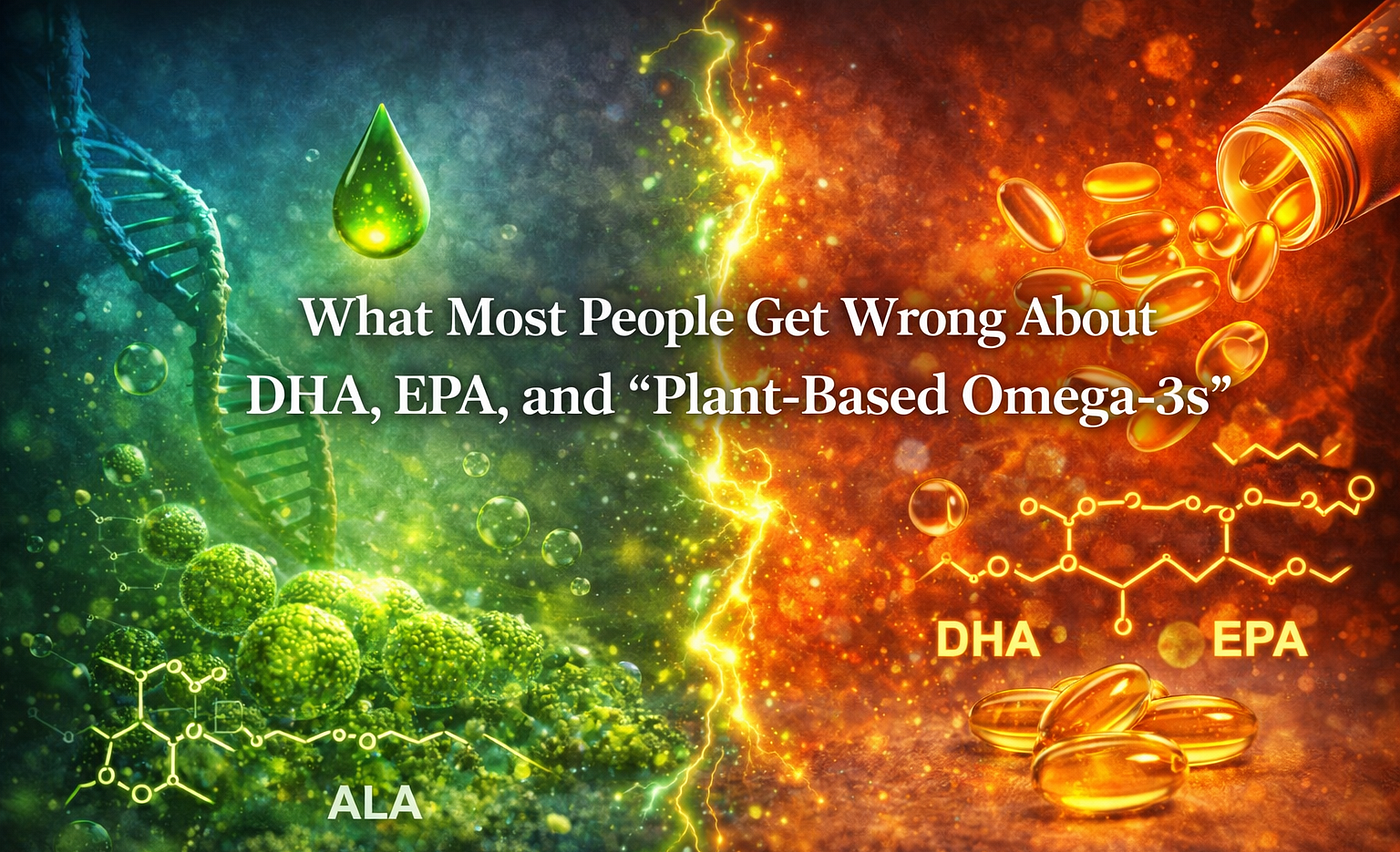
A lot of people hear “plant-based omega-3” and assume they are automatically getting the same thing someone means when they talk about DHA and EPA. But the National Institutes of Health draws a much sharper line than that. ALA, the omega-3 found in plant oils like flax, soybean, and canola, is different from DHA and EPA. And while the body can convert some ALA into EPA and then DHA, that conversion is very limited, with reported rates of less than 15%. The NIH goes even further and says that consuming EPA and DHA directly from foods or supplements is the only practical way to raise levels of those fatty acids in the body. (Office of Dietary Supplements)
That one distinction clears up most of the confusion.
The short version
If you are eating flax, chia, walnuts, or other ALA-rich foods, that is not the same thing as using a direct-source DHA product.
Those foods still matter. But they are not solving the exact same problem.
If your real goal is direct DHA support, especially as part of a vegan or vegetarian routine, then algae oil belongs in a different category from generic “plant-based omega-3” talk. The NIH notes that DHA and EPA are originally synthesized by microalgae at the base of the marine food chain, and fish accumulate them from there. That means algae oil is not some distant replacement for fish oil. It is a direct marine-source option. (Office of Dietary Supplements)
Why this topic gets explained badly so often
Most articles flatten everything into one big omega-3 bucket because that is easier to write.
But it is not very helpful.
Once you start using the term “plant-based omega-3” loosely, you end up merging:
- ALA from foods like flax and chia
- direct algae-based DHA products
- broader vegan supplement questions
- fish-oil alternative discussions
That makes the whole category harder to understand than it needs to be.
A better question is much simpler:
Which omega-3 am I actually trying to get?
That question is where things get clearer fast.
ALA, DHA, and EPA are not interchangeable
This is the part most readers need, but not enough articles say plainly.
ALA is an omega-3. DHA is an omega-3. EPA is an omega-3.
But that does not mean they are interchangeable in practice.
The NIH’s health professional fact sheet separates them clearly. ALA is found in plant oils. DHA and EPA are present in fish, fish oils, krill oils, and algal oil products. Since ALA conversion is limited, you cannot just assume that “some omega-3” means “the same omega-3 outcome.” (Office of Dietary Supplements)
That is why so many people think they are covering the same ground when they really are not.
Why this matters for vegan omega-3 buyers
If you are vegan or vegetarian, this distinction matters even more.
A lot of plant-based eaters are already doing many things right. They are eating nutrient-dense foods, thinking more carefully about ingredients, and avoiding low-quality shortcuts. But if the goal is direct DHA support, then “plant-based” by itself is not a complete answer.
That is why algae oil is such an important category.
It gives vegan and vegetarian buyers a direct-source route to DHA, instead of asking them to rely on the body to convert ALA in meaningful amounts. The NIH also notes that algal oil products are part of the supplement landscape for long-chain omega-3s, not some fringe exception. (Office of Dietary Supplements)
What most people should do with this information
Not panic.
And not swing all the way into thinking flax, chia, or walnuts are suddenly useless. That would be the wrong takeaway.
The better takeaway is this:
Healthy foods and direct-source supplements are not always trying to do the exact same job.
ALA-rich foods can still belong in a healthy routine.
But if what you actually want is direct DHA, then it makes sense to look at a product that is built around direct DHA.
That is where this stops being a nutrition vocabulary problem and starts becoming a product-selection problem.
What I would look for in an algae-based DHA product
This is where a lot of reviews stay vague. I think the better approach is to ask a few practical questions.
First, how much DHA does the product actually provide?
Second, does the company explain the source clearly, or does it just say “algae oil” and move on?
Third, is there any meaningful detail about the extraction or process?
Fourth, is there concrete testing language?
Fifth, does the product feel easy to justify as part of a real routine?
Those questions matter more than big category claims.
That is also the same logic behind **The Intentional Wellness Blueprint**. It is not about chasing more products. It is about making fewer, clearer decisions that actually hold up over time.
Why Ascent Nutrition’s Algae Oil DHA fits this conversation so well
If you read all of this and think, “Okay, I do not want vague plant-omega-3 language, I want a direct-source DHA product that is easier to understand,” then **Ascent Nutrition’s Algae Oil DHA** is a very natural example of what that looks like.
What makes it stand out is not just that it is algae oil.
It is that the current product page actually gives you real things to evaluate.
Ascent says the product uses a specific wild-strain of algae, is uniquely water extracted, and is third-party tested for microbial analysis and heavy metals. The same product page also shows two variants: the standard Algae Oil DHA Omega-3’s — Vegan and Vegetarian, 1000 mg and Algae Oil DHA with Organic cold-pressed Lemon peel oil, 1000 mg. It also states that one dropper equals 1 mL and provides 1,000 mg of DHA, with a suggested use of 1 to 2 droppers per day. (Ascent Nutrition)
That is the kind of product detail that makes a decision easier to make well.
The standard version vs the lemon version
This is one small detail, but I think it matters.
A lot of supplement categories force buyers into a hard jump between one product and a completely different product. Here, the two options live inside the same product family.
The standard version is the cleaner straight-line choice for someone who wants the simplest direct-DHA answer.
The lemon version makes sense for someone who likes the same core logic but prefers the added organic cold-pressed lemon peel oil option shown on the product page. (Ascent Nutrition)
That keeps the choice simple without making it feel one-note.
Why this is more useful than another generic “best vegan omega-3” list
Roundups can be helpful. But a lot of them blur together.
They often compare products without first fixing the core misunderstanding. And if the reader is still confused about ALA vs DHA and EPA, then even a decent list may not help them much.
That is why I think this framing works better:
Start with the misunderstanding. Clarify the forms. Then show the reader what a more direct DHA option actually looks like.
That makes the product recommendation feel earned instead of inserted.
A better way to think about the whole category
Here is the simplest way I know to say it.
If you are talking about flax, chia, and walnuts, you are talking about one kind of omega-3 conversation.
If you are talking about direct DHA and EPA support, you are talking about another.
Both matter.
But they are not interchangeable.
That is the distinction a lot of articles skip, and it is exactly why so many people still walk away from omega-3 content more confused than when they started.
FAQ
Are DHA and EPA the same as plant-based omega-3s?
Not always. “Plant-based omega-3” often refers to ALA-rich foods, while DHA and EPA are different omega-3s found in fish, seafood, and algal oil products. (Office of Dietary Supplements)
Is flax oil enough for DHA?
Flax oil provides ALA, not DHA directly. The NIH says conversion from ALA into EPA and DHA is very limited. (Office of Dietary Supplements)
Why does algae oil matter for vegans?
Because algae oil is a direct marine-source option for DHA, rather than relying only on ALA conversion. (Office of Dietary Supplements)
Is Ascent Nutrition’s Algae Oil DHA vegan?
The product page presents it as Algae Oil DHA Omega-3’s — Vegan and Vegetarian, 1000 mg, with a lemon variant also shown on the same page. (Ascent Nutrition)
Is there a discount code for Ascent Nutrition’s Algae Oil DHA?
If you decide to order, ZANE10 can be used for 10% off.
Final takeaway
What most people get wrong is not caring about omega-3s.
It is assuming the whole category means one thing.
It does not.
ALA, DHA, and EPA are all omega-3s, but they are not interchangeable in practice. The NIH is clear that ALA conversion into EPA and DHA is very limited, and that consuming EPA and DHA directly is the only practical way to increase levels of those fatty acids in the body. (Office of Dietary Supplements)
That is why algae oil matters so much in this conversation, especially for vegan and vegetarian buyers.
And that is why **Ascent Nutrition’s Algae Oil DHA and its lemon variant fit this topic so well. They offer a more direct DHA route, clearer product details, and a product page that actually gives you something to evaluate. If you want extra context, the [Ascent Nutrition reviews page](https://goascentnutrition.com/pages/reviews?_pos=1&_psq=reviews&_ss=e&_v=1.0&sca_ref=4340282.bwMQinSTso) is worth checking too, and ZANE10** can be used for 10% off. (Ascent Nutrition)
Disclosure: some product links may provide me compensation if you choose to order.
메타데이터
- post_id
- 3d8a762ca162
- slug
- the-omega-3-mistake-a-lot-of-plant-based-articles-still-make-3d8a762ca162
- url
- https://medium.com/@Zane369/the-omega-3-mistake-a-lot-of-plant-based-articles-still-make-3d8a762ca162
- canonical_url
- https://medium.com/@Zane369/the-omega-3-mistake-a-lot-of-plant-based-articles-still-make-3d8a762ca162
- author_url
- https://medium.com/@Zane369
- status
- ok
- fetched_at
- 2026-06-10 18:44:10