Energy Systems Have an Achilles Heel. CTMP Just Cut It Off.
Let me address something almost nobody in the energy conversation talks about.
Energy Systems Have an Achilles Heel. CTMP Just Cut It Off.
Let me address something almost nobody in the energy conversation talks about.
Every energy system humanity has ever built has a vulnerability.
Cut the fuel supply line. Bomb the storage facility. Blockade the shipping lane. Sanction the exporting nation. Destroy the above-ground infrastructure.
We saw it in 2022 when Russian gas pipelines became instruments of geopolitical coercion overnight. We see it whenever oil transit is threatened at maritime chokepoints. We see it every time a pipeline is sabotaged, a refinery is struck, a coal shipment is delayed, or exposed generation infrastructure is taken offline by war or weather.
Every conventional energy system has an Achilles heel.
CTMP is different.
Not because it is magical. Not because it is literally untouchable. Because its vulnerability profile is fundamentally different from the systems that came before it.
Here is why.
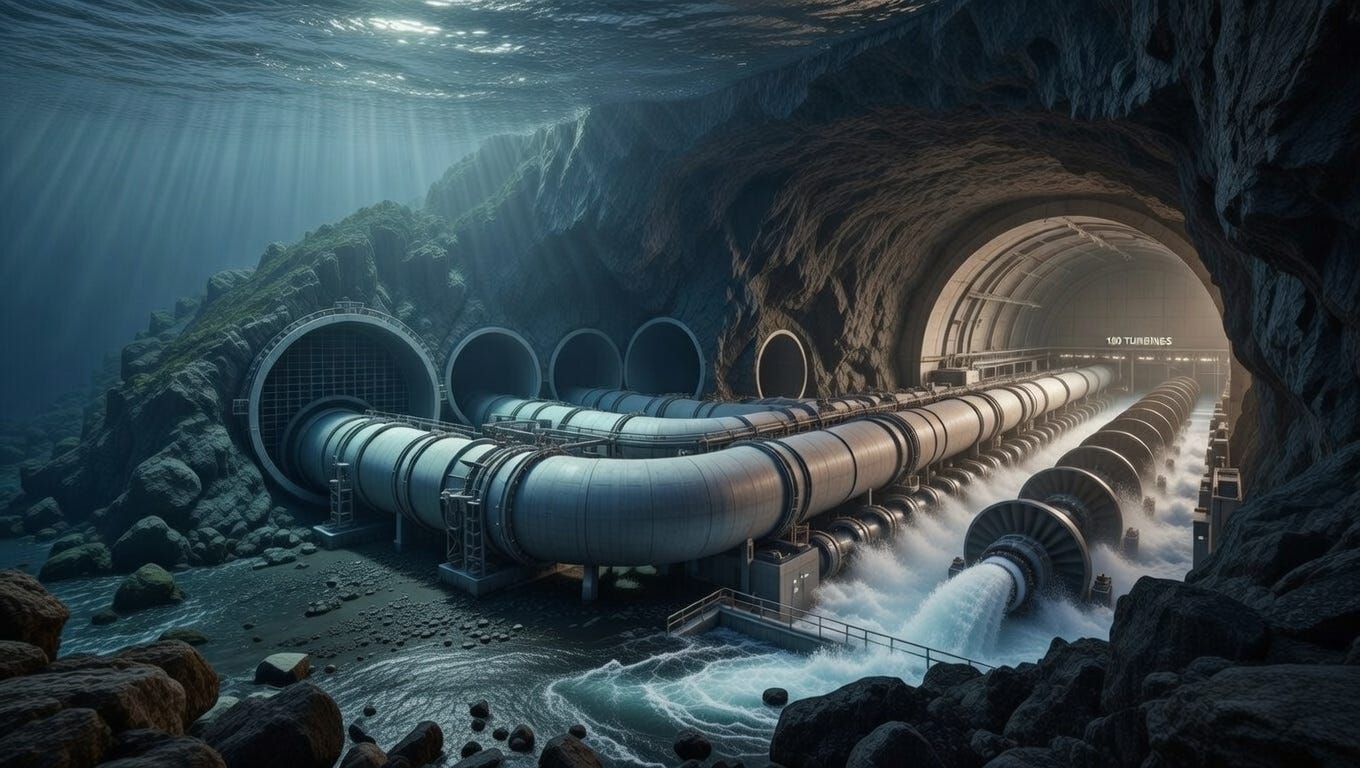
The ocean intake can be placed on the seafloor. That makes it far harder to identify, access, and target than exposed intake or fuel infrastructure.
The tunnels are bored through solid rock, potentially hundreds of meters underground. The same engineering logic that makes deep underground facilities among the hardest targets on Earth applies here: depth, rock cover, and subsurface dispersal.
The turbine caverns are deep subsurface. Minimal visible signature. Minimal exposed footprint. Little to target from the air compared with conventional surface generation.
The penstocks are underground, lined, pressurized, and encased within rock. They are not easy targets. An attacker would first have to locate them, then reach them, then generate enough effect at depth to disable them.
Most importantly, there is no fuel supply line to cut.
There is no tanker route to interdict. There is no fuel storage farm to ignite. There is no dependency on imported hydrocarbons. There is no export cartel that can withhold the primary energy input. There is no sanction regime that can suspend gravity or embargo ocean water.
Compare that with the vulnerability profile of conventional systems.
Solar farms are visible, surface-level, and distributed across exposed acreage. Destroy the panels and generation stops.
Wind farms are above ground, identifiable, and physically reachable.
Gas plants depend on fuel delivery before the plant itself is even considered.
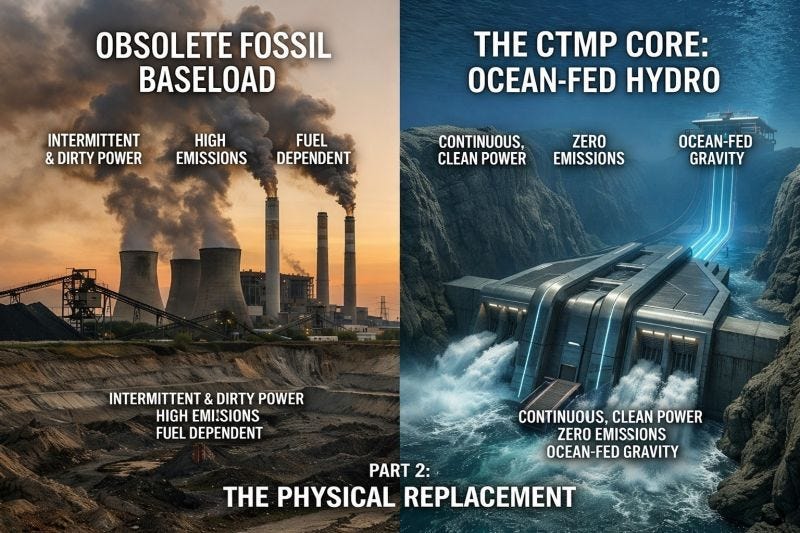
Coal plants rely on stockpiles, conveyors, rail, port access, and extensive exposed infrastructure.
Even HVDC systems, for all their value, still depend on known converter stations and other surface assets.
CTMP’s vulnerability profile is therefore closer to hardened subterranean infrastructure than to a conventional power plant.
That does not mean invulnerable. It means far harder to coerce, blockade, disable, or hold at risk through the classic methods used against modern energy systems.
And there is a second dimension beyond the physical.
The moment a module is operational and delivering free water to 100 million people, attacking it is no longer just an attack on an energy asset. It is an attack on a civilian life-support system with immediate, visible humanitarian consequences.
That matters.
The governance architecture makes that deterrent structural, not rhetorical.
The Sovereign Logic Engine records every cubic meter of free water delivered to every citizen of the host nation in real time. The record is public, auditable, and immutable.
Any actor who destroys the facility is not merely damaging infrastructure. It is interrupting the life-support flow of a civilian population at a scale that can be measured, counted, and seen by the world in real time.
That does not make attack impossible. It makes the political, legal, and moral cost of attack dramatically higher.
Which means CTMP is not merely engineered to withstand physical disruption better than conventional energy infrastructure.
It is engineered so that both the physical attack path and the political attack path become far more difficult.
No fuel line to cut. No shipment route to blockade. No exposed strategic dependency to sanction. No primary energy source controlled by any state, cartel, military, or market.
CTMP is not invulnerable.
It is something more credible and more important:
An energy and water system designed to deny the classic attack paths that have defined energy insecurity for the modern world.
Not because walls were built around it. Because the core works are buried in the earth and driven by forces that no government can embargo, no cartel can ration, and no navy can escort.
Physics does not negotiate. The ocean does not take sides.
메타데이터
- post_id
- 3d9012e81349
- slug
- energy-systems-have-an-achilles-heel-ctmp-just-cut-it-off-3d9012e81349
- url
- https://medium.com/@chris_16327/energy-systems-have-an-achilles-heel-ctmp-just-cut-it-off-3d9012e81349
- canonical_url
- https://medium.com/@chris_16327/energy-systems-have-an-achilles-heel-ctmp-just-cut-it-off-3d9012e81349
- author_url
- https://medium.com/@chris_16327
- status
- ok
- fetched_at
- 2026-07-13 06:23:13