UNDERSTANDING OF 7 LAYERS OF OSI MODEL
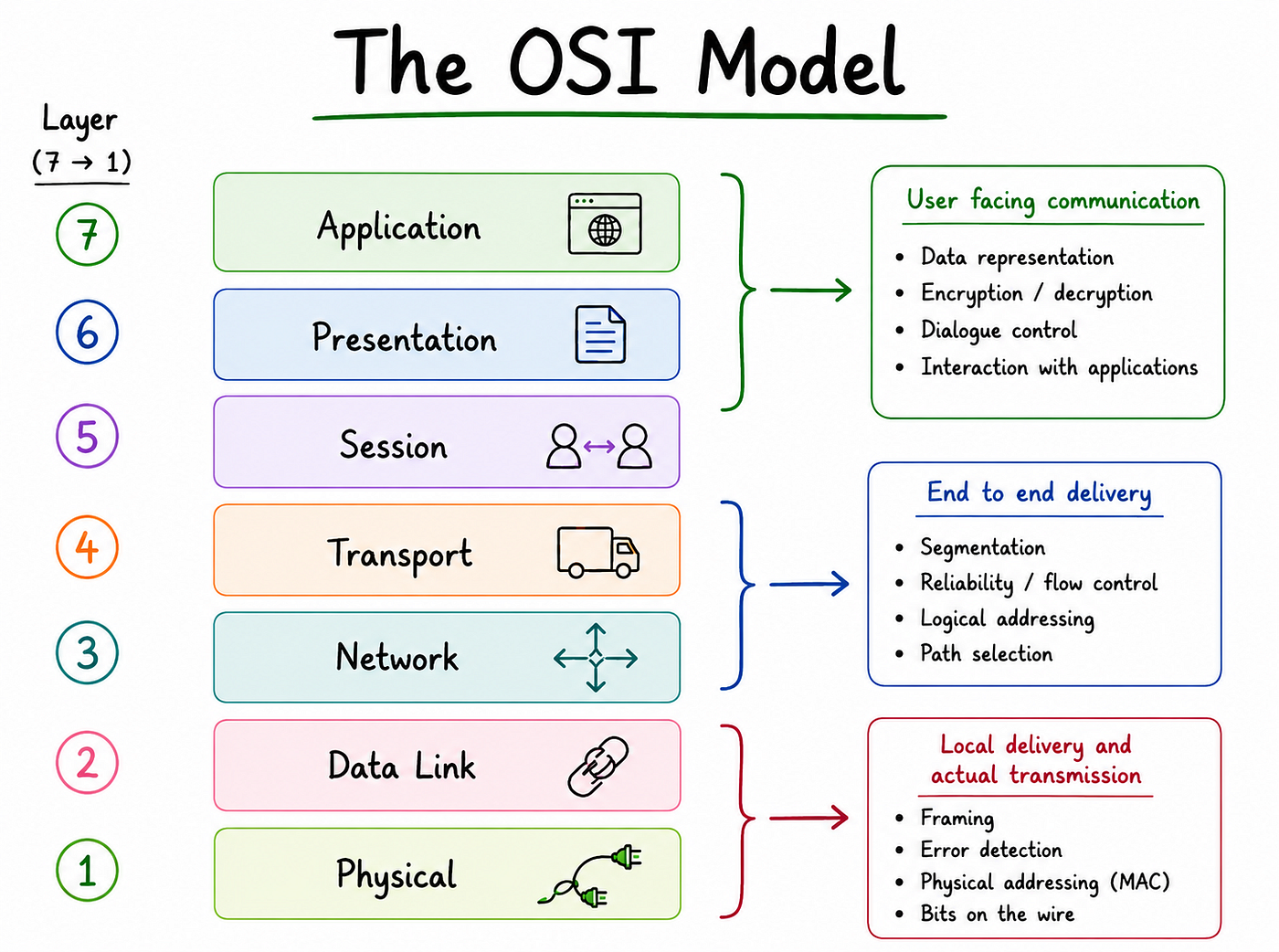
1. Upper 3 Layers — Application-Level Communication
UNDERSTANDING OF 7 LAYERS OF OSI MODEL
1. Upper 3 Layers — Application-Level Communication
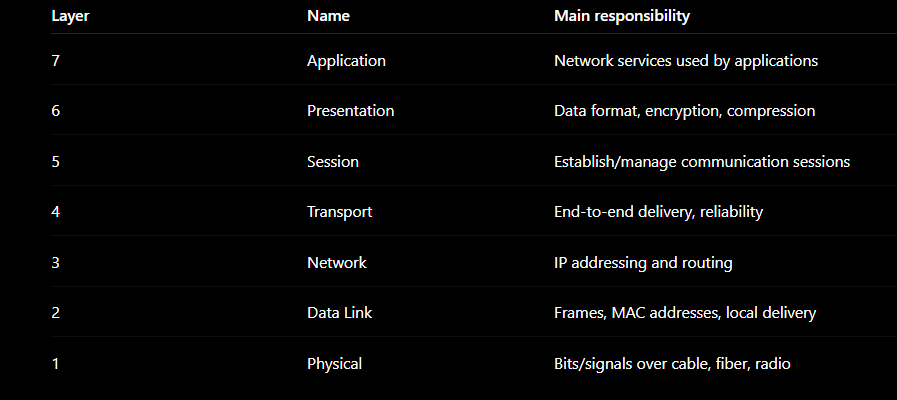
Layer 7 — Application
The Application layer provides network services to applications.
For example, when a browser wants to communicate with a web server, it can use HTTP/HTTPS.
Browser
   ↓
HTTP Request
   ↓
Application Layer
Examples of application-layer protocols include:
- HTTP/HTTPS
- DNS
- SMTP
- FTP
Layer 6 — Presentation
The Presentation layer is responsible for how data is represented.
Its common responsibilities include:
- Data translation/format conversion
- Encryption and decryption
- Compression and decompression
For example:
Application Data
       ↓
Presentation
       ↓
Encode / Encrypt / Compress
       ↓
Transport
So we can think of the Presentation layer as:
“How should the data be represented, secured, or compressed?”
Layer 5 — Session
The Session layer is responsible for establishing, managing, and terminating communication sessions between applications.
Think of it as managing a conversation:
Client Server ←── Establish Session ──→
←──── Communication ─────→
←──── Communication ─────→
←── Terminate Session ──→It can also provide synchronization and checkpoints during long communications.
Upper 3 in simple terms
Application → What service do I need? Presentation → How should the data be represented? Session → How should the communication session be managed?
2. Middle 2 Layers — Host-to-Host Communication
The Transport and Network layers are responsible for communication between hosts, but they have different responsibilities.
Layer 4 — Transport
The Transport layer provides end-to-end communication between applications running on different hosts.
TCP provides features such as:
- Reliable delivery
- Retransmission of lost data
- Flow control
- Congestion control
- Port numbers for identifying applications
For example, if TCP detects that some data was lost, it can request/retransmit that data.
So:
Transport = End-to-end delivery
Layer 3 — Network
The Network layer is responsible for host-to-host delivery and routing.
Its main responsibilities include:
- Logical addressing using IP addresses
- Routing packets
- Forwarding packets through routers
For example:
Your Computer
      ↓
Router
      ↓
ISP Router
      ↓
Internet
      ↓
Server
Routers examine the destination IP address and forward packets toward the destination.
So:
Network = Routing and host-to-host packet delivery
Important distinction
Don’t confuse Transport and Network:
Transport → reliable end-to-end delivery Network → routing packets between networks
The Transport layer does not choose the path. The Network layer handles routing.
3. Lower 2 Layers — Node-to-Node / Local Delivery
The Data Link and Physical layers deal with communication over the local link.
Layer 2 — Data Link
The Data Link layer handles node-to-node delivery over a local network/link.
Its responsibilities include:
- Frames
- MAC addresses
- Local delivery
- Error detection
- Access to the transmission medium
For example:
Laptop → Wi-Fi RouterThe communication between directly connected nodes is handled using the appropriate link-layer technology, such as Wi-Fi or Ethernet.
Layer 1 — Physical
The Physical layer deals with the actual transmission of bits.
It converts bits into physical signals such as:
- Electrical signals
- Radio signals
- Optical signals
For example:
Bits
 ↓
Physical signals
 ↓
Cable / Fiber / Radio
So:
Physical = transmitting raw bits through the physical medium
메타데이터
- post_id
- 3da2be00d115
- slug
- understanding-of-7-layers-of-osi-model-3da2be00d115
- url
- https://medium.com/@hari2612007/understanding-of-7-layers-of-osi-model-3da2be00d115
- canonical_url
- https://medium.com/@hari2612007/understanding-of-7-layers-of-osi-model-3da2be00d115
- author_url
- https://medium.com/@hari2612007
- status
- ok
- fetched_at
- 2026-08-23 21:42:59