Son of Saul : The Rejection of Holocaust Aestheticization and Hollywood Tropes
There have been countless films about the Holocaust, and I don’t think any of them can ever fully capture the scale of what actually…
Son of Saul : The Rejection of Holocaust Aestheticization and Hollywood Tropes
There have been countless films about the Holocaust, and I don’t think any of them can ever fully capture the scale of what actually happened. The real atrocities are simply too immense, too horrifying, and too deeply human to fit neatly within the boundaries of a film. Still, cinema continues to return to this history, trying to find new ways of understanding something that often feels impossible to understand. For a long time, many Holocaust stories have been told through familiar narrative frameworks such as sweeping portrayals of survival, clear distinctions between good and evil, and emotional journeys designed to leave audiences devastated but ultimately reassured. That’s often the Hollywood approach, and to be fair, some of those films are genuinely powerful. But after a while, those conventions can start to feel almost expected. You know where the emotional beats will land. You know when the music will swell. You know when the film wants you to cry. Set within the claustrophobic confines of Auschwitz-Birkenau, the film locks its camera entirely onto Saul Ausländer, a Hungarian prisoner forced to work in the Sonderkommando. Director László Nemes shoots the entire nightmare in a narrow, boxy 4:3 aspect ratio with a razor-thin depth of field — meaning the horrors around Saul are constantly blurred, existing only as a chaotic smear of shapes and muffled screams. There’s a striking defiance to Son of Saul as it completely detours from the familiar landscape of historical dramas, giving us something far more unsettling and raw.
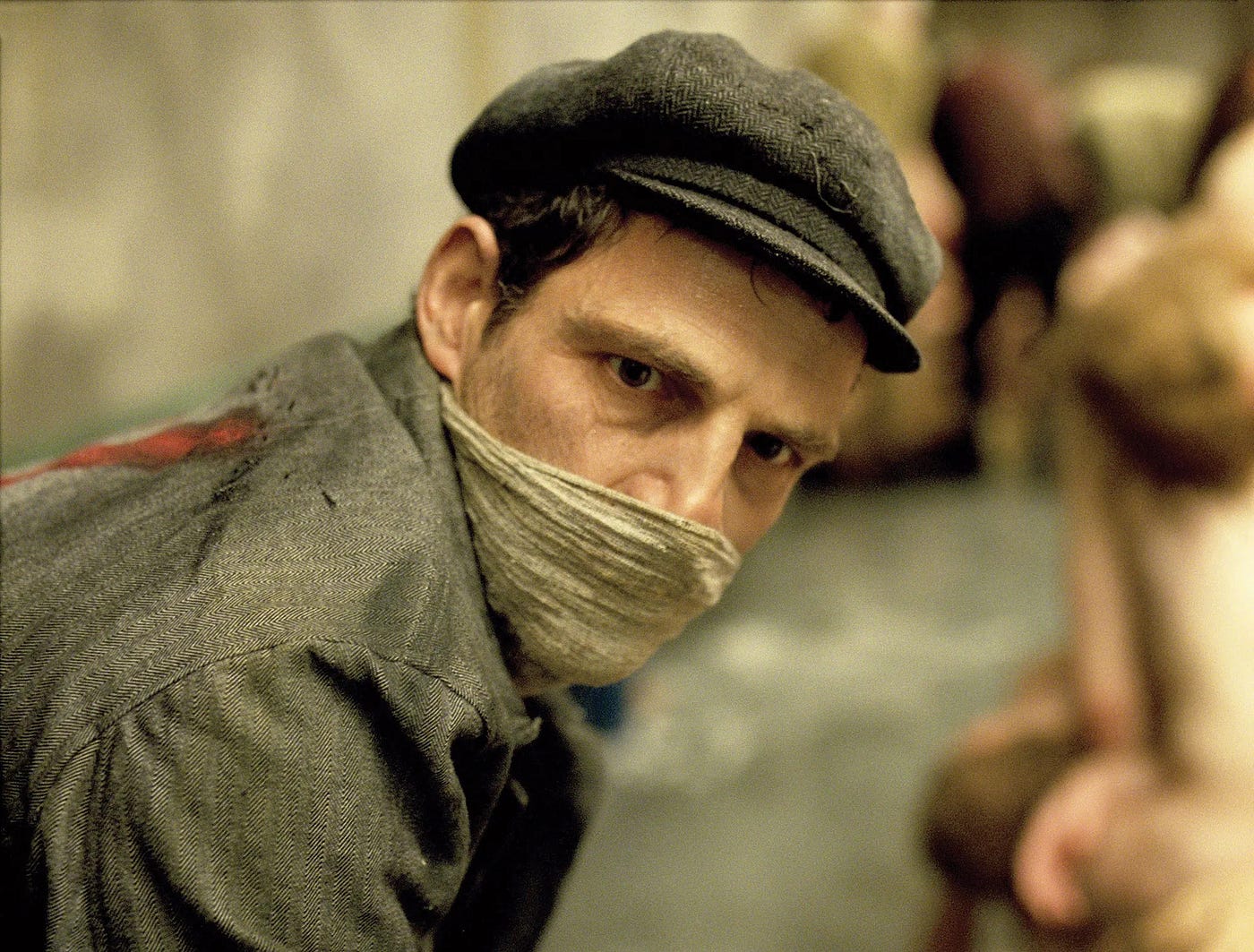
Son of Saul (2015), directed by László Nemes
To truly understand the radical nature of Son of Saul, one must look at how deliberately director László Nemes systematically strips away the comforting mythologies embedded in traditional Holocaust cinema. So many films about concentration camps fall into what critics often call the trap of aestheticization, where unimaginable suffering is transformed into something visually striking and emotionally digestible. Even when those films are made with the best intentions, there is always the risk that horror becomes too neatly packaged for an audience to consume. Nemes seems acutely aware of this danger, and Son of Saul feels like a direct rejection of it. Rather than embracing the familiar visual language of Holocaust films, he dismantles it piece by piece. For decades, cinema has relied on a recognizable set of images to evoke the Holocaust: barbed-wire fences stretching across bleak landscapes, smoke drifting from crematorium chimneys, or prisoners passing beneath the cruel Arbeit macht frei (“Work Sets You Free”) gates. These images remain powerful, but they have also become so ingrained in popular culture that they can sometimes function as cinematic shorthand. We recognize them instantly, yet that familiarity can create a certain distance from the reality they represent. Yet, Son of Saul refuses that distance. There are no sweeping wide shots inviting us to contemplate the camp from afar, no carefully composed images that transform tragedy into spectacle. Instead, the frame remains relentlessly narrow and claustrophobic, keeping us tethered to Saul while the machinery of death lingers at the edges of the screen as a blur of movement, noise, and terror. The result is deeply unsettling because the film never allows us the comfort of seeing the horror from a safe vantage point.
The film offers an incredibly specific perspective on the Holocaust through the eyes of Saul, a Sonderkommando prisoner trapped within the daily machinery of extermination. László Nemes’ accomplishment here is remarkable. He places the audience inside an almost unimaginable reality while navigating one of the most difficult artistic and moral challenges a filmmaker can face. I’ve often read about the longstanding taboo surrounding the direct depiction of gas chambers, and part of what makes Son of Saul so widely acclaimed is the way Nemes approaches that challenge without ever reducing it to spectacle. Rather than relying on familiar emotional cues or conventional storytelling devices, he strips them away entirely. There is no uplifting survival narrative, no triumphant act of resistance, and no emotional release waiting around the corner. Nemes builds a world without exits, a narrative that deliberately withholds the mercy of a reassuring ending. We are forced to simply sit in the heavy, unremitting stillness of the tragedy. It’s a film that bravely refuses to heal the wound it shows us, recognizing that some historical horrors are too vast for the comfort of a cinematic curtain call.
Son of Saul shifts the very orbit of how we remember. It steps away from the fragile, reassuring light of survival stories to plant itself firmly in the shadows of the lost — centering on the millions who never made it out. It’s a quiet, devastating correction to mainstream cinema. For decades, the screen has softened the edges of this history with tales of narrow escapes and heroic endurance. It forces us to confront the history as it actually was; a vast, unyielding silence where the majority were simply erased.
This brings to mind Stanley Kubrick’s famously sharp observation about Schindler’s List:
“The Holocaust is about six million people who get killed. Schindler’s List is about 600 who don’t.”
Whether one agrees with Kubrick entirely or not, the quote captures something essential about Son of Saul. Nemes aligns his camera with the six million. His film is less interested in survival than in confronting the machinery of death itself and the people consumed by it. That said, Son of Saul is not completely free from the contradictions it seeks to challenge. One of the film’s most fascinating aspects is that, despite rejecting many of the conventions of Holocaust cinema, it remains deeply stylized in its own way. The long tracking shots, the meticulously choreographed movement within the frame, and the claustrophobic shallow focus are all highly deliberate artistic choices. The true, hypnotic power of the film lies in this impossible tightrope walk. It fights desperately to strip away the spectacle of human suffering, yet it is still trapped within a medium that demands reality be sculpted into images. There remains a quiet, haunting danger that even the most reverent depiction of violence can become visually mesmerizing.
That philosophy extends to Saul himself. Saul Ausländer is not presented as a heroic, noble, or even particularly likable protagonist. . The film refuses to wrap him in the comforting cloak of traditional martyrdom; he is numb, unlikable, and driven by a tunnel-vision that borders on madness. The past has been entirely burnt out of him, leaving a blank slate where a person used to be. Nemes intentionally leaves the identity of the dead boy a mystery, hanging in a delicate, unsettling balance — is this truly Saul’s son, or is it a desperate projection, a final, fractured attempt to cradle his own dying humanity? That blurred line is where the true heartbreak of the film lives. It whispers a devastating truth about the Holocaust: the atrocity was so absolute that it didn’t just take lives; it erased the very architecture of identity, burying millions of individual histories in the mud, completely forgotten.
The film constantly reinforces this idea through its depiction of the camp itself. As I said before, Son of Saul doesn’t really show you the Holocaust as a historical event. It shows you what it feels like as the camp functions as a literal processing plant for human slaughter. Corpses are reduced to logistics, referred to as “pieces” and dragged across blood-soaked floors while executions happen casually at the edges of the frame. There is no space for mourning, dignity, or even basic human recognition. It’s an incredibly uncomfortable film to sit through, and I completely understand why some people struggle with it. It is precisely this total, suffocating vacuum of dignity that triggers Saul’s psychological fracture. When he witnesses the young boy briefly survive the gas chamber only to be clinically suffocated by an SS doctor, something in Saul snaps. Saul’s quest to find a Rabbi, secure a corpse, and organize a proper Jewish burial is, by any rational camp metric, a form of madness. It is a hopeless, logistical suicide mission that actively jeopardizes his own safety and the secret armed rebellion of his fellow Sonderkommando. Yet, in the context of total dehumanization, this “absurd” obsession becomes the ultimate act of resistance. The film presents two competing ideas of resistance. Saul’s fellow Sonderkommando are planning a physical, armed rebellion to blow up the crematoria. They are focused on physical survival. Saul, on the other hand, completely abandons the rules of physical survival to pursue a ritual. By any logical standard, risking everything for a corpse is mad. But Nemes’ point is clear: what is the use of surviving physically if the camp has already successfully murdered your soul? Saul’s rebellion is spiritual survival. By treating a single dead body not as a Stücke to be burned, but as a sacred human being deserving of a ritual, Saul rebels against the entire Nazi machinery. He chooses a dead boy over the living, and a religious obligation over physical survival. In a place that has completely erased humanity, Saul’s desperate quest is a frantic, dying grasp at reclaiming his own soul. The Nazi regime’s greatest horror wasn’t just killing millions; it was stripping them of their identity and dignity before and after death — turning human beings into numbers, ashes, and Stücke (pieces). By insisting on a traditional burial, a shroud, and a Rabbi to recite the Kaddish (the prayer for the dead), Saul restores the concept of the “sacred” to a place that is utterly profane. He forces the universe to recognize that this boy was a person, not factory waste.
But that’s also what makes it such a powerful work of art. The film argues that the ultimate horror of the Holocaust was not simply death itself, but the systematic destruction of human dignity. And because of that, its idea of resistance becomes something much smaller yet somehow much more profound. The victory here isn’t found in military triumphs, historical justice, or Hollywood-style endings. It’s found in the quiet, desperate, and stubborn decision to continue acting like a human being when everything around you is designed to turn you into something less. In the end, with everything Saul does throughout the film, I don’t think he’s really trying to save the boy at all. He’s trying to save whatever remains of his own soul.
메타데이터
- post_id
- 3dabddcddcb8
- slug
- son-of-saul-the-rejection-of-holocaust-aestheticization-and-hollywood-tropes-3dabddcddcb8
- url
- https://medium.com/@theanglosaxon/son-of-saul-the-rejection-of-holocaust-aestheticization-and-hollywood-tropes-3dabddcddcb8
- canonical_url
- https://medium.com/@theanglosaxon/son-of-saul-the-rejection-of-holocaust-aestheticization-and-hollywood-tropes-3dabddcddcb8
- author_url
- https://medium.com/@theanglosaxon
- status
- ok
- fetched_at
- 2026-06-11 17:15:47