Laminitis Made Simple: The Hidden Danger in Horse Hooves
Understanding laminitis without jargon
Laminitis Made Simple: The Hidden Danger in Horse Hooves
Horses are strong, graceful animals that amaze us with their speed, power, and presence. But despite their size, horses are incredibly delicate in one very important way: their hooves. A horse’s entire body weight rests on four small structures, and when something goes wrong with them, the consequences can be devastating. One of the most feared conditions that can affect a horse’s hooves is laminitis.
Laminitis is a painful and serious disease, and if it isn’t caught early, it can permanently affect a horse’s health and even threaten its life. But what exactly is laminitis, why is it so dangerous, and how can it be recognized early? That’s what we’ll explore in this post. This topic is especially meaningful to me because I’m currently working on a prototype horseshoe that can detect the early signs of laminitis , a project that combines my passion for veterinary medicine with my interest in innovative solutions for animal health.
What is Laminitis?
To understand laminitis, it helps to know a little about what’s inside a horse’s hoof. Beneath the hard outer wall of the hoof lies a soft, sensitive layer of tissue called the laminae. These tiny, finger-like structures are what connect the hoof wall to the bone inside the hoof, known as the coffin bone. Think of the laminae as Velcro — holding the bone and hoof wall firmly together so the horse can move comfortably.
When laminitis occurs, this tissue becomes inflamed. The inflammation weakens the bond between the bone and the hoof wall. In mild cases, it causes pain and discomfort. But in severe cases, the bone can rotate or sink within the hoof. This not only causes intense pain but can permanently damage the hoof’s structure.
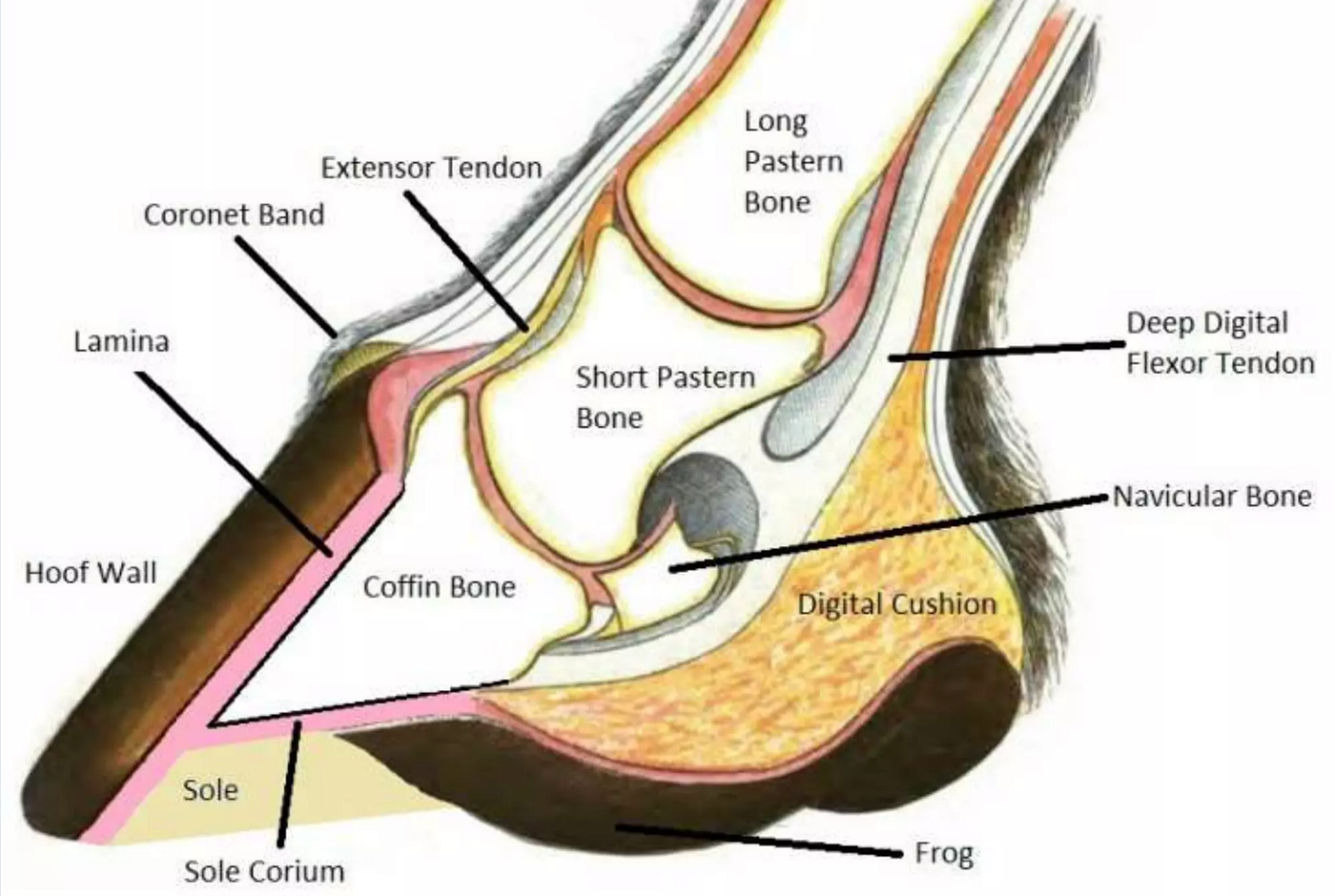
Diagram showing the anatomy of the hoof
Why is it Dangerous?
Unlike people, horses can’t simply take weight off their feet when something hurts. They rely on their hooves for everything — standing, walking, running, even lying down and getting up. If the hooves fail, the horse’s quality of life suffers dramatically.
Laminitis is considered dangerous because of the speed at which it can progress and the difficulty of reversing the damage once it has advanced. A horse that seems slightly sore one day may be struggling to stand the next. In the worst cases, the damage to the laminae is so severe that the horse cannot recover, making euthanasia the kindest option. That is why vets and horse owners treat laminitis as a medical emergency and stress the importance of catching it early.
Causes of Laminitis
Laminitis doesn’t have a single cause — it can be triggered by several different factors, often working together. One of the most common causes is overeating rich food. Horses that suddenly have access to lush green grass or large amounts of grain can develop digestive imbalances that trigger laminitis.
Hormonal problems, such as Cushing’s disease or Equine Metabolic Syndrome, also increase the risk. Excess body weight puts constant strain on the laminae, which can eventually lead to inflammation. Injuries, infections, or putting too much pressure on one leg (for example, if another leg is injured) can also bring it on. In reality, laminitis is a complex disease with many possible triggers, which makes prevention and awareness even more important.
Symptoms of Laminitis
Recognising the symptoms of laminitis early can make all the difference. Horses with laminitis often begin by moving stiffly or reluctantly, as if every step hurts. They may shift their weight uncomfortably, trying to take pressure off their painful hooves. Some horses spend more time lying down than usual, avoiding the effort of standing.
Another common sign is warmth in the hooves or an increased pulse in the arteries that run down to the hoof. In more advanced cases, the horse may adopt a characteristic “sawhorse stance,” where it leans back on its hind legs to take weight off the painful front hooves. The horse’s overall behavior may also change — what once was an active, lively animal may suddenly appear dull, restless, or clearly in distress.
Because horses are prey animals, they often hide pain until it becomes severe. That’s why it’s so important for owners to be alert to these early, subtle signs.
Sawhorse Stance by Oregon Equine
Why Early Detection Matters
The earlier laminitis is caught, the better the outcome. When inflammation is addressed quickly, the horse has a much higher chance of recovering without permanent damage. Early treatment also means less suffering for the animal and fewer costs for the owner.
Once the laminae are badly damaged, however, repairing them is extremely difficult. Even with treatment, some horses may never return to full soundness. This is why vets emphasize prevention and quick action: recognizing the problem at its earliest stage can mean the difference between a horse returning to health or facing lifelong consequences.
My Project
My personal interest in laminitis goes beyond studying it — I’m actively working on a prototype horseshoe designed to detect the early signs of this disease. The idea is that the shoe will have temperature and pressure sensors to monitor these key symptoms of laminitis. There will be four temperature sensors at the coronary band and frog area. And four pressure sensors at the base of the hoof, dividing it into four quadrants.
This will help monitor symptoms, identify trends, and hopefully intervene earlier if needed.
If successful, this kind of innovation could give owners and vets a head start in managing the disease, allowing them to step in with care and treatment before the condition becomes severe. While the project is still in development, I believe it’s an important step toward combining veterinary medicine with technology to improve animal welfare.
Conclusion
Laminitis may sound like a complicated medical term, but at its core, it’s a disease that shows us how vital healthy hooves are to a horse’s life. It’s painful, dangerous, and sometimes even life-threatening — but it doesn’t have to be a hopeless condition. With knowledge, early detection, and the right care, many horses with laminitis can recover and return to comfortable, happy lives.
Through this blog, my aim is to explain veterinary medicine in simple, clear language so that more people — whether they are horse owners, students, or simply animal lovers — can understand and take action when it matters most. Because at the end of the day, the more we know, the better we can care for the animals who depend on us.
메타데이터
- post_id
- 3db7328002f1
- slug
- laminitis-made-simple-the-hidden-danger-in-horse-hooves-3db7328002f1
- url
- https://medium.com/@ashneer650/laminitis-made-simple-the-hidden-danger-in-horse-hooves-3db7328002f1
- canonical_url
- https://medium.com/@ashneer650/laminitis-made-simple-the-hidden-danger-in-horse-hooves-3db7328002f1
- author_url
- https://medium.com/@ashneer650
- status
- ok
- fetched_at
- 2026-07-23 07:19:11