Trans Data: A Research and Design Agenda from Trans Activists’ Transformative Data Science
by Amelia Lee Dogan, Nikko Stevens, and Catherine D’Ignazio
Trans Data: A Research and Design Agenda from Trans Activists’ Transformative Data Science
by Amelia Lee Dogan, Nikko Stevens, and Catherine D’Ignazio
For years, our lab has worked with activists who turn to data to advocate for their communities–around issues like gender-based violence or housing. As we reflected on this work, we became curious about the trans activists who have long been taking care of our communities. We knew this care often involved creating, collecting, manipulating, and theorizing around data. In order to understand these processes in-depth, we interviewed 16 trans activists about their relationships with data.
Trans people use data in interesting and novel ways
Embodied Researched
When we talked to activists about how they collected or created data, much of that work came from the lived experience of being trans, or what they knew through living as a trans person. Much of that embodiment also happens from being a trans activist and hearing stories. One participant described, “I’ve had a lot of [experiences with] live, real-life human beings and their families and their experiences, and had that infused in my cellular structure and is retained in my brain for me then to regurgitate.” He compared this cellular knowledge to how he often struggles to find academic citations to support what he already knows to be true: that family support for trans children matters.
Pragmatic Recording
Another thing participants surfaced was how the data they had must be serving a purpose that protects trans communities. This often meant not collecting more data than necessary. Through previous research and our interviews, we know there are many constraints put on non-profits — they have to collect certain data for funders, like the number of meetings or client demographics. Within these constraints, participants still pragmatically chose what to collect and record. For example, Ben described how, when running support groups, “I don’t collect identities. I collect pronouns.” He made this choice not only because it is easier for participants to share, but also because he did not want to make participants define their identities.
Using Data to Reframe and Reform
As in their recording practices, trans activists also regularly choose to use data in ways that uplift the trans community. If data were collected, it had to serve the trans community, like improving trans experiences in the medical system. A participant described how he used a word cloud from focus groups about “what trans [and] gender diverse people want you [the medical provider] to know, and this is why this is important.” He uses those word clouds when training medical professionals to reframe common narratives about trans patients.
In another practice, Nell created a dashboard from letters from incarcerated people, many of whom are trans, about the violence they faced. Nell used those letters and data to write a report about Prison Rape Elimination Act violations in Texas prisons in hopes of reforming state policies. Nell also maintains a dashboard enumerating the number of letters she has received.
Press enter or click to view image in full size
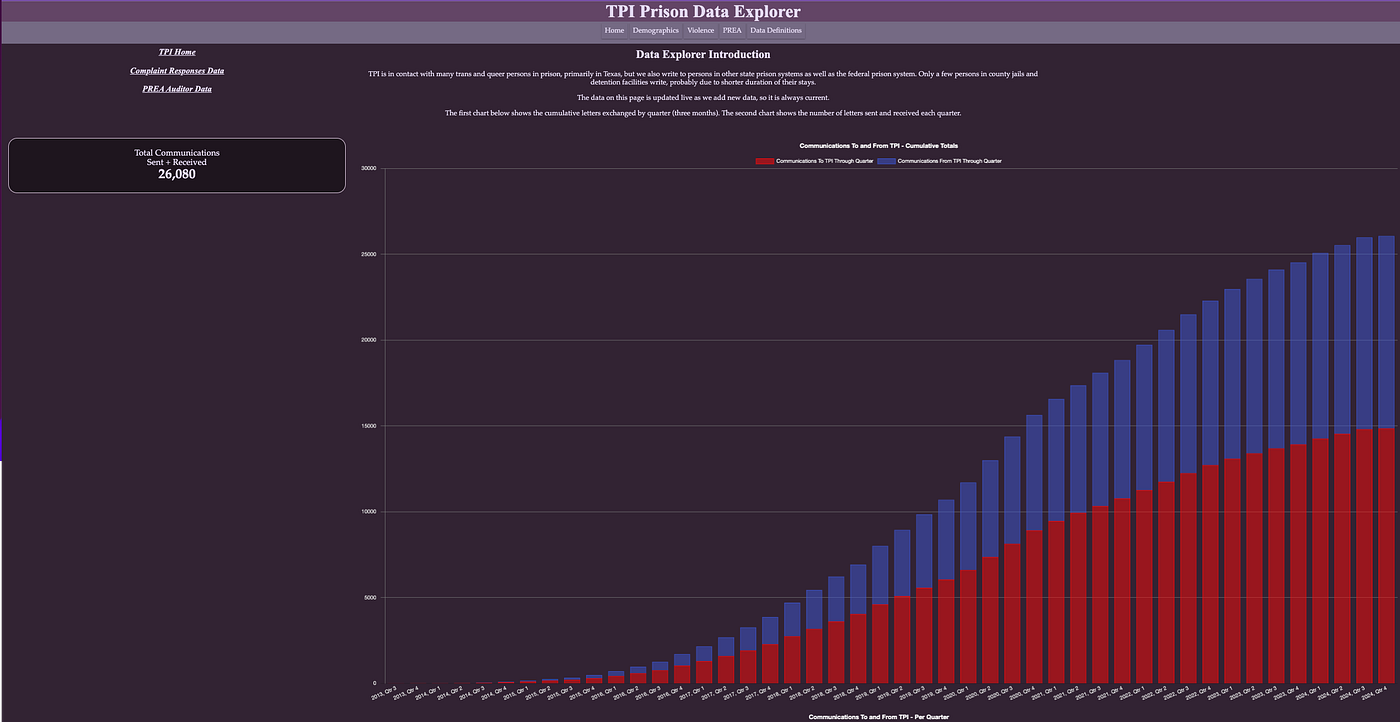
Figure 1: Screenshot of Trans Pride Initiative Prison Data Explorer showing cumulative communication with incarcerated people. In red, letters to the organization, and in blue, letters authored by the organization.
Refusing Data
In other circumstances, trans activists made an intentional choice not to collect data. This choice could be a principled one, such as when a mutual aid organizer focused on redistributing money, not monitoring how people spent it. The participant said, “We intentionally don’t follow up with anyone, because that’s not part of the work.” This refusal demonstrates the commitments that mutual aid is built on, about meeting the needs of people who express need without judgment or bureaucratic barriers. Additionally, participants often did not want to overcollect data to limit the bureaucratic barriers that trans people so often face, like in the medical system.
Trust trans people + what they tell you
From our interviews, we found trans activists had savvy and complex understandings of how they could use data to serve their activist needs, retain their political commitments, prioritize care and support, and uplift trans communities. We call this approach trans data:
- Trans data is about materially approving trans lives
- Trans data crosses boundaries
- Trans data requires power analysis
We hope these principles can be used to help build new data collection, analysis, and communication systems that serve trans liberation and help reorient researchers to the deep political commitments of data for and about trans people.
Acknowledgements
This material is based upon work supported by the National Science Foundation under Award №2213826.
Full Paper
Amelia Lee Dogan, Nikko Stevens, and Catherine D’Ignazio. 2025. Trans Data: A Research and Design Agenda from Trans Activists’ Transformative Data Science. Proc. ACM Hum.-Comput. Interact. 9, 7, Article CSCW501 (November 2025), 21 pages. https://doi.org/10.1145/3757682
This was originally published on the CSCW Medium.
메타데이터
- post_id
- 3db8a8a12f78
- slug
- trans-data-a-research-and-design-agenda-from-trans-activists-transformative-data-science-3db8a8a12f78
- url
- https://medium.com/data-feminism-lab-mit/trans-data-a-research-and-design-agenda-from-trans-activists-transformative-data-science-3db8a8a12f78
- canonical_url
- https://medium.com/data-feminism-lab-mit/trans-data-a-research-and-design-agenda-from-trans-activists-transformative-data-science-3db8a8a12f78
- author_url
- https://medium.com/@dogan_75281
- status
- ok
- fetched_at
- 2026-06-14 17:09:17