The Fireball and the Filing: How America Outsourced Its Space Program to Two Billionaires
A New Glenn rocket exploded in an orange fireball over Cape Canaveral days before its rival filed for the biggest IPO in history, and the…
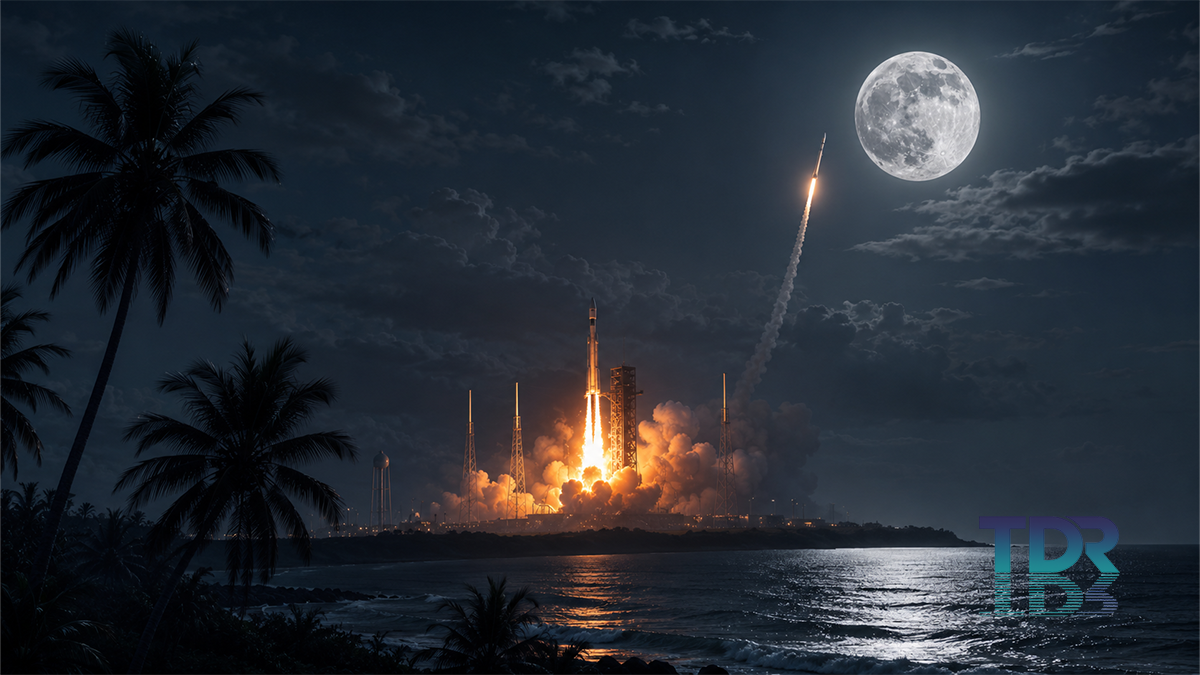
A Blue Origin rocket exploded on its pad at Cape Canaveral on Thursday night, days before it was to carry the first big batch of Amazon’s internet satellites into orbit. It happened the same week SpaceX filed for what could be the largest IPO in history, a reminder that America’s launches, its satellite broadband, and its return to the moon now ride on two private companies owned by two feuding billionaires. The question underneath the fireball is no longer whether a rocket fails, but how much the country has riding on the men who own them.
The Fireball and the Filing: How America Outsourced Its Space Program to Two Billionaires
A New Glenn rocket exploded in an orange fireball over Cape Canaveral days before its rival filed for the biggest IPO in history, and the wreckage exposes how a superpower handed its return to the moon to two private companies and their feud.
By The Daily Reflection · May 31, 2026 · 11 min read
It was just after 9 p.m. on Thursday night when the sky over Cape Canaveral turned orange. The blast shook houses in Cape Canaveral and nearby Cocoa Beach. Residents grabbed their phones, and within minutes the internet filled with photos of a fireball rising off Launch Complex 36.
What burned was a rocket. Specifically, it was Blue Origin’s New Glenn, the heavy-lift vehicle Jeff Bezos has spent more than a decade and a large slice of a personal fortune building. It detonated during a ground engine test, days before it was supposed to carry the first major batch of Amazon’s internet satellites into orbit. No one was hurt. Bezos posted on X that the cause was not yet known and called it a “very rough day, but we’ll rebuild whatever needs rebuilding.”
Here is the part that turns a Florida fireball into a national story. In the same week that one billionaire’s rocket was exploding on its pad, the other billionaire was preparing to take his rocket company public at a valuation approaching $2 trillion, in what would be the largest stock listing in history.
That is not a coincidence of the calendar. It is the shape of the American space program in 2026.
A Very Rough Day, Twice in a Month
Start with what actually happened on the pad, because the engineering matters before the metaphor does.
Blue Origin was running a hot-fire test, the kind where the rocket stays bolted to the ground and the engines are lit to confirm they work before flight. The vehicle was scheduled to launch around June 4 carrying roughly 48 satellites for Amazon Leo, Amazon’s satellite-internet service, the first of two dozen launches Amazon has booked on New Glenn. Instead, the rocket went up in a fireball that rattled windows for miles. Cape Canaveral Space Force Station warned that debris could wash ashore in the days that followed and told the public not to touch it. Launch Complex 36 is the only pad New Glenn flies from, which means any serious damage to it could keep the rocket grounded for a while.
The part that should worry Blue Origin more than the fireball is the pattern. This was the second New Glenn failure in roughly a month. The vehicle’s previous flight suffered a second-stage failure, and the FAA’s final mishap report, released a day before Thursday’s explosion, traced that earlier problem to a cryogenic leak that froze a hydraulic line and produced a thrust anomaly during the upper-stage burn. Blue Origin identified nine corrective actions. Then the next rocket exploded on the ground.
Building rockets is brutally unforgiving work, and every serious space official will tell you so. NASA said as much in its own statement after the blast, a reminder that new vehicles of this size are punishingly hard to develop and that anomalies come with the territory. That is fair. SpaceX blew up a long line of Starships before it learned to land them, and the FAA currently has SpaceX grounded pending its own mishap investigation. Rockets explode. The relevant question is never whether a given company has failures. It is how much the country has riding on that company while those failures get fixed.
For Blue Origin, what is riding on it turns out to be a great deal.
The Filing That Makes the Fireball Matter
While Blue Origin spent the week explaining a fireball, SpaceX spent it preparing for a number almost too large to picture.
On May 20, SpaceX made public the financial paperwork for an initial public offering that Bloomberg reported is seeking to raise tens of billions of dollars at a valuation of as much as $2 trillion. That would make it the biggest stock-market debut in history, larger than Saudi Aramco’s record listing in 2019, with a tentative trading date in mid-June. Buried in the filing was a super-voting share structure that would let Elon Musk keep majority control of the company even after selling a slice of it to the public.
The engine under that valuation is not the rockets. It is Starlink, the satellite-internet network that now claims around 10 million subscribers and carries the overwhelming majority of the world’s space-based internet traffic. Starlink generated the bulk of SpaceX’s revenue last year and is the one part of the business that reliably turns a profit. When Wall Street talks about a $2 trillion SpaceX, it is mostly talking about Starlink.
Hold the two events side by side. One company’s rocket detonates on a test stand. The other company is about to be priced by the public markets as one of the most valuable enterprises on earth. Both are owned and controlled by a single individual. Both individuals compete, directly, in the same handful of businesses: launch, satellite broadband, and the contract to put Americans back on the moon.
The American space sector, in other words, is no longer an agency with contractors. It is a duopoly of two men, and the gap between them is widening in real time.
Bezos’s Rocket Was Carrying Bezos’s Satellites
The satellites stacked for that doomed rocket deserve their own paragraph, because they reveal how tangled this rivalry has become.
Amazon Leo is the new name for Project Kuiper, the constellation Amazon rebranded in November 2025. It is Amazon’s bid to do to Starlink what Starlink did to rural broadband: blanket the sky with thousands of low-orbit satellites and sell fast internet to anyone underneath them. Amazon has approval for a constellation of more than 3,200 satellites. As of this spring, it had only a couple hundred in orbit, far short of an FCC deadline to deploy half the network by mid-2026, a deadline Amazon has already asked to push to 2028.
Now notice the ownership. Amazon Leo belongs to Amazon, the company Bezos founded. New Glenn belongs to Blue Origin, the separate space company Bezos also founded. So Thursday’s explosion was, in effect, Bezos’s rocket failing to launch Bezos’s satellites, in a race against a broadband network owned by Musk. And because Blue Origin cannot launch fast enough on its own, Amazon has also booked launches on Musk’s SpaceX, which means one billionaire is paying his rival to help deploy the very satellites meant to compete with that rival.
This is the part that should give pause to anyone assuming competition alone will discipline the market. Satellite internet is not a novelty anymore. It is becoming critical infrastructure: the connection of last resort for rural communities, ships, aircraft, disaster zones, and increasingly militaries. Control of it is a strategic asset. Right now, one man owns the dominant network, a second man is spending billions to build the only serious challenger, and the challenger depends on the incumbent’s rockets to reach orbit. That is not a healthy market structure. It is two fortunes deciding who gets to wire the sky.
The Moon Is a Hedge Bet Now
Here is the piece of this story that most coverage is burying beneath the fireball footage. The same two companies, and the same private uncertainty, now sit underneath America’s plan to return to the moon.
The United States wants astronauts back on the lunar surface by 2028, a timeline written into a Trump administration executive order that frames the goal as ensuring American space superiority over China, which is targeting its own crewed landing around 2029 or 2030. NASA’s program for this, Artemis, has a problem at its center: the agency does not own a vehicle that can land humans on the moon. It is renting one. Two of them, actually, and neither has flown.
The crewed lander for the early Artemis landings is a version of SpaceX’s Starship. The lander for a later mission is Blue Origin’s Blue Moon, the subject of a contract worth more than $3.4 billion. Both are years from being proven. Both require complicated sequences of in-orbit refueling launches that have never been demonstrated at the cadence the missions need. And this spring, the interim NASA administrator, Sean Duffy, reopened the lander contract for the first crewed landing specifically because SpaceX has slipped. “We’re in a race against China,” he said, explaining that NASA would fly whichever company is ready and would not wait for one of them.
Translate that out of agency-speak, and it means something stark: the plan to beat Beijing to the moon is now a hedge bet between two billionaires’ unproven hardware, and NASA is openly hoping at least one of them delivers in time. A test-stand fireball is a data point in that bet. So is every Starship that fails to reach orbit. Former NASA administrators have been blunt about the whole architecture. Michael Griffin, who once ran the agency, told Congress late last year that for America’s current moon effort, “mediocrity would be an improvement.” When the people who used to run the place are saying that out loud, the orange glow over Cape Canaveral is not just Blue Origin’s problem. It is the country’s.
What Happens When the Mission Is Privately Owned
None of this is an argument that privatizing spaceflight was a mistake. On the merits, it plainly was not. SpaceX dragged the cost of reaching orbit down by an order of magnitude and made the United States the dominant launch power on the planet, while NASA’s own government-built rocket, the Space Launch System, has run years late and billions of dollars over budget. The private model produced real speed, real savings, and real capability the old model could not. Anyone being honest about the trade has to start there.
But a trade is what it is, and the bill is now coming into view. When the mission is privately owned, the public gets the innovation and absorbs the strategic risk while two individuals capture the value. A government agency answers to Congress and to voters. It cannot simply post “we’ll rebuild” and move on, because its failures are public property. A private company can, and arguably should, take risks a public agency never could. The catch is that the country has now wired its most important space ambitions, its broadband backbone, its launch capacity, and its moon program into companies whose timelines, priorities, and appetite for failure are set by two men locked in a rivalry.
And it really is two men, not two boards. The SpaceX filing makes that explicit: even after a listing that could value the company in the trillions, the super-voting shares keep Musk in control. Bezos holds Blue Origin even more tightly, as a privately funded project he has bankrolled out of his own pocket for years. The public markets are about to put a civilization-scale price on one of these companies. The public sector is about to bet its lunar future on both. And in neither case does the public get a vote on how they are run.
That is the structure. A fireball just made it visible for a night.
The Bottom Line
Rockets explode. That is the first and least interesting thing to say about Thursday night, and it is true. New Glenn will probably fly again, Blue Origin will probably find the leak or the valve or the weld that failed, and the Amazon satellites that were never loaded onto the rocket are sitting safely in a hangar waiting for the next ride.
The more important thing is what the fireball lit up for a moment. The United States no longer runs its own race into space. It has handed the launch business, the satellite-internet business, and the contract to return to the moon to two private companies controlled by two of the richest men alive, who compete with each other in all three arenas at once. One of those companies is about to be crowned by the markets at a value approaching $2 trillion. The other just scattered debris across a Florida beach. The country’s ambitions ride on both.
There was a time when the space race meant one government straining against another, with a public agency and public accountability carrying the weight of the whole endeavor. That race put a flag on the moon. The race the United States is running now is mostly between Jeff Bezos and Elon Musk, with NASA standing off to the side as a customer placing hedge bets and hoping one of its vendors comes through before China does.
The fireball over Cape Canaveral will fade from the feeds by Monday. The arrangement it briefly illuminated will not. A superpower has bet its future in space on two billionaires who cannot stand each other, and on a quiet Thursday night, one of those bets went up in flames over the Atlantic.
The Daily Reflection cuts through the noise to find the stories that actually matter. Follow for thoughtful takes on politics, technology, and whatever’s shaping our world.
메타데이터
- post_id
- 3dbbbefaf03d
- slug
- the-fireball-and-the-filing-how-america-outsourced-its-space-program-to-two-billionaires-3dbbbefaf03d
- url
- https://medium.com/@TheDailyReflection/the-fireball-and-the-filing-how-america-outsourced-its-space-program-to-two-billionaires-3dbbbefaf03d
- canonical_url
- https://medium.com/@TheDailyReflection/the-fireball-and-the-filing-how-america-outsourced-its-space-program-to-two-billionaires-3dbbbefaf03d
- author_url
- https://medium.com/@TheDailyReflection
- status
- ok
- fetched_at
- 2026-06-09 15:37:30