Choosing the Mango Empire
Trading the obvious island survival kit for the sweet reward of patience
The Long Game
Choosing the Mango Empire
Trading the obvious island survival kit for the sweet reward of patience
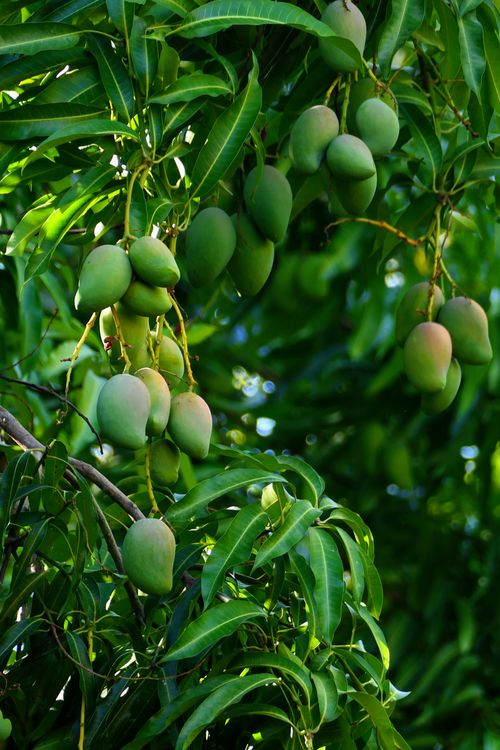
Green mangoes on the branch: the long game looking smug already. Photo by Armando H2
“If you could take only one seed to a desert island, what would it be?”
Hoping Susan is giving us a tropical island. And not Shetland — those cold, windy Scottish islands from the murder mystery, gorgeous to look at, less gorgeous to be stranded on, and not exactly mango country.
So more Death in Paradise vibe: sun, palms, suspicious corpse near the beach. Less Shetland: brooding detective, cold, wind and rain-lashed cliffs, and my mango seed applying for a transfer.

ChatGPT’s island forecast: more tropical murder mystery, less rain-lashed mango disaster.
It would be practical to say coconut or banana, the obvious answers. Coconut is basically a survival kit in a shell — water, food, oil, rope, shelter material. Banana gives you fast-growing, reliable calories, although, yes, the gardening folks over there are already clearing their throats because most edible bananas are not really grown from seed. Fine. Let us not ruin a perfectly good island fantasy with botanical admin overhead.
Both are sensible. Both are, if I am being honest here, a bit boring.
Because the question says seed. Not packed lunch. Not emergency ration. A seed is already a ridiculous little act of optimism. And mango? Mango is living, not just surviving.
Yes, it is a long game. From seed, a mango can take five to eight years to fruit, sometimes longer, so this is not a snack-by-this-season situation. A grafted tree would be quicker, but Susan said one seed, so apparently we are being tested. That is the quiet lesson of gardening: some choices feed you now, and some teach you how to wait.
Given the right island — tropical heat, full sun, decent drainage, and absolutely no Shetland nonsense — that seed can become a proper tree. Shade first. Blossom later. Fruit eventually. A small empire of patience.
And mango is useful before it ever becomes the golden, ripe thing everyone thinks of first. Raw mango does actual kitchen work. Pickle it Indian-style — chopped green mango packed with salt, oil and spices until it turns sharp, hot, sour and addictive. Make aamer chaatni — Bengali mango chutney, sweet-sour, sticky, spiced, the thing that wakes up the whole plate. Put it in aamer dal, the ultimate Bengali summer elixir where yellow lentils and tart raw mango team up to fiercely battle the heatwave.
Then there is aam panna — raw mango boiled or roasted, cooled down with sugar, salt, cumin, mint if you have it; basically a heatwave antidote in a glass.
And when the mangoes really start arriving, you can preserve them. Aam papad, or aamshotto in Bengali, is mango pulp spread out and dried into chewy fruit leather. Basically mango for later, which is exactly the sort of thing a person on an island should be thinking about before eating twenty ripe ones in one sitting and giving themselves a bellyache.
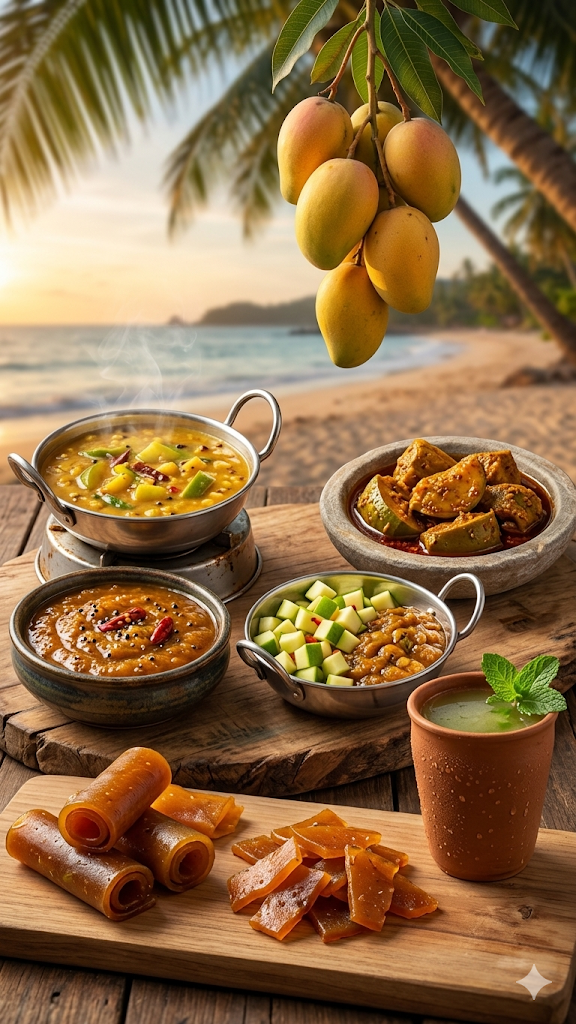
Raw, ripe, pickled, dried, drunk: mango doing the full shift. Image generated with Gemini
And the tree is not just food. In India, mango leaves are auspicious — tied above doors and temple entrances during festivals, weddings and puja to welcome prosperity and good fortune. So even before the fruit arrives, the tree has a job: shade, ritual, welcome, and the promise of good things coming.
So no, botanically, mango is not a vegetable. It is a fruit. But in the kitchen it absolutely does more than one shift. Raw mango gives you sourness and bite. Ripe mango gives you sweetness, energy, and around 100 calories per cup, plus fibre, vitamin C, vitamin A, folate and potassium. Mango is not pretending to be a sack of lentils. It will not solve the protein problem. But still useful. Still doing work.
Now, obviously, the dream would be some mango-coconut-banana hybrid. Shade, calories, hydration, dessert, rope, shelter, the full tropical starter pack. Tragically, this does not exist, because science is determined to disappoint me. That said, there are banana varieties people describe as creamy, apple-like, even dessert-ish. The Ice Cream banana, Blue Java, is famously creamy and almost vanilla-custard-adjacent. Nature got surprisingly creative without any help.
But three-in-one? Still a dream. Until then — mango, final answer. A long game, yes. But a good one. A ripe one eaten standing under the tree, juice running down both arms, completely unashamed.
Thank you, Susan Payton, for the challenge — and thank you to the Simple Gardening pub for making me think far too seriously about one imaginary seed, one imaginary island, and one very real mango obsession.
Have you answered the June Challenge yet? Come join us.
메타데이터
- post_id
- 3dbc881fcb85
- slug
- choosing-the-mango-empire-3dbc881fcb85
- url
- https://medium.com/simple-gardening/choosing-the-mango-empire-3dbc881fcb85
- canonical_url
- https://medium.com/simple-gardening/choosing-the-mango-empire-3dbc881fcb85
- author_url
- https://medium.com/@milwaukeemasala
- status
- ok
- fetched_at
- 2026-06-20 20:29:01