Communism, Socialism, and Democratic Socialism: What’s the Difference?
Understanding the ideologies shaping modern political debate.
Communism, Socialism, and Democratic Socialism: What’s the Difference?
Understanding the ideologies shaping modern political debate.
As debates around government regulation and the role of the state in social and economic life remain extremely relevant in the U.S. today, having a clear understanding of major ideologies and economic systems is increasingly important. Terms such as communism, socialism, social democracy, and democratic socialism are often mistakenly used interchangeably. Understanding the differences between these systems and ideologies better equips voters to evaluate legislation, public policy, and the actions of elected officials. By looking at the origins, principles, and real-world examples of these ideologies, citizens can better understand how they influence the modern political climate.
In the United States, the government has historically taken measures to prevent communist supporters from gaining traction. Many of these measures date back to the Cold War era, when the Red Scare caused a period of hysteria over the perceived threat of communism amidst high tensions between the U.S. and the Soviet Union. As public anxiety grew, Congress attempted to limit communist influence by passing landmark legislation, including the Smith Act (1940), which was actively used to prosecute communist leaders, and the Internal Security Act (McCarran Act) of 1950, which required organizations believed to be communist to register with the federal government.
While these Cold War policies were aimed specifically at communism, they contributed to a long-standing confusion in American discourse about other related political, social, and economic systems. Today, terms such as communism, socialism, social democracy, and democratic socialism are used in public debate, but are frequently mixed up or misunderstood. These different social systems shape the political and economic climate of the world around us, and influence public and legislative discourse in the U.S. Understanding the difference between these systems is essential to informed civic participation. This aligns with IssueVoter’s goal to make civic engagement more accessible and easier to understand.
Interested in Congress’s influence on economic and social systems?
Check out IssueVoter’s list of bills currently awaiting a vote in Congress.
On IssueVoter, you can easily learn about upcoming legislation, better understand both sides of a policy debate, and send your opinion directly to your elected officials with the click of a button.
Stay informed without information overload:
👉 Visit IssueVoter.org today!
Definitions and Ideological Distinctions
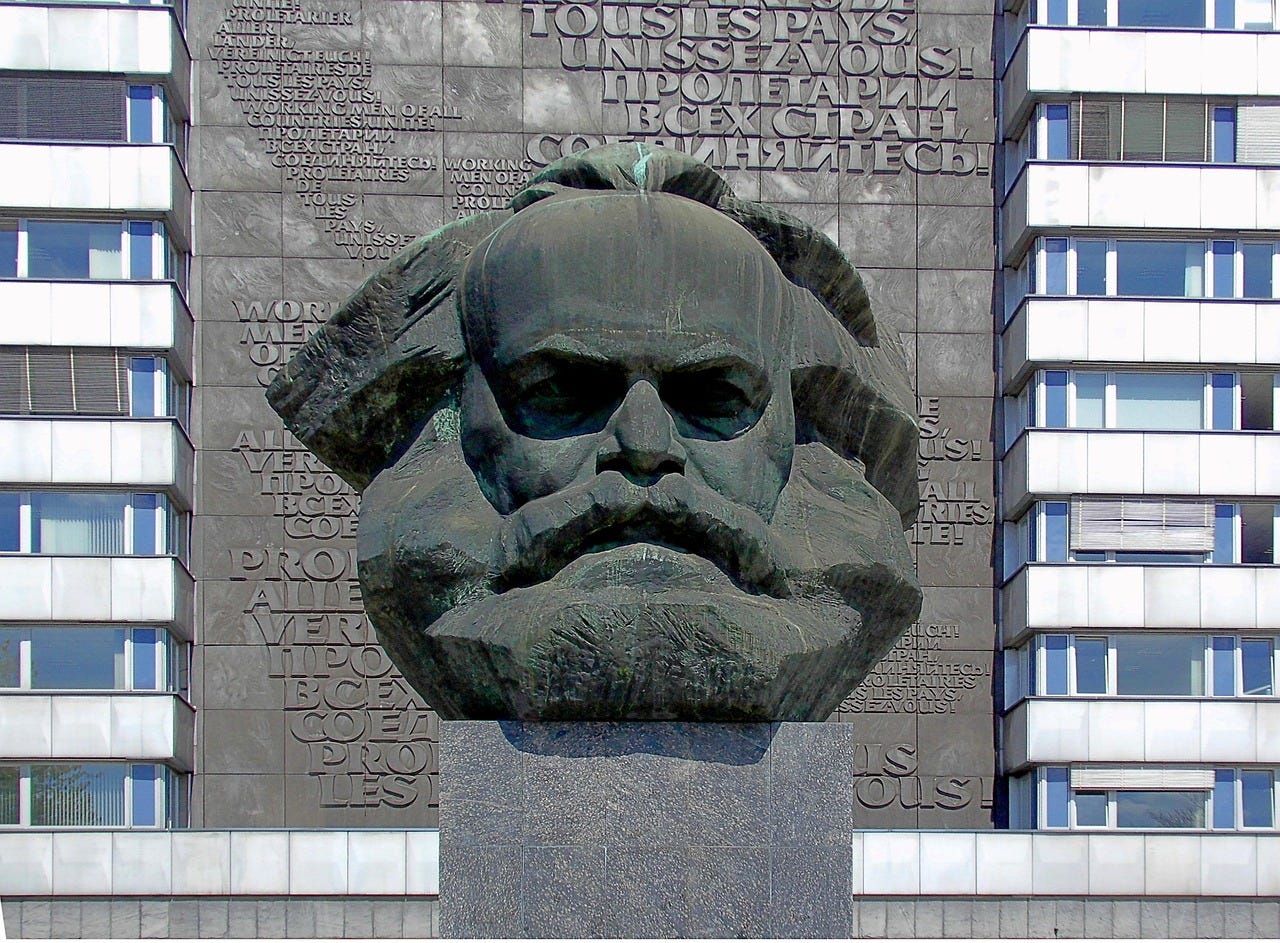
Karl Marx Monument in Chemnitz, Germany. Image provided by Dieter Loffler on Pixabay.
Communism
Communism, in its modern sense, dates back to the 19th century, when influential writers Karl Marx and Friedrich Engels published The Communist Manifesto and called for an end to the class divide that was created by the Industrial Revolution. Their ideas emerged during a time of rapid industrial growth across Europe. This divide consisted of the proletariat, or the working class, and the bourgeoisie, or those who owned the means of production and received most of the wealth. Marx and Engels argued that this imbalance of power and wealth led to exploitation and inequality.
Communism is based on the equitable distribution of wealth and the shared ownership of property among a nation’s people. Private ownership of the means of production is abolished, as society’s means of production are to be controlled by the working class. This is designed to prevent wealth from concentrating in the hands of a few people. Communism’s overall goal is to reach a stateless, classless society. In classical Marxism, communism is the final stage after socialism. At this final stage, a government would no longer be necessary because class conflict would no longer exist.
The Soviet Union, or USSR, was a historical communist state that ultimately failed. Its final leader, Mikhail Gorbachev, a Marxist-Leninist at the time, introduced *glasnost (“openness” or “transparency”). Glasnost increased political freedoms and the public’s ability to criticize the government. Another government policy, [perestroika](https://www.britannica.com/topic/perestroika-Soviet-government-policy) *(“restructuring”), was aimed at decentralizing the economy and improving efficiency. These political policies were two of many factors that contributed to the collapse of the Soviet Union, along with economic stagnation, defense spending, geopolitical pressure, and the lack of government transparency regarding the Chernobyl Nuclear Disaster.
American institutions have historically favored capitalism, emphasizing private property and individual economic control. While communism maintained minor influence, particularly in labor movements, intellectual circles, and some local politics, its growth was consistently constrained by government-led anti-communism efforts. These included the Red Scare and McCarthyism, foreign interventions during the Cold War, the Reagan-era policies supporting anti-communist movements abroad, and other post-Soviet rhetoric and policy aimed at containing communist influence internationally.
Socialism
Socialism, in its most basic sense, advocates for collective ownership of the means of production. Socialism emerged as a response to economic inequality and industrial expansion. Distribution of resources may depend on need, contribution, or democratic control. Socialist supporters believe that this reduces the inequality gap between social classes. A branch of socialism is market socialism, which has publicly owned enterprises while production and consumption are guided by the market, rather than the government. Market socialism combines elements of public ownership** **with the efficiency of market competition.
Both communism and socialism emerged as responses to the Industrial Revolution and the rise of Capitalism, which allows private businesses or individuals to own capital goods and operate in a free market. Capital goods include factories, land, tools, and financial capital. Most capital systems today consist of mixed economies with a level of regulation, combining government oversight with private ownership to promote efficiency and social welfare.
In the United States, socialist ideals have historically influenced labor movements, progressive politics, and social programs. However, socialism has never become a dominant political system. Socialist ideas often promote economic equality, workers’ rights, and public ownership or regulation of key resources. Under President Franklin D. Roosevelt, the United States introduced several key social welfare policies as part of the New Deal between 1933 and 1938. Programs such as Social Security and unemployment insurance provided retirement benefits, financial support for the unemployed, and aid to disabled workers. This reflected socialist-inspired principles of collective support, even within a largely capitalist economy. While FDR proposed limited health insurance programs, comprehensive public healthcare initiatives were later established under President Lyndon B. Johnson with the creation of Medicare and Medicaid in 1965.
Social Democracy
Social democracy is an extension of socialism that does not seek to abolish capitalism, but rather to build a strong, regulated welfare state. This system works within a capitalist framework to balance markets and protect democratic institutions. Other key features of social democracy include progressive taxation, collective bargaining, and unionization. The Nordic countries, including Finland, Sweden, and Norway, are examples of social democracies where most industries remain privately owned, and public ownership of production is limited, even as the government provides extensive social welfare and labor protections. While these countries have constitutional representative democracies and social welfare benefits, the majority of workplaces are under private control. Many modern Progressive American politicians, including Senator Bernie Sanders of Vermont and Alexandra Ocasio-Cortez [NY-14], have expressed support for aspects of the Nordic model, particularly Universal Health Care, strong social welfare programs, and labor protections.
Democratic Socialism
Democratic socialism seeks to have the government take control over certain sectors of the economy. Democratic socialism generally supports public or social ownership of key sectors of the economy, rather than primarily relying on regulated private markets as social democracy does. Resources may be distributed through democratic institutions such as the state or other publicly accountable bodies, rather than through private market forces alone. This system works to ensure that economic decisions are based on the will of the people, rather than private interests. Democratic socialism ultimately puts an emphasis on advancing society through democratic means, prioritizing social equality and collective decision-making.
Contemporary Issues

Statue of Liberty, New York City. Image provided by Avi Werde on Unsplash.
New York City’s newly elected mayor, Zohran Mamdani, a registered Democrat, identifies himself as a democratic socialist. Mamdani has been a long-time member of the Democratic Socialists of America (DSA), which is a left-wing political organization that is not a registered political party. Throughout Mamdani’s campaign and election, democratic socialism has increased in popularity and attention in New York City as well as across the entire nation.
Since this ideology has been pushed into the spotlight, many people have interpreted it in different ways. President Trump has called Mamdani a communist, which Mamdani promptly refuted. Mamdani explained that his brand of democratic socialism has a broad interpretation, with a main focus on finding a “better distribution of wealth for all of God’s children in this country.”
DSA’s broader goal is to “collectively own the key economic drivers that dominate our lives, such as energy production and transportation.” In practice, many American democratic socialists do not seek immediate full public ownership, instead focusing on practical policy reforms. Mamdani campaigned on a platform dedicated to stemming rising income inequality in New York City through measures like increased taxes for corporations and residents earning over one million dollars a year. This added revenue would be used to fund measures like city-owned grocery stores, building affordable housing, and raising the minimum wage.
Democratic socialists aim to advance their goals and create social change over time through organizing, lobbying, and protesting.
The Communist Party USA responds to Democratic socialism by agreeing that socialism is a goal to work towards, but they take it a step further by seeing socialism as a stepping stone on the road to communism. From this perspective, achieving socialism calls for a complete restructuring of the capitalist system currently in place in the United States.
Current Congressional Debates

U.S. Capitol, Washington, DC. Image provided by Jacqui on Pixabay.
H.Con. Res. 58 — Denouncing the Horrors of Socialism
This resolution condemns socialism, arguing that it concentrates power by comparing other totalitarian regimes. It declares that Congress does not support any form of socialism and that socialist policies will not be implemented in the United States. The bill was passed in the House of Representatives in November 2025 and is still awaiting a decision in the Senate.
Opponents of the bill assert that it is overly broad with a political message that is unlikely to accomplish anything. Consisting primarily of Democratic representatives, the bill’s opponents also believe that Congress should not be condemning the political processes of other nations but should rather be focused on strengthening relationships with democratic allies.
Proponents of the bill point out that history shows how socialism has led to economic collapse and oppression, citing Stalin’s Soviet Union government as an example. Republican proponents also point out that many American immigrants have fled countries with socialist structures. They place an emphasis on the need for Congress to denounce socialism in all its forms and reinforce American free-market principles.
Communism, socialism, social democracy, and democratic socialism all address inequality, but each ideology takes a different stance on how much control the state should have over the economy. Public debate has been shaped by confusion between these ideologies, including misunderstandings about democratic socialism versus communism in relation to Zohran Mamdani, as well as current congressional resolutions around socialism. Understanding the difference between these ideologies is essential to fully grasp the motivations and goals behind policy actions related to government regulation.
It is equally important for voters to recognize how these ideologies influence policy debates so they can more effectively evaluate legislation and elected officials. IssueVoter helps bridge this gap by providing clear, nonpartisan explanations of different bills currently in Congress, which better equip voters to understand how ideology shapes legislation. Voters can make more informed decisions on their own positions among these ideologies with IssueVoter’s extensive bill summaries that include both proponent and opponent positions.
IssueVoter is a non-partisan platform that makes civic engagement accessible, efficient, and impactful. Stay up-to-date with legislation and make your voice heard! Sign up for IssueVoter to keep track of Congress from your inbox!
메타데이터
- post_id
- 3dbcb5d4016d
- slug
- communism-socialism-and-democratic-socialism-whats-the-difference-3dbcb5d4016d
- url
- https://blog.issuevoter.org/communism-socialism-and-democratic-socialism-whats-the-difference-3dbcb5d4016d
- canonical_url
- https://blog.issuevoter.org/communism-socialism-and-democratic-socialism-whats-the-difference-3dbcb5d4016d
- author_url
- https://medium.com/@leah.smithh
- status
- ok
- fetched_at
- 2026-06-10 21:21:38