How to Measure ROI on Software Investments: A Practical Framework for Business Leaders
Software investments represent some of the most significant capital allocations modern businesses make. Yet many organizations struggle to…
How to Measure ROI on Software Investments: A Practical Framework for Business Leaders
Software investments represent some of the most significant capital allocations modern businesses make. Yet many organizations struggle to answer a fundamental question: Are we getting our money’s worth? Measuring return on investment (ROI) for software isn’t always straightforward, but it is essential for making informed decisions about technology spending.
Why Software ROI Matters More Than Ever
The average small to medium-sized business now uses between 25 and 50 different software applications. Annual spending on SaaS tools has grown exponentially, with many companies dedicating 10–15% of their operating budget to software alone. Without a clear framework for measuring returns, businesses risk accumulating expensive tools that deliver minimal value while draining resources that could be deployed elsewhere.
Beyond the direct costs, poor software decisions create hidden expenses: employee frustration, workflow disruptions, integration failures, and opportunity costs from delayed projects. A disciplined approach to ROI measurement helps organizations avoid these pitfalls and justify technology investments to stakeholders.
The Foundation: Direct Cost Savings
The most tangible component of software ROI comes from direct cost reductions. Start by identifying specific expenses the software eliminates or reduces:
Labor cost reductions often provide the clearest ROI calculation. If a $500 monthly software subscription automates tasks that previously required 20 hours of employee time at $30 per hour, the monthly savings of $600 generates positive returns immediately. Document these time savings rigorously — track before and after states to validate assumptions.
Operational cost reductions include eliminated paper processes, reduced error rates, lower compliance costs, and decreased need for specialized consultants. A document management system might save thousands in printing and storage costs. An automated compliance tool could reduce audit preparation time by 80%.
Replaced tool costs matter too. Consolidating three tools costing $200 each into one platform at $400 monthly saves $200 while potentially improving integration and reducing training overhead.
Revenue Impact: The Harder but Critical Metric
While cost savings are easier to quantify, revenue impact often drives the greatest returns. Software that enables new capabilities, improves customer experience, or accelerates sales cycles creates value that compounds over time.
Sales acceleration provides measurable returns. Customer relationship management tools that reduce sales cycle length by 20% effectively increase sales capacity by the same amount without adding headcount. E-commerce platforms that improve conversion rates by even small percentages generate substantial revenue increases at scale.
Customer retention improvements deliver outsized returns. A customer success platform that reduces churn by 5% might save hundreds of thousands in lifetime value, depending on your customer base. Support tools that improve response times and resolution rates directly correlate with satisfaction scores and renewal rates.
New revenue streams represent the highest-leverage opportunities. Software that enables subscription billing, marketplace functionality, or digital product delivery can transform business models. While harder to predict precisely, these capabilities often justify investments even when cost savings alone wouldn’t.
Productivity and Efficiency Gains
Beyond direct time savings, software creates value through improved productivity and decision-making quality:
Employee productivity improvements compound across your organization. Project management tools that reduce status meeting time by 30 minutes per person weekly, multiplied across a 20-person team, reclaim over 500 hours annually for productive work. Collaboration platforms that eliminate version confusion and communication delays accelerate project delivery.
Decision quality improvements are harder to quantify but profoundly valuable. Business intelligence tools that provide real-time visibility into operations enable faster, more informed decisions. The cost of a single poor decision avoided often exceeds annual software costs many times over.
Employee satisfaction and retention indirectly affect ROI. Teams equipped with modern, efficient tools experience less frustration and demonstrate higher engagement. Reduced turnover saves substantial recruitment and training costs while preserving institutional knowledge.
The Complete ROI Formula
A comprehensive software ROI calculation combines these elements:
Total Benefits = Direct Cost Savings + Revenue Impact + Productivity Gains + Risk Reduction Value
Total Costs = Subscription/License Fees + Implementation Costs + Training Time + Integration Expenses + Ongoing Maintenance
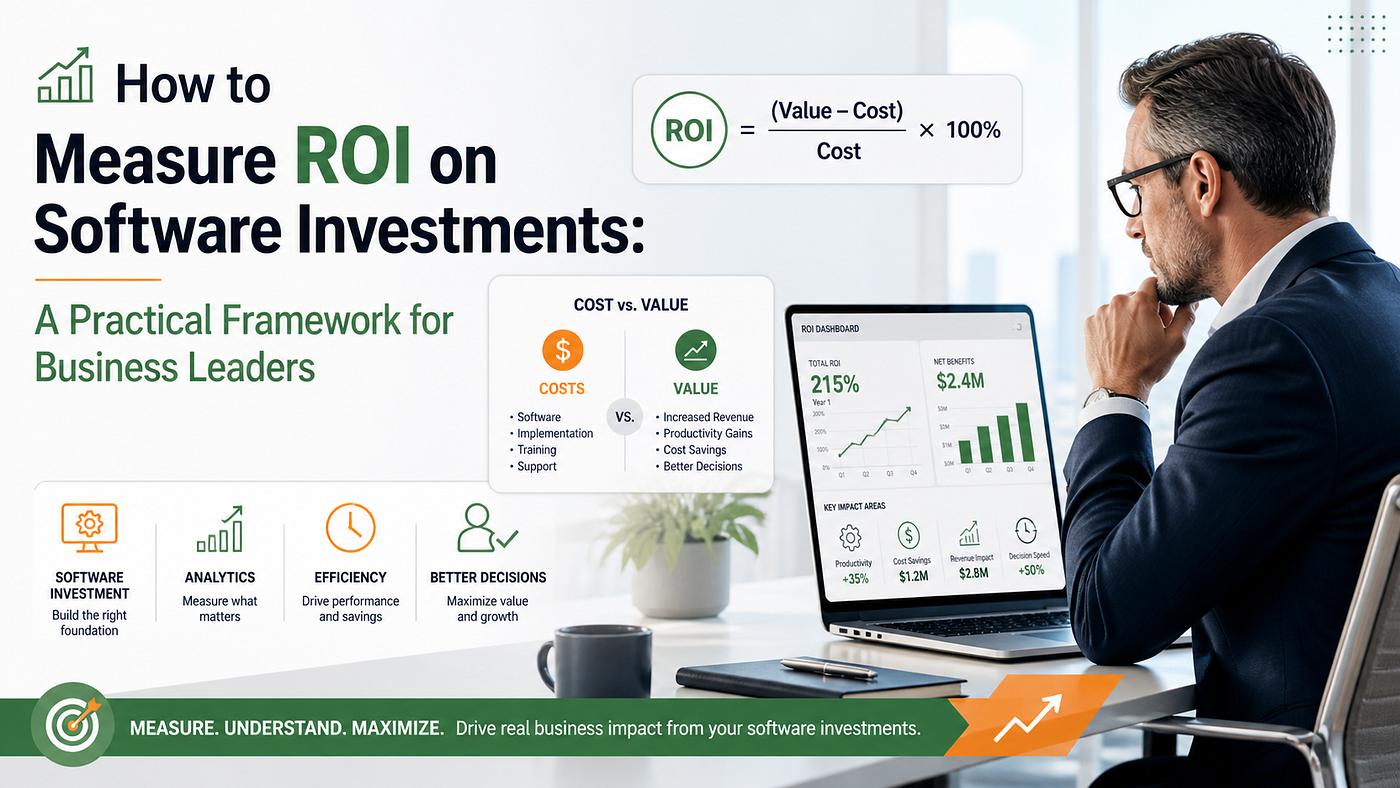
ROI = (Total Benefits — Total Costs) / Total Costs × 100
For example, a $12,000 annual software investment generating $8,000 in labor savings, $15,000 in revenue acceleration, and $5,000 in productivity improvements delivers:
($28,000 — $12,000) / $12,000 × 100 = 133% ROI
Time Horizons and Payback Periods
ROI calculations must account for implementation timelines. Most software investments show negative returns initially due to setup costs and learning curves. Establish realistic expectations:
Month 1–3: Negative returns due to implementation and training Month 4–6: Break-even as teams become proficient Month 7+: Positive returns accelerating as usage deepens
A reasonable payback period for most business software ranges from 6 to 18 months. Enterprise systems may require 24–36 months. Investments with payback periods beyond 36 months demand exceptional strategic justification.
Common Measurement Pitfalls
Organizations routinely undermine their ROI analysis through predictable errors:
Optimistic adoption assumptions plague many calculations. Assuming 100% feature utilization when historical data shows 40% actual usage dramatically overstates returns. Base projections on realistic adoption curves, not vendor case studies.
Hidden cost omissions distort analysis. Implementation consulting, data migration, integration development, and ongoing administration often add 50–100% to stated subscription costs. Include all expenses in calculations.
Attribution challenges complicate revenue impact measurement. When multiple factors drive sales improvements, isolating software contribution requires careful experimental design or at least conservative estimation.
Sunk cost confusion leads to poor decisions. ROI analysis should evaluate marginal returns going forward, not justify past expenditures. If a tool no longer delivers value, replacement generates better returns than continued investment.
Building Your Measurement Practice
Effective ROI measurement requires systematic tracking:
Establish baseline metrics before implementation. Document current state costs, times, and outcomes to enable meaningful comparison.
Define clear success metrics tied to business objectives. Avoid vanity metrics that look impressive but don’t correlate with value creation.
Review and adjust quarterly. Software value evolves as usage patterns change, features update, and business needs shift. Regular review ensures continued alignment.
Compare actual versus projected returns. This discipline improves future estimation accuracy and identifies opportunities for optimization.
Conclusion
Measuring software ROI transforms technology decisions from guesswork into disciplined investment management. While perfect precision remains elusive, a structured framework incorporating cost savings, revenue impact, and productivity gains provides sufficient clarity for sound decision-making.
The organizations that master this discipline gain significant advantages: they eliminate wasteful spending, justify valuable investments confidently, and build technology portfolios that genuinely advance business objectives. In an era of unprecedented software abundance, the ability to distinguish valuable tools from expensive distractions may be the most important technology skill of all.
메타데이터
- post_id
- 3dbe62e6e0b3
- slug
- how-to-measure-roi-on-software-investments-a-practical-framework-for-business-leaders-3dbe62e6e0b3
- url
- https://medium.com/@sandra-blake/how-to-measure-roi-on-software-investments-a-practical-framework-for-business-leaders-3dbe62e6e0b3
- canonical_url
- https://medium.com/@sandra-blake/how-to-measure-roi-on-software-investments-a-practical-framework-for-business-leaders-3dbe62e6e0b3
- author_url
- https://medium.com/@sandra-blake
- status
- ok
- fetched_at
- 2026-06-09 15:37:30