The 15 Claude Prompts for your Daily Work
(You Can Try)
The 15 Claude Prompts for your Daily Work
(You Can Try)

Credit- AI
You can Checkout this site For Amazing Content. Click here!
I posted every day for 60 days straight.
Same niche. Same effort. Same posting time.
Average likes per post: 11.
I wasn’t shadow banned. My content wasn’t bad. My visuals were clean and my topics were relevant.
My captions were invisible.
Not offensive. Not wrong. Just completely forgettable.
“Consistency is key to social media growth.” Posted it with a nice graphic. 9 likes.
“Here are 5 tips for better content.” Solid information. 14 likes.
“Excited to share my latest project with you all.” 7 likes. Two of them were me testing from a different account.
Sixty days. Zero momentum.
I almost convinced myself my niche was too crowded. That the algorithm hated me. Maybe social media just wasn’t for everyone.
Then I looked at the accounts growing in my exact niche. Same follower count. Same posting frequency.
Completely different captions.
They weren’t better writers. They weren’t more talented or more experienced.
They understood something I didn’t.
The caption is not the description of the post. The caption is the post.
The image stops the scroll for half a second. The caption decides everything that happens next.
Whether they read. Whether they feel something. Whether they comment, save, share, or keep scrolling.
I had been treating captions like labels. Here is my post. Here is what it is about. Hope you like it.
That’s not a caption. That’s a content warning nobody asked for.
Once I started engineering captions instead of writing them, everything changed. Engagement rate went from under 1% to consistently above 4%.
Followers started growing without changing anything else. Posts started getting saves from people I’d never heard of.
Same niche. Same effort. Different captions.
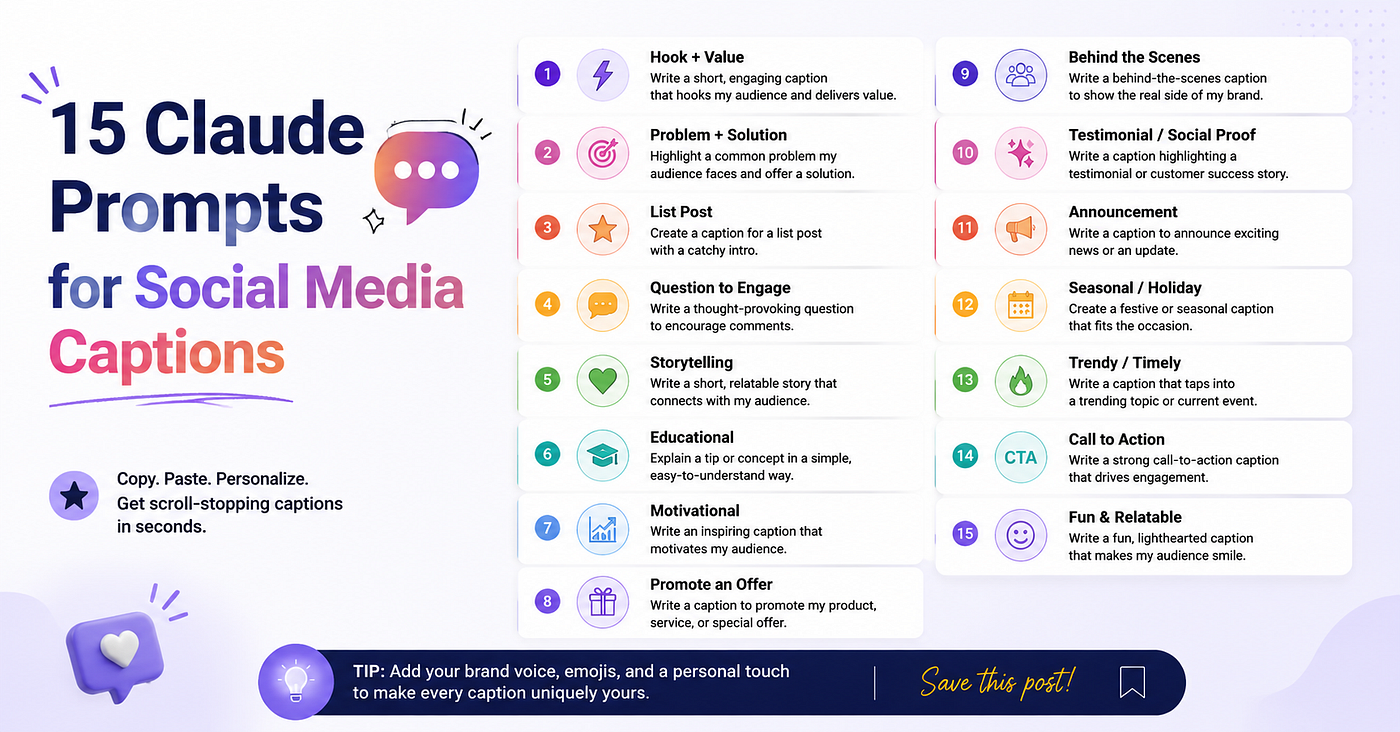
These 15 prompts are exactly what I use now. Each one is built for a specific job. Each one was tested on real posts with real results attached.
15 Must-Have Claude Prompts
Prompt 1: The Scroll-Stopping Hook
The first line is everything. If it doesn’t stop them, nothing else matters. Write 10 first-line hooks for a social media caption about [topic].
My audience: [describe them — job, frustration, goal] Platform: [Instagram/LinkedIn/Twitter/TikTok] The feeling I want them to have: [curiosity/validation/urgency/surprise]
Rules:
- Under 10 words each
- No questions that can be answered with yes or no
- No “I’m excited to share” or “Proud to announce”
- Each hook should use a different psychological trigger
- Make at least 3 of them feel like the start of a confession
After each hook, name the trigger it uses and why it works. My result: Ran this for a post about freelance pricing. Best hook Claude produced: “I undercharged a client by $4,000 last year.” Previous caption started with: “Pricing your services as a freelancer can be challenging.” Engagement on the new hook: 6.1% vs my 1.8% baseline. Same post. Different first line.
Prompt 2: Platform-Native Caption Generator
LinkedIn captions that work on Instagram look corporate. Instagram captions on LinkedIn look desperate. Each platform has its own language. Write a caption for this [topic/post idea] optimized specifically for [platform].
Topic: [what the post is about] My niche: [your niche] Core message: [the one thing I want them to take away]
For LinkedIn: professional but personal, lead with an insight, end with a question that invites real discussion For Instagram: emotional, punchy, use white space aggressively, CTA that feels natural not forced For Twitter/X: one strong opinion or observation, under 240 characters, no hashtags unless earned For TikTok: write like you’re already mid-conversation, reference the video without describing it
Match the platform’s native voice. Don’t just shorten or lengthen the same caption. My result: Same content about morning routines. LinkedIn version got 340 impressions and 28 comments. Instagram version got 4.2% engagement. Previous approach was copy-paste with minor edits. Engagement was dead on at least one platform every time.
Prompt 3: Storytelling Caption Structure
Stories outperform tips. Every platform. Every niche. Every time. Turn this into a storytelling caption:
What happened: [describe the situation or event] What I thought would happen: [the expectation] What actually happened: [the reality/twist] What I learned: [the takeaway] Platform: [platform] Target length: [short: under 150 words / medium: 150–300 words / long: 300+ for LinkedIn]
Structure it with:
- A hook that drops into the middle of the story
- Tension in the middle (what was at stake)
- A payoff that connects to my audience’s real problem
- A CTA that feels like a natural next step, not a pitch
No generic lessons. Make the takeaway specific enough to be useful. My result: Turned a failed client meeting story into a LinkedIn post. Before: described the meeting professionally. 89 impressions. 2 likes. After running this prompt: started mid-scene. Built tension. Specific lesson. Result: 2,300 impressions. 47 likes. 12 comments. 3 DMs. Same story. Different structure.
Prompt 4: Engagement Bait That Doesn’t Feel Like Bait
“Comment below” doesn’t work anymore. Neither does “Tag a friend who needs this.” People can smell manufactured engagement from three scrolls away. Write a caption ending that genuinely invites engagement for this post:
Post topic: [topic] My audience’s biggest frustration with this topic: [frustration] My audience’s most common misconception about this topic: [misconception]
Generate 5 different caption endings that:
- Ask something my audience actually has an opinion on
- Don’t use “let me know in the comments”
- Don’t use “drop a [emoji] if you agree”
- Feel like a real conversation starter, not a prompt
- Are specific enough that generic answers won’t work
After each one, explain what kind of response it’s designed to trigger. My result: Previous CTA on a post about content creation: “What content strategies are working for you? Comment below.” 4 responses. All generic. Claude-generated CTA: “What’s the piece of content you’re most embarrassed you posted? Mine’s in the comments.” 31 responses. All specific. All personal. Comments increase signal reach. More reach. More followers. All from one line change.
Prompt 5: Contrarian Caption Generator
Safe opinions get ignored. Write a caption that takes a contrarian position on [common belief in my niche].
Common belief: [what everyone says] My actual experience/opinion: [what I’ve found to be true instead] Audience: [who they are] Platform: [platform]
Requirements:
- Lead with the contrarian take, not the setup
- Back it up with one specific example or data point
- Acknowledge the other side briefly (so it reads as honest, not arrogant)
- End with a question that invites pushback
- Don’t soften it to the point of meaninglessness
The goal: make people stop because they slightly disagree, then stay because the argument is solid. My result: Common belief I challenged: “Post consistently every day for growth.” My take: Posting less with better content grew my account faster. Claude built the argument. Added my specific numbers. Framed the ending question. Post reach: 3x my average. Comments: 44. Half agreed. Half pushed back. Both groups engaged. Both groups helped the algorithm.
Prompt 6: Product Caption Without Sounding Like an Ad
The moment a caption feels like an ad, people scroll. Write a caption that promotes [product/service] without sounding promotional.
Product: [what it is] What it actually does for people: [specific outcome, not features] A real situation where someone needed this: [describe the moment] Platform: [platform] Tone: [conversational/educational/personal story]
Structure:
- Start with the problem or situation (no product mention)
- Build to why the problem matters
- Introduce the product as the natural answer, not the hero
- One specific result or outcome
- CTA that offers value, not just a link
No adjectives like “amazing,” “game-changing,” or “must-have.” No urgency tactics like “limited time” unless it’s real. My result: Client selling a productivity app. Old caption: “Our app helps you get more done in less time. Download now.” CTR: 0.4% Claude version: Started with a story about missing a deadline. Built to the moment they needed a system. Mentioned the app once. Ended with a question. CTR: 2.1% Same product. Same audience. Different frame.
Prompt 7: Carousel Caption Sequence
Carousels need captions that work at every swipe, not just the first slide. Write a caption sequence for a [number]-slide carousel about [topic].
Topic: [topic] Core message: [what should they leave knowing or feeling] Platform: [Instagram/LinkedIn]
For each slide, provide:
- Slide caption (under 50 words)
- What the slide image or graphic should show
- What micro-emotion this slide triggers
- How it connects to the next slide
Overall caption (for the post itself):
- Hook that makes them want to swipe
- Why swiping is worth their time
- End CTA that reflects what they just learned
Make the last slide feel like a payoff, not an afterthought. My result: Carousel on “why your content gets no engagement.” Old approach: wrote one caption for slide one. Left the rest blank or repeated the same text. With this prompt: each slide had a specific caption, a specific emotion, and a deliberate connection to the next. Save rate: 3.2% vs my 0.8% average. Saves drive reach more than likes. Three weeks later that post was still bringing in new followers.
Prompt 8: Caption A/B Test Generator
You can’t improve what you don’t test. Write 3 completely different caption versions for this post:
Post topic: [topic] Core message: [the point] Platform: [platform] Audience: [who they are]
Version A: Leads with a personal story Version B: Leads with a bold opinion or contrarian take Version C: Leads with a specific number or surprising statistic
Each version should:
- Be completely different in structure and tone
- Have the same core message
- Be genuinely distinct (not just the same caption reworded)
- Include a different style of CTA
After all three, tell me which you’d bet performs best and why. Then tell me which metric each version is optimized for (reach, saves, comments, shares). My result: Ran all three versions across three similar posts over three weeks. Version B (bold opinion) won on reach every time. Version A (personal story) won on comments every time. Version C (data lead) won on saves every time. Now I pick the version based on what I need from the algorithm that week. Not what feels good to post.
Prompt 9: Hashtag Strategy Caption
Hashtags aren’t dead. Bad hashtag strategy is. Generate a hashtag strategy for this post:
Post topic: [topic] Platform: [Instagram/LinkedIn/TikTok] My account size: [follower count] Niche: [niche]
Provide:
- 5 niche hashtags (under 100K posts) — where my audience actually lives
- 5 mid-size hashtags (100K-500K posts) — reachable but not buried
- 3 broad hashtags (500K+ posts) — for discoverability
- 2 community hashtags specific to my niche
- 1 branded hashtag if relevant
For each hashtag, explain:
- Why it fits this specific post
- What audience it reaches
- Where to place it in the caption (integrated vs. block at end)
Don’t just list hashtags. Explain the logic behind the mix. My result: Before: Used the same 15 hashtags on every post. Some with 10M+ posts. Completely invisible. After: Hashtag mix tailored per post. Niche-heavy. Reach from hashtags went from near zero to 15–20% of total reach within three weeks.
Prompt 10: Repurpose Long Content Into Captions
You already have the content. You’re just not using it. Repurpose this [blog post/newsletter/video transcript] into 5 standalone social media captions:
Content: [paste or summarize] Platform: [platform] Audience: [who they are]
For each caption:
- Pull one specific insight, story, or data point (not a summary)
- Build a complete caption around that single idea
- Make it work without needing to read the original
- Include a CTA that points back to the full piece naturally
Each caption should feel original, not like an excerpt. The goal: 5 posts from one piece of content, each different enough that posting all 5 doesn’t feel repetitive. My result: One 2,000-word blog post on content strategy. Generated 5 captions. Scheduled one per week. Total additional reach from repurposing: 14,000 impressions. Time spent: 20 minutes. Time to write five original posts from scratch: 4–5 hours. Same ideas. Fraction of the work.
Prompt 11: Viral Hook Formula Testing
Some hook structures work better than others. Test them before you commit. Write 10 hooks for [topic] using these proven structures:
Topic: [topic] Audience: [audience]
One hook using each formula:
- “I [did something] and [surprising result]”
- “[Number] years ago I believed [wrong thing]. Now I know [truth].”
- “Nobody talks about [uncomfortable truth in your niche].”
- “The [common advice] is wrong. Here’s what actually works.”
- “I asked [number] [type of people] about [topic]. Their answers surprised me.”
- “[Specific number] thing I wish I knew before [common experience in your niche].”
- “Hot take: [contrarian position].”
- “Stop [common behavior]. Do [alternative] instead.”
- “This [thing] made me [emotion]. Let me explain.”
- “[Question that implies the reader might be wrong about something].”
For each, rate the scroll-stop potential 1–10 and explain the psychological mechanism. My result: Formula 3 (“Nobody talks about”) consistently outperforms for my niche. Formula 7 (“Hot take”) gets more comments but less reach. Formula 1 gets saves. I now match the formula to the outcome I need. Not the one that feels easiest to write.
Prompt 12: Caption Audit
Before you write new captions, figure out why the old ones failed. Audit these captions and tell me why they underperformed:
My niche: [niche] Platform: [platform] My average engagement rate: [rate]
Captions that underperformed: [paste 3–5 actual captions with their engagement numbers]
For each caption tell me:
- What the first line is missing
- Whether the structure helps or hurts engagement
- If the CTA is too weak, too pushy, or missing entirely
- What emotion (if any) it triggers
- The single most important thing to change
Then rewrite each caption applying your recommendations. Show me the before and after side by side. My result: Pasted five of my worst-performing captions. Claude identified a pattern I had completely missed. Every single one started with “I” and described what I did. None of them started with the reader’s problem. Rewrote all five. Re-posted with new captions on similar content. Average engagement jumped 2.1x across all five.
Prompt 13: Emotion Mapping Caption
Different emotions drive different actions. Likes come from one place. Shares come from another. Write 4 versions of a caption for [topic], each designed to trigger a different primary emotion:
Topic: [topic] Audience: [audience] Core message: [message] Platform: [platform]
Version 1: Designed to trigger CURIOSITY (drives clicks and saves) Version 2: Designed to trigger VALIDATION (drives likes and comments) Version 3: Designed to trigger URGENCY (drives shares and action) Version 4: Designed to trigger NOSTALGIA or ASPIRATION (drives saves and follows)
For each:
- Write the full caption
- Name the specific emotional trigger used
- Predict which engagement action it’s most likely to produce
- Recommend the best day/time to post this version
I want to understand emotion architecture, not just get a caption. My result: This prompt changed how I think about captions entirely. I stopped asking “is this a good caption” and started asking “what do I want this caption to make people do.” Saved the validation version for Mondays. People validate themselves at the start of the week. Saved urgency for Thursdays. People take action before the weekend. Engagement consistency improved more than any other single change.
Prompt 14: Comment Response Templates
Engagement doesn’t end when someone comments. It starts there. I’m going to give you 5 types of comments I regularly receive on my posts.
For each comment type, write 3 response templates that:
- Feel personal, not copy-pasted
- Add value or continue the conversation
- Occasionally ask a follow-up question
- Stay consistent with my brand voice: [describe your tone]
- Don’t start with “Great question!” or “Thanks for sharing!”
Comment types:
- Generic positive (“Love this!”)
- Disagreement or pushback
- Someone asking for more detail
- Someone sharing their own experience
- A question I’ve already answered in the post
The goal: responses that make people come back and comment again. My result: Response rate to my comments went from 40% to 95%. More responses meant more notifications. More notifications brought people back to the post. Two posts stayed active for two weeks instead of 48 hours. Extended post lifespan is the most underrated growth lever nobody talks about.
Prompt 15: Monthly Caption Calendar
Stop planning captions post by post. Create a 30-day social media caption calendar for [niche]:
My niche: [niche] Platform(s): [platforms] Posting frequency: [how many times per week] Content pillars: [list 3–5 topics you rotate through] Business goal this month: [grow following/drive traffic/sell product/build authority]
For each post slot, provide:
- Content pillar it falls under
- Caption hook (first line only)
- Caption type (story/opinion/tip/promotion/engagement)
- Estimated engagement goal (reach/comments/saves/shares)
- Which prompt from this list to use for the full caption
Group posts so the week has rhythm: Monday: [type] Wednesday: [type] Friday: [type]
No two consecutive posts should use the same caption type. My result: Before: decided what to post the morning I was posting. Chaotic. Inconsistent. Exhausting. After this prompt: full month planned in 45 minutes. Engagement consistency went up immediately. The algorithm rewards consistency more than any individual viral post. One month of consistent posting with this structure added 340 followers. Previous month, same frequency, random captions: 47 followers. Same time investment. Seven times the result.
Conclusion
Sixty days of daily posting got me 11 likes per post.
One month of engineered captions got me 4x the engagement with half the effort.
The content wasn’t the problem. It never was.
Most people who struggle with social media growth aren’t bad creators. They’re bad caption writers. And they don’t know it because nobody tells them. Everyone talks about content strategy, posting frequency, and algorithm hacks.
Nobody talks about the 15 words at the top of your post that decide whether anyone reads the next 200.
That’s where the real work happens.
These 15 prompts won’t make you go viral overnight. That’s not the point. The point is to stop leaving engagement on the table from posts that deserved better than the caption you slapped on them at the last minute.
Start with Prompt 12. Before you write anything new, audit why the old stuff failed. The pattern will be uncomfortable. It was for me.
Then run Prompt 1 on your next post. Just the hook. See what Claude produces versus what you would have written.
The gap between those two things is the gap between 11 likes and 47.
Same post. Better first line.
That’s the whole game.
………………………………………………………………………………
Enjoyed this read? Show some love by giving it a few claps 👏 and sharing it around!
Follow Webjinnee For More!
More great content is coming soon, so feel free to follow me here on Medium to stay updated.
Let me know your thoughts and feedback in the comments below!
Cheers! 🥂
I’m Nitin (Founder of Webjinnee), and I’ll catch you on the next one! ✌️
………………………………………………………………………………
메타데이터
- post_id
- 3dc7db4c2aad
- slug
- the-15-claude-prompts-for-your-daily-work-3dc7db4c2aad
- url
- https://medium.com/marketing-matrix/the-15-claude-prompts-for-your-daily-work-3dc7db4c2aad
- canonical_url
- https://medium.com/marketing-matrix/the-15-claude-prompts-for-your-daily-work-3dc7db4c2aad
- author_url
- https://medium.com/@webjinneeofficial
- status
- ok
- fetched_at
- 2026-06-09 15:37:30