Unpacking CubeSats: A Detailed Blueprint of Their Design
Ever dreamed of sending your own satellite into orbit? CubeSats — those compact, cube-shaped marvels no bigger than a loaf of bread — are…
Unpacking CubeSats: A Detailed Blueprint of Their Design
Ever dreamed of sending your own satellite into orbit? CubeSats — those compact, cube-shaped marvels no bigger than a loaf of bread — are making that dream a reality for students, startups, and space enthusiasts worldwide. Born in 1999 from a collaboration between Cal Poly and Stanford, CubeSats follow a standardized design that’s revolutionized low-cost space missions. In this deep dive, we’ll dissect every critical component of a CubeSat’s design reference, exploring how these tiny powerhouses operate in the harsh void of space. Let’s build one together, piece by piece, in an engaging journey through their engineering magic.
The Structure: The CubeSat’s Backbone
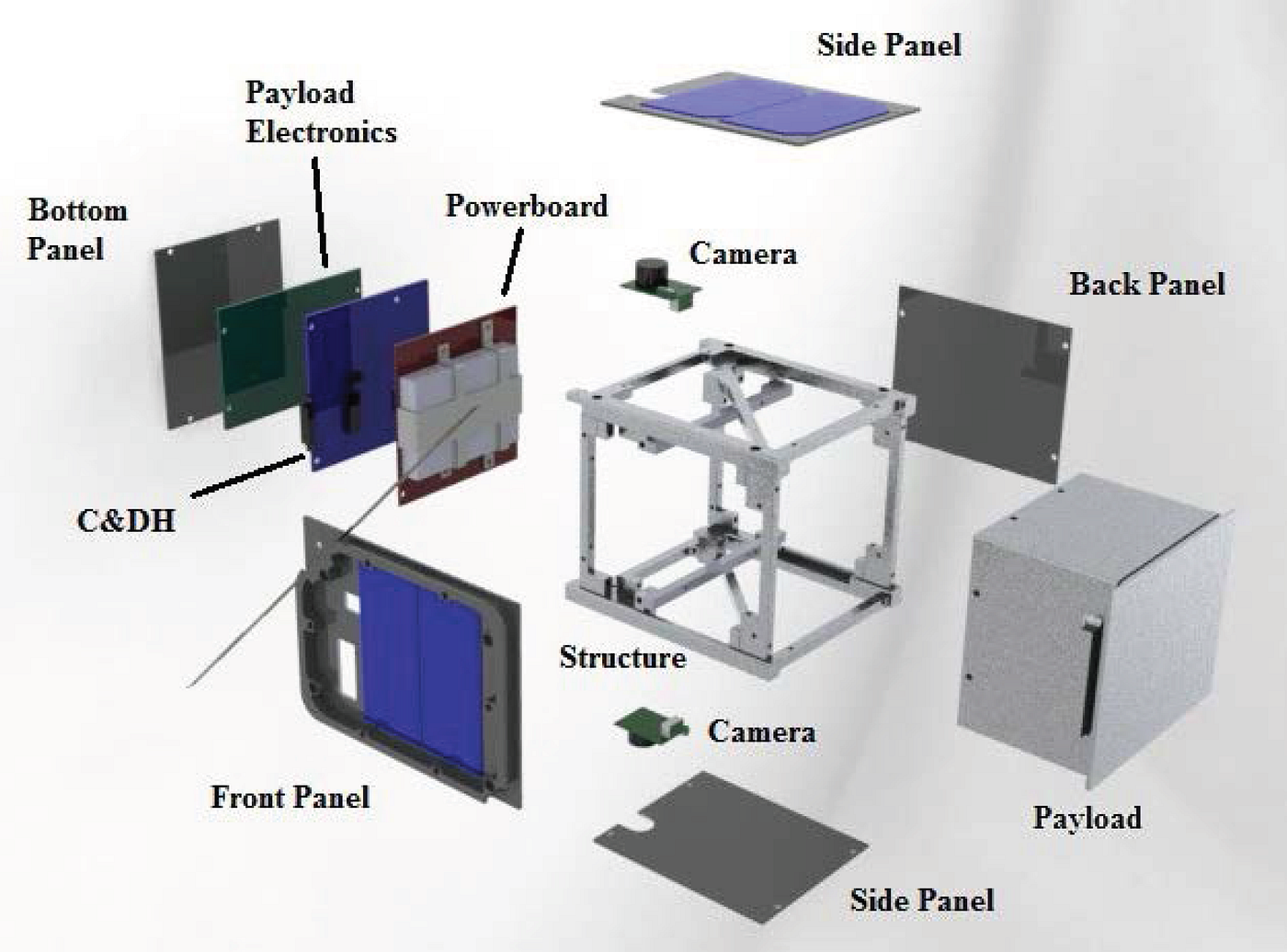
The structure is the CubeSat’s skeleton, a lightweight yet robust framework typically crafted from aluminum 6061-T6 or carbon fiber composites. Standardized in “U” units (1U = 10x10x10 cm, ~2 kg max), it’s designed to endure launch stresses — vibrations up to 10g — and extreme conditions like -40°C to +85°C and the vacuum of space. The chassis features rails for smooth deployment from a launch canister (like a P-POD or ISIPOD) aboard rockets such as SpaceX’s Falcon 9 or Rocket Lab’s Electron. Precision matters: tolerances are tight, often ±0.1 mm, to ensure compatibility with deployers. Think of it as a sturdy, modular box protecting your space dreams.
Electrical Power Subsystem (EPS): The Energy Lifeline
Power keeps a CubeSat alive, and the electrical power subsystem (EPS) is its beating heart. Solar panels, often gallium arsenide cells, cover the exterior or deploy as foldable wings, generating 1–10 watts per U in sunlight. During orbital eclipses (about 30 minutes every 90-minute orbit), lithium-ion batteries — typically 2–20 Wh — take over. Power conditioning units regulate voltage (3.3V or 5V for most components), while maximum power point trackers (MPPTs) optimize solar efficiency. Advanced CubeSats, like NASA’s MarCO, use deployable panels for extra juice, enabling missions as far as Mars. Without a reliable EPS, your satellite’s just space junk.
On-Board Computer (OBC): The Brain
The on-board computer (OBC) is the CubeSat’s brain, orchestrating every operation. Often a microcontroller (like an ARM Cortex-M or radiation-hardened MSP430) or a compact single-board computer (e.g., a modified Raspberry Pi Zero), the OBC runs flight software written in C or Python. It handles task scheduling, data processing, and fault detection — say, rebooting if cosmic rays cause a glitch. Radiation shielding or error-correcting memory (ECC RAM) protects against single-event upsets. For example, the OBC on Planet Labs’ Dove CubeSats processes high-res imagery in real time, proving small doesn’t mean weak.
Communications Subsystem: Phoning Home
The communications subsystem connects your CubeSat to Earth. Transceivers operate on UHF (400–450 MHz) or VHF (144–146 MHz) bands, with data rates from 1,200 baud for simple telemetry to 1 Mbps for images or science data. Patch or dipole antennas, often deployable, ensure reliable links. Ground stations track signals using Doppler shift corrections, while protocols like AX.25 or CCSDS add error correction. Some CubeSats, like those from Spire Global, use S-band for higher bandwidth or even laser comms for cutting-edge missions. It’s your satellite’s voice, whispering data across the cosmos.
Attitude Determination and Control System (ADCS): Staying Oriented
To point cameras or antennas accurately, the attitude determination and control system (ADCS) keeps the CubeSat oriented. Sensors — sun sensors, magnetometers, gyroscopes, or star trackers — determine its position and rotation relative to Earth or stars. For instance, star trackers can achieve arcsecond precision by mapping constellations. Actuators like reaction wheels (spinning masses for torque), magnetorquers (interacting with Earth’s magnetic field), or micro-thrusters adjust orientation. A 3U CubeSat might use a reaction wheel assembly for fine pointing, like NASA’s ASTERIA, which nailed exoplanet observations. No ADCS? Your CubeSat’s tumbling blindly.
Payload: The Mission’s Purpose
The payload is the CubeSat’s raison d’être, tailored to its mission. Earth-observing CubeSats, like those from Planet Labs, carry multispectral cameras capturing 3–5 m resolution images. Science missions might pack spectrometers for atmospheric studies or radiation detectors for space weather. Some even test biology in microgravity, like NASA’s BioSentinel studying yeast in deep space. Payloads drive design: a 1U CubeSat might dedicate 50% of its volume to a camera, while a 6U offers more room for complex instruments. It’s the star of the show, defining what your CubeSat does.
Propulsion: Adding Mobility
While not standard, propulsion systems give CubeSats maneuverability. Cold-gas thrusters, like those on CubeSail, use compressed nitrogen for small delta-V changes (10–100 m/s), adjusting orbits or avoiding debris. Electric propulsion, like ion thrusters, offers higher efficiency for interplanetary missions — think JPL’s Lunar Flashlight. Propulsion adds complexity and cost, so many CubeSats rely on natural orbital decay, lasting 1–5 years in low Earth orbit (LEO). It’s like giving your CubeSat a tiny jetpack for cosmic adventures.
Thermal Control: Surviving Extremes
Space swings from scorching to freezing, so thermal control keeps components in check. Passive systems — multilayer insulation (MLI) blankets or reflective coatings — manage heat by reflecting sunlight or trapping warmth. Active systems, like heaters or radiators, are rare in CubeSats due to power constraints but appear in larger 6U designs. Thermal modeling ensures components stay within -20°C to +60°C. For example, the MarCO CubeSats used MLI to survive deep space. It’s the unsung hero keeping your electronics cozy.
Putting It All Together
Every component interlocks like a cosmic puzzle, guided by standards like the CubeSat Design Specification (CDS) from Cal Poly. A typical 3U CubeSat might weigh 4 kg, cost $50,000–$200,000 to build, and launch for $100,000–$300,000 via rideshare programs. From climate monitoring to asteroid prospecting, CubeSats are versatile. Want to start? Check NASA’s CubeSat 101 guide or join AMSAT’s community. The stars are closer than you think — design, launch, explore!
Reference
메타데이터
- post_id
- 3dca55171e42
- slug
- unpacking-cubesats-a-detailed-blueprint-of-their-design-3dca55171e42
- url
- https://levelup.gitconnected.com/unpacking-cubesats-a-detailed-blueprint-of-their-design-3dca55171e42
- canonical_url
- https://levelup.gitconnected.com/unpacking-cubesats-a-detailed-blueprint-of-their-design-3dca55171e42
- author_url
- https://medium.com/@giulio.sistilli
- status
- ok
- fetched_at
- 2026-06-25 12:15:08