Your Community Forum Is a Gold Mine. Your Support Team Is Treating It Like a Landfill.
The real problem with forum support isn’t volume. It’s the invisible architecture holding everything apart and the new AI workflows is…
Your Community Forum Is a Gold Mine. Your Support Team Is Treating It Like a Landfill.
The real problem with forum support isn’t volume. It’s the invisible architecture holding everything apart and the new AI workflows is finally building to fix it.
There’s a strange irony buried inside every growing product’s community forum. The forum is, by almost any measure, the richest source of signal a team will ever have. Edge cases that no roadmap predicted, and no QA team ever imagined. Solutions that community members share before the fix makes it into the product. Bugs that surface weeks before monitoring tools catch them. Feature requests that become the product roadmap when they are properly surfaced and connected.
“Discourse Forum is one of the most efficient support systems. It scales without adding cost, as users answer each other’s questions and build a searchable knowledge base over time.”
And yet for most support teams, the community forum is also where things quietly fall apart. Not when the community is small and the team can read every thread. The collapse happens slowly, then suddenly — the way Hemingway described bankruptcy. More users. More threads. More replies stacking onto already-resolved discussions. More of the same question arriving in ten different phrasings. And context scattered across GitHub issues, email chains, Notion docs, and past messages.
Eventually, the forum stops being a place where issues get resolved. It becomes a place where they accumulate.
The Real Problem with Growing Community Forum Support Is Fragmentation
The standard response to this kind of friction is a headcount argument. More support agents. More moderators. Better tagging. Smarter templates. And for a while that works but it breaks because the problem was never volume but context.
Why Context Fragmentation Is Costing Support Teams More
Support agents spend considerable time toggling between tools like checking ticket systems for history, billing platforms for account details, CRMs for customer profiles. Each tool holds a piece of the picture. None of them holds the whole thing. So, before anyone can solve an issue, they have to reconstruct the issue which means assembling context from a half-dozen disconnected sources while the queue keeps growing behind them.
This is where the real cost lives, and it is larger than most organizations realize. Research by Gloria Mark, drawing on Microsoft data, finds that frequent context switching significantly reduces productivity with some estimates placing the annual cost at hundreds of billions of dollars in the US economy alone. That sounds abstract until you translate it into something concrete: a support engineer who spends the first twenty minutes of every ticket rebuilding context.
For forum-based support, this effect is compounding. A Discourse thread doesn’t exist in isolation. It connects or should connect to GitHub issuesR, support email, documentation pages, and internal decisions. The support agent who needs all of this has to go find it, one tab at a time, every single time.
Key insight:
The community forum isn’t broken. The architecture that holds it apart from everything else is. Fixing forum support means fixing the connections, not the forum.
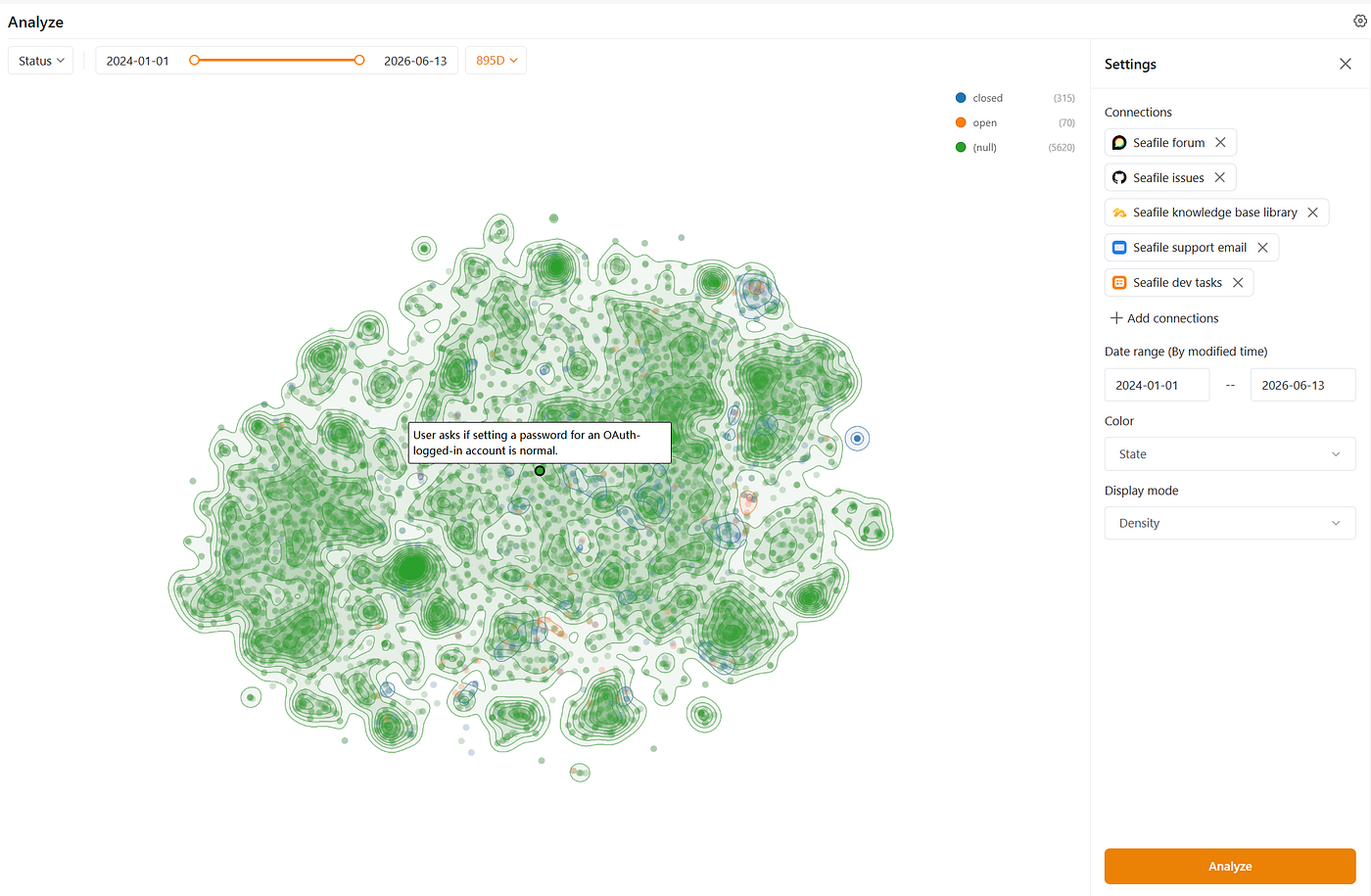
What Community Forums Capture and Why It’s Undervalued
It’s worth pausing on what community forums actually capture, because this is the thing most organizations systematically undervalue.
GitHub Issues handles bugs. Documentation explains APIs. But the community forum captures something neither does: practical knowledge from thousands of people. That knowledge base becomes more valuable as it grows, turning the forum into living infrastructure rather than just another support channel.

The key phrase is living infrastructure. A forum thread isn’t a ticket that closes and disappears. It’s a document that accumulates meaning over time — as more users confirm the same issue, as replies evolve, as the original question gets refined by the community into something more precise than the person who asked it knew how to articulate. Forums are, in a very real sense, the best-quality training data a product team will ever generate about their own product’s failure modes.
The gap between what forums contain and what teams extract from them is where enormous amounts of value quietly disappear.
Agentic AI and the Shift in Community Forum Support
Something meaningful has changed in how organizations think about this problem. The conversation shifted — it stopped being about automation, the idea that AI could simply replace the support loop and started being about intelligence. Specifically: how do you give an AI agent enough context to be genuinely useful rather than confidently wrong?
The defining trends of 2026 include agentic AI (autonomous decision-making), hyperautomation, intelligent process automation, and cross-system orchestration. Alongside these, most enterprises are adopting AI governance frameworks and human-in-the-loop models to maintain control and compliance as automation scales across departments.
What is Agentic AI?
AI systems that are capable of autonomous decision-making and multi-step reasoning. Systems that can plan, retrieve, analyze, and produce outputs without requiring your instruction at each step. For support operations, this means AI that can analyze a forum thread, retrieve related context from multiple connected systems, and produce structured recommendations — all before opening the issue.

Human-in-the-Loop: An Architecture, not a Compromise
The phrase that matters most here is human-in-the-loop. It sounds like a hedge — a way of acknowledging that AI isn’t ready to go fully autonomous. But the better framing, the one emerging from teams that have actually deployed agentic systems in production, is that HITL isn’t a fallback. It’s an architecture choice.
What is Human-in-the-loop (HITL)?
AI governance approach where qualified people retain decision authority at critical points in an automated workflow. In practice, it means a person with timely context, authority to intervene, and a defensible rationale is embedded at key decision points.
For forum support: AI analyzes and suggests; you review, modify, and approve. Nothing executes without your authorization.
The promise of AI agents is autonomy: systems that reason, decide, and act without constant supervision. Most enterprise teams discover quickly that full autonomy isn’t the actual goal. The goal is controlled autonomy — agents that operate independently within defined boundaries, escalate when necessary, and integrate your judgment exactly where it adds the most value.
For community forum support, this distinction is critical. The goal isn’t an AI that automatically replies to every thread. The goal is an AI that understands every thread deeply enough to tell your team what the thread is actually about, what it connects to, and what action would most likely resolve it, so they can decide in seconds instead of twenty minutes.

The Architecture of Connected Community Forum Support
What AI-powered forum support looks like in practice is a fundamental rethink of how forum discussions flow through the rest of a support ecosystem.
The Traditional Model
The traditional model is siloed by design. Discourse lives here. GitHub lives there. Email is somewhere else. Documentation is wherever the last person who updated it decided to put it. The support agent job is to manually connect these systems every single time they work a ticket. They are doing the work that software should be doing.
The Emerging Model: Context Arrives Before the Agent Does
The emerging model inverts this entirely. Instead of the agent moving between tools to assemble context, a unified workspace assembles context before the agent ever looks at the issue. The forum thread arrives with its history already attached — related discussions, linked GitHub issues, relevant documentation, previous resolutions from similar cases.

This changes the nature of the work fundamentally. Rather than support agents being downstream of AI decisions — executing what the system suggests — they are upstream: setting direction, exercising judgment on analysis the AI has already structured. That’s a qualitatively different job. And a more satisfying one.
What AI analysis produces in a connected forum workflow:
Structured outputs — what changed, what the thread connects to, what might be happening, and what actions are worth considering. Your team reviews, decides and approves. Then, and only then, does anything happen externally: a reply posted to the forum, a label added to a GitHub issue, an internal ticket created for engineering follow-up.

Knowledge That Compounds: The Long-Term Case for Unified Forum Support
There’s a longer-term value here that often gets overlooked in conversations about support tooling. Every resolved community forum thread is a dataset. Every confirmed bug is a pattern. Every feature request closed as “not planned” is a record of what the product chose not to do and why. This information has value beyond the original resolution — but only if it’s captured somewhere searchable, structured, and connected to future analysis.
Most support workflows don’t do this. Issues resolve, threads close, and the knowledge just generated dissipates into the archive. The next time a similar issue arrives, someone starts from zero.
“The systems breaking this pattern treat resolved tickets not as endpoints but as entries — records that future AI analysis can draw on when a related discussion surfaces next month.”
When an issue resolves in a well-architected system, it becomes a knowledge base record. Future AI analysis draws on it automatically when a related discussion surfaces. The forum builds on itself. The context the AI brings to next month’s threads is richer than what it brought to this month’s, because this month’s resolutions are now part of the foundation.
This is what compounding looks like in support operations. Not just faster ticket resolution, though that is a symptom. It’s an organization that gets measurably smarter about its own product over time, automatically — because the workflow is designed to capture learning rather than discard it.

What Support Teams Actually Gain:
“More efficient support” is a phrase that sounds meaningful and says nothing. Here is what the shift actually produces.
The concrete change is this: support teams stop starting from zero.
When a new community forum thread arrives, the context around it is already assembled. When a related GitHub issue exists, it’s already linked. When the same question came up three months ago and was resolved a particular way, that resolution is already visible. The engineer doesn’t search. They review.

AI-powered unified knowledge search significantly reduces context switching by delivering answers in the flow of work. The community forum stops being a place that exists outside the support system. It becomes part of it — continuously synced, analyzed, and connected to everything else the team works with.
FAQ: Community Forum Support and AI Workflows
What is the biggest problem with scaling community forum support?
The biggest problem is context fragmentation, not volume. Support agents must manually reconstruct context by toggling between ticket systems, billing platforms, CRMs, GitHub issues, and documentation for every new forum thread. This context-switching is the core productivity drain — not the number of incoming questions. Adding headcount treats the symptom; unified workflows treat the architecture.
How does AI improve community forum support in 2026?
Agentic AI automatically assembles context around forum threads before a support agent reviews them — linking related discussions, GitHub issues, documentation, and past resolutions. The AI provides structured analysis: what the issue connects to, what has worked before, what action is worth taking. You make the final decision. This eliminates the reconstruction phase that currently consumes the majority of per-ticket time.
Why are community forums more valuable than chat support for product teams?
Community forums are public, indexed by search engines, and accumulate knowledge permanently. Each resolved thread becomes a searchable resource for future users — creating compounding value over time. Private chat support is ephemeral: when the conversation ends, the knowledge may disappear. Forums drive both customer retention and top-of-funnel organic search discovery. Chat helps only the current customer. For a growing product, this has significant long-term consequences for support cost and SEO alike.
How does Discourse integrate with GitHub and support tools in an AI support workflow?
In a unified AI support workflow, a middleware layer continuously syncs Discourse threads with GitHub issues, email tickets, documentation, and other support platforms. When a new thread arrives, the AI retrieves and surfaces all related records from connected systems before the support agent ever opens the issue. No manual tab-switching.
The Bottom Line: Your Community Forum Was Always the Signal
The underlying premise of forum-based community support is a sound one. Let users talk to each other, in public, in a structured format that accumulates knowledge over time. The forum is one of the most efficient support mechanisms ever designed. It scales without scaling costs, because users answer each other’s questions, and each answer compounds into a searchable archive that helps every future visitor.
The breakdown happens not because forums are wrong, but because the infrastructure around them doesn’t treat them as a first-class data source. They become a fire to manage rather than a signal to read.
Organizations that continue deploying standalone AI features on top of fragmented support stacks will see diminishing returns. Those that embed AI into their workflows — connected to their forum, their GitHub, their documentation, and their ticket systems — will drive value that moves the business forward: not just efficiency gains, but better product decisions, stronger team alignment, and a support operation equipped to grow with the community.
The forum isn’t the problem. The isolation is. And the fix isn’t more headcount, better tagging, or smarter templates. It’s architecture — the kind that connects a Discourse thread to the rest of your support ecosystem, brings AI intelligence to bear on what’s actually happening, and keeps humans in the position where they belong: deciding, not reconstructing.
That’s the model 2026 is building toward. Not AI that replaces the support team. AI that gives the support team back what fragmentation took from them: the time to actually think.
Explore how unified forum support workflows are changing the way product teams handle community issues at seaticket.ai
메타데이터
- post_id
- 3dd7a121ff54
- slug
- your-community-forum-is-a-gold-mine-your-support-team-is-treating-it-like-a-landfill-3dd7a121ff54
- url
- https://medium.com/@seaticketai/your-community-forum-is-a-gold-mine-your-support-team-is-treating-it-like-a-landfill-3dd7a121ff54
- canonical_url
- https://medium.com/@seaticketai/your-community-forum-is-a-gold-mine-your-support-team-is-treating-it-like-a-landfill-3dd7a121ff54
- author_url
- https://medium.com/@seaticketai
- status
- ok
- fetched_at
- 2026-08-04 02:42:28




