Managing Instability in the Age of AI: Why Intuition Has Become a Strategic Capability
Artificial intelligence is often described as a tool that improves decision-making. In practice, it is doing something more consequential…
Managing Instability in the Age of AI: Why Intuition Has Become a Strategic Capability
Artificial intelligence is often described as a tool that improves decision-making. In practice, it is doing something more consequential: it is reshaping how decisions are framed, accelerated, and governed inside organizations. As AI compresses time and expands interdependence across functions, instability is no longer an exception but a structural condition of operating at scale. What ultimately distinguishes resilient organizations from fragile ones is not the sophistication of their algorithms, but whether human judgment — especially intuition — can improve and scale alongside AI rather than be crowded out by it (Snowden & Boone, 2007; World Economic Forum, 2024).
This challenge is frequently misunderstood. When AI-enabled systems behave unpredictably, executives often respond by demanding better data, more sophisticated models, or tighter controls. These reactions assume that instability is a technical flaw, when in reality it is a design and governance problem. From a systems perspective, instability emerges when decision velocity increases faster than an organization’s capacity for sense-making. AI accelerates feedback loops, shortens reaction times, and tightly couples decisions that were once loosely connected, creating cascading effects that escape linear management logic (Meadows, 2008; Sterman, 2000). What appears as volatility is often a symptom of structural misalignment rather than operational failure.
In such environments, analytical reasoning alone reaches its limits. Data-driven optimization performs well when systems are relatively stable, variables are observable, and historical patterns remain predictive. Yet AI is increasingly deployed precisely where these conditions do not hold — markets shaped by uncertainty, novelty, and rapid change. In these contexts, leaders are not short of information; they are overwhelmed by signals without a shared hierarchy of meaning. The executive challenge shifts from prediction to prioritization: deciding what matters when objectives conflict and trade-offs are unavoidable (Kahneman, 2011; OECD, 2024).
This is where intuition becomes indispensable. Properly understood, intuition is not instinct or impulse. It is a form of expert pattern recognition developed through experience, allowing decision-makers to integrate weak signals, contextual cues, and cross-domain knowledge when formal models fall short. As AI takes over execution and prediction, intuition migrates upstream — toward problem framing, boundary-setting, and strategic judgment. These are the decisions that shape long-term value creation, risk exposure, and organizational legitimacy (Kahneman & Klein, 2009; Klein, 2017).
The difficulty is that most organizations still treat intuition as an individual trait rather than a system capability. In the early stages of AI adoption, decision-making is often fragmented: algorithms optimize locally while coherence at the enterprise level erodes. As confidence in models grows, organizations frequently drift toward model-centric control, implicitly trusting outputs while accountability becomes diffuse. For boards and investors, this diffusion of accountability represents a material governance risk, particularly when failures occur without clear ownership (MIT Sloan Management Review, 2023; World Economic Forum, 2023).
Only a minority of organizations move beyond this reactive phase. Those that do recognize that the core challenge is not technological maturity but decision maturity. They explicitly define which decisions machines may optimize and which require human judgment, and they institutionalize escalation points where intuition must override automation. In these organizations, accountability remains human even when execution is automated — a prerequisite for regulatory trust, reputational resilience, and investor confidence (European Commission, 2024; OECD, 2024).
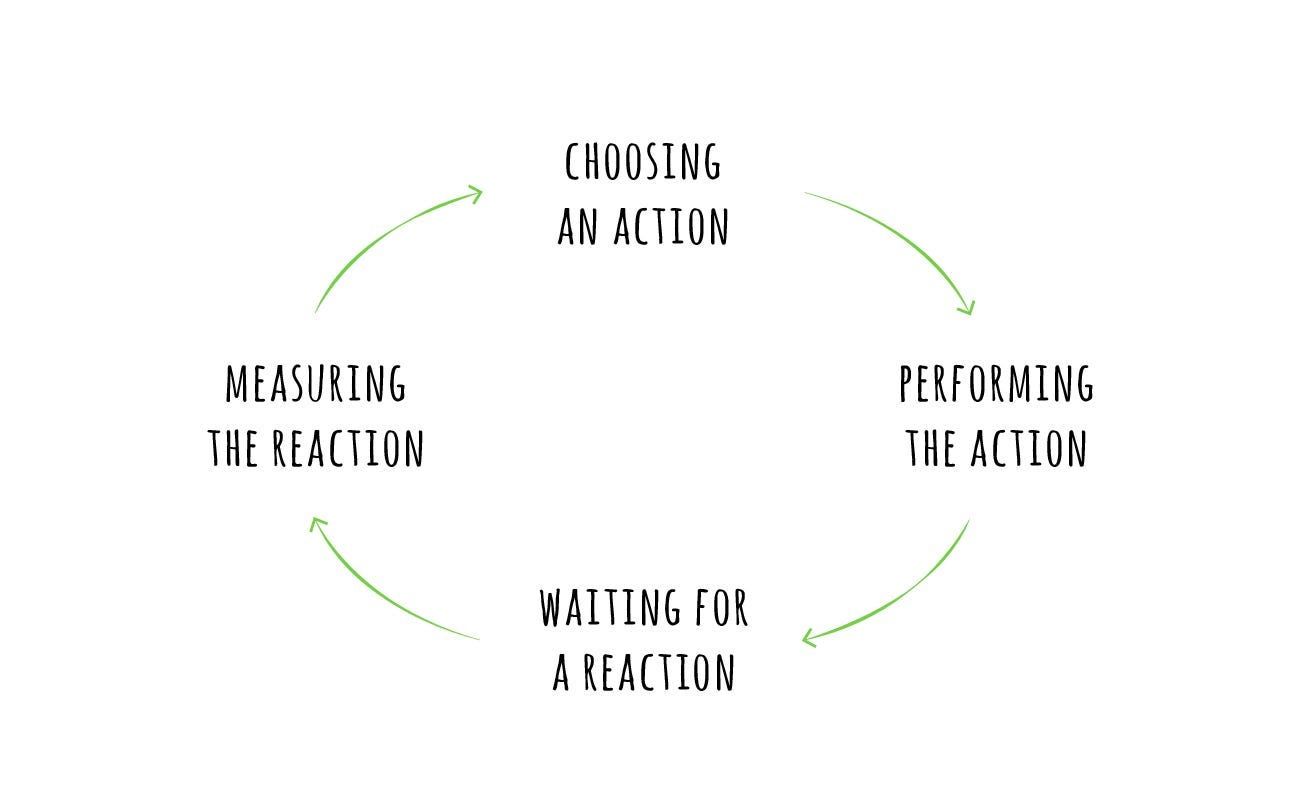
From a systemic perspective, this design choice is decisive. AI-enabled systems naturally generate reinforcing loops: faster decisions increase confidence, confidence drives further automation, and speed amplifies fragility. Intuition introduces balancing dynamics. It slows decisions when risk accumulates, reframes problems before optimization locks organizations into value-destroying paths, and surfaces weak signals long before performance metrics register change. Without these balancing mechanisms, efficiency gains are achieved at the expense of resilience (Meadows, 2008; Sterman, 2000).
This is why managing instability in the age of AI is fundamentally a leadership and governance issue. Organizations rarely fail because an algorithm is inaccurate; they fail because no one is clearly accountable for deciding when the algorithm should not decide. Treating intuition as “soft” or subjective obscures its real economic function: maintaining coherence when complexity exceeds formal models. In AI-driven environments, intuition is not the opposite of rigor — it is what rigor requires when certainty disappears (Snowden, 2010; Financial Times, 2025).
For executives, analysts, and shareholders, the implications are stark. Competitive advantage will not come from superior algorithms alone, which are rapidly commoditizing. Advantage will accrue to organizations that design human–AI decision systems capable of learning, adapting, and remaining legitimate under pressure. These organizations reduce systemic risk not by slowing innovation, but by aligning speed with sense-making, thereby protecting long-term value and trust across stakeholders (McKinsey Global Institute, 2024; World Economic Forum, 2025).
This brings the argument full circle. In the AI era, instability is unavoidable. The strategic question is no longer how to eliminate it, but how to operate intelligently within it. That question leads directly to the central issue leaders must confront: how can organizations improve intuition at scale, rather than rely on it accidentally? The answer does not lie in individual brilliance or executive instinct alone, but in the deliberate design of decision systems that make room for judgment under uncertainty, clarify override authority, and reward sense-making as much as speed. In such organizations, intuition becomes a strategic capability — one that determines whether artificial intelligence strengthens resilience and valuation, or quietly amplifies risk.
References
European Commission. (2024). Ethics guidelines for trustworthy artificial intelligence: Implementation and governance update. Publications Office of the European Union. https://digital-strategy.ec.europa.eu
Financial Times. (2025). Why human judgment still matters in an age of automated decision-making. Financial Times. https://www.ft.com
Kahneman, D. (2011). Thinking, fast and slow. Farrar, Straus and Giroux.
Kahneman, D., & Klein, G. (2009). Conditions for intuitive expertise: A failure to disagree. American Psychologist, 64(6), 515–526. https://doi.org/10.1037/a0016755
Klein, G. (2017). Sources of power: How people make decisions (2nd ed.). MIT Press.
McKinsey Global Institute. (2024). The economic potential of generative AI: The next productivity frontier. McKinsey & Company. https://www.mckinsey.com
Meadows, D. H. (2008). Thinking in systems: A primer. Chelsea Green Publishing.
MIT Sloan Management Review. (2023). Governing AI: Building trust and accountability at scale. MIT Sloan Management Review. https://sloanreview.mit.edu
OECD. (2024). AI governance and accountability: Policy considerations for high-impact AI systems. OECD Publishing. https://www.oecd.org
Snowden, D. J. (2010). The Cynefin framework. Cognitive Edge. https://cognitive-edge.com
Snowden, D. J., & Boone, M. E. (2007). A leader’s framework for decision making. Harvard Business Review, 85(11), 68–76.
Sterman, J. D. (2000). Business dynamics: Systems thinking and modeling for a complex world. McGraw-Hill.
World Economic Forum. (2023). Global AI governance: Aligning innovation with responsibility. World Economic Forum. https://www.weforum.org
World Economic Forum. (2024). AI in strategic foresight: Governance, risk, and resilience. World Economic Forum. https://www.weforum.org
World Economic Forum. (2025). The global risks report 2025. World Economic Forum. https://www.weforum.org
AILeadership, #AIgovernance, #StrategicDecisionMaking, #HumanAI, #ExecutiveDecisionMaking, #BusinessResilience, #CorporateGovernance, #AIrisk, #SystemsThinking, #LeadershipStrategy, #DecisionIntelligence, #AIethics, #BoardGovernance, #DigitalTransformation, #FutureOfLeadership
메타데이터
- post_id
- 3de8bb40122d
- slug
- managing-instability-in-the-age-of-ai-why-intuition-has-become-a-strategic-capability-3de8bb40122d
- url
- https://medium.com/@tarifabeach/managing-instability-in-the-age-of-ai-why-intuition-has-become-a-strategic-capability-3de8bb40122d
- canonical_url
- https://medium.com/@tarifabeach/managing-instability-in-the-age-of-ai-why-intuition-has-become-a-strategic-capability-3de8bb40122d
- author_url
- https://medium.com/@tarifabeach
- status
- ok
- fetched_at
- 2026-06-09 15:37:30