The Hidden Meanings Behind Sandro Botticelli’s Primavera
Sandro Botticelli’s Primavera (circa 1480) is one of the most celebrated works of the Italian Renaissance. Painted for the Medici family…
The Hidden Meanings Behind Sandro Botticelli’s Primavera
Sandro Botticelli’s Primavera (circa 1480) is one of the most celebrated works of the Italian Renaissance. Painted for the Medici family, this large and intricate work brims with mythological figures, symbolizing not only the arrival of spring but deeper themes of love, fertility, and power. The painting’s layered symbolism has intrigued art historians for centuries, revealing hidden meanings that go beyond its surface beauty.
The Central Theme: Spring and Fertility
In Sandro Botticelli’s Primavera, the central theme of spring and fertility is presented through a vibrant composition of mythological figures, lush flora, and symbolic gestures. The painting exudes a celebration of nature’s rebirth, echoing the seasonal renewal that comes with the arrival of spring. This theme is intricately linked with ideas of fertility, growth, and the life cycle, as represented by the characters of Venus, Flora, Zephyr, and Chloris.
At the heart of the painting stands Venus, the Roman goddess of love, beauty, and fertility. She is often interpreted as embodying the harmony and balance that springtime brings to the natural world. In many readings, Venus is the orchestrator of the scene, symbolizing the creative and generative forces that drive nature’s renewal. Her serene posture and placement at the center indicate her role as a guiding force of love, both romantic and cosmic. Venus’s presence in the garden suggests that love, in all its forms, is essential to the natural order and the continuation of life.
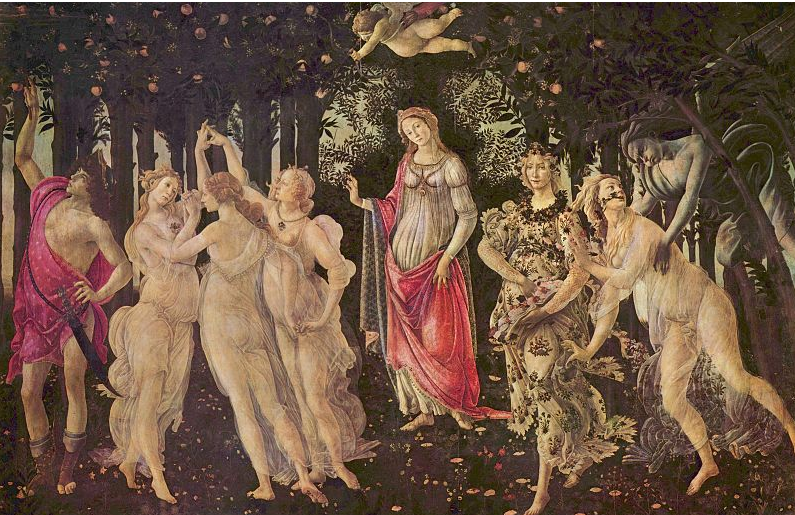
On the right side of the composition, we see Zephyr, the god of the west wind, aggressively pursuing Chloris, a nymph associated with spring. According to classical mythology, Zephyr abducts Chloris, but after their union, she transforms into Flora, the goddess of flowers and spring. Flora, now depicted scattering flowers across the garden, embodies the flourishing of nature, a symbol of fertility and the abundance that follows the arrival of spring. The transformation of Chloris into Flora is a metaphor for the cycle of death and rebirth inherent in nature — a key aspect of the painting’s deeper symbolism. It also suggests that from tumultuous forces (represented by Zephyr), beauty and fertility (Flora) can arise.
The floral motifs throughout Primavera are central to its theme of fertility. Art historians have identified over 500 different plant species in the painting, each symbolizing various virtues or aspects of growth and life. Flora, as she scatters these flowers, acts as a literal and figurative symbol of spring’s fecundity. The painting also coincides with Renaissance ideals that revered nature’s regenerative cycles, linking the renewal of spring to human creativity and intellectual blossoming.
Overall, Botticelli’s Primavera uses the allegory of spring and fertility not only to celebrate nature’s beauty but also to suggest deeper philosophical themes related to life, love, and the eternal cycle of growth and decay. Through its intricate depiction of mythological figures and lush, blooming nature, the painting communicates a universal truth about the vitality of spring as a symbol of renewal and transformation.
The Medici Influence and Neoplatonism
The Medici family, prominent patrons of the arts in Renaissance Florence, played a crucial role in shaping the intellectual and cultural landscape of the period. Botticelli’s Primavera reflects this influence, particularly through its connections to Neoplatonism, a philosophical movement supported by the Medici court. Neoplatonism sought to harmonize classical Greco-Roman ideas with Christian theology, emphasizing the notion of a divine hierarchy and the elevation of the human soul toward higher ideals.
In Primavera, Venus stands at the center as a symbol of both earthly and divine love, reflecting Neoplatonic ideas of the soul’s journey. In Neoplatonism, physical beauty and love are seen as a pathway to spiritual enlightenment, and Venus represents this duality — she embodies both sensual love (eros) and higher, spiritual love (agape). The presence of Mercury, who uses his caduceus to dispel clouds, symbolizes the clearing of ignorance, promoting intellectual clarity and transcendence.
The Medici influence is also apparent in the painting’s allegory of harmony and civic unity, values the Medici family sought to project as rulers of Florence. Botticelli’s Primavera thus not only celebrates natural beauty but also reflects the intellectual aspirations of Florence’s leading family.
Allegory of the Human Soul
In Sandro Botticelli’s Primavera, an allegory of the human soul is woven into its rich mythological imagery, drawing from the Neoplatonic philosophy of the time. According to Neoplatonism, the soul’s journey is a progression from earthly desires toward spiritual enlightenment, and this is reflected in the figures and their interactions within the painting.
At the center stands Venus, symbolizing love as the mediator between the earthly and divine realms. In this allegory, Venus represents the role of love in guiding the soul towards higher understanding and spiritual purity. Surrounding her are the Three Graces — beauty, chastity, and pleasure — who dance harmoniously, suggesting that balance among these elements leads to virtuous living. Their intertwined hands symbolize the interconnectedness of virtues in the elevation of the soul.

Mercury, positioned to the far left, uses his caduceus to clear away clouds, symbolizing the removal of ignorance and the pursuit of knowledge. This act mirrors the soul’s intellectual ascent in Neoplatonism, where wisdom is essential for spiritual growth. Flora’s transformation from Chloris, too, reflects the soul’s metamorphosis — emerging from base desires (Zephyr’s pursuit) into a state of purity and grace.
Thus, Primavera illustrates the soul’s path, guided by love, knowledge, and virtue toward enlightenment.
Political and Social Commentary
Sandro Botticelli’s Primavera offers a rich political and social commentary, reflecting the cultural and political aspirations of Renaissance Florence, particularly those of the influential Medici family, who commissioned the work. The painting, while often interpreted through mythological and philosophical lenses, subtly conveys messages about the Medici’s role in shaping the city’s prosperity and cultural prominence.
Civic Unity and Cultural Flourishing
The abundant flowers scattered by Flora, the goddess of spring, represent the blossoming of culture, art, and intellect under Medici patronage. The Medici were not only political rulers but also champions of the Florentine Renaissance, fostering a cultural environment where artists, philosophers, and scholars could thrive. Botticelli’s meticulous depiction of over 500 different plant species underscores the theme of fertility and growth, both in nature and in the arts.
Venus’s central position in the garden symbolizes the Medici’s role as a unifying force in Florence, maintaining peace and balance within the city. The harmonious interaction between the mythological figures in the painting suggests an idealized version of Florentine society, one where all elements — whether political, social, or artistic — work in concert to create a thriving city.
Allegory of Florence’s Golden Age
More broadly, Primavera can be seen as an allegory of Florence’s Golden Age under the Medici. The figures of Venus, Flora, and the Three Graces represent the flourishing of art, culture, and intellect that defined the Renaissance, while also symbolizing the Medici’s ability to cultivate this golden age through their patronage and governance.
In conclusion, Primavera serves not only as a celebration of nature and beauty but also as a political statement that reinforces the Medici family’s influence and ideals. Through its allegorical references, the painting reflects the Medici’s vision of Florence as a harmonious and prosperous society under their leadership.
Conclusion
Botticelli’s Primavera is far more than a celebration of spring. It weaves together mythology, philosophy, and politics, reflecting the intellectual and cultural currents of Renaissance Florence. Each figure and gesture is rich with symbolism, making Primavera a complex allegory that explores themes of love, beauty, fertility, and the soul’s journey toward enlightenment. Its hidden meanings have captivated scholars and art lovers for centuries, ensuring its status as one of the most iconic masterpieces of the Italian Renaissance.
메타데이터
- post_id
- 3e07321a5015
- slug
- the-hidden-meanings-behind-sandro-botticellis-primavera-3e07321a5015
- url
- https://medium.com/@gustavowoltmann_31750/the-hidden-meanings-behind-sandro-botticellis-primavera-3e07321a5015
- canonical_url
- https://medium.com/@gustavowoltmann_31750/the-hidden-meanings-behind-sandro-botticellis-primavera-3e07321a5015
- author_url
- https://medium.com/@gustavowoltmann_31750
- status
- ok
- fetched_at
- 2026-07-31 09:22:26




