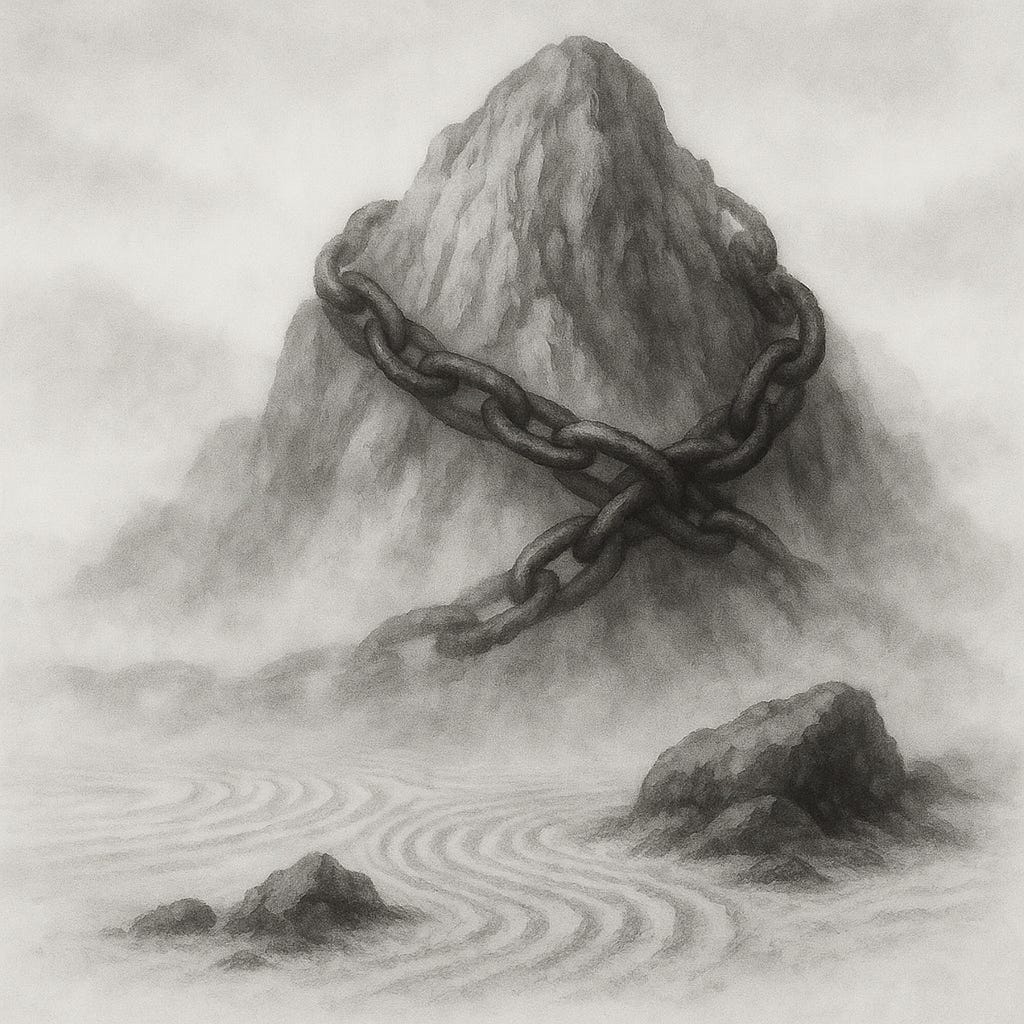
What to Tell Yourself When Everything Falls Apart
Why your wisdom disappears exactly when you need it
What to Tell Yourself When Everything Falls Apart
Why your wisdom disappears exactly when you need it

Here’s what nobody warns you about hard moments.
You have read the books. You know, intellectually, that you should stay calm, assume good intent, focus on what you control. You could give a competent talk on all of it.
And then the message lands, or the meeting goes sideways, or you find out what was said about you when you weren’t in the room. And every bit of that knowledge evaporates. What’s left is heat, and a mind running in tight fast circles, and no access whatsoever to the wisdom you supposedly own.
Knowing what to do and being able to reach it are completely different capacities. Almost nobody builds the second one.
Which is what makes the passage I want to show you so unusual. Somewhere in the source text this series draws from, the teachers do something you almost never see in a wisdom tradition. They stop offering principles. They start offering scripts.
Twenty-six of them. One for each situation.
Not Advice. Instructions.
The structure is always the same. When you find yourself in this situation, tell yourself this.
Not “cultivate equanimity.” Not “practise non-attachment.” The literal sentence to say to yourself, in the moment, when your capacity for original thought has left the building.
It reads less like philosophy and more like a card you’d keep in your wallet. Which, I suspect, is exactly the point.
Because the moment you need wisdom is the moment you are least able to generate it. Your thinking narrows. Your options collapse to two, both bad. What you need at that moment is not a framework. It is a pre-written line, decided by a calmer version of you, that you can simply reach for.
Here are some of them.
When your heart is tied in a thousand knots
The first and most confronting one.
The one who tied the knot must untie it. 解鈴還須繫鈴人.
Whatever is knotted in you was, at some point, knotted by you. Not the event. The knot. Someone else may have handed you the rope, but the tangle is yours, and no amount of waiting for them to apologise will loosen it.
The teachers add a line that closes the last exit: even when communication seems impossible, you must still try.
When you notice you’ve been living inside other people’s opinions of you
Step out of the whirlpool.
Notice the word. Not a wall, not a weight. A whirlpool. Something that pulls you in circles while feeling, from the inside, like motion.
That’s what it is to organise your life around how you are being perceived. Enormous energy. Constant movement. No progress in any direction, because you are orbiting a fixed point that isn’t yours.
When you catch yourself certain you’re right
Put down the “I.” Consider what they’re saying.
Not “you might be wrong.” That’s a proposition, and you can argue with a proposition.
Put down the I is an instruction. Do this thing. It bypasses the debate entirely, which is the only way anything gets past a mind that has already made up its mind.
When you feel envy rising
Look at what they’re actually good at.
This one seems too simple until you try it.
Envy runs on a very specific mental move: reducing a whole person to the one axis where they exceed you. Deliberately widening the frame, actually attending to what they do well and why, breaks the mechanism. It is difficult to resent someone you are genuinely studying.
When you keep needing others to do it your way
Start by changing yourself.
There’s a companion line for the version of this that shows up at work: when you’re sure your idea is right and nobody is following it, ask whether you’re being too sharp for them to receive it.
That’s a hard reframe. The failure of your correct idea might be a delivery problem, and delivery is yours.
When you want to fix the whole organisation
Begin with yourself.
Everyone who has ever wanted to improve a team, a family, or a community has felt the pull to start with the structure. New process. Better system. If only they would.
Start with yourself is not modesty. It is the recognition that you are the only component you have direct write access to.
When you notice you’re getting more miserable, not less
Know yourself.
The teachers put this one exactly where you’d least expect: in the middle of the path, aimed at the person who is doing everything right and feels worse for it.
They don’t say push harder. They don’t say you’re doing it wrong. They say stop and look at what’s actually happening in you. Sometimes the practice is fine and the person has quietly turned it into another way to fail.
When you’ve done your best and it wasn’t received
Persist. Try again.
No consolation. No reframe about how it was valuable anyway.
Some situations don’t have a clever move available. They just have the next attempt. There’s something honest about a tradition that admits it.
The Pattern Underneath All Twenty-Six
Read enough of them together and the shape becomes obvious.
Every single one turns the attention back to the thing you can actually reach.
Someone slandered you? Stand without guilt before Heaven. Someone won’t take your advice? Look at your delivery. The organisation is a mess? Begin with yourself. You feel envious? Change what you’re looking at.
Not one of the twenty-six tells you how to make another person behave differently. Every one of them hands you back a lever you can actually pull.
Epictetus, teaching in a different language on a different continent with no contact between the two traditions, built his entire philosophy on one distinction: some things are within our power and some are not, and nearly all human misery comes from confusing the two.
Same instruction for two different civilisations. Arrived at independently, which is usually a sign that something is true.
Why You Should Write Your Own
Here is the part I’d actually do something with.
You have maybe five situations that reliably undo you. Not twenty-six. Five. The same handful, recurring across different people and years, that reduce you to a worse version of yourself every time.
You already know what they are. You could name them right now.
Write the sentence for each one. Now, while you’re calm. One line, plain language, the thing a steadier version of you would say. Keep them somewhere you can actually get to them, which means your phone and not a notebook in a drawer.
That’s the whole method. It looks almost too basic to work.
It works because the moment is not when you do the thinking. The moment is when you retrieve the thinking you already did. The ancients understood this so well that they wrote twenty-six of them down and handed them over, which is a strange and generous thing for a wisdom tradition to do.
The Long Game
Character is often described as what you do under pressure. That’s roughly right, but it’s missing a step.
What you do under pressure is mostly determined by what you have available under pressure. And what you have available is whatever you prepared when nothing was happening.
Nobody rises to the occasion. You fall back on what you’ve got within reach.
So put something there.
This is Article 11 in Built From Within — a weekly series drawing on ancient wisdom, rewritten for the modern reader. This article opens Volume 3, on the Heart-Mind.
New articles every week. Follow the series so you don’t miss the next one.
메타데이터
- post_id
- 3e2197df4cf7
- slug
- what-to-tell-yourself-when-everything-falls-apart-3e2197df4cf7
- url
- https://medium.com/@twentysix26/what-to-tell-yourself-when-everything-falls-apart-3e2197df4cf7
- canonical_url
- https://medium.com/@twentysix26/what-to-tell-yourself-when-everything-falls-apart-3e2197df4cf7
- author_url
- https://medium.com/@twentysix26
- status
- ok
- fetched_at
- 2026-09-16 06:11:56