Diamonds Best Friend? Cartier @ V&A Museum, London
All the tiaras you could want and more. Plus fascinating provenance notes, and often a diamond count included.
Diamonds Best Friend? Cartier @ V&A Museum, London
All the tiaras you could want and more. Plus fascinating provenance notes, and often a diamond count included.
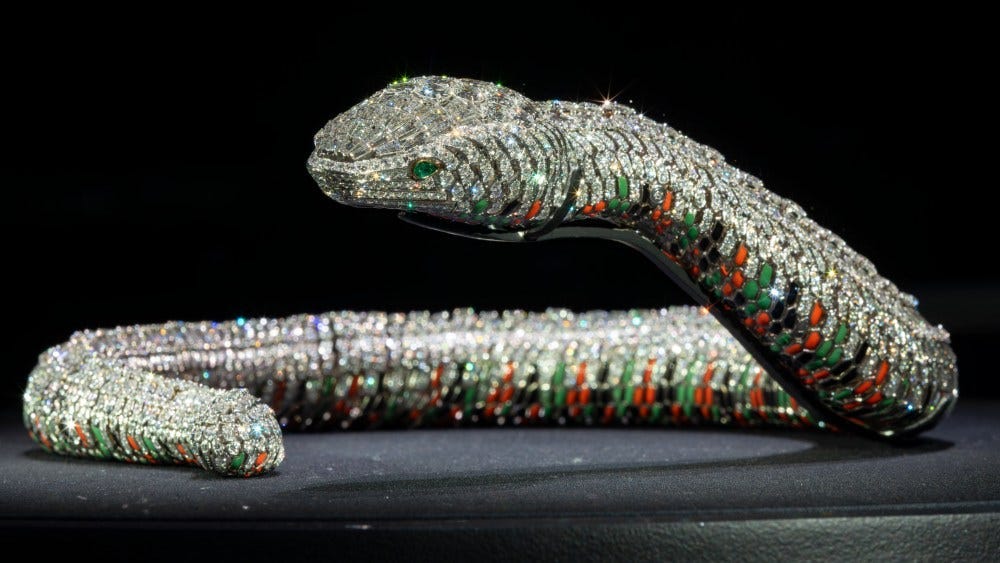
None of the available images do it justice — but over 2470 diamonds on this beauty! which gets to twinkle away in its own case. Although it’s the enamel stripes which dazzle, matching the colours of the Mexican flag. And the thought that it’s a necklace!!!
We learn about the Cartier’s inspiration — from other cultures to tank tracks. And their penchant for softer pastel colours as opposed to the bright fuchsia bling of Faberge. Though Faberge and Cartier were often doing the same kind of luxury creation — detailed enamelling, mineral stone carved animal object d’art, Cartier tended to be softer and smaller. But the colour palettes and style can often look very, very similar.

Surely this mauve desk clock on an ink stand set is Faberge? No, it’s Cartier!
I love the Surrealist Crash wristwatch from 1967, which looks like Dali has broken into Cartier and tampered with the watch designs.

Ofcourse there were the famous jewels — a necklace belonging to Elizabeth Taylor; royal purchases such as clips which made a tiara as well as a diamond engagement ring for Grace Kelly, a panther clip broach for the Duke of Windsor (obs) or the bracelets worn in Sunset Boulevard. Not to mention jewellery worn by Rihanna (the 1902 Scroll tiara).


And a whole room full of tiaras!


I’d like this delicate 1908 one please!

I didn’t expect the clocks, mostly made of see through rock crystal and sometimes imitating Chinese mirror stands. A golden covered book! Or the Persian book binding inspired vanity case, whose sides were worth looking at as much as the delicate front.

Lacquer work, enamel, precious materials and often older jewels or decorations were used to create new Indian, Persian, Asian and Egyptomania inspired designs. For a useful compare and contrast, the curator had inserted some actual originals alongside — such as the Cartier scarab broach, and an ancient Egyptian Scarab. Then there were all the sparkling diamonds, over time, whose backs became as visible and filigreed as their fronts, allowing you view the delicate objects all round. The heart shaped Manchester tiara from 1903 being a case in point:

I really appreciated the info cards warning influencers to be careful when taking photos and to respect other viewers faces! Whilst this didn’t always happen in reality, it’s a really positive behaviour to enforce — we don’t need to point a phone at everything we see, particularly when others are trying to look too!
As well as tiaras, delicate bow broaches were key, sometimes imitating flowing folds of lace too, and enormous necklaces looking like rivals for the 18th-century affair of the diamond necklace. I can hear Marie Antionette stampeding away in horror all over again.


This 1928 multi-tiered necklace I believe has lost its emeralds over the years. Originally made for Bhupindra Singh, Maharaja of Patiala. But imagine it on! And now you can!

Then there were the new functional items for new social lives — the compacts and compact/lipstick broaches, the tiny vanity cases, the cigarette cases and lighters, the evening bag clasps, the bracelet watches (where sometimes the watch would be concealed within the strap), tinier and tinier watches. All combined beauty and functional style.
Got some diamonds lying around? Cartier will conjure something up for you! We also got to glimpse some of the designs, indicating where items should have been enamelled, but ended up being left plain, in some cases.
Then there was all the popping ‘tutti-frutti’, a bubble of multi-coloured gems, seen in a 2024 necklace:

Or the 1928 Mountbatten bandeau — who needs a tiara?!!

Shape and form were also key, combined with cultural influences, combining delicate and bold influences at the same time. Peer closely at Chinoiserie and you’d see the etched faces, very subtle lines — but still there. My only regret (apart from not being able to take a souvenir home, and train chaos making this a speedy visit) is that the presentation cases weren’t mirrored all the way through. I would love to see all of these items all the way round!
It was also intriguing to consider how differently jewels were worn over time, such as many individual jewels originally being in headpieces.

This 1969 lunar model wasn’t included among the many wonderful things — but I wish it had been!

Support my writing and future cultural adventures for the price of a cup of coffee at Kofi: https://ko-fi.com/susanadventuresinculture
@Images are not the author’s own, are the property of Cartier and used purely to illustrate the exhibition Cartier at the Victoria and Albert Museum, London. July 2025
메타데이터
- post_id
- 3e3281dbfa4f
- slug
- diamonds-best-friend-cartier-v-a-museum-london-3e3281dbfa4f
- url
- https://medium.com/@susan-bystryenglish/diamonds-best-friend-cartier-v-a-museum-london-3e3281dbfa4f
- canonical_url
- https://medium.com/@susan-bystryenglish/diamonds-best-friend-cartier-v-a-museum-london-3e3281dbfa4f
- author_url
- https://medium.com/@susan-bystryenglish
- status
- ok
- fetched_at
- 2026-07-19 00:27:16