The Shrine That Survives by Never Surviving
How Japan has preserved its most sacred site for 1,300 years — by destroying it every 20
The Shrine That Survives by Never Surviving
How Japan has preserved its most sacred site for 1,300 years — by destroying it every 20
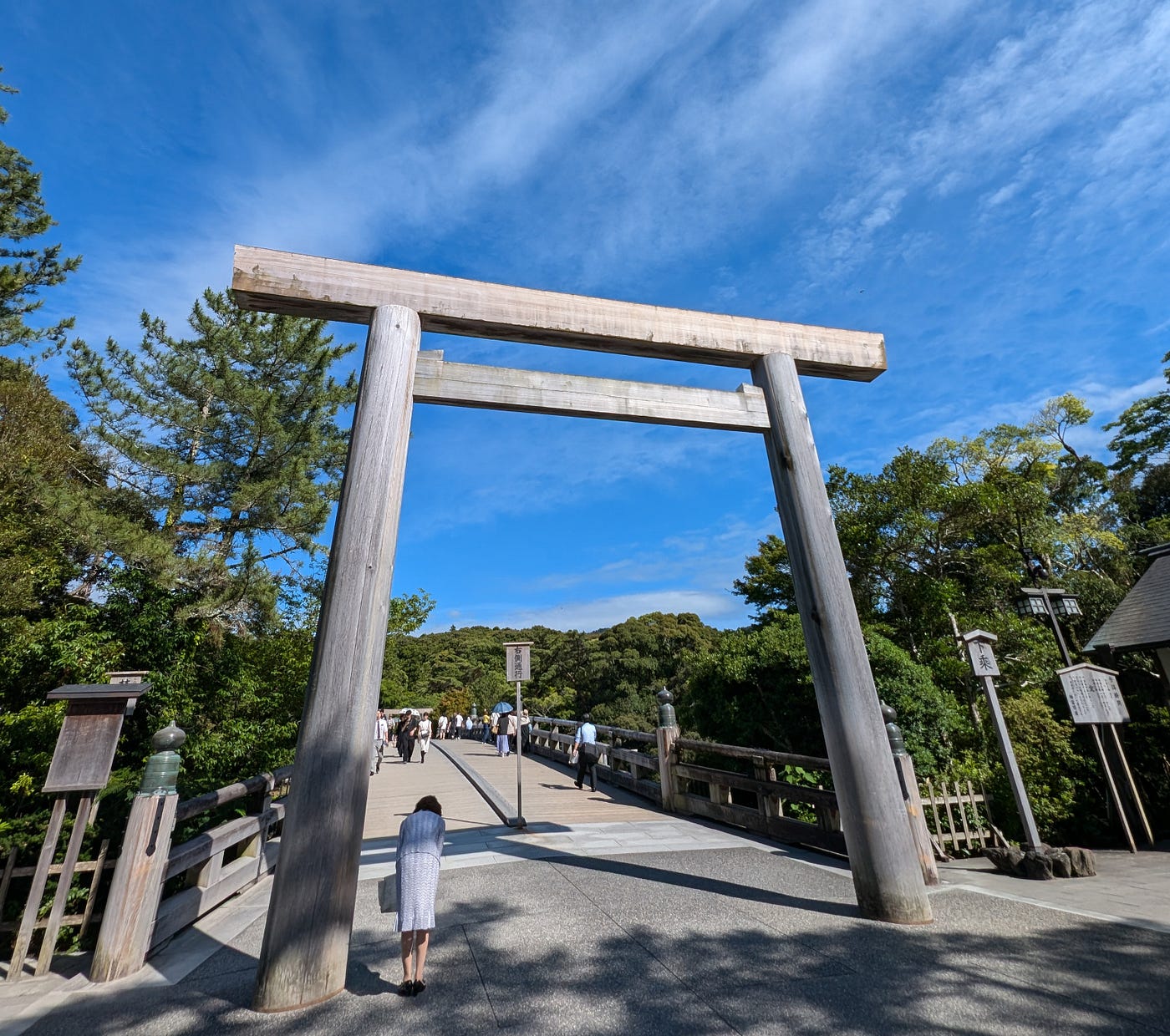
Deep in the forested mountains of Mie Prefecture, where cedar trees have stood for centuries, lies a place unlike any other in Japan.
Ise Jingu — known affectionately as “O-Ise-san” — is the most sacred Shinto shrine in the country. If the Vatican is the spiritual center of global Catholicism, Ise Jingu holds that same absolute authority for Japan’s indigenous faith, Shinto.¹ Among roughly 80,000 shrines scattered across Japan, Ise stands alone at the top.
The complex enshrines two of the most revered deities in Japanese mythology: Amaterasu Omikami (天照大御神), the Goddess of the Sun and divine ancestor of the Imperial family, housed in the Inner Shrine (Naiku); and Toyouke no Omikami (豊受大御神), the guardian of food, clothing, and shelter, at the Outer Shrine (Geku). Together with affiliated sub-shrines, the full complex encompasses 125 individual sanctuaries.²
Its scale is extraordinary. Its history, incomparable.
But neither of those things is what makes Ise Jingu truly unique.
Every 20 years, every single structure in the complex is demolished — and rebuilt from scratch on the adjacent plot of land.
This ritual is called Shikinen Sengu (式年遷宮) — literally, “the periodic relocation of the gods.”
New buildings rise. The deities are ceremonially transferred. The old structures are dismantled, and their sacred timber is redistributed to Shinto shrines across Japan, where the wood lives on as torii gates and building materials. Then the 20-year clock resets. Two decades later, the whole process begins again.
This has continued, with almost no interruption, for over 1,300 years.
The scale is almost impossible to comprehend. Rebuilding all 125 sanctuaries — along with every sacred object, garment, and utensil used by the deities — cost approximately ¥55 billion (roughly $400 million USD) when it was last completed in 2013, the 62nd time this ceremony has taken place. The next cycle, scheduled for 2033, is projected to exceed ¥100 billion ($700 million).
Modern Japan — a country of bullet trains, robotics, and cutting-edge technology — has been pouring this kind of money and manpower into the same ritual, every 20 years, for thirteen centuries.
Why?

Three Reasons That Will Change How You Think About Preservation
Reason 1: In Shinto, the Building Is Just a Vessel
To understand Sengu, you first have to let go of a deeply Western assumption: that age equals value.
When we look at the Colosseum, or Notre-Dame Cathedral, or the Parthenon, we see sanctity in their survival. The older, the more sacred. The more weathered, the more authentic. Western religious architecture is often designed to last millennia precisely because the building itself becomes the object of reverence — the physical proof of an unbroken faith.
Shinto works from the opposite premise entirely.
In Shinto belief, the divine does not reside in a building. It resides in a place — in the energy, the atmosphere, the invisible presence that a location carries. The structure is merely a vessel: a temporary home prepared to receive a god. And vessels, by their nature, are best when fresh.
This connects to one of Shinto’s most fundamental concepts: kegare (穢れ) and harae (祓い). Kegare doesn’t mean “dirty” in the ordinary sense — it refers to a state of spiritual depletion, a dulling of life force and sacred energy.³ Harae is the act of purification that restores it. This is why even ordinary Japanese people visit shrines periodically to receive blessings — not because they’ve done anything wrong, but because spiritual energy needs renewal.
The same principle applies to the gods’ dwelling.
Wood is alive. Even after a tree is felled, it continues to breathe — absorbing moisture, contracting in cold, slowly changing. No amount of careful maintenance can stop this transformation. After 20 years, the timber that once hummed with freshness has begun its inevitable decline. The 20-year cycle is a precisely calibrated intervention: move the gods before the vessel ages, so the sacred space is always renewed, always at peak vitality.
Here is the key insight: in Ise Jingu, “new” is not inferior to “old.” New is the point. The gods of Japan’s most ancient shrine have, in a very real sense, lived in a brand-new home for every single year of the past 1,300.
And it goes further than architecture. During Sengu, everything in the divine household is renewed. The sacred objects known as Oshozoku Shinpo (御装束神宝) — approximately 1,600 items including silk robes, swords, bows, arrows, and horse equipment — are all recreated from scratch using ancient techniques, by hand, by living craftspeople.⁴
Sengu is not just a renovation. It is a total reset of an entire divine life.

Reason 2: The 20-Year Cycle Is a Living Blueprint
The architectural style of Ise’s main halls is called Yuiitsu Shinmei-zukuri (唯一神明造) — a style found nowhere else on Earth.
The buildings sit elevated on stilts, their roofs crowned with distinctive crossed beams called chigi (千木) and a row of cylindrical logs called katsuogi (鰹木) laid horizontally across the ridge.⁵ The pillars are set directly into the ground rather than resting on stone foundations. And perhaps most remarkably: not a single nail is used anywhere in the construction. Every joint, every beam, every connection is made through kigumi (木組み) — a sophisticated system of interlocking wood joinery where pieces are shaped to fit together with such precision that the structure holds itself up through geometry alone.
This technique is extraordinarily difficult. And here is the problem: it cannot be written down.
No manual captures it. No diagram conveys it. You cannot learn it from a video. The knowledge lives in the hands — in the specific pressure applied to a chisel, the sound a joint makes when it fits correctly, the feeling of grain running the right way through the wood. This is what Japanese craftspeople call shintaichi (身体知): embodied knowledge, wisdom that exists only in a body that has done the work.
Which is precisely why the 20-year cycle is not arbitrary.
A craftsman who joins the Sengu workforce at age 20 participates again at 40 as a mid-level artisan, and again at 60 as a master instructor. Over a working lifetime, a single person can experience the full arc three times — as student, as practitioner, as teacher. The 20-year rhythm maps almost perfectly onto the human career cycle, ensuring that knowledge passes from hand to hand before the hands that hold it are gone.
What makes this system genuinely brilliant is that the training is the performance. Most craft traditions involve separate phases — apprenticeship in controlled settings, then the real work. At Ise, there is no rehearsal. You learn by building the actual shrine, with full accountability, under the eyes of your masters. The highest-stakes possible environment becomes the most effective classroom.
And it’s not just carpenters. Sengu involves over 30 distinct traditional craft disciplines: hiwadabuki (檜皮葺き) roof thatchers who work exclusively with cypress bark, metalworkers, silk weavers, lacquer artists, and more.⁶ Every 20 years, each of these crafts must prove it has survived. Sengu functions as a living audit of Japan’s entire intangible cultural heritage.
UNESCO formally recognized “intangible cultural heritage” as a concept worthy of global protection relatively recently — in 2003. Ise Jingu had been running a systematic program to preserve exactly that for over a millennium before anyone invented the terminology.

model
Reason 3: The 120 Years of Silence — and What They Cost
Sengu traces its origins to the reign of Empress Jito, around 690 CE. Through famine, plague, political upheaval, and foreign threat, the cycle held.
Until it didn’t.
For approximately 120 years — from around 1462 to 1585 — Sengu was not performed.
Japan had fractured. The Onin War of 1467 triggered a century of civil conflict so total it is remembered as the Sengoku period: the “Warring States” era.⁷ The imperial court, which traditionally sponsored Sengu, had lost its financial base entirely. There was simply nothing left. No money. No skilled labor to spare. No political stability to organize anything of such scope.
The results were devastating.
Without renewal, the sacred structures began to decay. Roofs sagged and collapsed. Pillars rotted. The site that had represented the pinnacle of Japanese civilization — the literal home of the gods — fell into ruins that contemporaries described in terms of national humiliation. One historical account records the anguish of a priest who wrote that if the gods’ dwelling had fallen to such a state, the country itself could not survive.
Those 120 years taught Japan what it means to lose something you thought would always be there.
When Toyotomi Hideyoshi began unifying Japan in the 1580s, the restoration of Sengu was among the first priorities — even before the wars had fully ended. The urgency was not merely symbolic. There was a practical crisis: six generations of craftsmen had lived and died without ever participating in a Sengu. By the simplest calculation, six complete cycles of knowledge transmission had been severed.
It took generations after the restoration to rebuild the lost mastery.
This is the memory that drives modern Japan’s commitment to the practice. The next Sengu’s preparation begins the year after the previous one ends — because the Japanese know what happens when you allow a gap.
There is one more detail that encapsulates this understanding completely. The cypress timber used for Sengu construction must come from trees that are at least 200 years old. The forests around Ise cannot currently supply enough timber of that age. So Ise Jingu is now actively growing trees — not for the next Sengu, but for the one after that. Two hundred years from now, those saplings will be ready.
Today, they are planting trees for a ceremony that won’t happen until the 2200s.
That is what it looks like to truly learn from history.

The Night I Stood in the Dark
I first visited Ise Jingu the year before the 2013 Sengu — the most recent one completed.
Walking through the towering cedar corridor to the shrine, I noticed something shift in the air. It wasn’t silence exactly — more like a different quality of presence, as if the atmosphere had weight. I remember thinking: this is what it feels like when a place has been considered sacred for long enough that even the land seems to remember it.
I struck up a conversation with a local who had spent his life near the shrine.
“You know,” he said, “the pyramids, the Easter Island statues — nobody alive today could build those. The knowledge is gone. But here?” He gestured at the surrounding wood. “We’ve been building the same thing, exactly the same way, for 1,300 years. The knowledge never died. And because the knowledge lives, when other shrines across Japan need repair or rebuilding — we can help them. The techniques are still alive.”
That stopped me. The conventional idea of preservation is freezing something — keeping it from changing, stopping time. But Ise had done the opposite. By refusing to freeze anything, by insisting on constant renewal, it had kept something far more valuable than the buildings alive. It had kept the knowing alive.
I’ve returned to Ise every year since.
In 2013, through a connection I’m still grateful for, I was given permission to witness the Sengyo no gi (遷御の儀) — the ceremony in which the deity is transferred from the old shrine to the new one — at one of the sub-shrines.
The ceremony takes place at midnight, in complete darkness. No electric lights. Torches only, their flames throwing moving shadows across white-robed priests who processed in near-silence. The only sounds were footsteps on gravel and wind in the trees.
I thought: a thousand years ago, this looked exactly the same.
It was not the feeling of watching something ancient. It was the feeling of being inside something that had never stopped. That is a different sensation entirely — one I haven’t found words for in English, and am not sure exist.

What This Means for the Rest of Us
The philosophy behind Sengu speaks to questions that feel urgently modern.
On sustainability: We usually frame environmental responsibility as making things last longer — more durable products, less waste, longer lifespans. Ise Jingu offers a different model: cycle deliberately. The old timber isn’t discarded; it travels to shrines across Japan, where it continues serving for decades more. Make, use, release, remake. The shrine has been practicing circular material culture for over a millennium.
On knowledge transfer: In an age of AI and automation, we are beginning to realize that certain kinds of knowledge — the kind that lives in hands and bodies and years of practice — cannot be digitized or stored. It can only be transmitted through doing. Ise Jingu built a system that forces that transmission to happen, on schedule, every generation. Every organization that relies on tacit expertise faces the same challenge. The Sengu model suggests an answer: create regular, high-stakes opportunities for masters to teach by doing.
On ritual and meaning: Sengu is also a reminder of what repetition, done with intention, can become. A family dinner at the same table every year. A morning ritual that never changes. These things feel small while they’re happening. But 20 years in, they have become tradition. 100 years in, they are heritage. 1,000 years in, they are civilization.
You Can Be Part of It — Right Now
The next Sengu is 2033. And unlike most of the ceremonies surrounding the shrine — which are closed to the public — there is one that isn’t.
In 2026 and 2027, the Okihiki (お木曳) festival is underway: the event in which the giant cypress logs that will become the new shrine’s sacred pillars are felled in the mountains, floated down rivers, and then pulled through the streets to Ise on wooden carts — by hand, by the public. This happens only once every 20 years. Anyone can participate.
If you go, also visit Sengukan (せんぐう館), the museum dedicated entirely to Shikinen Sengu, located just beside the Outer Shrine. Its centerpiece is a full-scale replica of the Outer Shrine’s main hall — the only way any visitor can see the architecture up close, since the actual building sits behind multiple sacred barriers inaccessible to the public.⁸ Staff from the shrine give daily guided explanations in front of the replica. Multilingual audio guides are available. Currently on exhibition: a documentary film about the sacred timber being harvested for the 2033 ceremony.
The shrine itself shows you what has endured. Sengukan shows you how and why. Together, they offer something rare: not just a beautiful place to visit, but a philosophy to take home.

A Final Thought
Stone endures by not changing. Ise Jingu endures by never stopping.
One approach says: build it so well that it outlasts us. The other says: keep building it, and we will outlast ourselves.
The shrine does not preserve a building. It preserves the act of building. It does not protect the past. It practices it — again and again, in the present tense, for the future.
That is what 1,300 years of wisdom looks like.
The next Sengu is in 2033. The Okihiki public participation festival runs through 2026–2027. Sengukan Museum: www.sengukan.jp/en — located steps from the Outer Shrine, with English audio guides available.
Notes
¹ Shinto is Japan’s indigenous spiritual tradition, rooted in the belief that gods (kami) inhabit natural phenomena — mountains, rivers, forests, the sun. Unlike organized religions with a single founder or doctrinal text, Shinto has existed as a cultural and spiritual practice for millennia. Today, most Japanese people practice both Shinto and Buddhism simultaneously without perceived contradiction.
² The 125 sanctuaries within Ise Jingu are organized in a hierarchical structure: the two main shrines (shogu), fourteen sub-shrines (betsugu), 43 affiliated shrines (sessha), 24 minor shrines (massha), and 42 administered shrines (shokansha).
³ Kegare (穢れ) is often mistranslated as simply “impurity.” In Shinto thought, it more precisely describes a state of spiritual exhaustion or depletion — similar to how a battery loses charge — rather than moral wrongdoing. The solution is not guilt or confession, but purification (harae), which restores energy.
⁴ The 1,600 sacred objects include items from every aspect of divine “daily life” as conceived in the Nara period (710–794 CE): garments, ceremonial weapons, musical instruments, food vessels, furniture, and horse equipment. Each is produced using techniques documented in ancient imperial records, many of which are themselves only preserved because of this ongoing practice.
⁵ Chigi (千木) are the crossed beams that extend above the roofline in an X-shape. Katsuogi (鰹木) are the horizontal cylindrical logs lying across the ridge. Both are distinctive markers of the Shinmei architectural style and have no structural function — they are purely ceremonial, their form preserved unchanged for over a millennium.
⁶ Hiwadabuki (檜皮葺き) is a roofing technique using thin strips of cypress bark layered thousands of times to create a weatherproof surface. It is among the most labor-intensive traditional crafts in Japan, and the Sengu cycle is considered one of the primary reasons the technique has survived.
⁷ The Sengoku period (roughly 1467–1615) is Japan’s equivalent of the Wars of the Roses or the Hundred Years’ War — a prolonged era of civil war among feudal lords (daimyo) competing for national supremacy. At its peak, Japan had no effective central authority for nearly a century.
⁸ Ise Jingu follows a layered system of sacred boundaries. Most visitors can only approach the outer fence of the main halls — the inner precincts are accessible only to the highest-ranking Shinto priests. The full-scale replica at Sengukan is therefore the closest most people will ever come to seeing the actual architecture of the shrine’s heart.
메타데이터
- post_id
- 3e376ad993da
- slug
- the-shrine-that-survives-by-never-surviving-3e376ad993da
- url
- https://medium.com/@officelink108/the-shrine-that-survives-by-never-surviving-3e376ad993da
- canonical_url
- https://medium.com/@officelink108/the-shrine-that-survives-by-never-surviving-3e376ad993da
- author_url
- https://medium.com/@officelink108
- status
- ok
- fetched_at
- 2026-07-13 19:30:36




