There Is No Time in Spacetime — But There Is a Shape
Einstein gave us spacetime — four dimensions stitched together, three of space and one of time. Most people treat time as the obvious one…
There Is No Time in Spacetime — But There Is a Shape
Einstein gave us spacetime — four dimensions stitched together, three of space and one of time. Most people treat time as the obvious one. It’s the one we feel. The one that runs. The one that, according to Einstein, can stretch and compress depending on how fast you move or how deep a gravitational well you inhabit.
But what if time isn’t a dimension at all? What if it’s something that emerges — a story space tells about itself as it changes, not a fundamental ingredient of reality? What if “time” is less like a river and more like a ledger: a record of how a deeper structure rearranges itself, state by state?
This is the central claim of Flux Emergence (FE): that the universe is built not from four spacetime dimensions but from a single three-dimensional structure — one with a very specific shape — and that what we call “time” is nothing more than the sequence of changes propagating through that structure. No clock. No arrow. Just pattern, changing.
The Problem With Time
Physicists have been quietly troubled by time for a century. The trouble begins with what is called the “block universe” — the picture of reality that falls directly out of Einstein’s general relativity. In that picture, all moments in time exist simultaneously, laid out like frames of film. Past, present, and future are equally real; the present is just where you happen to be. Time doesn’t flow. Nothing is actually moving forward. The feeling of “now” is an illusion, or at least an artifact of how minds like ours experience a static four-dimensional structure.
Then there is the measurement problem. How do we actually measure time? We look at change. A pendulum swings. An atom vibrates. An electron oscillates between energy states. Every clock in human history — from a sundial to an atomic clock — works by tracking something moving through space and counting its repetitions. Time, in practice, is always inferred from spatial change. We have never measured time directly. We have only ever measured motion.
“Every clock in the universe measures space moving, not time passing.”
There is also the arrow of time problem. The fundamental equations of physics — classical, relativistic, and quantum — work equally well run forward or backward. There is nothing in the laws themselves that says time must go one direction. Yet we never see a shattered cup reassemble itself. We never un-remember things. The universe appears to have a direction, but the laws it obeys don’t demand one. Something is happening at a deeper level that the equations aren’t capturing.
Physicists like Julian Barbour, in his book The End of Time, and Carlo Rovelli, in The Order of Time, have both argued — from very different starting points — that time is not a fundamental feature of reality. It is something that appears when you look at complex systems from the outside. It is a description, not a foundation. The framework of Flux Emergence takes that intuition seriously and asks: if time is not fundamental, what is? And what exactly is doing the changing?
Space Has Structure — And a Very Specific Shape
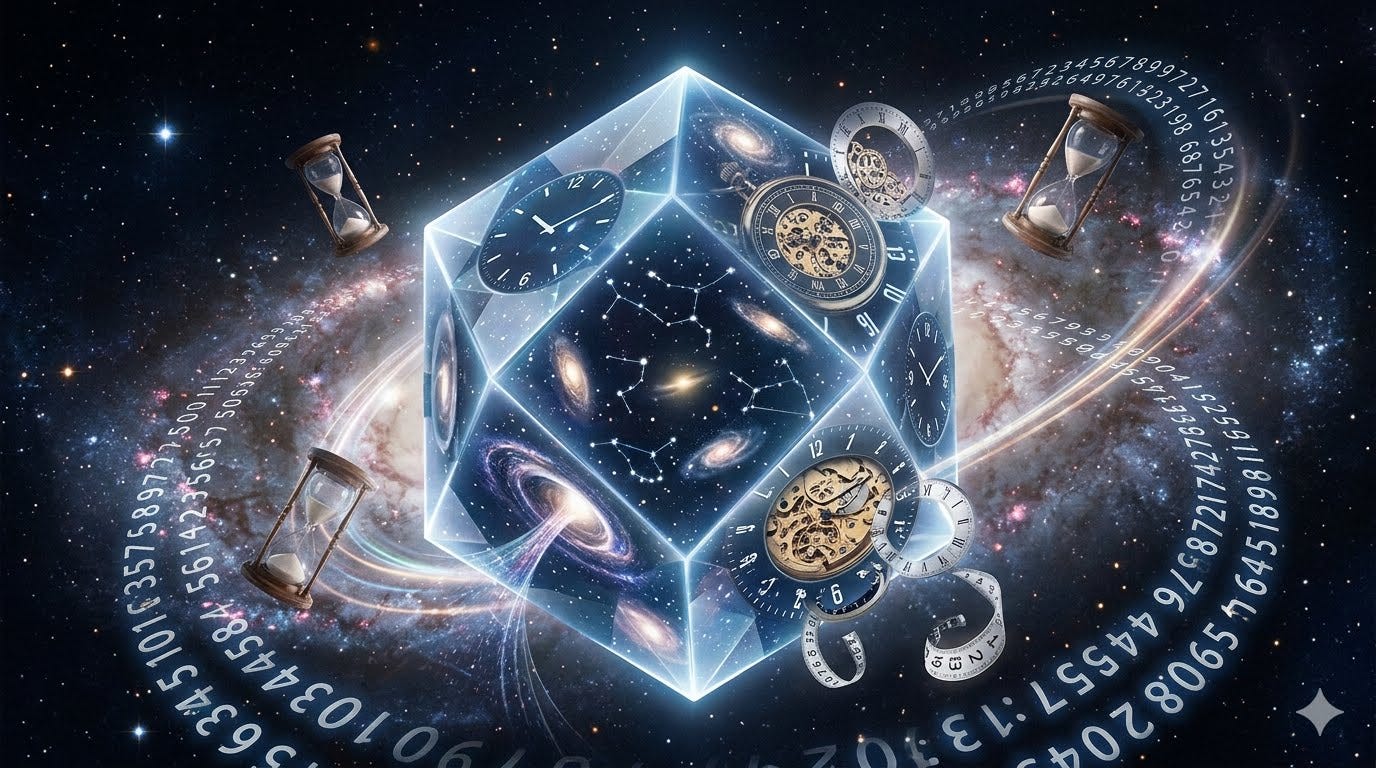
If time is not a dimension but a process, then something must be doing the processing. Flux Emergence proposes that the something is space itself — not the smooth, featureless continuum of classical physics, but a structured medium with a very specific geometry. And that geometry has a name: the rhombic dodecahedron.
The rhombic dodecahedron (RD) is a shape with twelve identical diamond-shaped faces, fourteen corners, and a remarkable property: it fills three-dimensional space perfectly, with no gaps, no overlaps, and no wasted volume. Imagine stacking these shapes like bricks — every surface matches every neighboring surface exactly, in all three dimensions simultaneously. No other shape achieves this with the same combination of symmetry and efficiency. The RD is, in a precise mathematical sense, the optimal solution to the problem of filling space.
“Honeybees, garnet crystals, and the densest possible sphere packings all independently arrive at the same geometry. That is not a coincidence — that is structure.”
What makes this more than geometry-for-geometry’s-sake is where the shape keeps appearing in nature. The deep-red garnet crystal, the one you might find in a ring or a geology collection, grows naturally into this exact form. The cells that appear when you pack spheres as densely as possible — the Voronoi cells of that arrangement — are rhombic dodecahedra. Even honeybees, optimizing the end-caps of their hexagonal combs to minimize wax, arrive at angles that correspond to this shape. Three completely independent natural systems, under three completely different pressures, all converge on the same answer. Mathematics left its fingerprints everywhere.
The key ratio encoded in the shape is elegant: the long diagonal of each diamond face is exactly the square root of 2 times the short diagonal. This is not a decorative coincidence. It is the precise proportion that allows the faces to lock together across all three spatial dimensions simultaneously — the geometric key that makes the perfect tiling possible. When space is built from this shape, it locks.
What Flux Emergence Proposes
Flux Emergence proposes that space is not a smooth continuum. It is a three-dimensional lattice — a vast, interlocking mesh of rhombic dodecahedral cells — and that this lattice is the medium through which all physical phenomena propagate. Fields travel through it. Energy moves along it. Particles exist within it. And what we call “time” is simply the sequence of states that lattice passes through.
In FE, a particle is not a point. It is a pattern. Think of a persistent whirlpool in a river: the river is always moving, new water is constantly arriving and leaving, but the whirlpool holds its shape. It is a stable, self-maintaining structure in the medium. Particles in FE are like that — they are recurring, self-organizing patterns in the lattice that persist because the geometry of the RD and the rules of propagation maintain them. A particle’s properties — its mass, its charge, its spin — are properties of its pattern, not of some irreducible point-like thing that happens to carry those labels.
Forces follow from this naturally. When two patterns coexist in the same lattice, each one influences the cells around it through what FE calls the Ψ (psi) field — a field that permeates the lattice and reflects the influence of every pattern on its neighbors. When the Ψ field of one pattern reaches another, the second pattern responds. That response is what we call a force. There is no mystery about action at a distance because the field is genuinely present everywhere in the lattice — there is no gap for the force to “cross.”
The lattice has exactly twelve channels — twelve directions in which neighboring cells connect — because the rhombic dodecahedron has twelve faces. This means energy, information, and influence travel through the lattice along twelve natural pathways. The physics that emerges from twelve-channel propagation is highly symmetric and highly connected — and that symmetry is what produces the isotropy we observe in nature: the fundamental laws of physics look identical in every direction and at every location. That is not an assumption in FE. It falls out of the geometry.
“Time,” in this picture, is the forward progress of lattice states. An event that occurred “in the past” is a lattice configuration that preceded the current one. There is no separate fourth dimension being traversed; there is only the lattice, iterating through states according to its own internal rules. Duration is the count of those iterations. Simultaneity is a feature of how quickly changes propagate. The entire apparatus of relativistic time — dilation, simultaneity, the light-speed limit — becomes, in FE, a description of how the propagation velocity of the lattice relates to its geometry. Time does not run. The lattice updates.
Why the Shape Changes Everything
Among all shapes capable of filling three-dimensional space, the rhombic dodecahedron is the Voronoi cell of the face-centered cubic (FCC) lattice — the arrangement in which equally sized spheres are packed as densely as physically possible. If you ask the question “what configuration minimizes energy for a regular arrangement of points in three-dimensional space?”, the FCC lattice is the answer, and the RD is the region of space closest to each point. Any physical medium seeking minimum energy would naturally settle into this form. The RD is not an arbitrary guess. It is the shape that equilibrium demands.
Here is another number that matters: twelve. The rhombic dodecahedron has twelve faces — meaning every cell in the FE lattice touches exactly twelve neighbors. Twelve is also the maximum number of non-overlapping spheres that can simultaneously touch a central sphere in three-dimensional space, a result known as the “kissing number” problem, which was formally proved in 1953. This means every node in the FE lattice is as connected as it is mathematically possible to be. Maximum connectivity means maximum information flow — every disturbance in the lattice reaches its neighbors through the greatest number of independent pathways. A lattice built from any other space-filling shape would be less connected and therefore less efficient at propagating physical signals.
Perhaps most striking of all: the rhombic dodecahedron is the three-dimensional projection — the shadow — of the 24-cell, the most symmetric object that exists in four-dimensional space. The 24-cell is a four-dimensional polytope with no three-dimensional analogue in terms of its degree of symmetry; it is uniquely beautiful among all four-dimensional shapes. If the universe contains hidden structure beyond the three dimensions we perceive, the RD is the shape that naturally appears at the boundary between that hidden structure and visible space. FE proposes we may already be looking at that shadow, in every garnet crystal and every lattice calculation, without having recognized what we were seeing.
What FE Predicts That Physics Cannot Yet Explain
A framework that cannot make predictions is philosophy, not physics. Flux Emergence makes specific, testable predictions — and it makes them in areas where current physics already knows something is off.
Consider the Casimir effect — a real, measured force between two uncharged metal plates held extremely close together in a vacuum. Standard quantum field theory predicts it by summing the energy of vacuum fluctuations between the plates. FE agrees with that prediction at normal scales, but diverges at very small separations — below the characteristic scale of an individual lattice cell. At those distances, the discrete structure of the RD lattice would become apparent, producing a deviation from the smooth prediction of continuous-field theory. The Casimir effect at extreme proximity is, in principle, a probe of whether space has grain.
Then there is the muon anomaly. The muon’s anomalous magnetic moment — how strongly the muon responds to a magnetic field, compared to what the Standard Model predicts — has shown a persistent discrepancy. Fermilab confirmed a deviation of roughly five standard deviations from theoretical expectation in 2023. The Standard Model’s community has been searching for a new particle to explain this gap. FE offers a different interpretation: the discrepancy scales with the structural complexity of the particle’s pattern in the lattice. The muon, being heavier and more complex than the electron, shows a larger deviation. The tau lepton, heavier still, should show an even larger one. This is a direct, falsifiable prediction that doesn’t require inventing any new particles.
Finally, quantum entanglement. Bell inequality violations — the now-famous experiments confirming that entangled particles are correlated across any distance, faster than any signal could travel — look paradoxical in a local, point-particle world. In FE, they are expected. The Ψ field spans the entire lattice. Correlations established between two patterns are correlations in the underlying field structure, not in the particles themselves. Measuring one pattern does not send a signal to the other — it simply reveals a pre-existing feature of a field that was never local to begin with. Entanglement, in FE, is not spooky. It is geometric.
A Framework Still Being Built
Flux Emergence is a working research program — not a completed theory. The mathematical alignment work is active and ongoing, systematically comparing FE’s framework against more than twenty landmark physics experiments across gravity, quantum mechanics, particle physics, and molecular chemistry. Where FE agrees with existing results, it explains why. Where it diverges, it marks the divergence as a prediction. That process of systematic comparison — not hand-waving, not vague gestures toward “new physics” — is what distinguishes a serious research program from speculation.
The rhombic dodecahedron was not chosen because it looks interesting or because garnet crystals are beautiful. It emerged from asking a precise mathematical question: if space has a discrete structure, what properties must that structure have to reproduce the physics we already observe — isotropy, maximum connectivity, minimum energy configuration, and compatibility with four-dimensional symmetry? The RD is the unique shape that satisfies all of those requirements simultaneously. The geometry was not assumed. It was derived.
FE is transparent about its boundaries. It says clearly what it knows, what it predicts, where it agrees with established physics, and where it expects deviations that have not yet been detected. That intellectual honesty — the willingness to be wrong in specific, checkable ways — is what makes a framework worth taking seriously. Flux Emergence is worth watching precisely because it has committed to being falsifiable.
The next time you hold a garnet crystal and notice its twelve identical faces, consider this: that shape is not decorative. It is not accidental. It is the three-dimensional solution to a deep mathematical problem — how to fill space as efficiently as possible, with maximum symmetry, along the maximum number of channels. Nature solved that problem billions of years before we named it, etching the answer into mineral lattices, into the cells of honeybee combs, into the geometry of densely packed spheres. The answer is always the same shape.
Flux Emergence asks whether the universe didn’t just find that shape in a crystal — but whether the universe is that shape, all the way down. And if it is, then what we call time is not the fourth dimension of reality. It is simply the pattern of the universe, changing. State by state. Cell by cell. Each update writing the next frame of the only story there is.
That is worth thinking about.
메타데이터
- post_id
- 3e3ef5eb082b
- slug
- there-is-no-time-in-spacetime-but-there-is-a-shape-3e3ef5eb082b
- url
- https://medium.com/@jamidan/there-is-no-time-in-spacetime-but-there-is-a-shape-3e3ef5eb082b
- canonical_url
- https://medium.com/@jamidan/there-is-no-time-in-spacetime-but-there-is-a-shape-3e3ef5eb082b
- author_url
- https://medium.com/@jamidan
- status
- ok
- fetched_at
- 2026-06-14 11:28:49