The Third Time in a Month: Why Saturday’s White House Shooting Is the Pattern, Not the Suspect
Three armed people reached the Secret Service perimeter around President Trump in the past 30 days. A 21-year-old is dead. A bystander is…
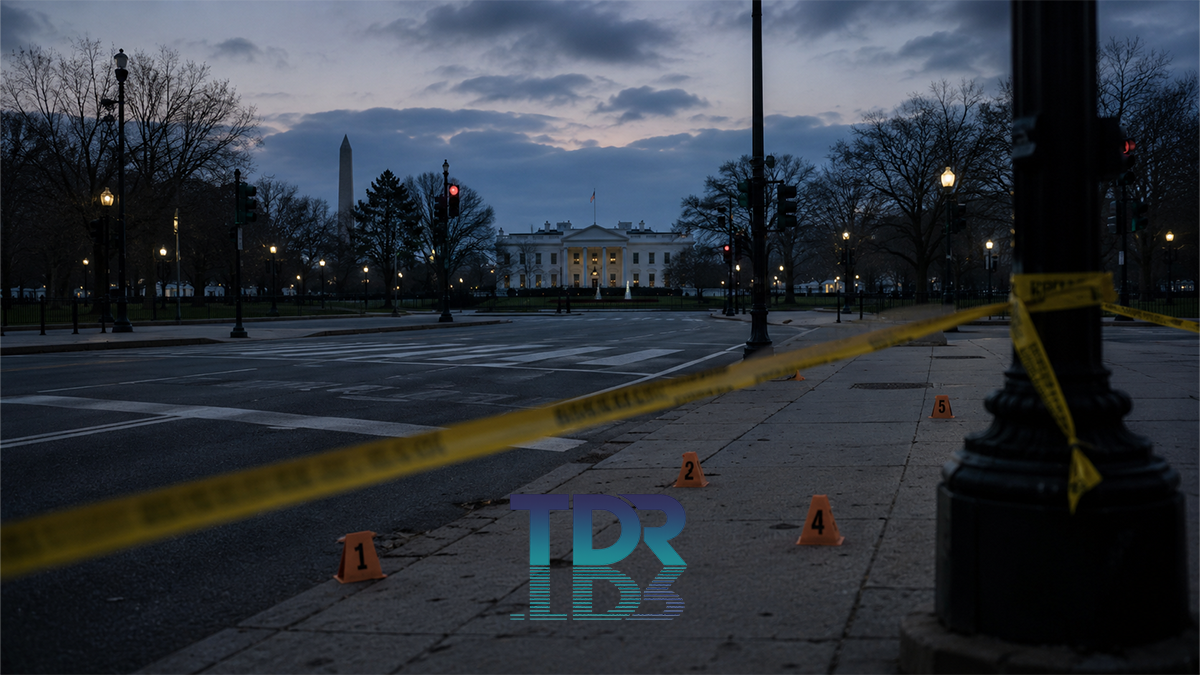
The intersection of 17th Street and Pennsylvania Avenue, where a 21-year-old opened fire at a Secret Service checkpoint on Saturday evening, became the third such scene in 30 days. The U.S. Capitol Police logged nearly 15,000 threats against members of Congress in 2025, the third consecutive annual increase. The story is no longer the suspect; it’s the pattern.
The Third Time in a Month: Why Saturday’s White House Shooting Is the Pattern, Not the Suspect
Three armed people reached the Secret Service perimeter around President Trump in the past 30 days. A 21-year-old is dead. A bystander is in critical condition. And the country is running out of words for what has stopped being shocking.
By The Daily Reflection · May 24, 2026 · 9 min read
It happened just after 6 p.m. on Saturday. A 21-year-old named Nasire Best walked up to a Secret Service checkpoint at the intersection of 17th Street and Pennsylvania Avenue, pulled a handgun from his bag, and opened fire on the officers posted there.
Somewhere between 15 and 30 rounds were exchanged, according to law enforcement sources cited by CBS News. ABC’s Selina Wang was filming a routine video for social media when the shooting started; her expression changes mid-sentence as the shots register, and she drops below frame. The clip has been viewed more than 3 million times. Officers returned fire and hit Best, who later died at a hospital. A bystander was also struck and remains in critical condition; investigators have not yet determined whether the bystander was hit by the suspect’s bullets or by return fire from the officers.
That is the event. The bigger story is what this is the third of.
Three Shootings in 30 Days
The Associated Press summed it up in a single line: this was the third time gunfire erupted near President Trump in the past 30 days. Read that twice. It is not a sentence that should describe any American president in any month.
The first incident was on April 25 at the Washington Hilton, where the annual White House Correspondents’ Association dinner was underway. Cole Tomas Allen, who was staying at the hotel as a guest, charged past officers at the main security checkpoint carrying a shotgun, a pistol, and multiple knives. In a manifesto attributed to him, Allen called himself the “Friendly Federal Assassin” and said he intended to target Trump administration officials. One officer was struck in a bullet-resistant vest. Allen has pleaded not guilty to attempted presidential assassination and remains in federal custody.
The second incident was on May 4, near the Washington Monument, several blocks from the White House. Secret Service officers shot a man named Michael Marx, 45, of Midland, Texas, after they said he fired at officers. A teenage bystander was wounded in the exchange. Marx is facing federal charges.
Then came Saturday at 17th and Pennsylvania.
Three suspects. Three different states of origin. Three different weapons profiles. Three different ideological flavors, where ideology is even known: Allen’s manifesto was explicitly anti-Trump; Marx’s motive has not been publicly stated; Best’s motive remains under investigation. And one common element. Each was a lone individual who walked himself into the security perimeter around the President of the United States with a gun and started shooting.
When something happens three times in 30 days, it has stopped being an anomaly and started being a pattern.
Pattern recognition is the entire analytical task here. Each individual incident is a story; the cluster is the analysis. The cluster is what most coverage will not have caught up with by Monday morning.
The Lone Offender Profile
A profile has emerged across the past two years of political violence aimed at U.S. officials, and the unsettling thing about it is how ordinary it looks.
Five senior law enforcement officials told reporters that Best had a documented history of mental health issues. Best also had a prior arrest for attempting unauthorized entry to a White House checkpoint, which means the system that should have prevented Saturday already had him in it once. Allen’s manifesto contained the grandiose self-naming and stated political target that researchers associate with self-radicalized lone actors. Thomas Crooks, the 20-year-old who fired at Trump at a Pennsylvania rally in July 2024, acted alone and left no clear organized motive. So did Ryan Routh at the Mar-a-Lago golf course two months later. So did Vance Boelter, the man who killed former Minnesota House Speaker Melissa Hortman and her husband in June 2025.
Researchers at the London School of Economics flagged this pattern earlier in May: modern attacks on political figures rarely resemble the classic conspiracies of the twentieth century. They look more like the mass-shooter profile the country has spent a decade arguing about. Isolated individuals, often with mental health histories, operating inside a polarized digital environment that hands them a script, a target, and the sense that becoming a shooter is a form of meaning.
That is not a left or right observation. It is a structural one. The country has built an information environment that takes vulnerable people and gives them an ideology, a target, and a narrative arc to slot themselves into. The political content varies by attacker. The shape of the pipeline does not.
The suspects do not look like each other. The system that produces them does.
The Wider Catalog
The sense that political violence has gotten worse in the United States is not a vibe. It is a measurement.
The U.S. Capitol Police logged nearly 15,000 threats against members of Congress in 2025, the third consecutive annual increase. Several states have started providing security details for local lawmakers who would never have been considered candidates for protection five years ago. The wider list of attacks in the past 18 months is long enough to be its own dark catalog.
The Butler rally shooting. The Mar-a-Lago golf course attempt. The Hortman assassination in Minnesota. The killing of UnitedHealthcare chief executive Brian Thompson in December 2024. The shooting of conservative commentator Charlie Kirk on a Utah college campus last September. The April 2026 incident at New York City Mayor Zohran Mamdani’s residence, where two men were charged with bringing homemade bombs to an anti-Islam protest outside his home and told police they were inspired by the Islamic State. And now three armed incidents inside Trump’s security bubble in a single month.
Read that list again. The targets span the entire ideological map: a Democratic state lawmaker, a Republican president, a left-wing mayor, a right-wing commentator, and a corporate executive. There is no coherent ideological thread running through the violence. There is a coherent willingness to use violence running through it.
That is what has changed. Not what people believe. What they are willing to do about it.
The Script That Plays Before the Suspect Is Identified
There is a depressing political ritual that now follows every incident of this kind, and the past 24 hours have showcased it again.
Within hours of the Saturday shooting, Representative Adam Smith said the event was part of a “pattern of violence” aimed at the president and the press. Press Secretary Karoline Leavitt, responding to last month’s Correspondents’ Dinner shooting, blamed a “left-wing cult of hatred” against Trump and pointed to media commentators who compare the president to authoritarian figures. Conservative voices online argued that liberal rhetoric was creating permission structures for violence. Liberal voices noted that the same accusation flies the other direction whenever the target sits on the political left, which is true.
Both sides have a script ready. Both sides deploy it before the suspect’s name is even released. Both sides are sometimes right and sometimes wrong about the individual case, because some attackers have a clear ideology and some have none. But the script does not depend on the facts of the case. It depends on the political utility of the script.
The cost of this ritual is that the country never gets a sustained conversation about the structural problem. The structural problem is not which political tribe is more dangerous. The structural problem is the set of systems that produce shooters of every flavor.
There are three of those systems. None of them are getting better.
What’s Actually Producing the Pattern
The first system is mental health infrastructure. Best had a documented history that law enforcement was already aware of. He had been arrested before for attempting unauthorized entry at a White House checkpoint, which means the system that should have prevented Saturday already had him in it once. He is not the first attacker in this category to have been on someone’s radar. The country has spent two decades watching mass shooters cycle through emergency rooms, family pleas, and law enforcement contacts without ever ending up inside a system capable of intervention. The same broken pipeline applies to attackers who pick political targets instead of schools or supermarkets. There is no triage capacity for the gap between “this person is unwell” and “this person has done something arrestable.”
The second is access to weapons. The political class spent the past several years arguing about whether mass shootings warranted any meaningful change to firearms access; the same question, applied to political violence, has not yet been seriously asked. Saturday’s suspect had been previously arrested at a White House checkpoint and still had access to a handgun on Saturday. The country’s functional answer to that fact is “of course.”
The third is the radicalization environment, and technology has made this one worse and faster. The path from “alienated young man” to “lone offender with a target” runs through online spaces where political grievance, conspiracy content, and gun culture braid into a single product. Researchers have been describing this pipeline since the early 2010s. The platforms that host it have changed almost nothing about it in that time. The output of the pipeline has grown more frequent, not less.
You cannot pick one of these three systems and solve the pattern. They reinforce each other. A country with better mental health systems but the same gun access and the same radicalization platforms will still produce shooters, just fewer of them. A country with tighter gun laws and the same vulnerable population and the same online environment will produce attackers using different methods. A country with better content moderation but the same broken safety net will keep generating the population in the first place.
The Bottom Line
The temptation after every incident like Saturday’s is to focus on the suspect. The motive. The manifesto. The political identity. Whether his story confirms or refutes whichever narrative your side wants to confirm or refute.
That temptation is the trap. Every individual story is real, but the individual stories cannot explain why the same shape of event keeps recurring. Three armed people reached the president’s security perimeter in 30 days. That is the data. The data does not say anything specific about left or right. It says something about a country whose institutions have stopped catching the people who should have been caught.
The Secret Service did its job on Saturday. The officers at 17th and Pennsylvania ended the threat in seconds. They will do it again the next time, because that is what they are trained for. But asking the Secret Service to solve the political violence problem is like asking emergency rooms to solve the addiction crisis. They are the last stop in a long failure, not the place where the failure can be fixed.
A bystander is in critical condition because of where they were standing on a Saturday evening. The next bystander may not survive. And the political class will keep performing its scripted argument about whose rhetoric is to blame while the population that produces these attackers continues to be ignored by the systems that should have reached them first.
Three in 30 days. That is the news. The rest is commentary.
The Daily Reflection cuts through the noise to find the stories that actually matter. Follow for thoughtful takes on politics, technology, and whatever’s shaping our world.
메타데이터
- post_id
- 3e4333356079
- slug
- the-third-time-in-a-month-why-saturdays-white-house-shooting-is-the-pattern-not-the-suspect-3e4333356079
- url
- https://medium.com/@TheDailyReflection/the-third-time-in-a-month-why-saturdays-white-house-shooting-is-the-pattern-not-the-suspect-3e4333356079
- canonical_url
- https://medium.com/@TheDailyReflection/the-third-time-in-a-month-why-saturdays-white-house-shooting-is-the-pattern-not-the-suspect-3e4333356079
- author_url
- https://medium.com/@TheDailyReflection
- status
- ok
- fetched_at
- 2026-06-09 14:34:10