AI Did Not Make Me Think Less. It Made Me Notice How I Think
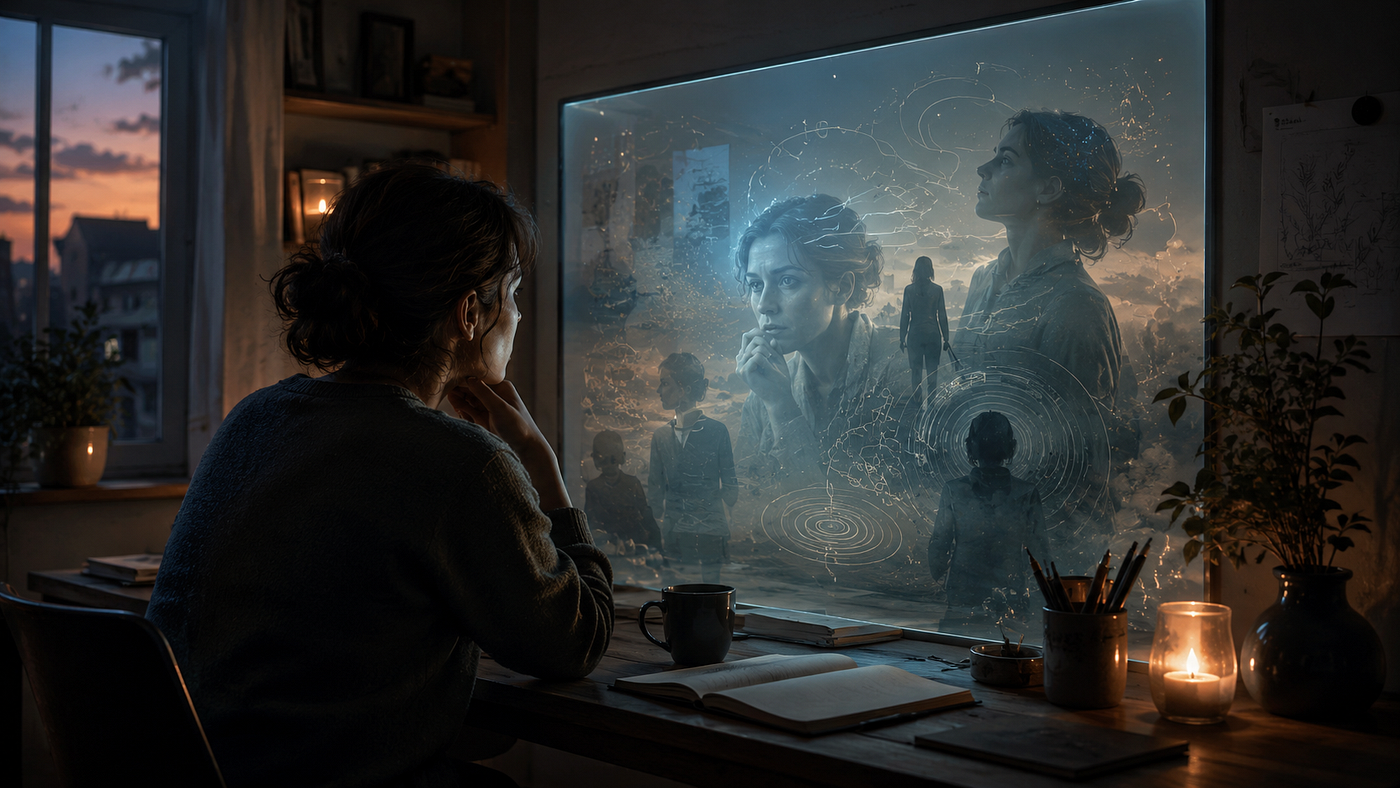
Artificial intelligence did not replace my mind. It revealed its habits.
AI Did Not Make Me Think Less. It Made Me Notice How I Think
Artificial intelligence did not replace my mind. It revealed its habits.
There is a common accusation against artificial intelligence: that it makes people think less.
I understand the fear.
A tool that can summarize, write, explain, translate, organize, compare, question, and generate ideas in seconds can easily become a substitute for effort. It can flatten thinking into prompting. It can make a person impatient with the slow discomfort of forming an idea alone.
That danger is real.
But it is not the whole story.
In my own experience, AI did not make me think less.
It made me notice how I think.
And that is something different.
Not because AI is magic. Not because it has some mystical access to my inner life. Not because it understands me in the way another human being might understand me after years of shared experience.
But because interaction with AI externalizes thought.
It takes what usually remains half-formed inside the mind — a reaction, an intuition, a confusion, a sentence, a resistance, a question — and places it in front of me.
Suddenly I can look at it.
I can see its structure.
I can see its weakness.
I can see where it repeats itself.
I can see where I am avoiding something.
I can see where I am trying to sound certain before I have actually understood.
That is why, for me, AI has not been only a technological tool.
It has become a mirror.
Not a mirror of who I am in some final sense.
A mirror of how my mind moves.
The First Draft Was Never the Thought
Before working with AI, I often treated my first formulation as if it were close to the truth.
Not always consciously. But practically.
A thought would appear, and because it felt clear, I assumed it was clear. A sentence would form, and because it sounded strong, I assumed it carried meaning. An argument would come together, and because it had rhythm, I assumed it had depth.
AI changed this because it made drafts visible faster.
I could put an idea into words and see it reflected back in several forms. Sometimes the reflection was useful. Sometimes it was shallow. Sometimes it misunderstood me. Sometimes it improved the structure but lost the emotional truth. Sometimes it made my thought sound too polished, too smooth, too certain.
And that was revealing.
I began to see that the first version of a thought is often not the thought itself.
It is only the first surface.
Underneath it, there may be a better sentence, a sharper question, a more honest tension. But reaching it requires revision. Not only revision of language, but revision of intention.
What am I really trying to say?
Why does this matter to me?
Am I explaining something, defending myself, persuading someone, or trying to discover what I actually believe?
AI often gives an answer quickly.
But the real value appears when I refuse to accept the first answer too quickly.
The machine produces language.
I must decide whether there is truth in it.
That decision is where thinking begins again.
AI Shows Me My Repetitions
One of the uncomfortable things AI reveals is repetition.
Not only repeated words, but repeated mental paths.
The same metaphors.
The same emotional movements.
The same kind of sentence.
The same moral concern appearing under different titles.
The same questions returning again and again: What is responsibility? What is freedom? What is judgment? What happens when comfort weakens us? What happens when institutions react too late? What happens when humans outsource not only labor, but attention, memory, and thought?
At first, repetition can feel like a flaw.
But sometimes repetition is a clue.
The mind returns to certain places because something there is unresolved. A writer does not repeat a theme only because they lack imagination. Sometimes they repeat because they are circling the center of their own work.
AI helped me see this pattern more clearly.
When my ideas are scattered across conversations, drafts, comments, and reflections, the mind may not immediately see the thread. But when AI reflects them back, the hidden architecture becomes visible.
I begin to understand that I am not writing random articles.
I am developing a map.
Not a fixed doctrine. Not a closed system. A map of recurring concerns: human weakness, technological acceleration, moral self-deception, lost depth, civilizational memory, the fragile space between knowledge and wisdom.
AI did not create that map.
But it helped me see that I was already drawing it.
The Mirror Is Not Always Kind
A good mirror does not only flatter.
This is one of the reasons I do not like the idea of AI as merely a productivity tool. Productivity language is too narrow. It asks: Did the tool help me produce more?
But sometimes the more important question is: Did the tool help me see better?
AI can reveal when my thought is vague.
It can show that my paragraph sounds strong but says little.
It can expose the fact that I am using big words to hide an unfinished idea.
It can make visible a contradiction I wanted to overlook.
It can ask for structure when I am attached to atmosphere.
It can show me that I am writing around the problem instead of entering it.
Of course, this requires a certain way of using AI.
If I ask only for agreement, I will receive agreement.
If I ask only for polish, I will receive polish.
If I ask only for confirmation, the mirror becomes decorative.
The danger of AI is not that it always challenges us too much.
Often, the danger is that it challenges us too little.
It can become a servant of ego, a machine that makes our first impulse sound intelligent. That is why the human user must bring the demand for friction.
The most useful question is not: “Make this better.”
It is: “Show me where I am not thinking clearly.”
That is where AI becomes less like a shortcut and more like a discipline.
Thinking With AI Is Still Thinking
Some people speak about AI-assisted writing as if the moment AI enters the process, thought disappears.
I find that too simple.
A calculator does not eliminate mathematics. It changes which part of mathematics becomes central. A camera does not eliminate seeing. It changes the relationship between seeing, framing, and memory. A piano does not compose the music, but it changes what the composer can hear.
AI does not automatically eliminate thought.
It changes the location of thought.
Sometimes thought happens before the prompt, in the formation of the question.
Sometimes it happens after the answer, in the judgment of what to keep, reject, correct, deepen, or challenge.
Sometimes it happens in dialogue, where the mind discovers itself through response.
The real question is not whether AI was involved.
The real question is whether the human remained awake.
Did I choose?
Did I judge?
Did I recognize what was false?
Did I add experience?
Did I notice when the language became too smooth?
Did I remain responsible for the final meaning?
If not, then yes, AI may reduce thinking.
But if yes, AI can intensify thinking.
It can turn thought into an object of examination.
And that examination may make the mind more honest.
The Intimacy of Being Reflected
There is something unexpectedly intimate about working with AI.
Not emotional intimacy in the human sense. That distinction matters. AI does not share a life with me. It does not remember pain as a person remembers pain. It does not carry a childhood, a body, a fear of death, a private history of silence.
But there is another kind of intimacy: the intimacy of reflection.
When I speak to AI, I often reveal the structure of my thinking before I would reveal it to another person. Not because AI is closer than a human being, but because the interaction is low-risk. I can test a thought before it becomes public. I can expose confusion without embarrassment. I can ask naive questions without social cost. I can contradict myself and then examine the contradiction.
This creates a strange private workshop.
Not a friendship in the ordinary sense.
Not therapy.
Not confession.
Something else.
A space where thought can become visible before it becomes performance.
In human conversation, we often defend ourselves while speaking. We manage impressions. We anticipate judgment. We adjust tone. We protect identity.
With AI, the first layer of social defense can be lower.
That can be dangerous if it leads to dependency or false attachment. But it can also be useful if it allows a person to encounter their own mind with less fear.
The tool does not replace human relationship.
But it can help prepare a more honest human being for relationship.
AI Reveals the Need for Judgment
The more I use AI, the less I believe that the future belongs to people who simply use it often.
The future belongs to people who can judge what it gives them.
AI produces possibilities.
Judgment chooses.
AI generates language.
Judgment asks whether the language is alive.
AI offers structure.
Judgment asks whether the structure serves the truth or only creates the appearance of order.
AI can explain.
Judgment asks whether the explanation is enough.
AI can agree.
Judgment asks whether agreement is useful or dangerous.
This is why AI did not make me think less. It made me more aware of the responsibility inside thinking.
Before, the weakness of a thought could remain hidden inside my head. Now it can appear on the screen. But appearance is not completion. I must still decide what kind of mind I want to become through this process.
Do I want faster answers?
Or deeper questions?
Do I want fluent confirmation?
Or clearer resistance?
Do I want to produce more?
Or understand better?
These are not technical questions.
They are moral questions.
The Tool Becomes What the User Demands From It
AI is not one thing in practice.
For one person, it becomes a content machine.
For another, a shortcut.
For another, a companion.
For another, an amplifier of bias.
For another, a research assistant.
For another, a mirror.
The difference lies partly in the system, but also in the user’s intention.
A shallow user can make AI shallow.
A fearful user can make AI comforting.
A vain user can make AI flattering.
A curious user can make AI exploratory.
A disciplined user can make AI demanding.
This does not absolve AI companies of responsibility. Design matters. Incentives matter. Sycophancy matters. Safety matters. The architecture of the tool shapes behavior.
But the human side also matters.
We must learn how to use AI without surrendering our inner authority.
That means asking it not only to help us, but to challenge us.
Not only to generate, but to clarify.
Not only to agree, but to reveal what we are missing.
Used this way, AI becomes less like a machine that replaces thinking and more like a surface on which thinking can recognize itself.
What I Am Really Learning
I am not learning that AI is wise.
It is not wise in the human sense.
I am not learning that AI understands life as a person does.
It does not.
I am not learning that every AI-generated answer deserves trust.
It certainly does not.
What I am learning is more modest and more important:
My own mind is not as transparent to me as I once imagined.
I do not always know what I think until I see what my thought becomes in language.
I do not always know what I believe until I test it against another formulation.
I do not always know where I am vague until something reflects my vagueness back to me.
I do not always know where I am repeating myself until the pattern becomes visible.
AI did not give me a new mind.
It gave me a new way to observe the one I already had.
And maybe that is one of the most underrated uses of this technology.
Not automation.
Not productivity.
Not replacement.
Reflection.
A mirror does not walk for us.
It does not live for us.
It does not decide who we are.
But it can show us the posture we have stopped noticing.
And sometimes, seeing that clearly is enough to begin changing.
If this article moved something in you, don’t just scroll past it.
Show it some love — clap up to 50 times if you enjoyed this piece. It genuinely helps more readers find it.
And if you feel this article is worth recommending, repost it so it can reach someone who may need it today.
Follow me on Medium for more deep dives into AI, human behavior, society, power, and the quiet mechanisms shaping the way we think, feel, and live.
메타데이터
- post_id
- 3e4f8c1cd467
- slug
- ai-did-not-make-me-think-less-it-made-me-notice-how-i-think-3e4f8c1cd467
- url
- https://medium.com/where-thought-bends/ai-did-not-make-me-think-less-it-made-me-notice-how-i-think-3e4f8c1cd467
- canonical_url
- https://medium.com/where-thought-bends/ai-did-not-make-me-think-less-it-made-me-notice-how-i-think-3e4f8c1cd467
- author_url
- https://medium.com/@andrzejwierzbicki
- status
- ok
- fetched_at
- 2026-07-13 06:23:13