The Battle of Rezang La: The Last Stand of 13 Kumaon in 1962
120 Indian soldiers against 5,000 enemy guns. High up at $18,000$ feet, they chose death over surrender. This is their tragic, heroic song.
The Battle of Rezang La: The Last Stand of 13 Kumaon in 1962
120 Indian soldiers against 5,000 enemy guns. High up at $18,000$ feet, they chose death over surrender. This is their tragic, heroic song.
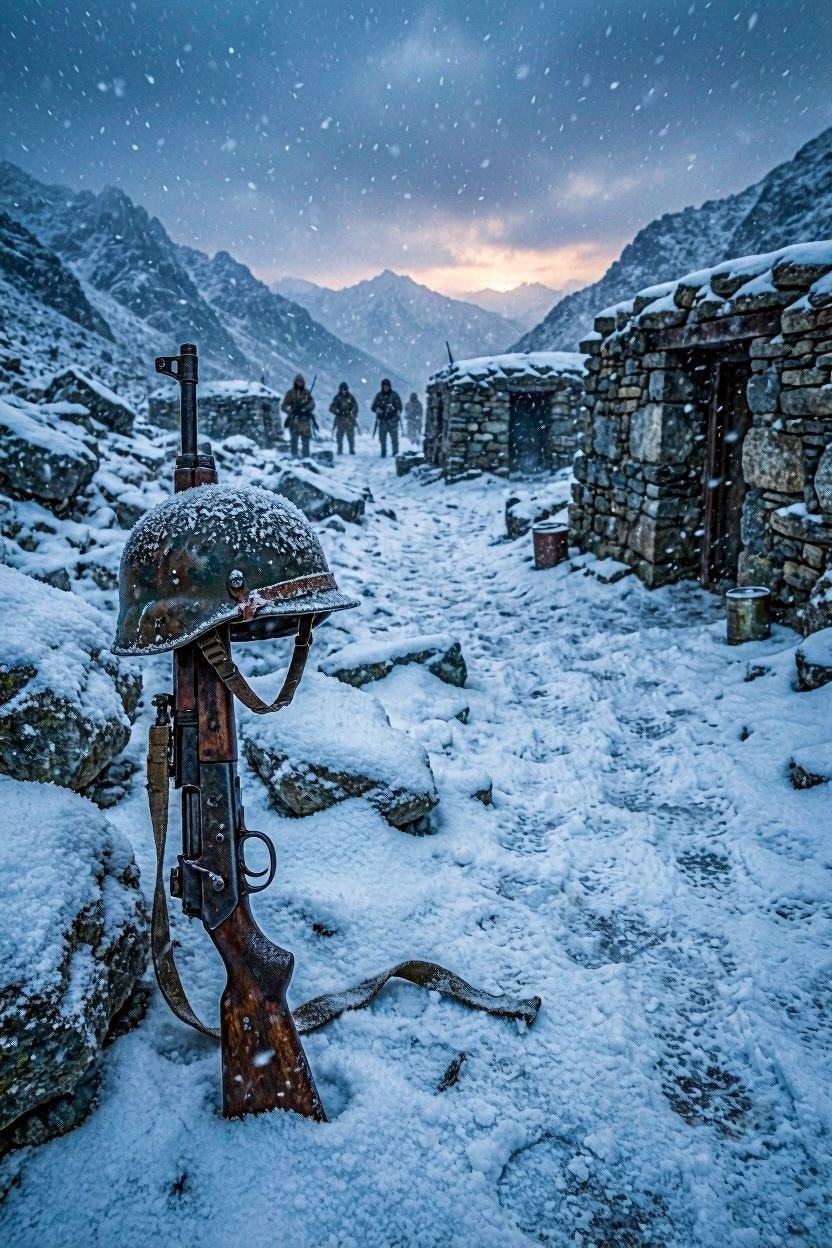
A solemn cinematic painting of a soldier’s helmet and rifle in the snow at Rezang La pass, Ladakh, symbolizing the sacrifice of the 13 Kumaon Regiment. ( Image Generated by AI)
The annals of military history are filled with tales of courage, but few match the raw, heartbreaking grit displayed on November 18, 1962. High up in the icy desolation of the Chushul Sector, at an altitude of $16,000$ to $18,000$ feet, $120$ souls from the Charlie Company, 13 Kumaon Regiment faced a human wave of over $5,000$ heavily armed troops.
Led by the lion-hearted Major Shaitan Singh, these men — mostly Ahirs from Haryana — refused to retreat. With obsolete bolt-action rifles, no artillery backup, and temperatures plummeting below -30 C, they fought to the very last man.
When the snows melted months later, they were found frozen in time, their fingers still locked on the triggers, facing the enemy. This is their song and their story.
The Song of the Frozen Guardians
High on the ridges of Ladakh’s cold breath,
Where the wind screams of winter and the freeze is of death,
At eighteen thousand feet in the whispering white,
“Rezang La” stood waiting for the terrible night.
One hundred and twenty of Kumaon’s elite,
In thin woolen sweaters, with frost on their feet,
With old bolt-action rifles, no cannons behind,
They held the cold border, determined of mind.
Before the first dawn split the valley in grey,
Five thousand dark shadows marched out for the prey.
With mortars and gunfire, the enemy crept,
Thinking the passes of India slept.
But Major Shaitan Singh raised his sword to the storm,
“Stand fast, my brave Ahirs, keep your spirits warm!”
The old .303 s spat their fire and their lead,
And the snows of the pass turned a terrible red.
The barrels were freezing, the fingers went numb,
Yet none would retreat, for no retreat would come.
When bullets were empty, they rose from the mud,
With bayonets and fists, they wrote history in blood.
And when the spring melted the winter’s cold sheet,
And searchers climbed up to this ridge of defeat,
They wept at the silence, they wept at the sight —
For the heroes were standing, still frozen in fight.
A finger on trigger, a bandage of thread,
Still facing the valley, alive though they’re dead.
No back turned in fear, no white flag of shame,
Rezang La belongs to their glorious name.
The Story of November 18, 1962
To survive in the desolate wasteland of Rezang La at 18,000 feet is a feat in itself. The air is thin, oxygen is scarce, and the freezing wind cuts through skin like a knife. The temperature on that fateful morning was between -30 C and -40 C.
The men of Charlie Company, 13 Kumaon, did not have modern automatic weapons. They held .303 bolt-action rifles, which required manual reloading after every single shot. They had no artillery cover because a massive mountain ridge blocked the line of sight of Indian defensive artillery.
At 4:45 AM, under the cover of a freezing blizzard, the Chinese People’s Liberation Army (PLA) launched an assault with over 5,000 soldiers, supported by heavy artillery, rockets, and mortars.
[ The Battle of Rezang La ]
          ==========================
          [ 5,000+ Heavily Armed Troops ]
                     |
                     v (Heavy Artillery & Mortars)
          [ 120 Indian Kumaon Soldiers ]
            - Old .303 Bolt-Action Rifles
            - No Artillery Cover
            - Temperature: -30°C to -40°C
The Battle to the Last Man
When the Chinese waves rushed the pass, Major Shaitan Singh ordered his men to hold their fire until the enemy was in clear sight. When the order to fire was given, the Kumaoni soldiers unleashed a devastating volley. The first two waves of the enemy assault were completely decimated, leaving the rocky slopes littered with bodies.
Frustrated by the resistance, the enemy turned their heavy artillery on the shallow, stone-walled Indian trenches. One by one, the bunkers were blown to pieces. The extreme cold began to freeze the oil in the Indian rifles, causing them to jam. Yet, the jawans did not run.
When they ran out of ammunition, the fight turned into a brutal, face-to-face brawl. Outnumbered 1:10, the brave Kumaonis charged out of their broken trenches with bayonets, rocks, and bare hands. They fought like tigers, refusing to surrender a single inch of their homeland.
The Heartbreaking Aftermath
The most painful chapter of this battle was written in February 1963, three months after the war had ended. As the winter ice began to thaw, a search party reached the high-altitude battlefield of Rezang La.
What they witnessed was a scene that brought hardened military officers to their knees in tears:
- The Frozen Statues: The bodies of the fallen soldiers were frozen solid, preserved exactly in the posture of their final moments of combat.
- Fingers on Triggers: Dozens of jawans were found dead inside their shattered stone bunkers, their stiff fingers still locked onto the triggers of their rifles.
- The Healing Hand: Nursing Assistant Dharampal Singh was found frozen dead with a medical bandage and syringe still clutched in his hand, killed by shrapnel while trying to save a brother-in-arms.
- Torn Uniform Bandages: Another soldier was found with a makeshift bandage made of his own torn uniform tied around a head wound, still holding a bayonet in a lunging position.
Of the 120 men, 114 laid down their lives on that ridge. Only five severely wounded soldiers survived to tell the tale, and one was taken prisoner but eventually escaped back to Indian lines. Together, this tiny group of 120 men had killed nearly 1,300 enemy soldiers, making it one of the most lopsided casualty ratios in the history of modern warfare.
Eternal Glory
For his extraordinary leadership and self-sacrificing bravery, Major Shaitan Singh was posthumously awarded the Param Vir Chakra, India’s highest military decoration. Eight of his men received the Vir Chakra, and the 13 Kumaon was awarded battle honors.
Today, a simple monument stands at Rezang La, overlooking the silent, wind-swept peaks. On it are carved the famous words of the English poet Thomas Babington Macaulay:
“How can a man die better,
Than facing fearful odds,
For the ashes of his fathers,
And the temples of his Gods?”
They died so that we may live. Let their names never be forgotten in the drifting snows of time.
This story is published under “Writer’s Circle.” A space for raw thoughts, everyday fictional and non-fictional stories, and voices that feel real and relatable. Would you like to contribute? Follow our publication. Have a story to tell? Share it with us here.
메타데이터
- post_id
- 3e676df051fa
- slug
- the-frozen-120-battle-of-rezang-la-1962-epic-poem-3e676df051fa
- url
- https://medium.com/writers-chaupal/the-frozen-120-battle-of-rezang-la-1962-epic-poem-3e676df051fa
- canonical_url
- https://medium.com/writers-chaupal/the-frozen-120-battle-of-rezang-la-1962-epic-poem-3e676df051fa
- author_url
- https://medium.com/@kousiknavy80
- status
- ok
- fetched_at
- 2026-06-20 20:29:01