When RAG Fails, Look Beyond the Vector Database
Architectural mistakes that quietly undermine AI performance
When RAG Fails, Look Beyond the Vector Database
Architectural mistakes that quietly undermine AI performance
(Not a Medium paid member…no worries, read for free here)
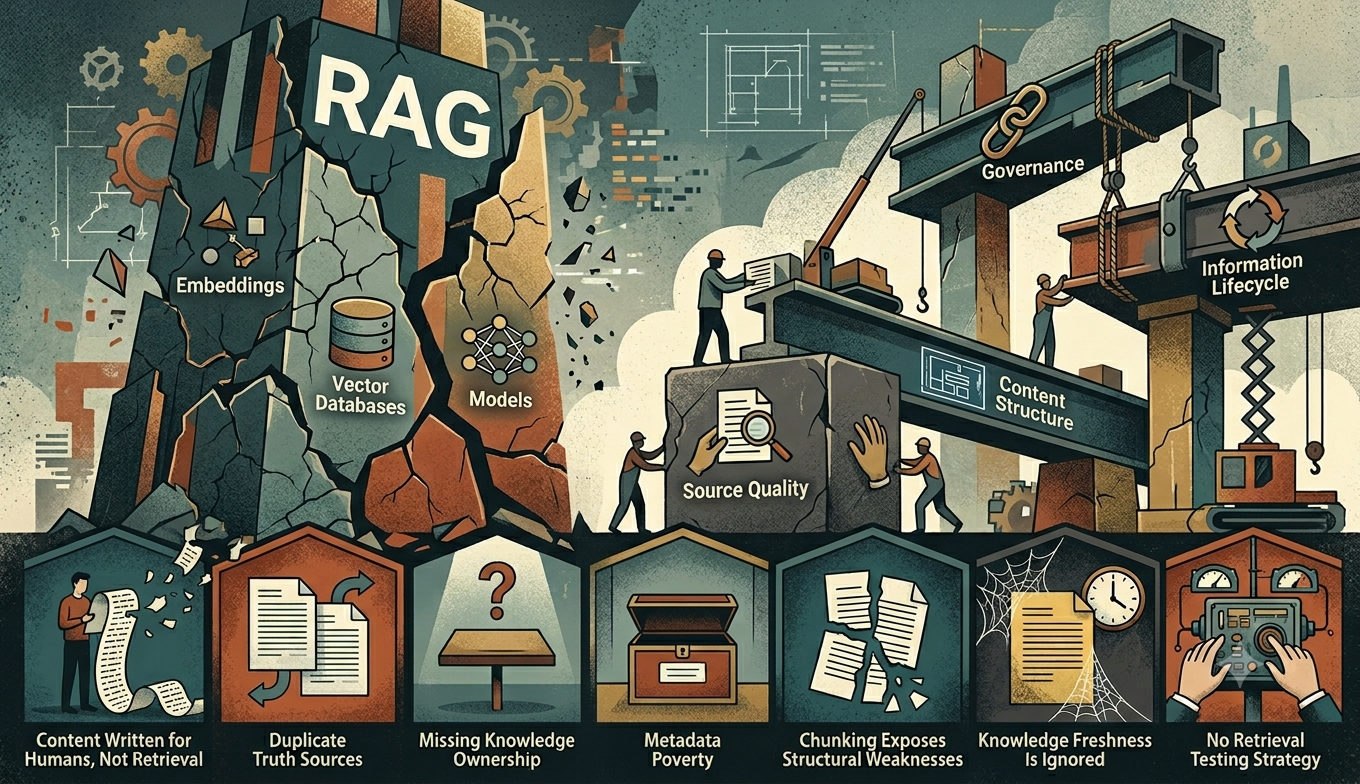
Image owned by Author (Created using Google Gemini)
In 2025, most RAG conversations shared a common focus.
Better embeddings. Better vector database. Better model.
By now, every team has gone through this loop, working through these three with solid engineering effort behind each attempt.
But still for many the retrieval quality graph still may seem quite flat
Because the real failure was never sitting in the retrieval layer. It was sitting in the layer that many ignored or could not prioritize:
The Knowledge Substrate it was Built On
Most think RAG failures are AI System Failures
When a RAG system gives a wrong, outdated, or inconsistent answer, the instinct in the room is usually:
“Our retrieval isn’t good enough.”
“We need a better embedding model.”
“Let’s try a different vector DB.”
So many engineering teams tend to end up spending weeks on:
- Swapping embedding models
- Re-tuning chunk sizes
- Testing five vector databases
- Adding rerankers
- Prompt-engineering their way around bad context
And sometimes, this helps (marginally).
But often, the same category of wrong answers shows up again.
At that point, many teams can also assume:
“RAG just isn’t mature enough yet.”
But it’s not the technology that isn’t mature. It’s the knowledge feeding it.
Most RAG Failures are Knowledge System Failures
Here’s the pattern I’ve seen repeat itself, almost identically:
Poor answer → (assumed) Bad model → Need better AI Poor answer → (actual) Poor retrieval → Poor source content → Knowledge architecture issue
The model isn’t hallucinating out of nowhere.
It’s exposing what was already broken in how the knowledge was managed
A retrieval system can only retrieve what exists and equally importantly the way it exists.
If your content was never designed to be retrieved, fragmented, ranked, and recombined by a machine, no embedding model can make it better.
Architecture Problems Hiding Behind “Bad Retrieval”
Failure #1: Content Was Written for Humans, Not Retrieval
Traditional documentation was built on one quiet assumption: a human will read this top to bottom, in context, inside a structure they can navigate.
That assumption shows up everywhere:
- “As mentioned above…”
- “Refer to the previous section for setup.”
- “See the table below.”
Humans follow context. They scroll, they backtrack, they hold the page in their head.
Agents don’t. They retrieve fragments.
So when a chunk gets pulled out of its page and handed to a model, “as mentioned above” means nothing. The fragment is the only world the model can see.
This isn’t an embeddings problem.
It’s a content dependency design problem.
And no amount of re-chunking fixes content that was never written to stand on its own.
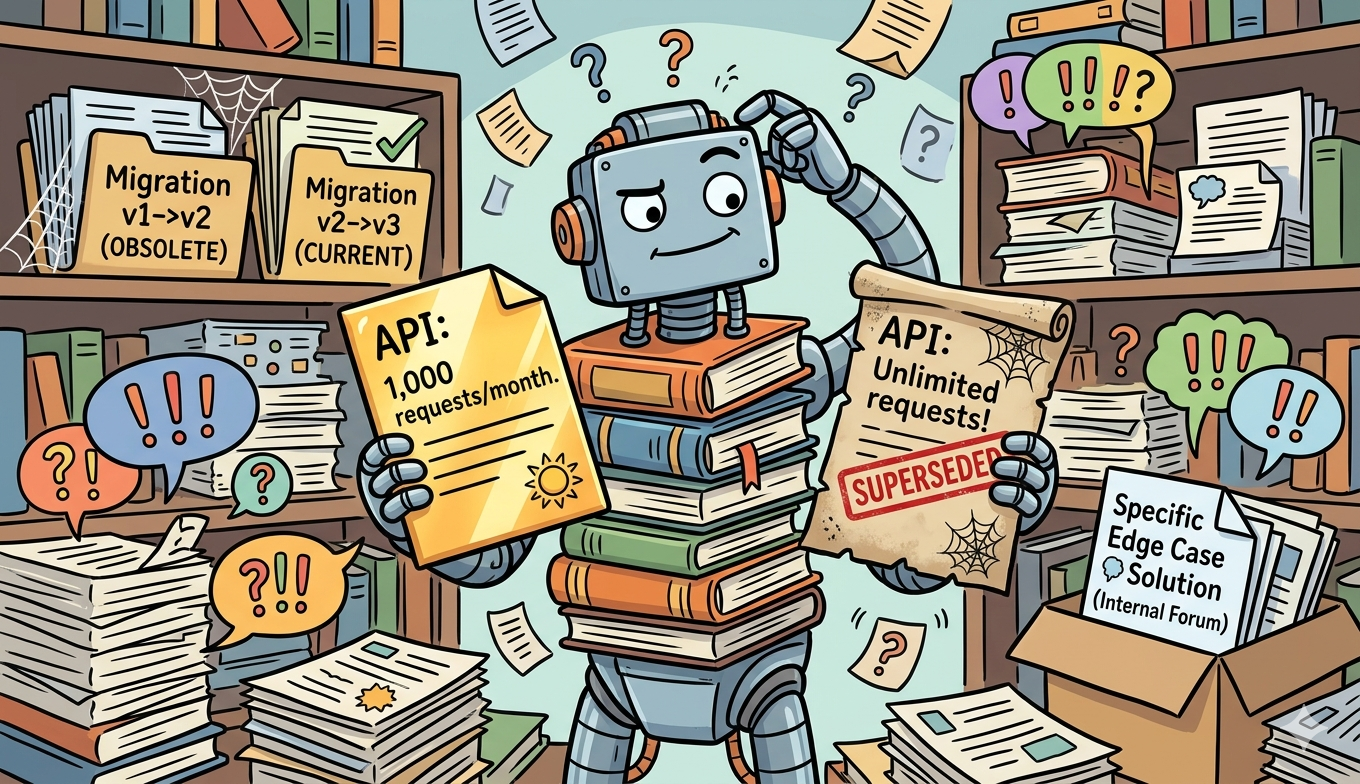
Failure #2: Duplicate Truth Sources
Walk into almost any mid-to-large organization and ask: “Where does this fact live?”
You’ll usually get five answers:
- The official documentation
- An internal wiki page that’s “mostly accurate”
- A SharePoint file someone updated once
- A Slack thread where the real answer actually lives
- An old announcement that was never formally retracted
Each one tells a slightly different version of the same truth.
When a RAG system retrieves from all of these sources, it doesn’t pick a winner.
It just surfaces whichever fragment ranked highest. Not whichever fragment was right.
So when the answer feels contradictory or hallucinated, look closer.
The AI isn’t hallucinating. The organization is presenting multiple truths, and the model is just reading them out loud.
👉 But notice what retrieval can’t do here. It has no way of knowing that “refund policy” in the wiki and “return terms” in the SharePoint file are the same concept wearing two names. To the system, they’re just text that happens to rank similarly.
And that’s a point where it doesn’t stay a content structure problem anymore. It’s a meaning problem, and content modeling was never built to solve it. Fixing it means defining “refund policy” as a single entity and linking every source back to it. That’s a semantic layer’s job, not a schema’s.
Failure #3: Missing Knowledge Ownership
Most organizations can tell you, instantly, who owns a product, a service, or a feature.
Ask them who owns a piece of knowledge, and the room goes quiet.
- Who owns this FAQ?
- Who owns this policy doc?
- Who’s responsible when this page goes stale?
Usually: no one. Or everyone. Which is the same as no one.
Without ownership:
- Content ages silently
- No one flags it as outdated
- Retrieval quality degrades slowly, not suddenly
- Trust erodes long before anyone notices why
You can’t maintain what nobody owns.
And a retrieval system built on top of unowned knowledge will always, eventually, retrieve unmaintained knowledge.
Failure #4: Metadata Poverty
Ask most retrieval pipelines a simple question: “Is this still valid?”
Often, they can’t answer that. Because the metadata was never captured in the first place.
Things like:
- Product version
- Audience (internal vs external, beginner vs expert)
- Region
- Lifecycle stage (draft, current, deprecated)
- Effective date/expiry date
When this metadata is missing, the retrieval system can technically still “find” the right content.
But it can’t tell the difference between what’s current and what’s expired.
And no clever prompt engineering fixes a missing field.
You can’t prompt your way around metadata that was never structured to begin with.
Failure #5: Chunking Exposes Structural Weaknesses
Chunking gets blamed for a lot. “Our chunk size is wrong.” “We need semantic chunking.” “Our overlap settings are off.”
Sometimes, sure.
But more often:
Chunking doesn’t break content. It reveals where the content was already broken.
When a single chunk surfaces and feels confusing or incomplete, look at what it’s actually exposing:
- Multiple topics crammed into one section
- Hidden assumptions that depended on earlier context
- Mixed audiences addressed in the same paragraph
- Weak structure that only worked because a human could scroll past it
A well-structured document chunks cleanly almost by default.
A poorly structured one just finds a new way to fail, this time at the chunk level instead of the page level.
Failure #6: Knowledge Freshness Is Ignored
Teams will spend months building:
- Pipelines
- Vector databases
- Embedding refresh jobs
And then completely skip the question: “How do we know when this content is no longer true?”
No tracking of:
- Content age
- Review dates
- Policy validity windows
- Expiration
Which means retrieval can be technically accurate and practically wrong at the same time.
The system retrieves exactly the chunk it was asked to find. It’s just that the chunk describes a policy that expired four months ago.
Accurate retrieval of obsolete information is still a failure. It just fails quietly.
Failure #7: No Retrieval Testing Strategy
Software teams test software. Every release, every PR, some kind of test suite runs.
Content teams review content. Editors, style guides, approval flows.
But almost no one tests retrieval itself.
Retrieval QA isn’t about whether the content is well-written. It asks three very different questions:
- Can this be found at all?
- Is it found correctly (the right chunk, not just a related one)?
- Is it found consistently (same query, different phrasing, same correct result)?
Without this, organizations only discover retrieval gaps after a user hits one in production.
That’s the most expensive way to find a knowledge architecture problem.
A Real-World Flavor of This Failure
Picture a support AI agent trained on a company’s help center, internal wiki, and product changelogs.
A customer asks about a refund policy.
The agent retrieves a chunk from the help center confidently. The chunk is well-written, clearly worded, and… three policy versions out of date. Meanwhile, the actual current policy lives in a Slack announcement from two months ago that was never pushed into the documentation.
The retrieval pipeline worked exactly as designed. The embeddings were fine. The vector database did its job.
The knowledge architecture didn’t.
No one owned the refund policy page. No metadata flagged it as superseded. No freshness check caught the drift. No retrieval test ever asked, “If a user asks about refunds today, do we surface the current truth?”
This is what most “AI failures” actually look like once you trace them back far enough.
A Quick Retrieval QA Checklist
Before blaming the model, run your content through this:
- Can this content stand alone outside its original page?
- Does this fact have exactly one source of truth, not five?
- Does this piece of knowledge have a named owner?
- Does it carry metadata: version, audience, region, lifecycle stage, effective date?
- Does it chunk cleanly into single-topic, single-audience fragments?
- Do we know how old this content is, and when it should be reviewed?
- Have we actually tested whether this gets retrieved correctly, not just whether it exists?
If your answer was “no” more than twice, your next fix isn’t a better vector database.
A Simple Maturity Model for Agent-Ready Content
If you want to know where your content actually stands today, not where you assume it stands, this gives you a quick way to place it, stage by stage, and spot exactly where the gap is.
Level 1 — Human-Only Content
Written for navigation and context. Assumes a reader, not a retriever. Breaks immediately under chunking.
Level 2 — Retrievable Content
Self-contained sections. Reduced dependency language. Still missing ownership and metadata.
Level 3 — Structured Content
Tagged with version, audience, lifecycle stage. Has a named owner. Chunks cleanly.
Level 4 — Governed Content
Freshness tracked. Conflicting sources reconciled or deprecated. Retrieval tested on real queries.
Level 5 — Agent-Ready Content
Designed knowledge architecture from creation. Single source of truth by design, not by cleanup. Continuously tested, continuously owned, continuously fresh.
Most organizations till today are sitting somewhere between Level 1 and Level 2, while trying to deploy Level 5 expectations on top of it.
And that gap, more often than not, is the actual cause of the poor AI performance you’ve been blaming on the model.
Beyond Level 5: Where Structure Runs Out
Level 5 gets you content that’s owned, fresh, cleanly chunked, and retrievable on its own terms. For most organizations, getting there would already be a transformation.
But even at Level 5, structure alone has a ceiling.
A well-structured page can still fail silently if the system has no way of knowing that two differently worded facts describe the same thing, or that “Product” in your catalog and “SKU” in your inventory system are the same entity wearing two names.
That’s not a chunking problem. It’s not a metadata problem: A meaning problem, the content structure was never built to solve it.
Solving it means moving from how content is organized to what content actually refers to:
Shared vocabularies, entity relationships, formal models of concepts and how they connect.
That’s semantic modeling. Ontologies, knowledge graphs, the kind of scaffolding that lets a system reason about equivalence and relationships, not just retrieve strings that rank well.
Most teams don’t need to start there.
Content modeling is the prerequisite, but if your retrieval problems persist after your content is genuinely well-structured, the next fix isn’t a better chunk size. It’s asking whether your system understands what your content means, not just where it lives.
To conclude, I would say:
Till 2025, the AI conversation was about who has the best model.
But in 2026, that race is closing fast, and the gap between “good enough” models is shrinking every quarter.
Which means the next competitive edge won’t come from the model at all.
Next leap will come from what the model is allowed to see.
And the next generation of AI systems won’t be won by organizations with the smartest models.
They’ll be won by organizations that finally treated knowledge like infrastructure, not an afterthought.
Because you can swap the vector database as many times as you want.
But if the knowledge underneath was never designed to be found, owned, and trusted, you’re not fixing retrieval. You’re just redecorating the failure.
Thanks for reading this article; don’t forget to clap and follow ❤️
You can send me an invite @ LinkedIn or Substack 😎
Looking forward to connecting with you 🤝
You may also like to read:
메타데이터
- post_id
- 3e88173cd1a6
- slug
- when-rag-fails-look-beyond-the-vector-database-3e88173cd1a6
- url
- https://medium.com/womenintechnology/when-rag-fails-look-beyond-the-vector-database-3e88173cd1a6
- canonical_url
- https://medium.com/womenintechnology/when-rag-fails-look-beyond-the-vector-database-3e88173cd1a6
- author_url
- https://medium.com/@bhurji.pk
- status
- ok
- fetched_at
- 2026-07-11 23:27:18