You Say “Hidari,” I Say “Shidari”
What a dialect project in Japan can teach us about the importance of local cultures
You Say “Hidari,” I Say “Shidari”
What a dialect project in Japan can teach us about the importance of local cultures
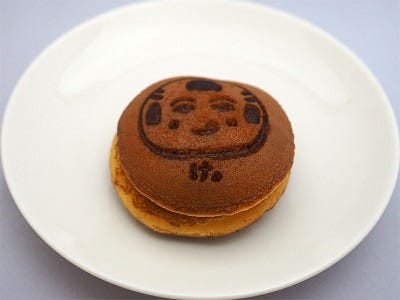
The kana け (ke) is used on this dorayaki, featuring the character Naruko-ttsan, to mean “Eat!” in the local dialect of Sendai, Japan. Free-to-use image at riscascape.net.
To get an idea of how old Japan is, picture this:
・Buddhism was introduced to Japan in the 6th century, when Justinian the Great was emperor of the Eastern Roman Empire.
・The Tale of Genji was written in the early 11th century, around the time Leif Erickson explored the northeastern fringes of North America.
・The Battle of Sekigahara, a decisive battle for the ascendant Tokugawa clan, was fought as Shakespeare was writing his plays in the late 16th century.
The age of a country like Japan also manifests in the great variety of dialects that the people speak.
Given enough time, dialects may even become separate languages. I’ve heard it said, for example, that Mandarin and Cantonese are as different from each other as Spanish is to Italian, though they belong to the same language family.
When traveling in Japan and listening to the different ways Japanese people speak, one wonders if a similar dynamic is at work. While Japanese textbooks employ standard Japanese (標準語, hyoujungo), the reality is that one can hear many colorful dialects of Japanese spoken throughout the country.
One of these dialects is called Sendai-ben (仙台弁), named after the capital city of Miyagi Prefecture, in the Tohoku region. I became interested in this dialect after learning that my wife was from Miyagi when we were still dating. (However, having lived in the Kansai region for years now, she no longer uses it.)
Miyagi is a part of Japan that Japanese people themselves may not know about beyond its fateful connection to the 2011 earthquake and tsunami. It may even surprise them to hear someone talk about how great a place it is to visit.
In my experience, not only are zunda shakes refreshing, but getting to hear the way people in Tohoku speak, mostly those from an older generation, is fascinating—even as I can’t understand a word of it!
Why is this important? To know that there are such variations of spoken Japanese not only broadens one’s perspective of Japanese culture, but it also gives a sense of the integrity of local cultures in Japan.
This is why, for example, the local character Naruko-ttsan was created, along with her inner circle of anthropomorphic kokeshi dolls. Unapologetically speaking Sendai-ben, these characters are meant to promote the culture of Miyagi and Tohoku to a wider audience.
So I was pleasantly surprised when, on a trip to Sendai with my wife in August, we came across a book at a bookstore called *Yon-koma Sendai-ben Kokeshi *(4コマ 仙台弁こけし), in which these characters are featured in four-panel comic strips (i.e. manga). Categorized by the four seasons, the manga in this book are a go-to for how Sendai-ben can be used in various situations.
For example, in a comic strip for summertime, Ban-tsan’s granddaughter, Sakunami-chan, is trying to split a watermelon while blindfolded, yet she can’t understand the directions Ban-tsan is giving her. In this instance, we learn words like しだり (shidari), which means “left,” and め (me), which means “in front.”
Although we can see how these words are similar to hidari and mae in standard Japanese, the punchline comes when Sakunami-chan exclaims that she can’t understand anything Ban-tsan is saying, to the latter’s astonishment.
Not only does this comic illustrate the generational gap between Japanese speakers, it also teaches us basic words of Sendai-ben while employing a classic trope of summers in Japan — splitting a watermelon with a stick fit for a piñata.
Not only can we learn about Japanese from these comics and their explanatory notes, we can also get a sense of how people in Tohoku enjoy the four seasons and how useful Sendai-ben can be. This in turn allows us to appreciate the cultural richness of a neglected part of Japan.
The cute illustrations and humorous situations at least make this book worth checking out. I believe it sets a good example for other local scenes in Japan to raise awareness of the vitality of regions outside urban centers.
Even if you don’t plan on visiting Tohoku anytime soon, at least the promotion of Sendai-ben on social media and such suggests a heightened interest in local cultures throughout Japan. This would be a good thing as more and more Japanese can take pride in where they come from, even as economic circumstances often dictate that people move far from home.
Indeed, projects like Sendai-ben Kokeshi teach us that there is power in knowing where you come from, no matter where you are in the world, and in knowing the diversity of dialects that define a country.
As people from Tohoku might say, Omosheh! (Wow!)
By the way, here are a few other expressions used in Sendai-ben.
・Sendai-ben: Nda. (んだ。)
・Standard Japanese: Souda. (そうだ。)
・English: That’s right.
・Sendai-ben: Ndakara. *(んだから。)
・Standard Japanese: Soudayone. (そうだよね。)
・English: Exactly. (Pretty much.)
*This can actually cause a misunderstanding between Japanese speakers, since the standard Japanese expression, “Dakara?” (or, “Dakara nani?”) means “So what?” with the implication of, “Who cares?” This scenario is also illustrated in the manga.
・Sendai-ben: Ganbappe! (がんばっぺ!)
・Standard Japanese: Ganbatte! (がんばって!)
・English: Keep at it! (Good luck!)
메타데이터
- post_id
- 3e8a00e4afcd
- slug
- you-say-hidari-i-say-shidari-3e8a00e4afcd
- url
- https://medium.com/japonica-publication/you-say-hidari-i-say-shidari-3e8a00e4afcd
- canonical_url
- https://medium.com/japonica-publication/you-say-hidari-i-say-shidari-3e8a00e4afcd
- author_url
- https://medium.com/@cmrpatton
- status
- ok
- fetched_at
- 2026-06-28 04:42:08