WSDOT Graffiti Complaint Data: An AI Challenge — Part One
TL;DR: After repeating the same exact ramblings about AI that I expressed in a previous Medium post I detail the complaints that Washington…
WSDOT Graffiti Complaint Data: An AI Challenge — Part One
TL;DR: After repeating the same exact ramblings about AI that I expressed in a previous Medium post I detail the complaints that Washington State residents reported to WSDOT about graffit on Washington’s freeways.
With my mangled syntax, odd sentence structure, and clearly dyslexic influenced spelling patterns — one thing becomes clear when you plop down and read something authentically written by me. That authenticicy being that you’ll always be able to tell when it’s me versus an LLM derived chatbot.
Like everybody else, I am now, fully, into thedaily use of LLM AI ChatBots. Google Gemini and Claude lead my usage, but i’ve also made a concerted effort to try Mistral’s LeChat and to continue on with ChatGPT. I even pestered DeepSeek repeatedly about Tiananmen and Chiang Kai-shek.
I recently had the opportunity to attend a function about generative content creation for language learning as well as a second speech about different tools and websites that assist in language learning. Fun fact learned in a recent speech: who knew that the country of Poland launched their own, domestic, Polish Large Language Model?
I’ve read, and thought, a lot about where I think the next 24 to 36 months will take us. I do think that by the time of the 2028 election — and indeed most certainly by January 1st of 2030 — a lot of very substantial change will be in process and will have most assuredly already taken place.
I, for one, will welcome a technological advance that will enable robotics to eliminate 60 percent of manual labor in the developing world and 50 percent of knowledge industry jobs in the developed. Smooth transitions all around — especially combined with a once-in-a-century El Nino.
JK, as the kids say.
I am actually mildly optimistic about the next few years — although I certainly don’t share the ra-ra cheerleading evangelism of AI’s biggest proponents. Nor do I have the same sense of complete doom-and-gloom about the impending impact of AI that pervades so many of the conversations online and in the absolutely dorky podcast universe dedicated to AI. The other day I listened to a Dwarkesh Podcast episode about LLMs that was so infused with tech-bro evangelism it sounded like two gerbils on speed.
Maybe it’s just me, but I kind of feel that where one’s opinions about AI falls, closely corresponds to where one finds themselves in the “process versus result” debate.
Those who wholeheartedly find themselves cheering the “increased productivity” angle of LLMs sure seem like those who self-define as “result” oriented. I would put myself in this category, although I would say I have somewhat softened my position over the years.
Those who fully seem to be mired in the “job destruction” angle of the AI debate seem to be those who I would define as the “process” oriented folk. For the “process” oriented folks, the possibility of job loss is real. And since there are only a limited number of jobs then there will be — by definition — substantial job losses.
I never know how to catergoize myself. I am, clearly, far away from being connected into any economy in any meaningful way. People around me — namely German family members — seem puzzled that I support capitalism.
Not sure what to say: most important things that I have done in my life weren’t driven by a profit motive or material gain. To people with a Marxist view point (to which, at this point, I would include the MAGA folks and their decidedly zero-sum worldview) my actions must seem to be an enigma.
Not so long ago, a German family member of mine confided to me that she was flabbergasted that a favorite artist she had been listening to for weeks on a electro-folk Spotify playlist was, in fact, AI generated!
In that most German of fashion it was argued that: “there must be rules!”
I didn’t know what to say. Was I supposed to be angry? Was I supposed to agree that an E.U.-style “regulatory framework” is necessary if only to prevent AI from creating music that was nearly completely electronic to begin with?
I wonder what’s German for: “that horse has already left the barn.”?
She seemed puzzled when I repeated then what I strongly believe now:
Elon Musk didn’t invest hundreds of millions into Trump’s reelection in order for there to be any serious regulatory scheme for A.I. Peter Thiel doesn’t keep sharoing his anecdote about being sickened at how the Biden White House discussed a regulatory framework for A.I. for no reason. Silicon Valley is not enthusiatic about having a “conversation” about something which is likely to rapidly transform the economy and further cement the power of a small number of people.
There will be no meaningful regulations for the foreseeable future. We will all likely wake up on January 1st of 2030 and many of us will likely think to ourselves that, “things sure could’ve been different.”
Maybe we’ll be saying that after Skynet turns on. Who knows.
For the rest of us I assume it will just be like, well:

To the brave new world.
Anyhooter! Let’s get to it! As I have mentioned before, one of my hobbies is filing public record and federal Freedom of Information Act requests.
Without a doubt, AL chatbots such as Google Gemini, ChatGPT, and most especially Claude, have become an extraordinary tool in crafting and filing requests.
In the past year or so I have also been contemplating another issue related to public record requests and AI. That being: what requests for data might be both assisted by AI tools and what new types of public data could be better interpreted by AI itself.
I’ve played around with a couple of ideas (remember that public record requests often take months while FOIA requests might take years) related to the relationship between AI and public data.
One thing that has intrigued me is the public reporting of graffiti. I’ve noticed that many municipalities and state agencies have reporting features for citizens to flag troublesome graffiti in their communities. I decided to try filing public record requests for photographs of graffiti reported and uploaded to communities such as Watsonville and El Cajon, California.
I then had AI assume the role of a law enforcement intelligence analyst for the purpose of evaluating the graffiti and looking for patterns. While I only have a limited amount of data (released photographs) thus far, I have started to document this on Substack. It’s interesting to compare how Gemini, ChatGPT, LeChat and Claude interpret the same data.
In that same spirit, today I tried something similar. The results are, to me at least, interesting. And, if you’re not writing for yourself, then who are you writing for? Sincerest apologies to my 12 readers.
WSDOT stands for Washington State Department of Transportation. WSDOT has a graffiti reporting page online and news reporting in recent years has detailed attempts by WSDOT to combat highway graffiti in the state of Washington.
I lived in Washington state more than 15 years ago, and have made a couple sporadic trips back since then. I always recall the graffiti along Western Washington’s freeways to be pretty bad — and always in stark contrast to the usual picturesque surroundings.
Using the Muckrock service, I filed the following request:
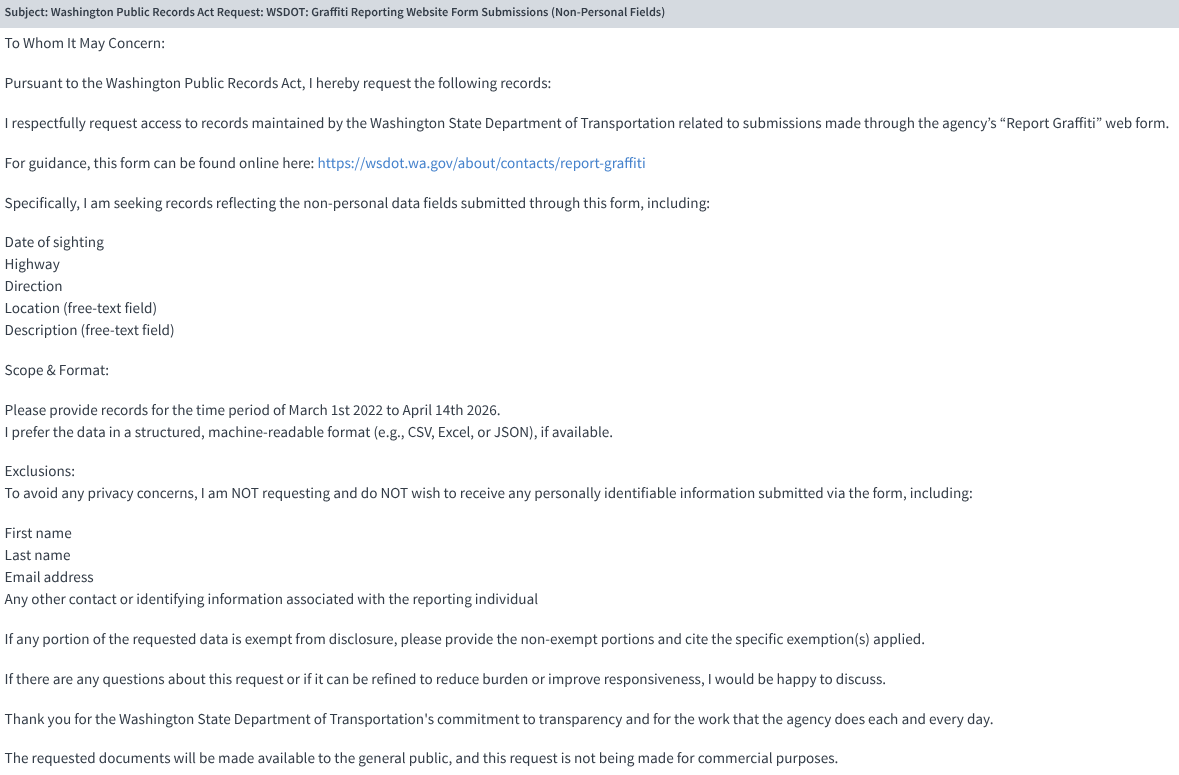
Screenshot of a request I filed with WSDOT via the Muckrock service.
Here’s the text of the request:
“To Whom It May Concern:
Pursuant to the Washington Public Records Act, I hereby request the following records:
I respectfully request access to records maintained by the Washington State Department of Transportation related to submissions made through the agency’s “Report Graffiti” web form.
For guidance, this form can be found online here: https://wsdot.wa.gov/about/contacts/report-graffiti
Specifically, I am seeking records reflecting the non-personal data fields submitted through this form, including:
Date of sighting Highway Direction Location (free-text field) Description (free-text field)
Scope & Format:
Please provide records for the time period of March 1st 2022 to April 14th 2026. I prefer the data in a structured, machine-readable format (e.g., CSV, Excel, or JSON), if available.
Exclusions: To avoid any privacy concerns, I am NOT requesting and do NOT wish to receive any personally identifiable information submitted via the form, including:
First name Last name Email address Any other contact or identifying information associated with the reporting individual
If any portion of the requested data is exempt from disclosure, please provide the non-exempt portions and cite the specific exemption(s) applied.
If there are any questions about this request or if it can be refined to reduce burden or improve responsiveness, I would be happy to discuss.
Thank you for the Washington State Department of Transportation’s commitment to transparency and for the work that the agency does each and every day.
The requested documents will be made available to the general public, and this request is not being made for commercial purposes.”
As you can read from the request, I specifically did NOT ask for identifying information of any of the reported complaints. This request was filed on April 14th of this year, and the reply came today, May 11th.
WSDOT replied to this request and released an Excel file with complaints reported to their website from 2024 to 2026. Here’s a collection of some of the most interesting ones:

Graffiti reported to WSDOT on December 23rd of 2024. Refereces the murder of UnitedHealthCare CEO Brian Thompson.

Lake Washington graffiti in a women’s restroom (?)
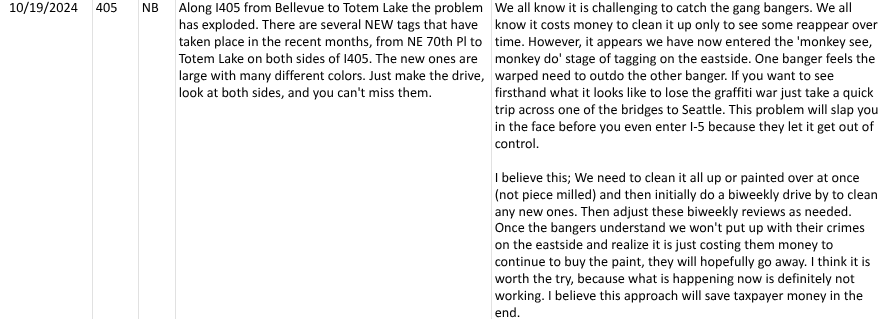
Every baby boomer I know calls suspected gang member “bangers” — every Gen Xer uses “bangers” as a superlative.

I-90 West from Mercer Island into Seattle. “Our city used to take pride in how it presented itself, now it does not.”

Overpass issue in Seattle: who controls the overpass, WSDOT or the city of Seattle?

“What’s going on here in Bellevue?”

A complaint about a large number of wheat pastes of “Hugh Winskill”
Here’s a full list of the reported complaints.
https://claude.ai/public/artifacts/5a27037f-057e-411f-a322-45eed3adb0f3
Next time, in part 2, i’ll show you an interesting thing that I tried with AI related to these requests.
메타데이터
- post_id
- 3ec21dfdcc2a
- slug
- wsdot-graffiti-complaint-data-an-ai-challenge-part-one-3ec21dfdcc2a
- url
- https://medium.com/@robbydelaware1979/wsdot-graffiti-complaint-data-an-ai-challenge-part-one-3ec21dfdcc2a
- canonical_url
- https://medium.com/@robbydelaware1979/wsdot-graffiti-complaint-data-an-ai-challenge-part-one-3ec21dfdcc2a
- author_url
- https://medium.com/@robbydelaware1979
- status
- ok
- fetched_at
- 2026-06-09 15:37:30