How FDA-Cleared Home Sleep Kits Are Changing Sleep Medicine
For decades, “getting checked for sleep apnea” usually meant spending a night in a sleep lab, wired to sensors, trying to fall asleep in a…
How FDA-Cleared Home Sleep Kits Are Changing Sleep Medicine
How FDA-Cleared Home Sleep Kits Are Changing Sleep Medicine
For decades, “getting checked for sleep apnea” usually meant spending a night in a sleep lab, wired to sensors, trying to fall asleep in a place that feels nothing like your own bedroom. That model still matters but it’s no longer the only door into care.
Today, **FDA-cleared home sleep kits are reshaping sleep medicine by making testing more convenient, faster to access, and easier to scale, especially for people who’ve put off evaluation for years. And considering how common sleep apnea is, that shift is a big deal: obstructive sleep apnea affects nearly 30 million Americans, and about 80% of cases are estimated to be undiagnosed**.
What’s changing isn’t just where testing happens. It’s the entire pathway, from suspicion to diagnosis to follow-up becoming more flexible, more digital, and (when used appropriately) more patient-friendly.
Why sleep apnea is still underdiagnosed
Sleep apnea often hides in plain sight. People normalize snoring, chalk up daytime fatigue to stress, or assume their morning headaches are “just dehydration.” Even when symptoms are classic, the friction of scheduling and completing in-lab testing can delay action.
A recent National Sleep Foundation report found the overwhelming majority of people reported never being tested or diagnosed (81%), even though a large share of adults are at increased risk.
Common reasons people delay testing
- “I don’t want to sleep in a lab.”
- “Appointments take too long to schedule.”
- “I’m not sure my symptoms are serious enough.”
- “I travel for work / have kids / can’t spare the time.”
This is exactly where FDA-cleared home sleep kits have created momentum: they reduce barriers without eliminating clinical oversight.
What “FDA-cleared” actually means (and why it matters)
Not every gadget that tracks sleep is medical-grade. An app that estimates snoring is not the same as a regulated diagnostic device.
FDA-cleared typically means the device has gone through a regulatory pathway (often 510(k)) demonstrating it’s substantially equivalent to a legally marketed device for its intended use. In plain language: it’s been reviewed for safety and performance for a medical purpose like home sleep apnea testing.
Real-world examples include devices such as WatchPAT, which is marketed as an FDA-cleared home sleep apnea test.
How FDA-cleared home sleep kits work
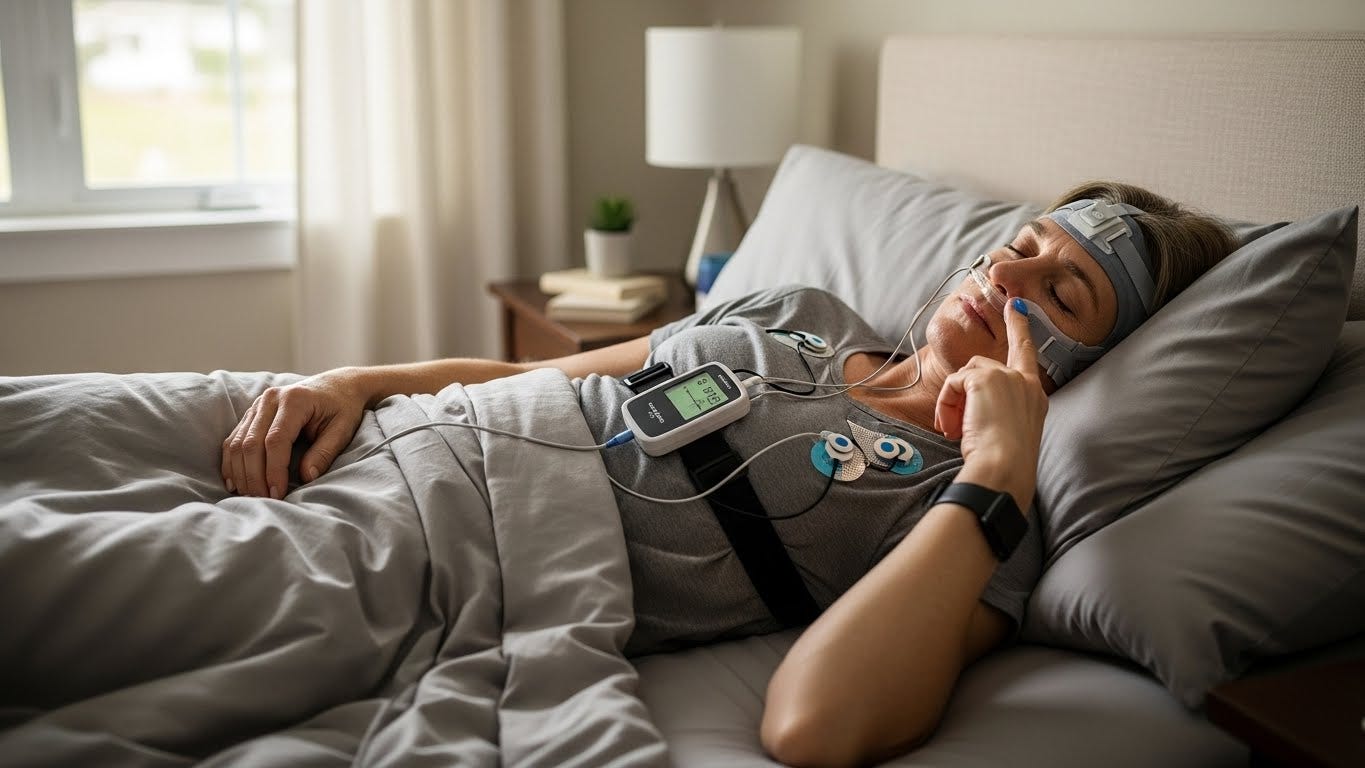
Most home sleep testing falls under **Home Sleep Apnea Testing (HSAT). These tests are designed to evaluate breathing patterns and oxygen levels overnight, helping identify obstructive sleep apnea in the right patient population. Technical guidance describes HSAT as an alternative for diagnosing OSA in uncomplicated adults** who have symptoms suggesting a higher risk of moderate to severe OSA.
What they typically measure
Depending on the device type, FDA-cleared home sleep kits may record:
- Airflow (nasal cannula)
- Breathing effort (chest/abdomen belt)
- Blood oxygen saturation (pulse oximetry)
- Heart rate
- Snoring or body position (some models)
For example, Resmed’s ApneaLink Air describes recording multiple channels including respiratory effort, pulse, oxygen saturation, nasal flow, and snoring.
What they don’t do
Most HSAT setups do not measure brain waves (EEG), which means they estimate sleep time differently than a full in-lab polysomnogram. That’s why patient selection and clinician interpretation matters.
When a home sleep test is a strong fit (and when it isn’t)
Sleep medicine experts have clear guidance here. The American Academy of Sleep Medicine’s diagnostic guideline supports home sleep apnea testing as an option for certain adults when used in the appropriate clinical context (and not as a standalone consumer test).
Good candidates for FDA-cleared home sleep kits
- Adults with strong symptoms of obstructive sleep apnea (loud snoring, witnessed pauses, daytime sleepiness)
- People without complex cardiopulmonary or neuromuscular conditions
- Those likely to have moderate-to-severe OSA based on screening
Situations where in-lab testing may be better
- Concern for central sleep apnea, significant heart failure, or complex breathing disorders
- Suspected parasomnias or seizure-related events during sleep
- Severe insomnia (insufficient sleep time for a reliable HSAT)
- Prior negative HSAT with persistent symptoms
A practical takeaway: FDA-cleared home sleep kits are powerful but they’re not one-size-fits-all. They work best as part of a clinician-led pathway.
The biggest benefits: what’s changing in real life
1) Faster access to diagnosis
Long wait times for lab studies can slow everything down. Home testing can often be initiated sooner, especially when paired with telehealth workflows.
2) More “real sleep” data
Some people sleep poorly in labs. Testing at home can reflect a more natural night your usual bed, your usual routine, fewer disruptions.
3) A scalable response to a huge problem
Undiagnosed sleep apnea isn’t just common; it’s costly. An AASM summary of a Frost & Sullivan analysis estimated the annual economic burden of undiagnosed sleep apnea among U.S. adults at about $149.6 billion, including productivity loss and accident-related costs.
Actionable expert tips to get the most accurate result
Even the best device can produce messy data if setup is sloppy. Here’s how to improve the odds of a clean, useful recording.
Before test night
- Practice the setup in daylight. Don’t make bedtime your first attempt.
- Avoid new variables. Skip alcohol that evening and avoid unusually late caffeine.
- Charge or confirm batteries if your device uses them.
On test night
- Follow the fit rules: snug straps, secure sensor placement, and confirm indicator lights (if your kit has them).
- Sleep as normally as possible. The goal is a representative night, not a “perfect” night.
- If you wake up and a sensor has slipped, re-seat it rather than ignoring it.
After the test
- Don’t self-diagnose from a number alone. Ask your clinician to explain:
- What severity range you fall into
- Whether results match your symptom story
- What the next step should be (CPAP, oral appliance, lifestyle changes, or more testing)
Where the “Sleep apnea home test” fits in modern care
A Sleep apnea home test isn’t just a convenience upgrade it’s often the first step that finally gets someone into treatment. In many practices, the pathway now looks like this:
- Screening + symptom review
- HSAT using an FDA-cleared device
- Clinician interpretation + diagnosis
- Treatment discussion and follow-up
And because comfort affects adherence, getting people into care earlier can make treatment feel more doable.
If you’re researching options, you’ll also see the phrase sleep apnea home test kit used to describe HSAT devices and their patient-facing packaging. The key is to make sure the pathway includes a qualified provider who can interpret results and guide next steps especially if symptoms are significant or the first test is inconclusive.
The future: home-first, but clinician-led
The most important shift isn’t that sleep medicine is “moving online.” It’s that sleep care is becoming more accessible while staying clinical where it counts. Done well, FDA-cleared home sleep kits can shorten the time between “something feels off” and “here’s what we’re going to do about it.”
A smart next step
If you (or your partner) notice loud snoring, choking/gasping, morning headaches, or ongoing daytime sleepiness, don’t wait for it to magically improve. Talk to a qualified clinician about whether an FDA-cleared home sleep kit is appropriate for your situation or whether an in-lab study makes more sense.
메타데이터
- post_id
- 3edc4e2165aa
- slug
- how-fda-cleared-home-sleep-kits-are-changing-sleep-medicine-3edc4e2165aa
- url
- https://medium.com/@alexahiggens/how-fda-cleared-home-sleep-kits-are-changing-sleep-medicine-3edc4e2165aa
- canonical_url
- https://medium.com/@alexahiggens/how-fda-cleared-home-sleep-kits-are-changing-sleep-medicine-3edc4e2165aa
- author_url
- https://medium.com/@alexahiggens
- status
- ok
- fetched_at
- 2026-06-09 15:37:30