AI-Powered Intelligent Maintenance
By integrating predictive monitoring with generative AI, we are building an intelligent maintenance system capable of self-diagnosing the…
AI-Powered Intelligent Maintenance
By integrating predictive monitoring with generative AI, we are building an intelligent maintenance system capable of self-diagnosing the root causes of equipment abnormalities. This solution helps quickly identify machine issues, reduce downtime, shorten repair cycles, and improve overall production efficiency — ideal for industries such as semiconductors, petrochemicals, and heavy manufacturing.
In the era of Industry 4.0 and smart manufacturing, anomaly detection alone is no longer sufficient to handle today’s increasingly complex production environments. The key challenge is:
How can predictive monitoring combined with generative AI enable machines not only to detect abnormalities, but also to automatically infer possible failure causes and provide actionable recommendations?
A 3 A.M. Call — Do You Still Have to Diagnose It Yourself?
If you are an equipment engineer, maintenance supervisor, or plant operations manager, this situation is probably all too familiar:
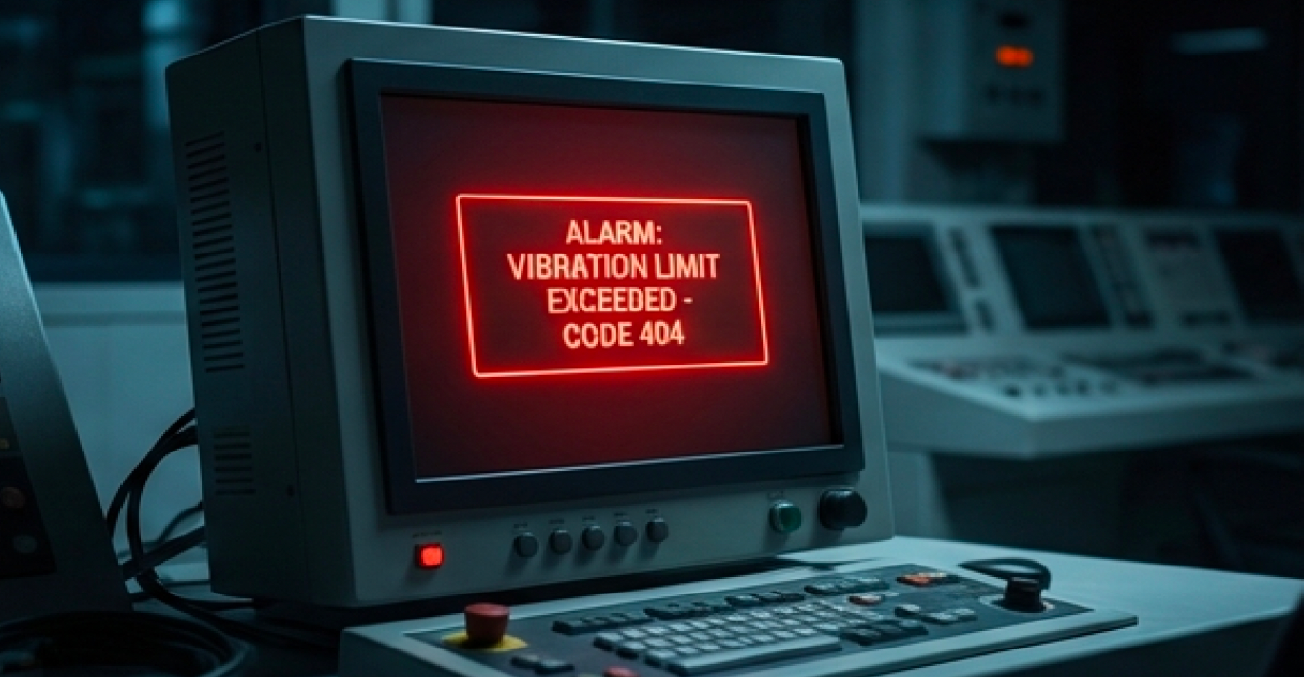
At 3 a.m., a critical production machine suddenly shuts down unexpectedly. The automated system triggers a “vibration anomaly” alarm — but what happens next still depends entirely on human decision-making.
Is it bearing wear? A gear misalignment? Or a hydraulic failure?
You must dig through historical records, wait for senior technicians to interpret the signals, and dispatch on-site inspections…
Even with early warnings, the system still cannot explain what is actually wrong.
The Maintenance Bottleneck Many Companies Face Today
This is where many enterprises remain stuck:
- Monitoring systems exist, but automatic diagnosis is missing
- Massive amounts of data are collected, but knowledge-based reasoning is absent
- AI analytics are available, but frontline application is still too slow
Why We Developed Predictive Monitoring + GenAI Diagnostics
That is exactly why we launched our Predictive Monitoring + Generative AI Diagnostic System:
- Enabling equipment to “tell you what might be going wrong”
- Delivering clear, understandable, and actionable recommendations
Truly realizing real-time intelligent maintenance decision-making
Industry Pain Points: Prediction ≠ Prevention, Data ≠ Knowledge — Three Key Challenges of Traditional AI Applications
Over the past decade, AIoT technologies have rapidly advanced across the manufacturing sector. From sensor deployment and cloud-based data collection to model training and the adoption of predictive maintenance tools, many enterprises are now able to “see the risks ahead.”
However, several critical real-world challenges remain unresolved…
1. Anomaly Detection Is Possible — But Anomaly Explanation Is Not
Most current systems can detect abnormalities through thresholds or machine learning models (such as FFT spectrum shifts or energy anomalies). Yet the outcome often stops at a simple “red-light alert.”
These systems are unable to further explain the underlying physical mechanisms, degradation pathways, or potential failure risks behind the anomaly. As a result, engineers still must rely on manual interpretation and experience-based guessing.
This means that while anomalies may be detected, they cannot be translated into clear actions — greatly weakening the most valuable aspect of predictive maintenance: early intervention.

Anomaly Detection Is Possible — But Anomaly Explanation Is Not
2. Frontline Personnel Struggle to Trust or Understand AI Judgments
Even when AI models achieve high accuracy, they often remain a “black box” to most field engineers.
When systems provide only scores, probabilities, or anomaly indicators — without clear causal explanations or reasoning logic — users find it difficult to convert outputs into real maintenance decisions.
In high-risk, high-cost production environments, a lack of interpretability directly leads to a lack of trust. Ultimately, AI recommendations are ignored, delayed, or not adopted at all.

Frontline Personnel Struggle to Trust or Understand AI Judgments
3. Diverse Equipment, Operating Conditions, and Root Causes Make Unified Modeling Difficult
Manufacturing environments involve a wide variety of machines. Different equipment types, process conditions, and operating behaviors can produce similar anomaly signals — yet originate from completely different root causes.
This makes traditional AI approaches, which rely heavily on large volumes of labeled training data, difficult to replicate and scale. Each new machine type requires costly model rebuilding and tuning.
As a result, AI projects remain difficult to industrialize: success stories cannot be replicated, and digital transformation stays limited to isolated pilot deployments.

Diverse Equipment, Operating Conditions, and Root Causes Make Unified Modeling Difficult
A Shared Core Need
All of these challenges point to one essential requirement:
We don’t just want to detect anomalies — we need to understand what the anomalies are trying to tell us.
Only when systems can translate abnormal data into human-understandable meaning, context, and actionable recommendations can predictive monitoring evolve from a technical showcase into a trusted decision-making tool adopted on the factory floor.
From Predictive Anomalies to Maintenance Recommendations
We integrate three key layers of technology — from foundational sensing and signal diagnostics to high-level semantic generation — to create an intelligent maintenance assistant that can truly “speak the language of humans.”
The core value of this system is not simply the accuracy of a single model, but rather its ability to connect and translate knowledge across multiple layers. Equipment conditions are no longer just data that only engineers can interpret, but decision-ready information that can be understood and adopted across the entire organization.

From Predictive Anomalies to Maintenance Recommendations
Layer 1: Real-Time Vibration Monitoring + FFT Spectrum Anomaly Analysis
- Continuous monitoring of critical equipment using high-precision vibration sensors
- Fast Fourier Transform (FFT) spectrum computation to identify abnormal frequency patterns
This is the system’s “sensory layer.”
We use high-precision sensors to continuously capture subtle operational changes in machinery. Through Fast Fourier Transform (FFT) techniques, complex vibration signals are decomposed into specific frequency components.
It is essentially a form of digital auscultation for machines — turning invisible physical characteristics into scientifically recognizable abnormal patterns.
By installing vibration sensors on key assets, the system performs 24/7 uninterrupted monitoring. We do not merely collect vibration values; we immediately apply FFT algorithms to transform complex time-domain signals into spectrum-based features, enabling early detection of abnormal frequency configurations long before issues become visible to the naked eye.
Layer 2: Data Structuring and Knowledge Definition
- Initial classification through a professional spectrum library (e.g., imbalance, misalignment, looseness, bearing defects, resonance)
- Feature-value matching based on spectral patterns
This is the system’s “logical layer.”
Detected spectra are not directly fed into AI models. Instead, they first enter a feature-matching stage.
By referencing an expert-defined spectrum library, the system performs preliminary identification of anomaly categories (such as imbalance or shaft misalignment). Frequency, amplitude, and environmental conditions are then encoded into structured event-based data with contextual relationships.
This step ensures that AI diagnosis is grounded in accurate, evidence-based facts rather than raw signals.
In other words, complex vibration information is “translated” into a structured syntax that AI can truly understand — laying a solid foundation for deeper diagnostic reasoning.
Layer 3: Generative AI for Decision Support
- Automatic generation of likely root causes based on diagnostic evidence
- Actionable reports guiding maintenance priorities and repair procedures
This is the system’s “brain layer.”
Traditional AI systems can only output probabilities or anomaly scores. In contrast, our generative AI diagnostic model can truly explain findings in human language.
Using an industrial maintenance–optimized large language model (LLM), the system does not merely raise alarms. Instead, it reasons based on structured evidence from the previous layers, automatically generating readable root-cause analysis and clear, actionable recommendations.
Through this approach, AI becomes a maintenance assistant that can “speak human” — helping users determine repair sequences, guiding frontline technicians with concrete actions, and clarifying maintenance priorities.
Most importantly, it addresses a long-standing challenge in industry:
the difficulty of transferring expert technician knowledge.
By transforming complex technical analysis into immediate operational capability, the system bridges the gap between data detection and real-world maintenance execution.
Building a Company-Specific Maintenance Brain
Engineers no longer need to manually compare hundreds of spectrum charts or historical failure cases.
The AI proactively organizes “possible root causes + supporting evidence,” allowing users to upload the most relevant internal knowledge sources — making maintenance decisions faster, more accurate, and more reliable.

Building a Company-Specific Maintenance Brain
AI Does Not Replace People — It Extends Human Judgment
This is where the concepts of Knowledge Graphs and Retrieval-Augmented Generation (RAG) come in.
They explain why AI does not simply “make things up” (the so-called hallucination problem).
Our system is not just running GPT in isolation. It is designed to integrate enterprise-specific knowledge, including:
- Internal maintenance manuals (SOPs)
- Historical repair logs
- Expert technician experience and insights
Through RAG technology, the AI retrieves real cases from the company’s database before generating recommendations. This ensures that the outputs are grounded in practical plant operations — not abstract theory.
What Changes When We Go One Step Beyond Traditional Predictive Maintenance?
1. Elevating Digital Transformation: Knowledge Becomes Intellectual Property (IP)
Manufacturing industries widely face the challenge of experienced technicians retiring, creating serious skill gaps.
This system captures the “craft knowledge” of senior experts — such as diagnosing issues by sound or vibration patterns — and converts it into digital logic rules and semantic models.
Valuable maintenance expertise is no longer a personal asset; it becomes a scalable corporate digital asset.
2. From Reactive Repair to Prescriptive Maintenance
Traditional maintenance is reactive: fix it after it breaks.
Predictive maintenance is proactive: fix it when it is about to break.
With generative AI, we enter the era of Prescriptive Maintenance:
AI provides a “maintenance prescription” — even drafting work orders — so engineers can enter the field with the right parts, at the right time, targeting the problem precisely.
Key Business Impact
1. Reduce Mean Time to Repair (MTTR) by Over 30%
When equipment abnormalities occur, the most time-consuming step is often diagnosing the cause.
With automated AI diagnostics, decision time is dramatically shortened.
In real cases, complex problems that previously required experts up to 8 hours to identify can now be concluded in just 90 minutes, allowing production lines to resume operation much faster.
2. Extend Equipment Uptime by 10–15%
The system can detect subtle early-stage signals, such as lubrication degradation.
By prompting timely oil replacement or parameter adjustments, AI prevents minor wear from escalating into major physical damage — delaying costly component replacement and maximizing asset value.
3. Lower Communication Costs and Accelerate New Engineer Learning
Manufacturers often struggle with the inability to transfer senior technician expertise.
This system converts years of accumulated “know-how” into natural-language guidance.
Even less-experienced personnel can quickly understand fault conditions with AI support, greatly reducing risks caused by miscommunication or incorrect judgment.
4. Data Becomes Knowledge, Knowledge Becomes Action
Instead of delivering only alarms and numerical indicators, we provide high-level semantic feedback.
AI answers:
- “Why is this happening?”
- “What should we do next?”
This interpretability supports not only frontline maintenance execution, but also management-level decisions across departments — optimizing resource allocation and ensuring every maintenance investment is spent where it matters most.
Predictive maintenance focuses on detecting signals.
AI monitoring goes further — interpreting root causes and prescribing next steps.
Predictive monitoring is no longer a novelty. The real differentiator lies in whether it can be translated into effective decision-making recommendations.
Ultimately, what truly separates companies is no longer who installs more sensors or collects more data, but who can transform data into decision intelligence that the organization can actually adopt.
When monitoring results remain limited to alarms and charts, enterprises are still constrained by manual interpretation, experience gaps, and delayed responses. Only by integrating sensing, diagnostics, and language generation — enabling equipment insights to be understood, discussed, and executed — can predictive monitoring become embedded into operational workflows and evolve into a long-term competitive advantage.
This transformation means that factories are no longer merely reacting passively to abnormalities. Instead, they gain the capability to continuously learn, accumulate knowledge, and support smarter decisions.
Equipment is no longer just an object being monitored; it becomes an intelligent node capable of providing recommendations. Maintenance is no longer simply a cost center, but a strategic function that creates value.
Only when intelligence is systematized, semantics are standardized, and experience is assetized can enterprises truly complete the final step from digitalization to intelligent transformation.
메타데이터
- post_id
- 3edec288f62f
- slug
- genai-powered-intelligent-maintenance-3edec288f62f
- url
- https://medium.com/@service_36837/genai-powered-intelligent-maintenance-3edec288f62f
- canonical_url
- https://medium.com/@service_36837/genai-powered-intelligent-maintenance-3edec288f62f
- author_url
- https://medium.com/@service_36837
- status
- ok
- fetched_at
- 2026-06-20 20:29:01