The Gods of Love Borrowed Women’s Bodies
Why poetry, painting, and myth across cultures imagined feminine beauty as proof of divine desire.
The Gods of Love Borrowed Women’s Bodies
Why poetry, painting, and myth across cultures imagined feminine beauty as proof of divine desire.
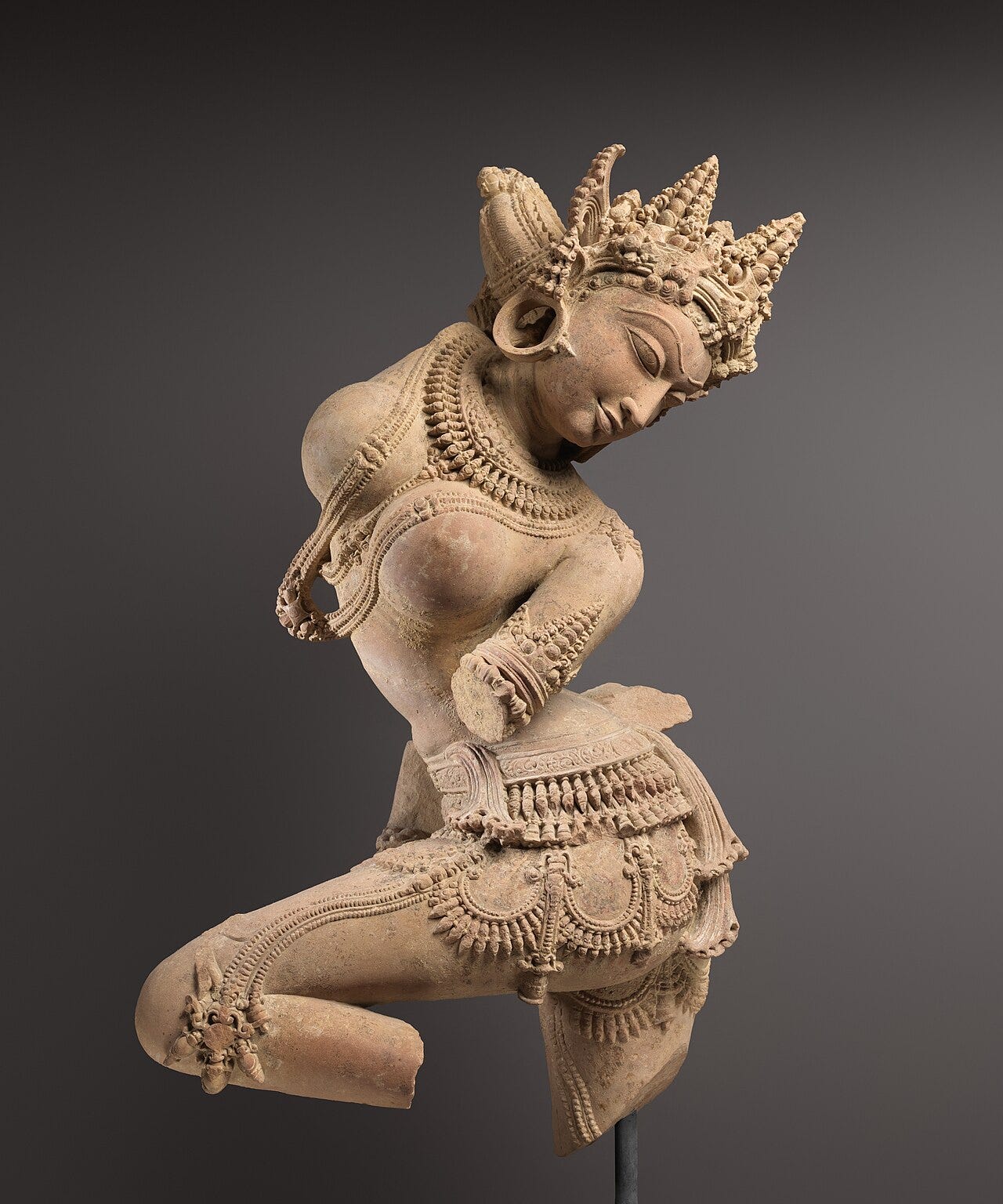
The female body was imagined as perfection itself; each curve, pose, and expression in ancient Indian sculpture speaks of a culture that looked at women as something beyond the human world. (Image credit- Wikimedia Commons Celestial dancer (Devata) mid-11th century, Chandela period, Madhya Pradesh)
The human female form is the most divine symbol across cultures. It curves into metaphor, transforms into a weapon, a throne, a vehicle, a promise of pleasure, and sometimes, proof that the gods of desire once walked among humans.
Across centuries and spaces, traditions searched for the language to describe beauty, longing, and seduction. Again and again, they arrived at the female form.
The West gave us the “Cupid’s bow,” the sharply curved upper lip named after Cupid, the Roman god of desire, imagined with his tiny arrows capable of making mortals fall helplessly in love. Even today, the phrase survives in beauty magazines and cosmetic advertisements, detached from the mythology that produced it.
In Indian traditions, however, the connection between women’s body and the god of desire- Kama, grew much deeper, producing iconic and bewildering forms.
In Vaishnava poetry and Shakta literature, women’s eyebrows become the bow of Kamadeva, the Indian god of love and erotic longing. The curve of the brow is no longer simply anatomy. It becomes a divine weapon.
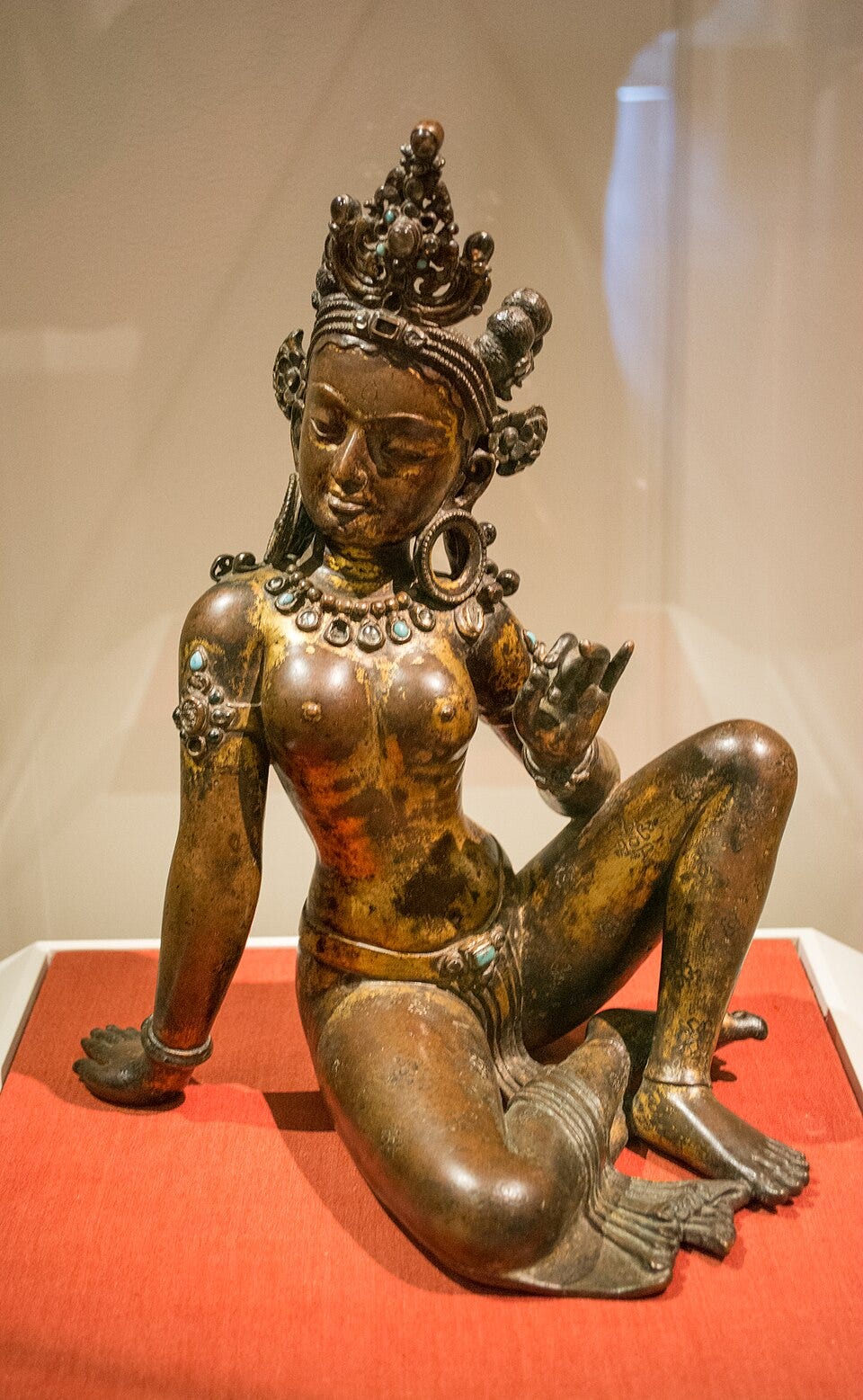
The Saundarya Lahari (Stream of Beauty) is a poetry written in the praise of Uma-Parvati, the Hindu goddess, wife of Shiva. While her other aspect, Kali is described in terms of her ferocity, her brows and eyes are taut and throwing fire at the enemy, in her calm aspect as Uma, she is often described in terms of her physical beauty and grace in devotional and traditional poetry and prose. (Image source: Wikimedia Commons, Uma 10th century gilt bronze from Nepal)
In Chaitanya Mangala, Vishnupriya’s eyebrows are described as defeating the bow of Archer Kamadeva himself. In ***Saundaryalahari***, the Divine Mother’s (Parvati) brows are equated with the sugarcane bow of Kama, her gaze launching arrows that pierce the heart of the onlooker.
Not only is a part of the female body eroticised and imagined as a weapon of desire, but in many instances, her entire form also becomes the architecture that sustains passion.
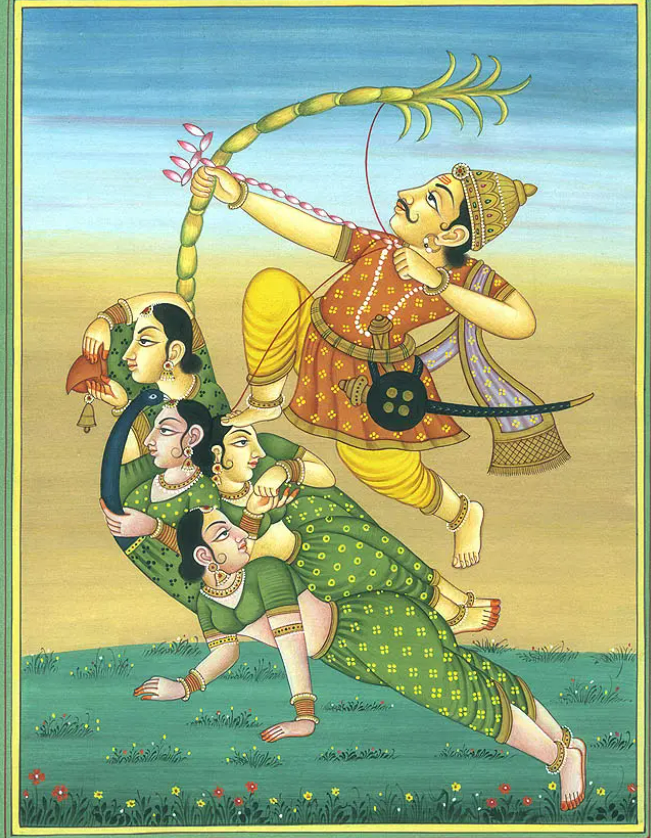
Kamadeva on mount of a parrot formed by bodies of women. (Image source: Exotic India Art https://www.exoticindiaart.com/product/paintings/kamadeva-and-his-mount-parrot-hi66/?srsltid=AfmBOora7iOh4X8LvJGFIxWZqfpQ6Xfpndli6POewwqwix10Oj-5F_N2)
Indian miniature paintings often show Kamadeva riding his parrot, his vahana. But this is no ordinary bird. The parrot itself emerges as an intensely sensual symbol: green like spring and fertility, red-beaked like passion and ripened fruit. In several artistic traditions, the boundaries between the female body and the parrot begin dissolving. Feminine curves merge into wings, torsos fold into feathers, and the mount itself starts resembling a living embodiment of erotic energy.
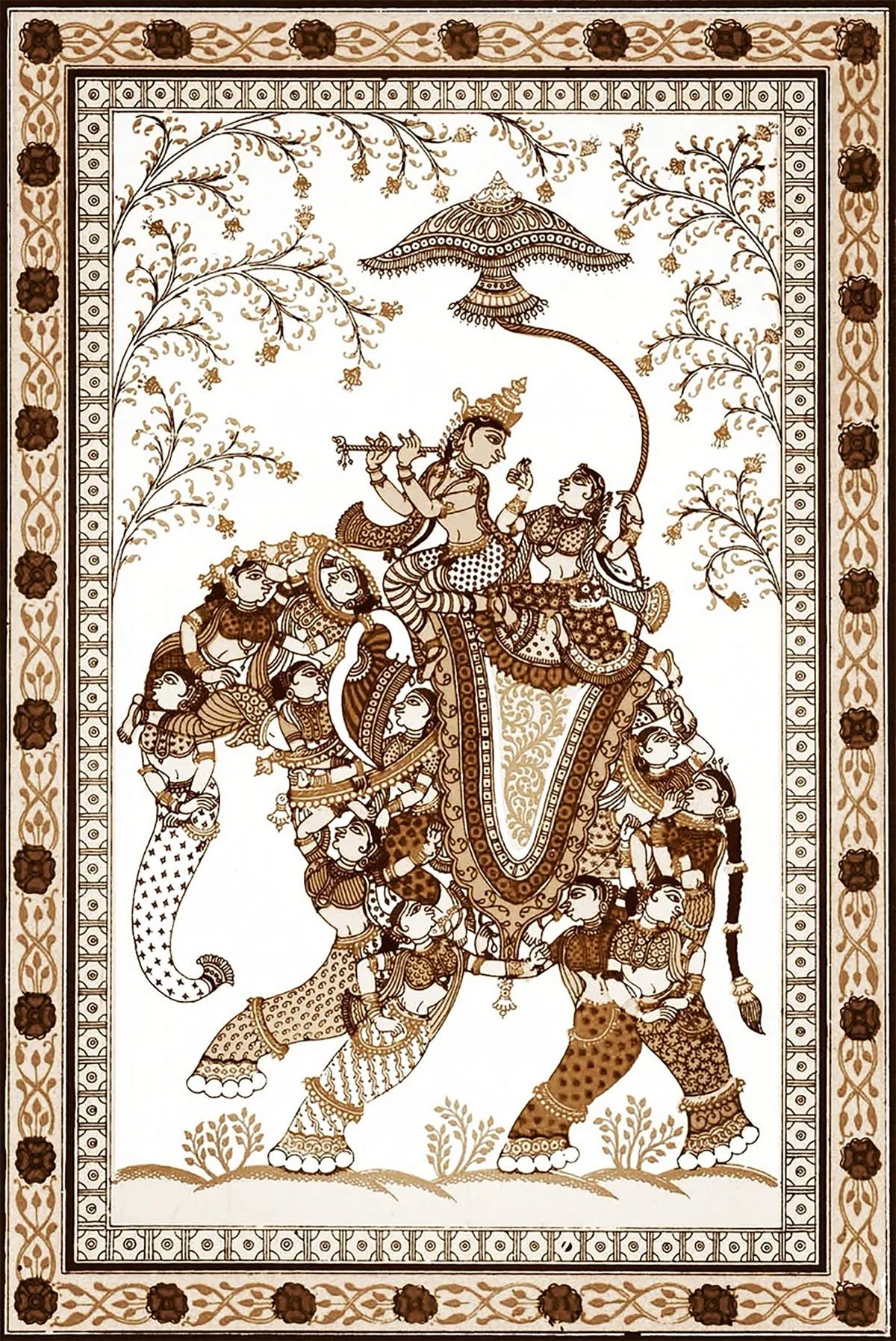
Krishna with Radha seated on Nari Gunjara/Kunjara (Image source- Pinterest/ https://in.pinterest.com/king_of_heart_007/)
And as if this was not enough, we have the masterful Nari-Gunjara, an elephant made entirely with the bodies of women, intertwined in a way that defies even the wildest imaginations.
At temples such as Virupaksha Temple in Hampi, sculptors carved elephants composed entirely of women’s intertwined bodies. In folk art such as Orissa’s Pattachitra, Nari-Gunjara is a popular theme, showing Krishna enthroned atop the animal.
Limbs become trunks, torsos become ears, braided forms become the massive animal itself. Upon this composite body sits Krishna as Rasaraj, the king of passions and emotions.
The image feels surreal even today.
Historical accounts even mention performances in royal courts where women physically assembled themselves into these living formations for kings and audiences. Art moved beyond stone and poetry into flesh itself.
Rati: Desire As A Goddess
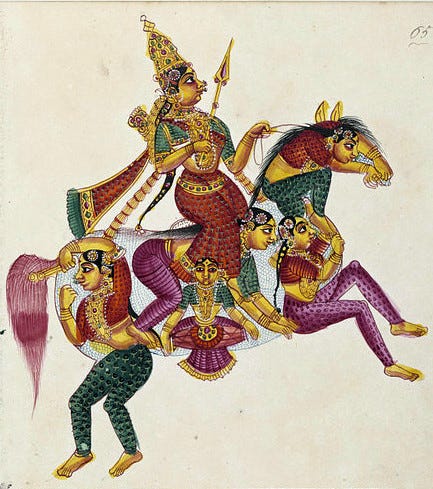
Rati on a composite horse made of bodies of women (Image source: Wikimedia Commons)
And beside Kamadeva stands Rati, perhaps the clearest example of desire itself being given the form of a woman. In the Shiva Purana (Rudra Samhita), after the sage names Kamadeva and foretell his dominion over passion, “a girl took birth from the drops of perspiration of Daksha.” Daksha names her Rati and offers her to Kandarpa, Kamadeva. Born not from light or lotus, but from perspiration itself, Rati emerges from the body’s heat, longing, and sensuality. The text repeatedly emphasizes her mesmerizing beauty, capable of enchanting even sages, making her the perfect counterpart to the god of desire. If Kamadeva shoots the arrows of longing, Rati becomes the atmosphere through which they travel. Together, they form one of the oldest imaginations of eros in Indian thought, where desire is never abstract, but embodied, gendered, and profoundly feminine.
The Male Gaze: An Ever-Present Reality of Sensual Aesthetics
There is undeniable beauty in these imaginations. But there is also discomfort.

Hoysala sculpture of a female with a bird (mynah or parrot) Image source: Pinterest/ https://in.pinterest.com/speakingarch/)
To look at these traditions today is to recognise what we now call the “male gaze.” Much of this imagery eroticises the female body for a predominantly male audience. Women become sites upon which desire, fantasy, conquest, and devotion are projected.
The body is endlessly aestheticised, fragmented into metaphors.
And yet, reducing these traditions only to objectification would flatten their complexity.
These images also reveal something profound about how cultures understood beauty itself. Beauty was not passive. It was dangerous, transformative, divine. The female form was seen as possessing such overwhelming power that even gods of love borrowed their imagery from it.
Kamadeva’s arrows could wound the universe, but poets still believed a woman’s glance was sharper.
There is awe in that imagination.
Perhaps that is why these images continue to survive. Not because they are simple, but because they are contradictory. They contain devotion and desire, reverence and possession, worship and eroticisation all at once.
And somewhere between a Cupid’s bow lip, Kamadeva’s arched eyebrows, a parrot stitched together from feminine curves, and Krishna seated upon an elephant of women’s bodies, one begins to understand how deeply cultures wished to give desire a visible form.
Again and again, they chose the body of a woman.
The same body they feared, worshipped, adorned, controlled, and turned into poetry.
메타데이터
- post_id
- 3edf5e709cf0
- slug
- the-gods-of-love-borrowed-womens-bodies-3edf5e709cf0
- url
- https://medium.com/women-write/the-gods-of-love-borrowed-womens-bodies-3edf5e709cf0
- canonical_url
- https://medium.com/women-write/the-gods-of-love-borrowed-womens-bodies-3edf5e709cf0
- author_url
- https://medium.com/@prakritipassion
- status
- ok
- fetched_at
- 2026-06-22 05:41:33