Bodily Integrity and the Child: Toward a Federal Prohibition on Corporal Punishment in Federally…
Abstract
Bodily Integrity and the Child: Toward a Federal Prohibition on Corporal Punishment in Federally Funded Institutions
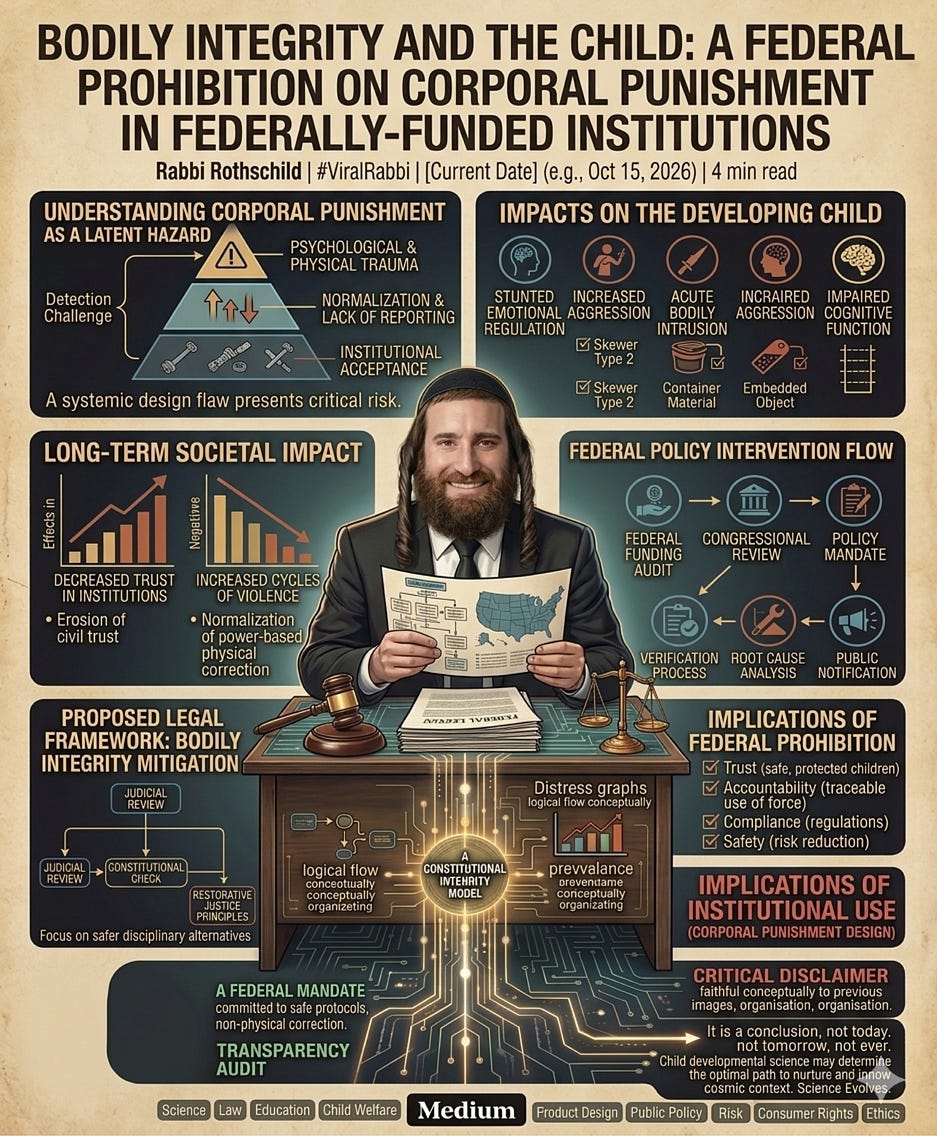
Abstract
This Note argues that corporal punishment of children should be prohibited in federally funded and regulated child-serving institutions through a conditional federal statutory regime. It contends that corporal punishment is (1) a doctrinal anomaly within American tort and constitutional law; (2) empirically harmful and unnecessary given validated non-violent alternatives; and (3) constitutionally regulable under the Spending Clause and substantive due process doctrine.
The Note further proposes the Children’s Humane Integrity and Legal Development (CHILD) Act of 2026, a federal statute conditioning federal child-related funding on abolition of corporal punishment and requiring implementation of evidence-based behavioral interventions.
⸻
I. Introduction
Corporal punishment occupies a structurally anomalous position in American law: it is broadly permissible in certain child disciplinary contexts while functionally prohibited in nearly all analogous adult settings. This asymmetry persists despite substantial empirical evidence demonstrating that physical punishment is both harmful and unnecessary.¹
This Note argues that this doctrinal exception cannot be reconciled with modern principles of bodily integrity, child welfare, or conditional federal spending regimes.
⸻
II. Doctrine
Corporal punishment constitutes a category-specific exception to the general prohibition on intentional physical harm. In tort law, battery requires intentional harmful or offensive contact; disciplinary intent is not a defense.² In criminal law, intent to correct behavior similarly does not justify physical assault outside narrow exceptions.³
The result is a structural inconsistency: the law permits conduct against children that would otherwise constitute unlawful violence.
⸻
III. Evidence
A substantial body of developmental psychology research finds that corporal punishment is associated with increased aggression, anxiety, depression, and weakened attachment, without long-term behavioral advantage.⁴ The American Academy of Pediatrics concludes that corporal punishment is ineffective and harmful to child development.⁵
⸻
IV. Comparative Law: The Swedish Model
Comparative legal systems provide strong evidence that abolition is both feasible and normatively stable. Sweden became the first country to prohibit all corporal punishment of children in 1979 through an amendment to its Parental Code (Föräldrabalken). The reform established the principle that children are entitled to care, security, and respect and may not be subjected to physical punishment or humiliating treatment.⁶
Unlike punitive enforcement regimes, the Swedish model operates primarily through normative reclassification and preventive intervention. Corporal punishment is treated as legally impermissible conduct embedded within a broader child welfare framework rather than a high-frequency criminal offense.
Empirical studies of the reform indicate no increase in youth violence or systemic instability and suggest long-term declines in public acceptance of physical discipline alongside increased reporting of child maltreatment.⁷
⸻
V. Critiques of the Swedish Model and Their Limits
Despite its influence, the Swedish model is subject to three principal critiques: enforcement ambiguity, cultural specificity, and causal attribution.
A. Enforcement Ambiguity
Critics argue that Sweden’s prohibition functions primarily through social services and norm enforcement rather than strict legal sanctioning. However, this critique does not undermine its doctrinal significance. The key legal effect is the reclassification of corporal punishment as presumptively impermissible conduct, which alters baseline expectations even absent frequent prosecution.
B. Cultural Specificity
A second critique attributes Sweden’s success to preexisting cultural conditions such as high institutional trust and low tolerance for physical violence. While cultural context is relevant, it does not negate the legal mechanism’s independent normative effect. Comparative diffusion across jurisdictions with varying institutional structures suggests that legal prohibition itself can function as a norm-generating instrument, not merely a reflection of existing norms.
C. Causal Attribution
A third critique questions whether observed outcomes can be causally attributed to the ban rather than concurrent welfare reforms. While causality is multi-factorial, the relevant legal inquiry is whether the prohibition plausibly contributes to restructuring behavioral expectations. On that standard, the Swedish model remains probative.
D. Doctrinal Implication
Taken together, these critiques refine rather than displace the relevance of Sweden. The model demonstrates that legal systems can reclassify corporal punishment as impermissible without destabilizing child welfare or parental authority. It therefore remains a valid reference point for assessing the feasibility of federal prohibition.
⸻
VI. Federal Power
Congress may regulate child welfare through conditional federal funding under the Spending Clause.⁸ The Supreme Court has upheld such frameworks where conditions are related to federal interests and not coercive.⁹
A federal prohibition on corporal punishment in federally funded institutions would operate through established funding mechanisms analogous to existing child welfare regimes.
⸻
VII. Rights and Strict Scrutiny
Opponents invoke parental liberty interests recognized in Pierce v. Society of Sisters¹⁰ and Wisconsin v. Yoder.¹¹ However, these cases do not establish a right to inflict physical harm on children.
Parental rights are constitutionally protected but limited by the state’s compelling interest in preventing harm.¹²
Under strict scrutiny, corporal punishment fails because non-violent disciplinary methods are empirically effective and less restrictive alternatives exist.
⸻
VIII. Alternatives
Validated non-violent disciplinary frameworks include:
- positive reinforcement
-
- logical consequences
-
- restorative practices
-
- cognitive-behavioral interventions
-
- structured environmental design
These methods achieve equal or superior outcomes without physical harm, eliminating necessity.¹³
⸻
IX. Synthesis
The constitutional conflict is properly understood not as parental autonomy versus state regulation, but as child bodily integrity versus state-permitted violence.
Bodily integrity is a core substantive due process interest.¹⁴ Once children are recognized as rights-bearing individuals, corporal punishment becomes constitutionally suspect as authorized physical harm.
⸻
X. Legislative Proposal: Children’s Humane Integrity and Legal Development (CHILD) Act of 2026
⸻
Be it enacted by the Senate and House of Representatives of the United States of America in Congress assembled,
⸻
§ 1. Short Title
This Act may be cited as the “Children’s Humane Integrity and Legal Development (CHILD) Act of 2026.”
⸻
§ 2. Findings
Congress finds that corporal punishment is harmful, unnecessary, and inconsistent with modern child welfare standards, and that non-violent alternatives are effective.
⸻
§ 3. Definitions
Defines “child,” “corporal punishment,” “covered entity,” and “non-violent disciplinary practice.”
⸻
§ 4. Prohibition
No covered entity receiving federal funds may administer, authorize, or permit corporal punishment of a child. Emergency safety interventions are excluded.
⸻
§ 5. Funding Conditions
Federal funding is conditioned on compliance with this Act. Noncompliance may result in suspension or recovery of funds.
⸻
§ 6. Implementation
Federal agencies shall provide training in non-violent disciplinary methods.
⸻
§ 7. Federalism Clause
This Act does not regulate purely private household conduct absent federal funding and does not preempt more protective state laws.
⸻
§ 8. Effective Date
Takes effect 12 months after enactment.
⸻
XI. Conclusion
Corporal punishment persists not due to necessity, but due to historical inertia. Under contemporary empirical and constitutional standards, it fails both harm-based justification and least-restrictive-means analysis.
The CHILD Act provides a coherent federal framework aligning child protection law with modern scientific and constitutional understanding.
⸻
Notes
- Gershoff & Grogan-Kaylor, 30 J. Fam. Psych. 1 (2016).
-
- Restatement (Second) of Torts § 13.
-
- LaFave, Substantive Criminal Law § 10.4 (3d ed. 2018).
-
- Gershoff & Grogan-Kaylor, supra note 1.
-
- Am. Acad. Pediatrics (2018).
-
- Swedish Parental Code (1979 amendment).
-
- Durrant, Child Abuse Rev. (2001).
-
- U.S. Const. art. I, § 8.
-
- South Dakota v. Dole, 483 U.S. 203 (1987).
-
- 268 U.S. 510 (1925).
-
- 406 U.S. 205 (1972).
-
- Prince v. Massachusetts, 321 U.S. 158 (1944).
-
- Kazdin, Parent Management Training (2005).
-
- Washington v. Glucksberg, 521 U.S. 702 (1997).
메타데이터
- post_id
- 3eeeff7d8345
- slug
- bodily-integrity-and-the-child-toward-a-federal-prohibition-on-corporal-punishment-in-federally-3eeeff7d8345
- url
- https://medium.com/@rabbirothschild/bodily-integrity-and-the-child-toward-a-federal-prohibition-on-corporal-punishment-in-federally-3eeeff7d8345
- canonical_url
- https://medium.com/@rabbirothschild/bodily-integrity-and-the-child-toward-a-federal-prohibition-on-corporal-punishment-in-federally-3eeeff7d8345
- author_url
- https://medium.com/@rabbirothschild
- status
- ok
- fetched_at
- 2026-06-09 15:37:30