Three Gunas in Bhagavad Gita Chapter 14 Shloka 10:… | DKSCORE
Bhagavad Gita Chapter 14, Shloka 10 explains how Sattva, Rajas, and Tamas — the three fundamental qualities of nature — constantly interact…
Three Gunas in Bhagavad Gita Chapter 14 Shloka 10:… | DKSCORE
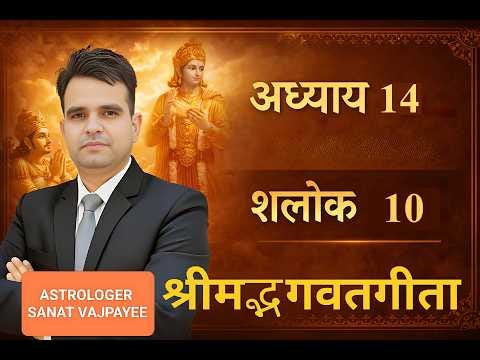
Bhagavad Gita Chapter 14, Shloka 10 explains how Sattva, Rajas, and Tamas — the three fundamental qualities of nature — constantly interact within every human being. Lord Krishna teaches Arjuna that one guna dominates at any given moment while the other two recede, and that true liberation requires transcending all three.
Quick Answer: What Is Bhagavad Gita Chapter 14 Shloka 10 About?
Bhagavad Gita Chapter 14, Shloka 10 teaches that Sattva, Rajas, and Tamas — the three gunas — are always present together in every person. At any moment, one guna rises to prominence while the other two are suppressed. Lord Krishna explains this cycle to Arjuna to help him understand how human thought, behavior, and destiny are shaped by these three forces. The teachings on Sattva Rajas Tamas Bhagavad Gita Chapter 14 remain among the most profound instructions in all of Vedic philosophy.
1. What Are the Three Gunas in Vedic Philosophy?
The three gunas — Sattva, Rajas, and Tamas — are the three fundamental qualities that make up all of material existence, called the Trigunatmak Sansara. Every object, thought, action, and emotion in the universe carries a combination of these three qualities. No human being is ever free from all three simultaneously; rather, one guna tends to be more active than the others at any given time.
Understanding Sattva Rajas Tamas Bhagavad Gita Chapter 14 is essential for anyone seeking to live a purposeful, dharmic life. These three gunas are not merely abstract philosophical concepts — they are living forces that shape every choice, every relationship, and every spiritual aspiration.
2. How Do the Three Gunas Interact With Each Other?
The three gunas do not operate in isolation — they constantly compete and suppress one another. When Sattva guna rises, Rajas and Tamas are pushed down. When Rajas guna dominates, Sattva and Tamas recede. When Tamas guna takes over, both Sattva and Rajas become weak.
This dynamic is not fixed across a day or a lifetime. The dominant guna can shift from moment to moment — even within a single thought. For example, a person may begin with a sattvic intention to serve society, but within the same thought, a rajasic desire for recognition and a tamasic readiness to use force may also be present.
3. What Does Each Guna Cause in Human Behavior?
Each of the three gunas produces a distinct set of mental and behavioral tendencies in a person. Understanding these effects helps one identify which guna is currently dominant in their own life.

GunaPrimary Effect on MindAssociated Behaviors

Sattva Guna
Peace, clarity, knowledge
Selfless service, truth-seeking, spiritual study, calm conduct

Rajas Guna
Desire, ambition, restlessness
Craving for personal gain, fame, action driven by self-interest

Tamas Guna
Laziness, delusion, ignorance
Procrastination, anger, excessive sleep, poor decision-making
4. How Do Diet, Company, and Environment Affect the Gunas?
According to the teachings of Bhagavad Gita Chapter 14, a persons dominant guna is directly shaped by their food, company, and surroundings. These external factors are not trivial — they actively increase or decrease the strength of each guna within the mind.
The principle resembles Faradays Law in physics: just as a magnetic field directly produces a proportional electric field, the quality of ones environment produces a proportional quality in ones thoughts and character. A person who consistently eats sattvic food — fresh vegetables, fruits, grains, and dairy prepared with care — will find their mind naturally gravitating toward clarity and peace. Conversely, rajasic food (spicy, stimulating, heavily processed) agitates the mind and increases desire, while tamasic food (stale, heavy, intoxicating) dulls the intellect and promotes lethargy.
Similarly, the company one keeps — known in Sanskrit as satsang — has a powerful effect on the gunas. Associating with wise, disciplined, and spiritually inclined individuals strengthens Sattva. Spending time in environments of competition, greed, and ambition amplifies Rajas. Surrounding oneself with laziness, negativity, and ignorance deepens Tamas.
5. What Is the Correct Spiritual Path Through the Three Gunas?
Lord Krishna does not suggest that one should try to eliminate all three gunas at once. Instead, He prescribes a gradual, practical path of inner refinement. The first step is to reduce the dominance of Tamas by cultivating Rajas — replacing laziness with effort, replacing ignorance with learning, and replacing passivity with purposeful action.
Once Rajas is dominant and Tamas is subdued, the next step is to refine Rajas into Sattva. This means transforming selfish ambition into selfless service, transforming restless craving into focused devotion, and transforming competitive desire into cooperative wisdom.
The final and most subtle step is to transcend even Sattva itself. Although Sattva guna brings peace, clarity, and spiritual knowledge, it is still a quality of material nature. As long as one is bound by any guna — even Sattva — one remains within the cycle of birth and death. True liberation, or moksha, requires going beyond all three gunas and resting in pure consciousness, which is the nature of the Atman (Self).
6. Why Is Tamas the Most Dangerous Guna?
Among the three gunas, Tamas is considered the most spiritually dangerous because it creates a veil of ignorance so thick that the person does not even recognize their own degraded state. A tamasic person often believes they are at rest when they are actually in stagnation. They mistake inaction for contentment, and confusion for wisdom.
Tamas manifests as excessive sleep, procrastination, addiction, anger without cause, and a deep resistance to change or learning. It is the guna most associated with the lower planes of existence and with the cycle of repeated, painful rebirths.
The antidote to Tamas, as prescribed in Vedic philosophy and the Bhagavad Gita, is disciplined action — even when one does not feel like it. Waking up early, engaging in physical exercise, studying sacred texts, and serving others are all powerful practices that break the grip of Tamas and allow Rajas and eventually Sattva to rise.
7. What Are the Signs That Sattva Guna Is Dominant?
When Sattva guna becomes dominant in a persons life, a number of clear signs appear. The mind becomes calm and steady. Thoughts become clear and free from obsessive craving. There is a natural inclination toward honesty, compassion, and spiritual inquiry. Sleep becomes restful and light. The person wakes up feeling refreshed and purposeful rather than groggy and resistant.
To know more click **here**.
Originally published at https://www.dkscore.com.
메타데이터
- post_id
- 3ef0ab11343e
- slug
- three-gunas-in-bhagavad-gita-chapter-14-shloka-10-dkscore-3ef0ab11343e
- url
- https://medium.com/@dkscore/three-gunas-in-bhagavad-gita-chapter-14-shloka-10-dkscore-3ef0ab11343e
- canonical_url
- https://medium.com/@dkscore/three-gunas-in-bhagavad-gita-chapter-14-shloka-10-dkscore-3ef0ab11343e
- author_url
- https://medium.com/@dkscore
- status
- ok
- fetched_at
- 2026-07-09 06:53:08