The React Tool That Replaced My Manual API State Management
I didn’t replace my API calls.
The React Tool That Replaced My Manual API State Management
I didn’t replace my API calls.
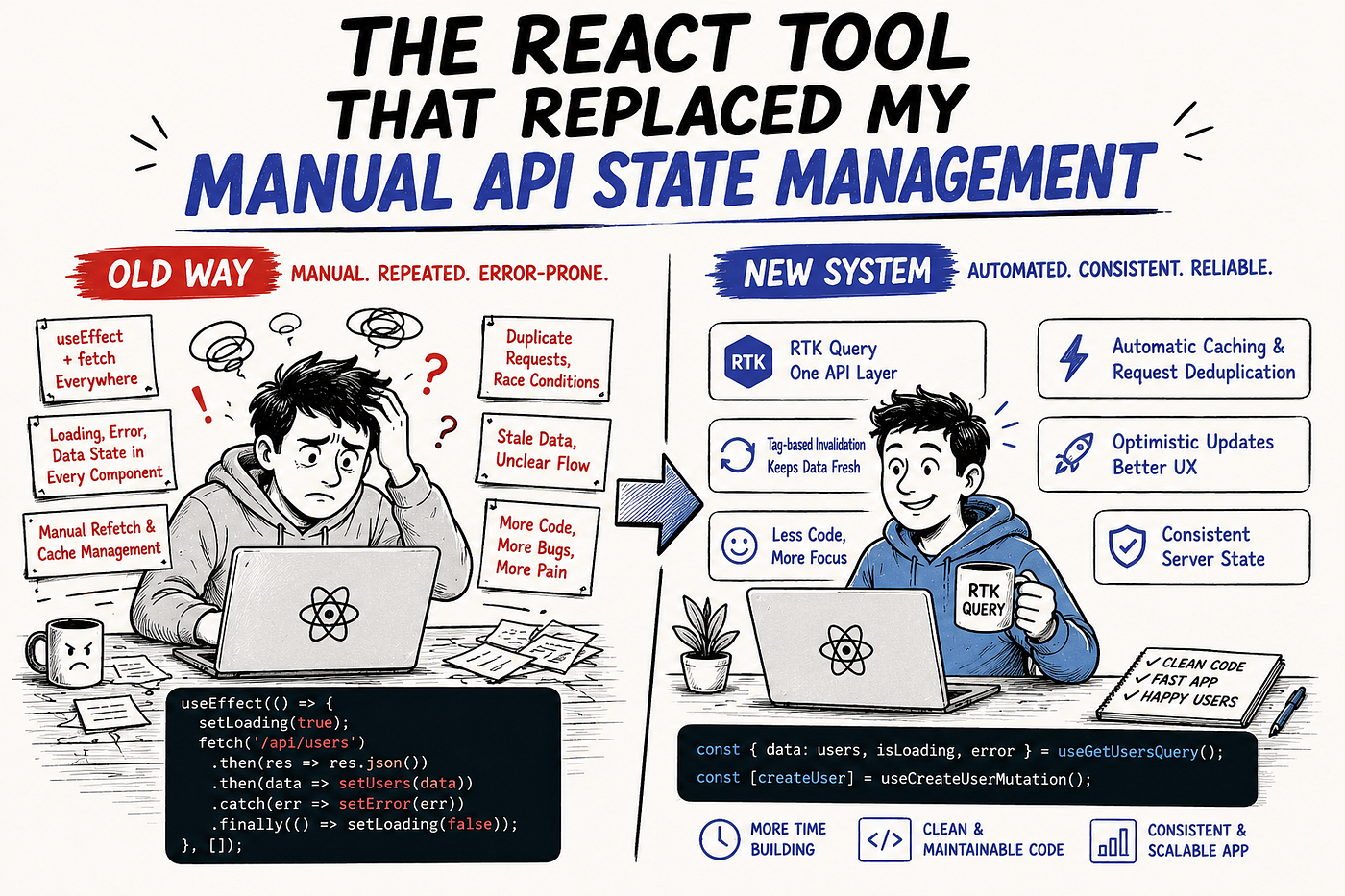
I replaced the way I thought about server state.
For years, I believed the hardest part of building React applications was creating good UI.
I was wrong.
The real challenge was keeping the UI synchronized with the server without drowning in loading states, duplicated requests, stale data, race conditions, and endless useEffect hooks.
The problem was never React.
The problem was that I was managing server state as if it were local component state.
That mistake followed me through multiple projects.
One project finally forced me to rethink everything.
Our dashboard had over forty API endpoints. Every page looked almost identical. Fetch data, show a spinner, handle errors, update local state, refetch after mutations, invalidate caches manually, and pray another developer didn’t forget one of those steps.
Nothing was technically broken.
Yet every sprint included bugs that felt embarrassingly avoidable.
Someone forgot to refresh a list.
Someone displayed stale user information.
Someone fired the same request five times because three components mounted together.
None of those bugs came from business logic.
They came from how we managed API state.
That was the project where I stopped writing manual API management and started using RTK Query.
It wasn’t another React trend.
It solved a problem I kept creating myself.
The Problem Was Never Fetching Data
Most developers think fetching data is easy.
Call an endpoint.
Store the response.
Render the UI.
Done.
Until reality shows up.
Real applications don’t fetch data once.
They refresh.
They cache.
They retry.
They invalidate.
They synchronize multiple screens.
They keep several users working simultaneously.
They recover from failures.
They update data without refreshing the page.
That is where manual state management slowly becomes expensive.
A simple users page usually starts like this.
const [users, setUsers] = useState([]);
const [loading, setLoading] = useState(false);
const [error, setError] = useState(null);

useEffect(() => {
  async function loadUsers() {
    setLoading(true);

    try {
      const res = await fetch("/api/users");
      const data = await res.json();
      setUsers(data);
    } catch {
      setError("Something went wrong.");
    } finally {
      setLoading(false);
    }
  }

  loadUsers();
}, []);
Nothing looks wrong.
In fact, this is how thousands of React developers begin.
The problem appears six months later.
Now there are twenty pages doing exactly the same thing.
Every endpoint has slightly different loading logic.
Every component has different error handling.
Some pages cache data.
Others don’t.
Some refetch after updates.
Others silently display outdated information.
Nobody notices until production.
Practical takeaway
Manual fetching scales much faster than manual maintenance.
Server State Is Not Component State
This was probably the biggest mindset shift for me.
React’s useState is excellent for things like:
- Modals
- Forms
- Selected tabs
- Theme preferences
- Input values
Those values belong to the component.
Server data doesn’t.
Your users list doesn’t belong to the component.
Your products don’t belong to the component.
Your orders don’t belong to the component.
The server owns that data.
Your application only borrows it.
That sounds like a small distinction.
It changes everything.
When developers treat server data like local state, they accidentally take responsibility for caching, synchronization, invalidation, polling, retries, deduplication, optimistic updates, and consistency.
Those are infrastructure problems.
Not component problems.
That realization completely changed how I structured React applications.
We Kept Solving the Same Problem Again and Again
One thing surprised me during code reviews.
Every developer built their own API system.
Different helper functions.
Different loading flags.
Different error messages.
Different retry logic.
Different caching.
Different assumptions.
Eventually the application looked like five frontend frameworks glued together.
The code worked.
The architecture did not.
One screen refreshed after creating a user.
Another required pressing F5.
Another updated instantly because someone remembered to call another fetch.
There was no shared contract.
Just hundreds of tiny decisions accumulating into technical debt.
This is where RTK Query immediately stood out.
Instead of asking every developer to remember every step, it provided one consistent way of interacting with the server.
Consistency matters more than cleverness.
RTK Query Reduced Hundreds of Lines of Boilerplate
When I first saw RTK Query, I assumed it was simply another request library.
It isn’t.
It treats your API as a central part of your application architecture.
Instead of scattering requests across components, you define them once.
export const api = createApi({
  reducerPath: "api",
  baseQuery: fetchBaseQuery({
    baseUrl: "/api",
  }),
  tagTypes: ["Users"],

  endpoints: (builder) => ({
    getUsers: builder.query<User[], void>({
      query: () => "/users",
      providesTags: ["Users"],
    }),

    createUser: builder.mutation<User, CreateUserDto>({
      query: (body) => ({
        url: "/users",
        method: "POST",
        body,
      }),

      invalidatesTags: ["Users"],
    }),
  }),
});
Now every component becomes dramatically simpler.
const { data, isLoading, error } = useGetUsersQuery();That’s it.
No useEffect.
No loading state.
No duplicated fetch logic.
No manual synchronization.
No remembering which list should refresh after creating a user.
RTK Query already knows because you defined the relationship once using tags.
The first time I removed several hundred lines of repetitive fetching code, I realized something important.
Most of my previous code wasn’t solving business problems.
It was compensating for missing infrastructure.
Automatic Caching Changed How Our Application Felt
Caching sounds like a performance feature.
It is actually a developer experience feature.
Without caching, every page behaves independently.
Navigate away.
Come back.
Request again.
Open another tab.
Request again.
Open a modal.
Request again.
The network becomes the busiest part of your application.
RTK Query automatically caches successful responses.
If another component asks for the same resource, it doesn’t immediately hit the server again.
It reuses the cached result.
That makes applications feel faster even when your backend hasn’t changed.
More importantly, developers stop writing custom cache logic everywhere.
Good engineering isn’t about writing more code.
Sometimes it’s about deleting the code you should never have owned in the first place.
- Request deduplication and background refetching
- Cache invalidation that actually works
- Optimistic updates
- Mutations without chaos
- When RTK Query is not the right choice
- Common mistakes teams make
Request Deduplication Is a Bigger Deal Than Most Teams Realize
One production bug made me appreciate RTK Query more than any benchmark ever could.
Three different components needed the authenticated user’s profile.
The navbar displayed the user’s avatar.
The sidebar displayed their role.
The dashboard displayed account statistics.
Each component mounted independently.
Each one executed the same request.
The backend received three identical API calls within milliseconds.
Nobody noticed during development because everything still worked.
Multiply that behavior across thousands of users, and suddenly your infrastructure is handling unnecessary traffic for no business value.
RTK Query automatically deduplicates identical requests.
If multiple components ask for the same data, they share the same request and the same cached response.
You don’t have to coordinate components manually.
You don’t have to create a global loading manager.
The library simply understands that identical requests should not become identical network calls.
That is not just cleaner code.
It is smarter engineering.
Practical takeaway
If multiple parts of your application need the same data, your application should make one request, not five.
Cache Invalidation Is Where Manual State Management Usually Breaks
Fetching data is easy.
Keeping that data correct is the difficult part.
Imagine an admin panel.
You display a list of users.
A modal opens.
A new user is created successfully.
Now what?
Should you manually call the users endpoint again?
Should you append the new user locally?
Should you invalidate every related screen?
Should you update pagination?
Should another browser tab refresh too?
Most teams solve this differently on every page.
That inconsistency becomes technical debt.
RTK Query introduces tag-based cache invalidation.
getUsers: builder.query({
  query: () => "/users",
  providesTags: ["Users"]
}),
createUser: builder.mutation({
query: (body) => ({
url: "/users",
method: "POST",
body
}),
invalidatesTags: ["Users"]
})The relationship is defined once.
Every component depending on that cache updates automatically.
No forgotten refreshes.
No stale tables.
No mysterious “works after pressing F5” bugs.
The exact tagging strategy will vary between teams.
The important part is having a shared strategy instead of relying on everyone’s memory.
Practical takeaway
The best cache invalidation strategy is the one your entire team can understand six months later.
Optimistic Updates Make Applications Feel Alive
Users don’t enjoy waiting.
Imagine clicking “Like” on a post.
If the button waits for the server before updating, the application feels slow.
Modern applications usually update immediately and silently synchronize with the server afterward.
Doing that manually is surprisingly difficult.
What if the request fails?
What if another mutation arrives first?
What if two users update the same resource simultaneously?
RTK Query supports optimistic updates in a structured way instead of encouraging scattered component hacks.
Instead of manually mutating local state everywhere, updates happen through the cache.
If something goes wrong, rolling back the change becomes predictable.
That predictability matters far more than saving a few milliseconds.
Fast software is impressive.
Reliable software earns trust.
Mutations Should Not Create More State Management
Reading data is only half the story.
Real applications constantly create, update and delete information.
Without a consistent approach, mutation logic quickly spreads across components.
One developer redirects after success.
Another shows a toast.
Another refetches manually.
Another updates local arrays.
Another forgets entirely.
Eventually every page behaves differently.
RTK Query keeps queries and mutations inside the same API layer.
const [createUser, { isLoading }] = useCreateUserMutation();await createUser(formData);The component doesn’t worry about cache synchronization.
It focuses on the user experience.
That separation makes components dramatically easier to read.
Business logic belongs in your application.
Networking logic belongs in your API layer.
Keeping those responsibilities separate reduces surprises for everyone who joins the project later.
Practical takeaway
The less networking code inside components, the easier those components are to maintain.
It Is Not Magic, and It Is Not Always the Right Choice
Whenever developers discover a useful tool, the internet quickly turns it into a religion.
RTK Query is excellent.
It is not mandatory.
If you’re building a small landing page with one contact form, introducing Redux Toolkit and RTK Query may be unnecessary.
Sometimes a simple fetch() call is perfectly reasonable.
The value appears when your application grows.
Admin dashboards.
E-commerce platforms.
CRM systems.
Learning management systems.
Healthcare portals.
Enterprise applications.
Projects where dozens of screens share the same server data.
That is where manual API management starts costing real engineering time.
Good engineers don’t choose tools because they’re popular.
They choose them because they remove recurring problems.
The Biggest Lesson Wasn’t About RTK Query
Looking back, RTK Query wasn’t the biggest improvement I made.
The mindset was.
I stopped treating server state as something every component should own.
Instead, I treated the API as a shared source of truth.
That small shift eliminated entire categories of bugs.
Duplicate requests disappeared.
Stale data became rare.
Code reviews became shorter.
New developers understood the project faster.
We spent less time arguing about implementation details and more time shipping features.
The library deserves credit.
But the architectural thinking matters even more.
Libraries come and go.
Good engineering principles usually stay.
Conclusion
For years, I thought writing more API management code meant having more control.
It didn’t.
It meant taking responsibility for problems the framework could solve better than I could.
RTK Query didn’t make me a better React developer because it hid complexity.
It made me a better developer because it placed complexity where it belonged.
Good React applications are not built by scattering useEffect hooks across dozens of components.
They are built by giving every layer a clear responsibility.
The UI should describe the interface.
The API layer should own server communication.
The cache should manage consistency.
And developers should focus on solving business problems instead of rewriting networking infrastructure for the tenth time.
Good software is not the application with the most custom code.
It is the application where every piece of code has a reason to exist.
If you’ve ever replaced hundreds of lines of manual fetching code with a cleaner architecture, I’d love to hear what changed for your team.
Automatic Caching Changed How Our Application Felt
Caching sounds like a performance feature.
It is actually a developer experience feature.
Without caching, every page behaves independently.
Navigate away.
Come back.
Request again.
Open another tab.
Request again.
Open a modal.
Request again.
The network becomes the busiest part of your application.
RTK Query automatically caches successful responses.
If another component asks for the same resource, it doesn’t immediately hit the server again.
It reuses the cached result.
That makes applications feel faster even when your backend hasn’t changed.
More importantly, developers stop writing custom cache logic everywhere.
Good engineering isn’t about writing more code.
Sometimes it’s about deleting the code you should never have owned in the first place.
Request Deduplication Is a Bigger Deal Than Most Teams Realize
One production bug made me appreciate RTK Query more than any benchmark ever could.
Three different components needed the authenticated user’s profile.
The navbar displayed the user’s avatar.
The sidebar displayed their role.
The dashboard displayed account statistics.
Each component mounted independently.
Each one executed the same request.
The backend received three identical API calls within milliseconds.
Nobody noticed during development because everything still worked.
Multiply that behavior across thousands of users, and suddenly your infrastructure is handling unnecessary traffic for no business value.
RTK Query automatically deduplicates identical requests.
If multiple components ask for the same data, they share the same request and the same cached response.
You don’t have to coordinate components manually.
You don’t have to create a global loading manager.
The library simply understands that identical requests should not become identical network calls.
That is not just cleaner code.
It is smarter engineering.
Practical takeaway
If multiple parts of your application need the same data, your application should make one request, not five.
Cache Invalidation Is Where Manual State Management Usually Breaks
Fetching data is easy.
Keeping that data correct is the difficult part.
Imagine an admin panel.
You display a list of users.
A modal opens.
A new user is created successfully.
Now what?
Should you manually call the users endpoint again?
Should you append the new user locally?
Should you invalidate every related screen?
Should you update pagination?
Should another browser tab refresh too?
Most teams solve this differently on every page.
That inconsistency becomes technical debt.
RTK Query introduces tag-based cache invalidation.
getUsers: builder.query({
query: () => "/users",
providesTags: ["Users"]
}),
createUser: builder.mutation({
  query: (body) => ({
    url: "/users",
    method: "POST",
    body
  }),
  invalidatesTags: ["Users"]
})
The relationship is defined once.
Every component depending on that cache updates automatically.
No forgotten refreshes.
No stale tables.
No mysterious “works after pressing F5” bugs.
The exact tagging strategy will vary between teams.
The important part is having a shared strategy instead of relying on everyone’s memory.
Practical takeaway
The best cache invalidation strategy is the one your entire team can understand six months later.
Optimistic Updates Make Applications Feel Alive
Users don’t enjoy waiting.
Imagine clicking “Like” on a post.
If the button waits for the server before updating, the application feels slow.
Modern applications usually update immediately and silently synchronize with the server afterward.
Doing that manually is surprisingly difficult.
What if the request fails?
What if another mutation arrives first?
What if two users update the same resource simultaneously?
RTK Query supports optimistic updates in a structured way instead of encouraging scattered component hacks.
Instead of manually mutating local state everywhere, updates happen through the cache.
If something goes wrong, rolling back the change becomes predictable.
That predictability matters far more than saving a few milliseconds.
Fast software is impressive.
Reliable software earns trust.
Mutations Should Not Create More State Management
Reading data is only half the story.
Real applications constantly create, update and delete information.
Without a consistent approach, mutation logic quickly spreads across components.
One developer redirects after success.
Another shows a toast.
Another refetches manually.
Another updates local arrays.
Another forgets entirely.
Eventually every page behaves differently.
RTK Query keeps queries and mutations inside the same API layer.
const [createUser, { isLoading }] = useCreateUserMutation();

await createUser(formData);
The component doesn’t worry about cache synchronization.
It focuses on the user experience.
That separation makes components dramatically easier to read.
Business logic belongs in your application.
Networking logic belongs in your API layer.
Keeping those responsibilities separate reduces surprises for everyone who joins the project later.
Practical takeaway
The less networking code inside components, the easier those components are to maintain.
It Is Not Magic, and It Is Not Always the Right Choice
Whenever developers discover a useful tool, the internet quickly turns it into a religion.
RTK Query is excellent.
It is not mandatory.
If you’re building a small landing page with one contact form, introducing Redux Toolkit and RTK Query may be unnecessary.
Sometimes a simple fetch() call is perfectly reasonable.
The value appears when your application grows.
Admin dashboards.
E-commerce platforms.
CRM systems.
Learning management systems.
Healthcare portals.
Enterprise applications.
Projects where dozens of screens share the same server data.
That is where manual API management starts costing real engineering time.
Good engineers don’t choose tools because they’re popular.
They choose them because they remove recurring problems.
The Biggest Lesson Wasn’t About RTK Query
Looking back, RTK Query wasn’t the biggest improvement I made.
The mindset was.
I stopped treating server state as something every component should own.
Instead, I treated the API as a shared source of truth.
That small shift eliminated entire categories of bugs.
Duplicate requests disappeared.
Stale data became rare.
Code reviews became shorter.
New developers understood the project faster.
We spent less time arguing about implementation details and more time shipping features.
The library deserves credit.
But the architectural thinking matters even more.
Libraries come and go.
Good engineering principles usually stay.
Conclusion
For years, I thought writing more API management code meant having more control.
It didn’t.
It meant taking responsibility for problems the framework could solve better than I could.
RTK Query didn’t make me a better React developer because it hid complexity.
It made me a better developer because it placed complexity where it belonged.
Good React applications are not built by scattering useEffect hooks across dozens of components.
They are built by giving every layer a clear responsibility.
The UI should describe the interface.
The API layer should own server communication.
The cache should manage consistency.
And developers should focus on solving business problems instead of rewriting networking infrastructure for the tenth time.
Good software is not the application with the most custom code.
It is the application where every piece of code has a reason to exist.
메타데이터
- post_id
- 3ef897444f9b
- slug
- the-react-tool-that-replaced-my-manual-api-state-management-3ef897444f9b
- url
- https://medium.com/skillstuff/the-react-tool-that-replaced-my-manual-api-state-management-3ef897444f9b
- canonical_url
- https://medium.com/skillstuff/the-react-tool-that-replaced-my-manual-api-state-management-3ef897444f9b
- author_url
- https://medium.com/@muhammadshakir4152
- status
- ok
- fetched_at
- 2026-07-08 21:56:07