Did 3I/ATLAS Deliver Extrasolar Life to Our Backyard?
The interstellar object 3I/ATLAS grazed the habitable zone of the Solar System on a path that was aligned to within 4.88 degrees with the…
Did 3I/ATLAS Deliver Extrasolar Life to Our Backyard?

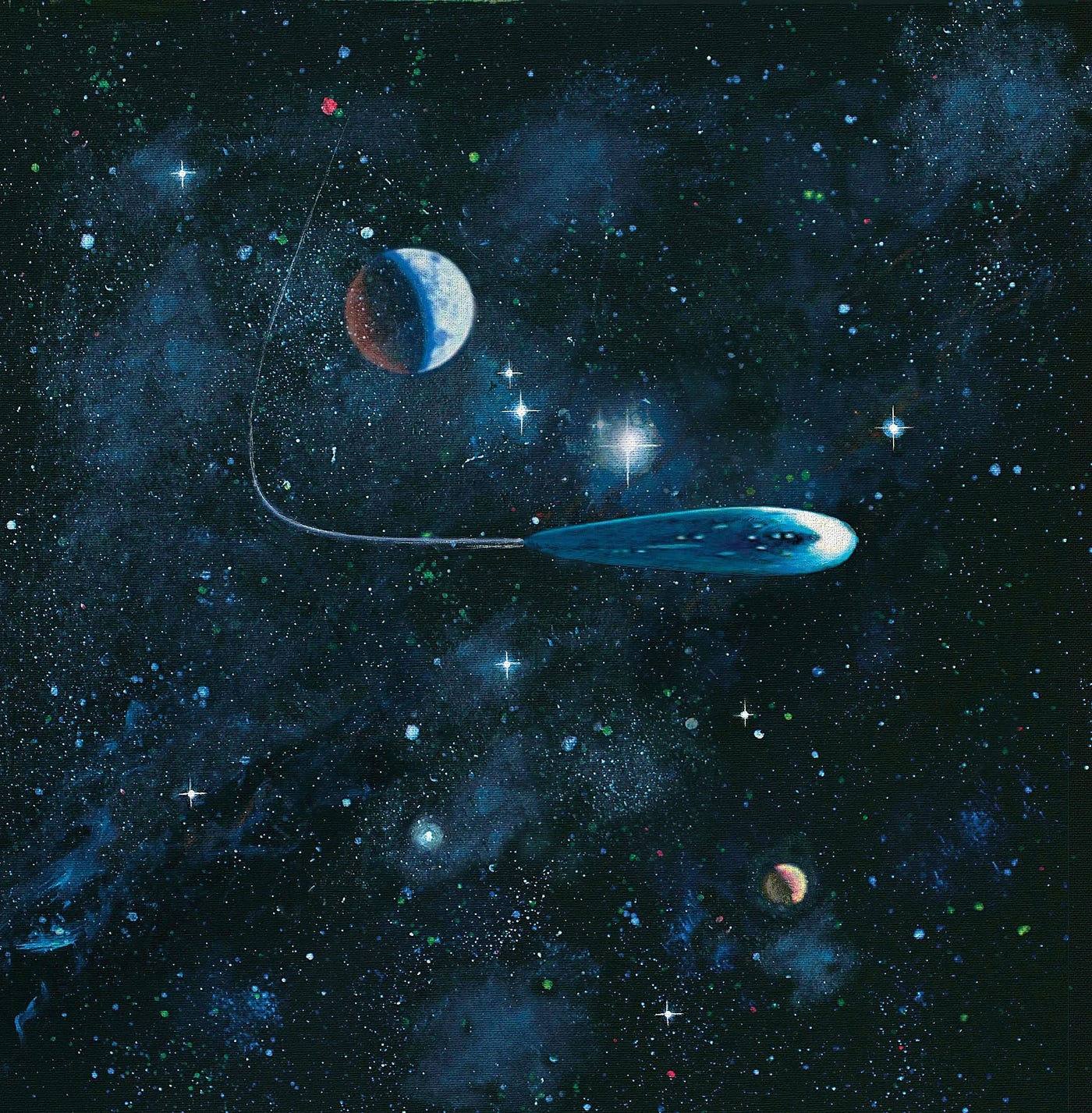
(Image credit: Julian Brooks/Alamy/Nature)
The interstellar object 3I/ATLAS grazed the habitable zone of the Solar System on a path that was aligned to within 4.88 degrees with the orbital plane of Earth around the Sun. 3I/ATLAS also exhibited a prominent sunward jet, likely made of large fragments of water ice or rock that were able to penetrate through the Solar wind and radiation (as I discussed in a paper with Eric Keto, published here).
The SPHEREx space observatory detected organic molecules, such as CH3OH, H2CO, CH4, and C2H6 with a production rate of 5x10^{26} molecules per second, of order a tenth of the simultaneous production of water molecules (as reported here).
The robust spectroscopic detection of methane (CH4) was confirmed by the Webb telescope here. Interestingly, methane was only detected after the passage of 3I/ATLAS near the Sun. Its delayed production is puzzling because methane ice is hyper-volatile, with a significantly lower sublimation temperature than carbon dioxide (CO2), having a value of -220 compared to -97 degrees Celsius, respectively. This implies that methane ice near the surface of 3I/ATLAS would have been vigorously sublimating at the time of the first reports of outgassing from 3I/ATLAS before perihelion. However, neither the Webb spectroscopy nor the SPHEREx spectrophotometry from August 2025, detected methane. This suggests that methane was depleted in the outermost layers of 3I/ATLAS and was released as a result of the warming by sunlight only close to the Sun. Within this scenario, the early detection of carbon-monoxide (CO) outgassing on 3I/ATLAS is surprising, as carbon monoxide is more volatile than methane and should therefore be even more depleted from the surface, yet it was detected prior to methane. Why did methane appear only close to the Sun?
In the atmospheres of exoplanets, methane is considered a prominent biosignature. A recent publication in the Proceedings of the National Academy of Sciences (PNAS) here, argued that methane could be the first detectable indication of life beyond Earth (as highlighted here). This raises an important question: Was the methane outgassing of 3I/ATLAS near the Sun produced by life?
The sunward jet (anti-tail) material shed by 3I/ATLAS could have carried extrasolar life on dust or ice fragments towards habitable planets within the Solar System. Such a phenomenon, called panspermia, would be analogous to the dandelion flower shedding its seeds to be carried by wind towards a fertile ground (as described here). I discussed Galactic panspermia in a 2018 paper published here, with my former postdocs Idan Ginsburg and Manasvi Lingam.
For interstellar icebergs, panspermia can be triggered by sunlight and is most effective if the iceberg arrives on a path that coincides with the orbital plane of habitable planets, as is the case for 3I/ATLAS. The large fragments of ice and rocks in its sunward jet are suitable as delivery vehicles of the seeds of extrasolar life.
I discussed the possibility of panspermia by the fragments shed from 3I/ATLAS in a research note posted here on February 3, 2026.
Could extrasolar life survive a long interstellar journey at freezing conditions inside an interstellar iceberg like 3I/ATLAS?
On Earth, microbes are known to survive in ice for millions of years, as discussed here and here. In a 2005 study here, microbes were found to survive inside ice crystals under 3 kilometers of snow for more than 30,000 years. The physicist Buford Price and graduate student Robert Rohde at the University of California in Berkeley, explained in a PNAS publication here that microbes could survive extreme conditions by creating a tiny film of liquid water around them, allowing oxygen, hydrogen, methane and other gases to diffuse to this film from air bubbles nearby, providing the microbes with sufficient food to survive. A 2020 study published in Nature Communications here demonstrated that microbes, 75 meters below the South Pacific Ocean seafloor (5,700 meters below sea level), are able to survive in rock sediments for over 100 million years in extremely low-energy conditions with very little nutrients. After being revived in the laboratory, these ancient microbes recovered from their hibernation state, metabolized and multiplied once again.
These are examples for the survival of terrestrial life-as-we-know-it. However, extrasolar life could be even more resilient to extreme conditions. Call it `survival of the fittest’ in interstellar space.
In addition to natural origins, there is the possibility of directed panspermia, whereby an interstellar gardener seeded 3I/ATLAS on a fertilization mission targeting the habitable planets in the Solar System. This would explain the rare alignment between the trajectory of 3I/ATLAS and the orbital plane of the habitable planets around the Sun, as well as the sunward jet with large fragments that plowed through the solar radiation and wind. Whether the seeds of extrasolar life reach a fertile ground in the Solar System remains to be seen.
If the NSF-DOE Rubin observatory will discover additional interstellar icebergs with clear statistical preference to the ecliptic plane, then the directed panspermia hypothesis will gain a higher likelihood. In such a case, our space agencies should plan a space mission to intercept the path of these icebergs. By directing a probe on a crash course towards the surface of these icebergs, we can diagnose the composition of the material they shed and infer whether it carries extrasolar life. In case it does, the most pressing question is whether extrasolar life resembles life-as-we-know-it. If so, perhaps life on Earth was seeded by an interstellar gardener.
This could be a fundamental discovery about our cosmic roots. Not only that life exists elsewhere, but interstellar gardeners may have seeded our existence.
ABOUT THE AUTHOR

(Image Credit: Chris Michel, National Academy of Sciences, 2023)
Avi Loeb is the head of the Galileo Project, founding director of Harvard University’s — Black Hole Initiative, director of the Institute for Theory and Computation at the Harvard-Smithsonian Center for Astrophysics, and the former chair of the astronomy department at Harvard University (2011–2020). He is a former member of the President’s Council of Advisors on Science and Technology and a former chair of the Board on Physics and Astronomy of the National Academies. He is the bestselling author of “*Extraterrestrial: The First Sign of Intelligent Life Beyond Earth” and a co-author of the textbook “[Life in the Cosmos](https://www.hup.harvard.edu/catalog.php?isbn=9780674987579)”, both published in 2021. The paperback edition of his new book, titled “[Interstellar](https://www.harpercollins.com/products/interstellar-avi-loeb-1?variant=40982888415266)*”, was published in August 2024.
Professional website:
https://lweb.cfa.harvard.edu/~loeb/
Social media:
*https://avi-loeb.medium.com/ [https://www.youtube.com/@ProfessorAviLoeb](https://www.youtube.com/@ProfessorAviLoeb)*
*https://open.spotify.com/show/1zhndXkvSY2b8FdjspFpCd [https://x.com/ProfAviLoeb](https://x.com/ProfAviLoeb)*
메타데이터
- post_id
- 3f0d3c5ec643
- slug
- did-3i-atlas-deliver-extrasolar-life-to-our-backyard-3f0d3c5ec643
- url
- https://medium.com/@avi-loeb/did-3i-atlas-deliver-extrasolar-life-to-our-backyard-3f0d3c5ec643
- canonical_url
- https://medium.com/@avi-loeb/did-3i-atlas-deliver-extrasolar-life-to-our-backyard-3f0d3c5ec643
- author_url
- https://medium.com/@avi-loeb
- status
- ok
- fetched_at
- 2026-06-09 15:37:30