The Whimsical Takeover
The fashion trend behind why everyone’s calling themselves ‘whimsical’
The Whimsical Takeover
The fashion trend behind why everyone’s calling themselves ‘whimsical’
I’ve been scrolling through Instagram for the past few weeks with a growing sense of déjà vu. So many accounts have this one word somewhere. In bios, in captions, in the way people describe themselves, their style, their whole personality — even their matcha.
Whimsical.
Every. Single. Time.
I. The obsession
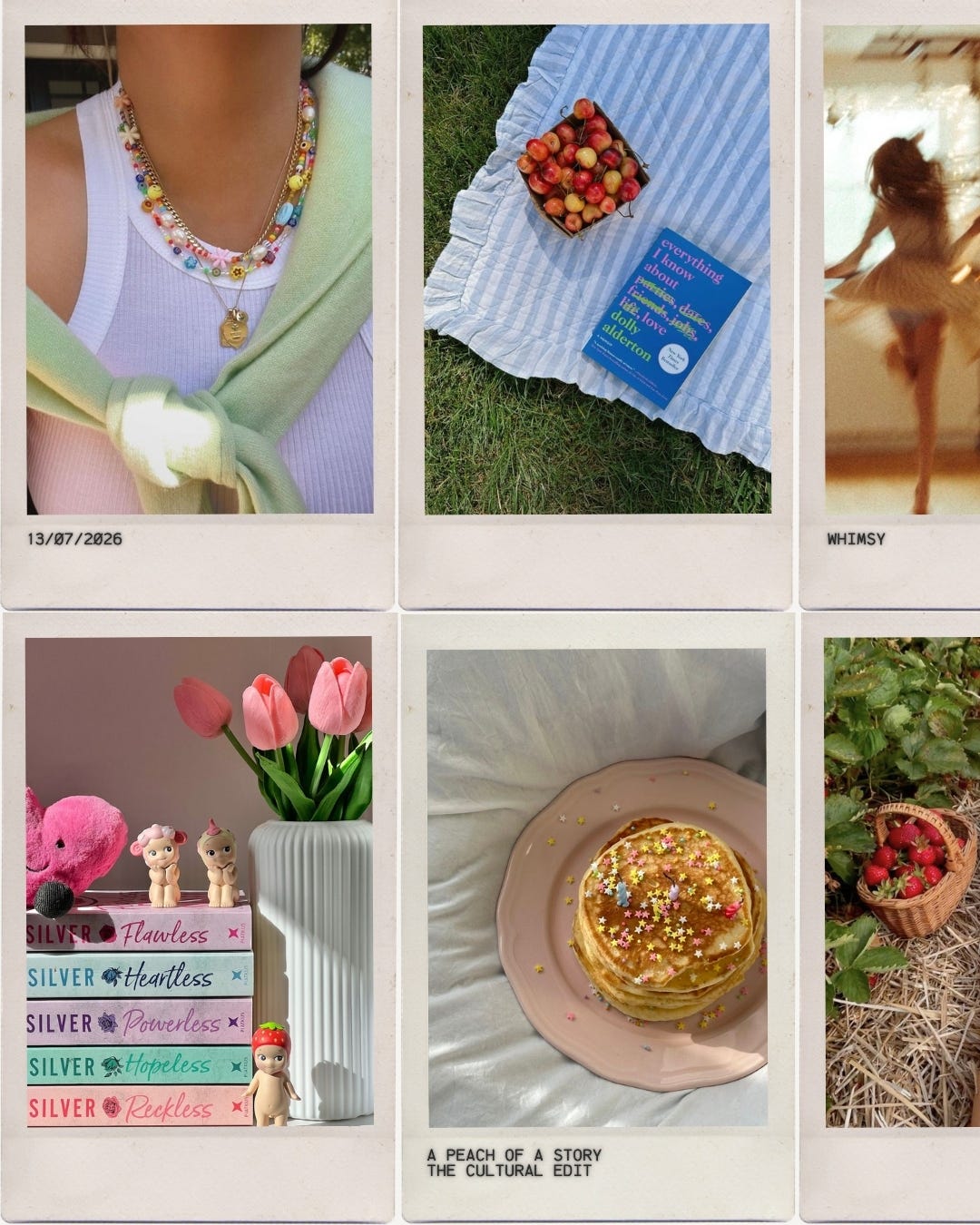
And the more I scrolled, the more it looked kind of the same. Oversized bows. Beaded jewellery. Bubble skirts. Colourful nails with little fruit on them. Aesthetic picnics with matching flowers, a vintage blanket and a basket. Pastel everything. That perfectly messy desk that somehow still has candles on it.
And oh — of course. The checklist. “5 things you need to be whimsical this summer.”
So I got curious. Where did this obsession actually come from? Because it didn’t appear from nowhere. And it looks like a trend.
II. The Story Told Backwards
To understand where “whimsy” came from, you have to go back. Further than you’d expect.
It started in 2008, with Phoebe Philo at Céline. When she arrived, she basically took everything away — the logos, the noise, the excess — and said: just the cut, just the fabric, just the quality. Backstage at her debut show, she put a name to it: “contemporary minimalism.” And it changed everything.
The concept spread throughout luxury fashion brands and beyond, and became the dominant language of the entire industry.
Then the pandemic happened. And something cracked.

III. Lockdown Nostalgia.
Locked inside, people started reaching for colour, nostalgia and comfort in ways that had nothing to do with looking expensive. Cottagecore — linen, wildflowers, the fantasy of a slower life — exploded in 2020, documented extensively by The New York Times as a collective desire to escape the present.
By 2022, the pendulum had swung further. Balletcore arrived — Vogue traced its roots to a post-lockdown desire for softness and femininity after years of shapeless comfort dressing. Then came coquette, then Barbiecore. Each micro-trend was, in its own way, a small rebellion against the idea that adult women should dress to communicate authority rather than pleasure.

But the industry pulled back. By 2023, quiet luxury had returned — harder, colder, more performative than ever. For many people it became a kind of imitation of Succession on HBO. Everyone started playing that game — beige, minimal, no logos, that distant look that says “I’m very busy and very important.” And suddenly everyone was performing a life they may or may not have been living.
Cool concept. But not real. And very exhausting to maintain.
IV. The Great Un-Beiging.
It was London Fashion Week that officially said it first. Spring 2024 — and two collections that changed the conversation entirely.
Jonathan Anderson** at JW Anderson** — who at that point was also serving as creative director of Loewe — opened his show at the Roundhouse with clothes literally moulded from plasticine. Hoodies cast in clay. Shorts hardened into sculptural forms. Show notes read: “Clothes meant to be used, misused and toyed with.” Guests received blocks of coloured clay as invitations. It was a manifesto. Fashion as a toy, not a status symbol — the direct opposite of everything quiet luxury had stood for.
**Simone Rocha** offered the other side of the same shift. Where Anderson spoke through deconstruction, Rocha spoke through enchantment. Fresh roses with long stems, sealed between layers of blush and misted tulle. Voluminous gowns where lace met leather in the same look. Not romance for romance’s sake — but a deliberate, conscious claim to the right to be delighted. University of Fashion called it “a dreamscape of whimsical silhouettes.” Vogue described it as models stepping out of a fairytale and onto the runway.

By 2025, Pinterest’s own data confirmed the shift: searches for colour, maximalism and playfulness were exploding. Some journalists even called it “The Great Un-Beiging.” Dazed declared whimsy the defining cultural urge of the year.
Fashion has always absorbed the mood of the world and reflected it back. After periods of collective turbulence, people want to linger toward something soft and unexpected, to feel light again.
Which is exactly what “whimsical” offered. And still does.
V. The wandering Whim-Wham
“Whimsical” isn’t just an aesthetic — it’s actually a psychological trait. Researchers who study adult playfulness describe it as a specific way of seeing: the ability to find something unexpected and delightful in places other people just walk past. Not pink and playful. A perspective. Which makes the mass adoption of the word on Instagram all the more fascinating — because most accounts using it are describing an aesthetic, not a worldview. The word travelled faster than its meaning.
Whimsical traces back to whim-wham — an English word from the 1520s, possibly from Old Norse hvima, meaning “to let the eyes wander.” It originally described a decorative trinket, a small eccentric object. By the 1650s it had become an adjective describing a person “full of odd fancies or peculiar notions.”
By the twentieth century it had softened into describing things that were “unusual in a playful or amusing way.” And by 2025, it had found a new home — in bios, in captions, in the way people choose to present themselves to the world. A word that began as a way of describing how someone sees the world had become a way of showing the world who you want to be.
VI. The Morning After Minimalism
Sometimes all it takes is one word to use. A code word — for permission. Permission to stop being so relentlessly serious, so optimised, so beige.
So if a pink bow in your hair makes the morning feel different — why not. If a picnic with mismatched vintage plates, hand-picked wildflowers and a linen blanket that took twenty minutes to fold just right is the thing that brings you back to yourself — why not. If your matcha tastes better when it’s served in a pretty cup, with sprinkles on top — why not.
If colourful nails with tiny fruit on them make you smile every time you type — honestly, why not.
You already know the code word.
Whimsical.
A good place to start.
This essay is part of my Cultural Edit series. · Read more on *Substack · See the visual story on [my Instagram](https://www.instagram.com/apeachofastory)*
메타데이터
- post_id
- 3f1c129bb708
- slug
- the-whimsical-takeover-3f1c129bb708
- url
- https://medium.com/@apeachofastory/the-whimsical-takeover-3f1c129bb708
- canonical_url
- https://medium.com/@apeachofastory/the-whimsical-takeover-3f1c129bb708
- author_url
- https://medium.com/@apeachofastory
- status
- ok
- fetched_at
- 2026-07-22 08:09:49