China’s Fujian Aircraft Carrier: First Reviews Are In
It’s not all plain sailing with some elementary design defects readily apparent, but good enough to cause concern
Aircraft Carriers
China’s Fujian Aircraft Carrier: First Reviews Are In
It’s not all plain sailing with some elementary design defects readily apparent, but good enough to cause concern
China’s Fujian aircraft carrier. Picture: Xinhua news agency
The Fujian, mainland China’s newest and most advanced aircraft carrier, has made its first transit of the Taiwan Strait since its commissioning, with Taipei keeping a close eye on its movements. There were no aircraft visible on its decks as Taiwanese airplanes monitored its transit.
A surveillance photograph of the Fujian shows no sign of carrier-based aircraft on the vessel’s flight deck during the transit. Jan 2026. Photo: Taiwanese Ministry of National Defence
It has been a long journey. China’s first aircraft carrier was bought from then Soviet Ukraine in 1998 for $20m in an auction. Her life started as a Soviet ‘Admiral Kuznetsov’ class ‘aircraft carrying heavy cruiser’, with her keel laid down in 1985. She never became operational as the USSR collapsed.
Over the subsequent ten or so years, China fitted her out in the Dalian Shipyard in northern China — the purchase included a set of plans as well.
Early August 2011 saw her first open-sea trials, carrying the name ‘Shi-Lang’.
A long march
In the 15 years since then China has come a long way in developing a carrier fleet. It’s not only the ships, it’s the massive enterprise that goes with the fleet.
The operational management systems, avionics systems integration, flight deck management, re-arming, repairing and so on — all have to be flowcharted, written up in manuals and tested. Then, pilots, aircrew, maintenance and flight operations controllers have to be trained. That requires schools and teachers. But first you have to train the teachers and build the schools. On top of that, a whole logistics infrastructure has to be created. It really is a huge task, and China is taking it seriously.
The Fujian
And now China’s Fujian (Type 003) aircraft carrier is the third milestone in the People’s Liberation Army Navy’s (PLAN) development of a blue water carrier fleet, a programme which was planned and started back in the late 1970s.
The latest carrier blends cutting-edge innovation with pragmatic engineering choices that highlight both strengths and inherent limitations of a conventionally powered supercarrier.
But there are clear issues with its design which are apparent to naval analysts. These issues probably arise from design compromises and design changes made during the build. If you ever had a boat or a house built, then you will understand the design compromise problem — tradeoffs and mission creep.
Launched in June 2022 and commissioned in late 2025 under the direct oversight of Xi Jinping, the Fujian displaces over 80,000 tonnes, making it the largest conventionally powered warship ever built.
It has three electromagnetic aircraft launch systems (EMALS) — a world-first for a non-U.S. carrier — enabling catapult-assisted take-offs and arrested recoveries (CATOBAR). This allows it to operate a sophisticated air wing, including the multirole J-15T, the stealthy fifth-generation J-35 fighter (successfully launched in tests during its ninth sea trial in 2025), the KJ-600 airborne early warning aircraft, and various drones.
State media footage from September 2025 highlighted seamless full-deck operations, with the carrier achieving initial full-deck operational capability and demonstrating sortie rates reportedly reaching 12.5 per hour in trials — surpassing older US Nimitz-class averages. But all is not rosy on the flight deck (more later).

Fujian exercises. Screenshot from Chinese state tv channel video.
MVDC power — a key differentiator
At the heart of this capability lies a pioneering Medium-Voltage Direct Current (MVDC) integrated electrical power system, marking a significant departure from the alternating current (AC)-based EMALS on the U.S. Gerald R. Ford-class carriers.
Chinese sources describe this MVDC architecture as more reliable and efficient. It uses supercapacitors for energy storage rather than flywheels, employs a parallel configuration with dedicated power modules per catapult track to isolate failures, and eliminates frequent AC-DC conversions — resulting in claimed failure rates below 0.2% (far lower than the Ford’s reported issues).
EMALS on the Ford has fallen short of expected reliability. The system is designed for much higher cycles between failures (around 4,000 for catapults) than what has been achieved in testing (around 600 cycles). (DefenceNews)
The stable DC output on the Fujian supports the immense burst power needed for electromagnetic launches while simplifying the overall electrical grid, contributing to higher energy conversion efficiency (theoretically over 90%) and enabling consistent 45-second launch intervals regardless of sequence.
I wrote about this power system design choice some time ago, looking at the pros and cons of both options. It generated some steam in the comments from Western engineers who thought it was a bad choice.
Fujian imperfections
Yet, as detailed in analyses like those in ‘Shipborne Weapons Defence Review’, the Fujian remains “far from perfect.”
Its conventional steam-turbine propulsion demands large exhaust funnels, forcing the island superstructure toward the deck’s center and constraining flight deck layout.
One catapult intrudes on the landing area (rendering it unusable during recoveries), another sits too close to an elevator (creating bottlenecks), and forward elevator placement may stem from mid-design shifts.

New Chinese aircraft carrier Fujian with 3 EMALS catapults. Photo: PLA Navy
Promotional imagery shows the layout of the carrier’s deck, which includes three catapults to launch aircraft. Credit: Pu Haiyang/China Ministry of National Defense
These issues limit simultaneous operations, capping launch rates during recoveries to just two catapults and reducing overall combat tempo compared to optimised U.S. nuclear carrier designs. But then, the US has had over eighty years to reach its pinnacle.
The review concludes that nuclear propulsion — potentially in the forthcoming Type 004 — would resolve most flaws by eliminating funnels, freeing deck space, boosting endurance, and providing abundant power for advanced systems without aviation fuel trade-offs.
Until then, the Fujian represents a practical workaround: a conventionally powered giant that pioneers MVDC to achieve EMALS reliability and flexibility rivaling (or, per some Chinese claims, surpassing) American counterparts in key metrics, all while Beijing accelerates towards a nuclear-powered blue-water navy.
This blend of ambition, ingenuity, and acknowledged compromise underscores China’s compressed naval ascent — from ski-jump carriers to electromagnetic stealth launches in fifteen years.
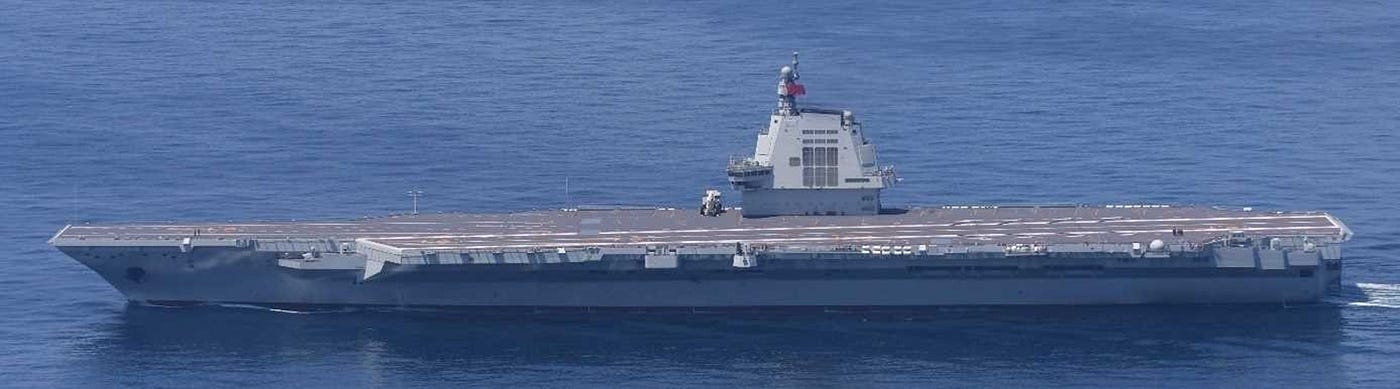
Chinese aircraft carrier Fujian, as photographed by JMSDF on September 11, 2025.. By 日本防衛省・統合幕僚監部 — https://www.mod.go.jp/js/pdf/2025/p20250911_01.pdf, CC BY 4.0, https://commons.wikimedia.org/w/index.php?curid=174876892
Those who have been watching developments in China have known for some time that China was serious about this investment.
There have been plenty of jokes about the Concrete Carrier they built in the Oriental Park in Shanghai as a flight deck trainer, but the fact is that building a carrier is one thing, operating one efficiently 24 x 7 in all weathers when under attack is quite another.
Let’s not kid ourselves, Chinese naval ambitions are very serious and even the most jaundiced observers recognise that achievement. And the Pentagon is worried about the growing Chinese naval capability..
The Fujian is a creditable engineering and logistical achievement, given that they started with a decommissioned Soviet carrier. But will it all hang together in a war setting?
I hope we never find out.
We can be almost 100% certain that China’s next carrier will be nuclear powered and, once they get the recipe right, they will clone them. Rapidly.
China plays a very long game, whereas Trump plays day to day, hour to hour.
And the US’s flagship carrier, the USS Gerald R Ford has her tail between her legs, anchored in Split, Croatia, after problems with blocked toilets and a very serious laundry fire.
It’s all Chinese to me but here are a couple of videos from Chinese state television (with a propaganda perspective), the first showing some flight deck operations and launches:
[embed]
[embed]
메타데이터
- post_id
- 3f2b86c27883
- slug
- chinas-fujian-aircraft-carrier-first-reviews-are-in-3f2b86c27883
- url
- https://medium.com/the-dock-on-the-bay/chinas-fujian-aircraft-carrier-first-reviews-are-in-3f2b86c27883
- canonical_url
- https://medium.com/the-dock-on-the-bay/chinas-fujian-aircraft-carrier-first-reviews-are-in-3f2b86c27883
- author_url
- https://medium.com/@james-marinero
- status
- ok
- fetched_at
- 2026-07-17 16:16:29