From Technology Value to Technology Yield
Why AI, Cloud, and SaaS Economics Demand a New Measure of Technology Performance
From Technology Value to Technology Yield
Why AI, Cloud, and SaaS Economics Demand a New Measure of Technology Performance
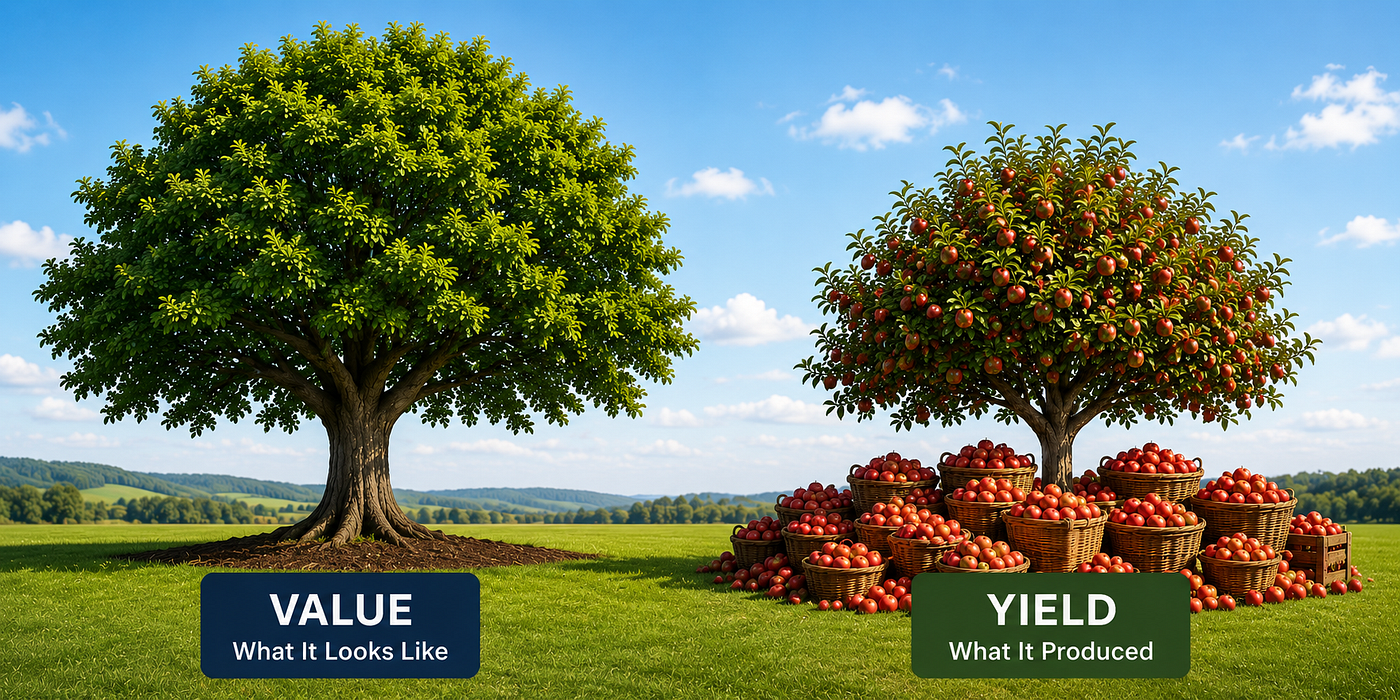
Why Enterprises Must Stop Measuring “What Happened” and Start Measuring “What It Produced”
Technology spending has never been higher. Technology expectations have never been greater. And yet — in boardrooms across every industry — the same quiet frustration keeps resurfacing.
Finance can show the spending. Technology can show the delivery. Architecture can show the structure.
But when the conversation turns to the only question that actually matters, the room goes still:
“What did we get for that investment?”
Most enterprises can’t answer it. Not with clarity. Not with confidence. Not with the rigor they apply to every other form of capital allocation.
And the reason is simple:
Every business case begins with claims.
“We’ll increase revenue.” “We’ll improve customer satisfaction.” “We’ll reduce costs.” “We’ll transform the business.”
Those are all claims.
Enterprises know how to measure technology value. They do not know how to measure technology yield.
Value is claimed.
Yield is proven.
Those two concepts sound similar. They are not.
Understanding the difference is what separates organizations that spend on technology from organizations that capitalize on technology.
The Problem Hiding in Plain Sight
Every enterprise can point to improvements:
- Sales conversion up
- Cycle time down
- Cost per transaction reduced
- Customer satisfaction improved
These are signals of technology value — the benefits created by a capability.
But value alone is not enough.
Value tells you something improved.
Yield tells you whether the improvement was worth the investment.
That distinction is where most enterprises fall apart.
They celebrate the improvement.
They report the metrics.
They declare the project successful.
But they never ask the harder, more consequential question:
“Was the improvement proportional to the cost required to achieve it?”
That is the question executives think they are answering.
They almost never are.
A Simple Example That Changes Everything
Consider a $12M CRM modernization.
After deployment, leadership sees encouraging signals:
“Sales conversion improved by 3%.”
“Onboarding time dropped by 30%.”
“Support resolution improved by 25%.”
Most organizations stop there. The project delivered. The metrics moved. Everyone feels good.
But those percentages hide a structural truth:
The same improvement does not produce the same enterprise yield.
Let’s compare two enterprises — same investment, same improvement, radically different outcomes.
Scenario Comparison
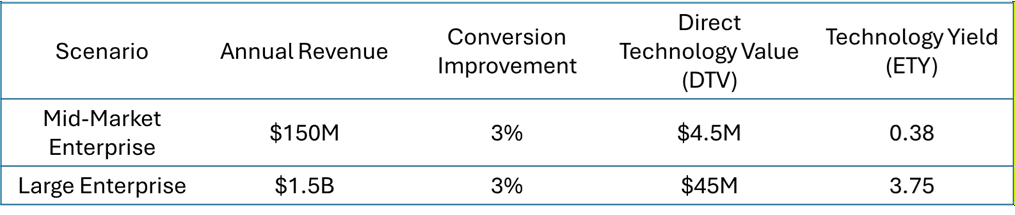
Both improved by 3%.
The results are not the same.
The mid‑market enterprise generated $4.5M of value on a $12M investment — a negative yield profile.
The large enterprise generated $45M of value on the same $12M — a yield of 3.75.
- Same project.
- Same improvement.
Completely different enterprise outcomes.
The enterprise that generated $45M in value would likely be celebrated.
The enterprise that generated $4.5M in value would probably celebrate itself as well.
This is why yield matters.
Value produces success stories. Yield produces accountability.
Technology Value: Necessary, But Not Sufficient
Technology value describes the benefits created by a capability. These benefits come in two forms:
Direct Value
- Revenue growth
- Margin improvement
- Cost reduction
Indirect Value
- Operational efficiency
- Capability enablement
- Risk reduction
- Resilience
These are important. They are real. They are observable.
But they do not answer the investment question.
Was the value meaningful relative to the cost?
That is the missing concept.
Introducing Enterprise Technology Yield
Enterprise Technology Yield (ETY) expresses the relationship between:
Enterprise Value Generated and Technology Investment Required
It does not replace ROI or NPV. It complements them.
- Where ROI asks, “What was the return?”
- Yield asks, “Was the return proportional to the investment?”
- Where NPV asks, “Was the investment financially sound?”
- Yield asks, “Was the investment enterprise‑productive?”
Yield is not about perfect causation.
It is about structured reasoning in complex environments.
Technology value explains outcomes.
Technology yield explains whether those outcomes justified the investment.
The formula is simple:
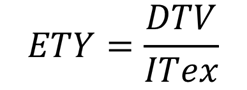
And when indirect value is included:

But the power of yield is not in the math.
It’s in the mindset.
Why Yield Thinking Changes the Leadership Conversation
When enterprises begin reasoning in terms of yield, new questions emerge:
- Which technology investments produce the highest enterprise yield?
- Which investments produce necessary but negative short‑term yield?
- Where should the next dollar of technology investment go?
- How does technology compete for capital alongside other business initiatives?
These are portfolio questions. Capital allocation questions. Enterprise strategy questions.
And they shift the conversation away from:
“Did the project deliver?”
toward
“Did the investment produce meaningful enterprise value relative to its cost?”
That shift is subtle. It is also transformative.
It reframes technology from an operational expense to a strategic investment class.
Why This Matters Now
Technology spending has changed. It no longer behaves like a fixed project cost.
Enterprises don’t fail because they can’t measure value. They fail because they never measure whether the value was worth the cost.
Modern digital enterprises operate on scaling economics:
- Cloud platforms scale with usage
- SaaS platforms scale with adoption
- AI workloads scale with interaction volume
In these environments:
Measuring consumption is no longer enough.
You must measure yield.
Without yield, leaders see the spend clearly but cannot see the performance of the spend.
They can measure the cost of technology. They cannot measure the productivity of technology.
Yield closes that gap.
The Future of Enterprise Technology Leadership
Yield is not a metric. It is a lens.
Yield is not a KPI.
Yield is the mechanism that determines whether the KPI mattered.
Every other major enterprise investment is expected to justify itself relative to the capital consumed.
Technology should not be exempt from that expectation.
Yield provides the missing language that allows technology to be managed as an investment rather than treated as a cost center.
That distinction may sound small.
It changes everything.
And it gives enterprises something they have never truly had:
A way to measure whether technology is producing enterprise yield — not just enterprise activity.
This is the shift modern organizations must make.
Because ultimately:
Technology should not only create value.
Technology should produce yield.
메타데이터
- post_id
- 3f4547955d53
- slug
- from-technology-value-to-technology-yield-3f4547955d53
- url
- https://medium.datadriveninvestor.com/from-technology-value-to-technology-yield-3f4547955d53
- canonical_url
- https://medium.datadriveninvestor.com/from-technology-value-to-technology-yield-3f4547955d53
- author_url
- https://medium.com/@p.b.brauer
- status
- ok
- fetched_at
- 2026-06-21 07:44:09