The Changing SEC and CFTC Interpretation of Crypto Assets: When Do Tokens and Transactions Fall…
The central question in crypto regulation is not simply whether a specific token is called a security, a commodity, a stablecoin, or a…
The Changing SEC and CFTC Interpretation of Crypto Assets: When Do Tokens and Transactions Fall Under Securities Law?
The central question in crypto regulation is not simply whether a specific token is called a security, a commodity, a stablecoin, or a utility token. What matters more is how the token was issued, sold, marketed, distributed, and used, as well as what kind of expectations were created among investors.
Based on the SEC’s interpretation of federal securities laws relating to crypto assets and the CFTC’s guidance on digital assets as of March 2026, this article explains how regulators approach crypto tokens, investment contracts, commodities, derivatives, stablecoins, RWA tokenization, crypto ETFs, and compliance obligations.
The key takeaway is clear: crypto regulation is increasingly focused on transaction structure, economic substance, investor protection, and intermediary conduct rather than token labels alone.
Table of Contents
- Why Transaction Structure Matters More Than the Token Itself
- The SEC Perspective: Crypto Assets and Investment Contract Analysis
- The CFTC Perspective: Digital Assets, Commodities, and Derivatives Regulation
- What This Means for Bitcoin, Ethereum, Stablecoins, RWA, and ETFs
- Compliance Checklist for Exchanges, Projects, and Users
- What Korean Readers Should Understand: Impact and Limitations
- References

1. Why Transaction Structure Matters More Than the Token Itself
One of the most common misunderstandings in crypto regulation is the belief that once a token is classified as a security or a commodity, every transaction involving that token will be treated the same way.
However, based on explanations from U.S. regulators and enforcement cases, the regulatory focus is often placed less on the token itself and more on the economic substance of the transaction.
For example, if a project sells tokens while emphasizing the development team’s efforts, ecosystem expansion, exchange listing expectations, and the possibility of price appreciation, that sale structure may be analyzed as an investment contract under securities law.
By contrast, if users are using a token primarily for access to a service or as a payment tool on a sufficiently decentralized network, a different analysis may apply.
In other words, the regulatory questions are not limited to the token name.
The real questions are:
Who issued the token?
What did investors expect?
Were expected profits primarily dependent on the efforts of others?
What message did the sales materials and marketing communicate?
What role did exchanges, brokers, custody services, lending platforms, or staking services play?
This is one of the core issues in SEC crypto regulation.

2. The SEC Perspective: Crypto Assets and Investment Contract Analysis
The SEC does not necessarily treat every crypto asset as a traditional stock or bond. However, depending on how a crypto asset is offered, sold, and distributed, it may fall under federal securities laws.
The framework most often discussed in this context is the Howey test.
In general terms, the Howey analysis considers whether there is an investment of money, in a common enterprise, with an expectation of profits, primarily from the efforts of others.
The important point is that the SEC does not simply declare every digital token to be a security automatically. Instead, it analyzes whether a specific crypto asset transaction constitutes a securities transaction or an investment contract based on the facts and circumstances.
For that reason, issuers should review the following from a regulatory-risk perspective:
Whitepapers
Token sale agreements
Lock-up structures
Token allocation
The role of foundations or development teams
Market-making arrangements
Exchange listing communications
Marketing materials
Several factors may increase the likelihood of securities-law analysis.
A structure where token buyers are primarily motivated by price appreciation rather than network use
Statements suggesting that token value depends on the continued efforts of the development team or foundation
Implied promises around exchange listings, liquidity support, or revenue sharing
Use of token sale proceeds to fund project development
Broad retail sales combined with aggressive marketing
At the same time, the conclusion does not follow merely because a token exists on a blockchain.
From the SEC’s perspective, substance matters more than form.

3. The CFTC Perspective: Digital Assets, Commodities, and Derivatives Regulation
The CFTC has explained digital assets within the framework of commodity-related regulation.
Bitcoin and certain digital assets have long been discussed as having commodity-like characteristics. The CFTC is particularly focused on digital asset derivatives, futures, options, swaps, leveraged transactions, fraud, and market manipulation.
The key difference between the SEC and the CFTC is the focus of jurisdiction.
The SEC focuses on securities issuance, securities sales, securities exchanges, broker-dealers, disclosure, and investor protection.
The CFTC focuses on the integrity of commodity derivatives markets, exchange registration, clearing, market surveillance, fraud prevention, and manipulation prevention.
However, just because a crypto asset has commodity-like characteristics does not mean all securities-law issues disappear.
Even if the spot asset itself is discussed as a commodity, the contracts used to sell that token, yield-bearing deposit products, leverage structures, staking services, lending products, and derivatives offerings may still be subject to separate regulatory analysis.
Therefore, the difference between SEC and CFTC crypto regulation should not be understood as a simple question of which agency always has priority.
A safer approach is to ask which activity, product structure, transaction, or intermediary function is being analyzed.
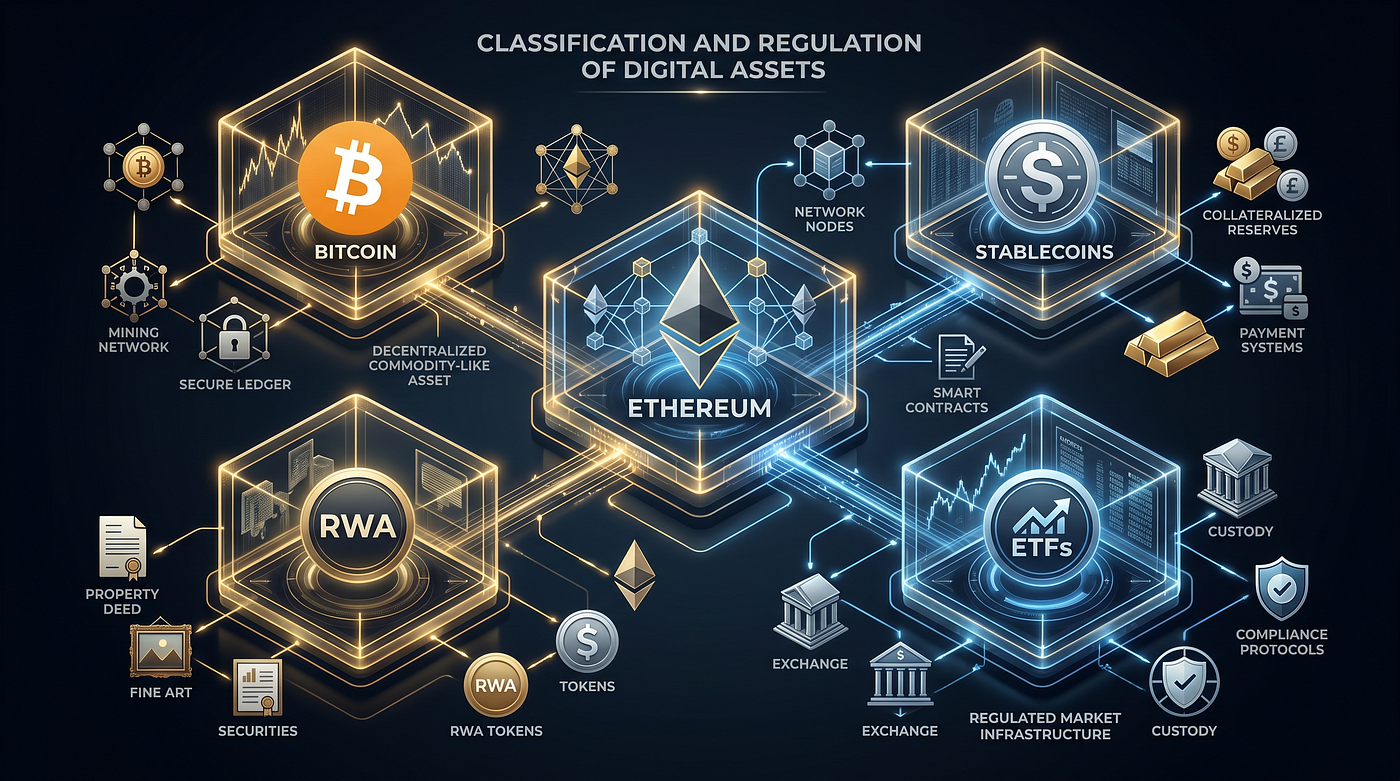
4. What This Means for Bitcoin, Ethereum, Stablecoins, RWA, and ETFs
- Bitcoin and Ethereum
Bitcoin regulation and Ethereum regulation remain among the most searched topics in the crypto market.
Bitcoin has long been discussed in connection with a relatively decentralized network and commodity-like characteristics. Ethereum also raises multiple regulatory questions depending on network structure, staking, related services, and ETF structures.
The key issue is not price outlook.
The more important question is how the asset is packaged and offered as a financial product.
Direct spot holding, ETFs, futures, staking services, and yield-bearing deposit products all raise different regulatory issues.
- Stablecoins
Stablecoin regulation is not limited to securities law.
It is also connected to payments, reserve assets, banking regulation, anti-money laundering controls, consumer protection, redemption rights, and disclosure obligations.
Several questions are especially important.
Is the stablecoin being used like a simple payment instrument?
Who receives the income generated from reserve assets?
Do users have a redemption right?
What disclosures does the issuer provide?
How are reserve assets managed?
Can users redeem at par?
What happens during market stress?
Stablecoins may appear simple from a user interface perspective, but from a regulatory perspective, they sit at the intersection of money, payments, banking, securities, commodities, and consumer protection.
- RWA Tokenization
RWA tokenization refers to the tokenization of real-world assets such as real estate, government bonds, private credit, fund interests, and other financial assets.
In many RWA structures, the underlying asset may already be a security or financial product.
Therefore, using blockchain technology does not eliminate existing securities laws, fund regulations, intermediary rules, custody requirements, or disclosure obligations.
This is a critical point.
Tokenizing an asset does not automatically simplify regulation. In many cases, it may add a new technological layer on top of existing legal obligations.
- Crypto ETFs
Crypto ETFs may appear to symbolize institutional adoption. However, ETF approval does not necessarily mean that a token’s overall legal status has been fully resolved.
An ETF approval generally means that a specific product structure has been reviewed in terms of disclosure, custody, market surveillance, investor protection, and trading mechanics.
It does not guarantee the legal status of every transaction involving that token.
It also does not guarantee future price direction.
Investors should therefore understand the difference between ETF approval and broader regulatory classification.

5. Compliance Checklist for Exchanges, Projects, and Users
- Exchanges
Crypto exchanges should review the following issues.
Token issuance and sale history during listing review
Potential access by U.S. investors and geographic restrictions
Separate regulatory analysis for staking, custody, lending, deposit, leverage, and yield products
Market surveillance systems for insider trading and market manipulation
Accuracy and risk level of listing disclosures and marketing materials
Exchange listing is not merely a business decision. It can also become a regulatory-risk point if the token’s issuance history, marketing claims, or service structure raises securities-law concerns.
- Projects and Issuers
Projects and token issuers should review the following.
Maintain records of securities-law analysis before token sales
Avoid excessive emphasis on expected profits in whitepapers and websites
Disclose token allocation, lock-up structures, foundation holdings, and developer compensation
Provide objective explanations of network utility, governance, and decentralization
Review whether sales to U.S. users are permitted, registered, or exempt
Projects should remember that marketing language matters.
If a token is promoted primarily as an investment opportunity dependent on the project team’s efforts, the regulatory risk may increase.
- Users and Investors
Users and investors should also review several issues.
How was the token initially sold?
Was it offered through a private sale, public sale, airdrop, exchange listing, or yield program?
Is the product a simple token holding, or is it a staking, lending, custody, or yield-bearing product?
Does exchange listing guarantee regulatory safety?
What is the difference between holding a spot token and holding an ETF?
Are official disclosures, issuer documents, and regulator announcements available?
Investors should not assume that exchange listing means a token is legally risk-free.
Regulatory risk can affect liquidity, exchange access, product availability, institutional participation, and long-term project strategy.

6. What Korean Readers Should Understand: Impact and Limitations
U.S. regulation does not always directly apply to the Korean market.
However, U.S. regulatory developments have significant influence on global exchanges, ETF issuers, custodians, market makers, project foundations, and institutional investors.
If a particular service is discontinued in the United States or faces registration-related issues, this may indirectly affect Korean exchanges, listing reviews, liquidity, institutional participation, and global project strategy.
At the same time, interpretations by the U.S. SEC or CFTC do not automatically determine the legal conclusion under Korean law.
Korea has its own regulatory framework, including:
Virtual asset user protection rules
Capital markets regulation
Electronic financial regulation
Anti-money laundering rules
The Act on Reporting and Using Specified Financial Transaction Information
Future digital asset legislation
Therefore, Korean investors should distinguish the following points when reading U.S. regulatory news.
A securities-law analysis under U.S. law is separate from the analysis under Korea’s Capital Markets Act.
Actions taken by U.S. exchanges and Korean exchanges may differ in timing and standards.
Approval of a foreign ETF does not automatically mean the product can be sold domestically in Korea.
For stablecoins and RWA, the key issues are the underlying asset, issuer, redemption structure, and investor protection design.
Ultimately, crypto regulation is moving in a direction that is more sensitive to transaction structure and investor protection than to token names alone.
Projects and exchanges should focus less on abstract classification debates and more on how the token is actually sold, distributed, marketed, custodied, and serviced.
Users should develop the habit of checking disclosures and regulatory risks rather than relying only on listings, market sentiment, or short-term price action.
7. References
SEC Crypto Assets
SEC Newsroom
CFTC Digital Assets
CFTC Law & Regulation
This article is based on publicly available information and is intended for general educational purposes only. It is not legal, tax, or investment advice. The legal analysis of any specific token, exchange, or product may vary depending on the facts, product structure, and jurisdiction.
SEC #CFTC #CryptoRegulation #CryptoAssets #SecuritiesLaw #HoweyTest #BitcoinRegulation #EthereumRegulation #StablecoinRegulation #RWATokenization #CryptoETF #DigitalAssets #BlockchainCompliance #InvestorProtection #CryptoLaw
[Official CrypWorld Channels]
- Website: crypworld.io
- Whitepaper: Read Whitepaper
Community:
- Telegram Channel: Join Here
- Medium: Follow us
- Twitter (X): @Crypworld_CWG
- Instargram: https://www.instagram.com/crypworld_official/
- Blog: koreagabriel.blog
메타데이터
- post_id
- 3f519fb8fdd9
- slug
- the-changing-sec-and-cftc-interpretation-of-crypto-assets-when-do-tokens-and-transactions-fall-3f519fb8fdd9
- url
- https://medium.com/@crypworld/the-changing-sec-and-cftc-interpretation-of-crypto-assets-when-do-tokens-and-transactions-fall-3f519fb8fdd9
- canonical_url
- https://medium.com/@crypworld/the-changing-sec-and-cftc-interpretation-of-crypto-assets-when-do-tokens-and-transactions-fall-3f519fb8fdd9
- author_url
- https://medium.com/@crypworld
- status
- ok
- fetched_at
- 2026-06-15 20:49:13