誠 (Makoto) — The Virtue of Not Lying to Yourself: What the Tylenol Crisis Reveals About Sincerity…
On Bushido’s fifth virtue — why sincerity is not about honesty, what a 1982 product recall teaches leaders today, and how trust is built in…
誠 (Makoto) — The Virtue of Not Lying to Yourself: What the Tylenol Crisis Reveals About Sincerity, Trust, and the Promise Every Business Makes
On Bushido’s fifth virtue — why sincerity is not about honesty, what a 1982 product recall teaches leaders today, and how trust is built in the quiet moments nobody is watching.
This piece is part of an ongoing series exploring the virtues of Bushido as described by Nitobe Inazo in Bushido: The Soul of Japan (1900).
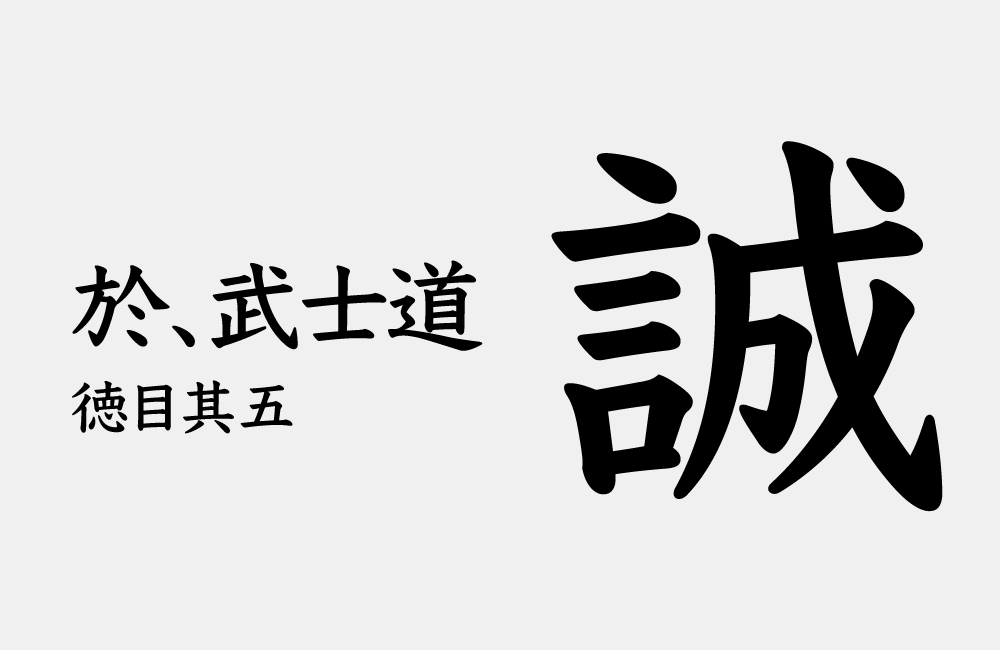
“Makoto” (Image data created by takeshi Kitagawa)
Chicago, 1982
In the last week of September 1982, seven people in the Chicago area died after taking Extra-Strength Tylenol capsules that had been laced with potassium cyanide by an unknown person. The victims ranged in age from twelve to thirty-five. They had done nothing wrong. They had taken a product they trusted, and it killed them.
The investigation quickly established that Johnson & Johnson — the manufacturer — bore no legal responsibility. The tampering had occurred after the product left their facilities. The company was, in the most straightforward legal sense, a victim itself.
Most companies, facing that situation, would have done what the law permitted them to do: issue a targeted recall in the Chicago area, cooperate with the investigation, and defend the brand as aggressively as possible. The legal team would have advised exactly that. The financial team would have agreed.
Johnson & Johnson’s leadership did something different.
Within days, they ordered the recall of every bottle of Tylenol in the United States. Thirty-one million bottles. At a cost that would reach hundreds of millions of dollars. Without any legal obligation to do so.
They did not issue statements explaining that they were technically not responsible. They did not wait to see how the investigation developed. They did not calculate whether the recall was worth more than the lawsuits. They asked a different question entirely: if a consumer cannot be certain this product is safe, then it is not safe, and it cannot remain on shelves.
That is not a legal question. It is not a financial question. It is a question about what kind of company you are — and what, exactly, you promised when you put your name on the bottle.
「誠は天の道なり、誠を思うは人の道なり。」 “Sincerity is the way of Heaven. To think of sincerity is the way of humanity.” — Mencius, in the tradition that shaped Nitobe’s thought
The Promise Nobody Signed
When a company brings a product to market, no contract is exchanged with the consumer. No document is signed. The transaction is simple: money for goods.
But underneath that transaction, something else is being offered. An implicit promise — not written, not enforceable in any court in the world, but real in the way that the most important things are real: this product does what we say it does. We have made it with care. You can trust it.
This is not sentimentality. It is the actual foundation of commerce. Markets function because buyers extend a degree of trust to sellers that no legal framework could fully replace. The legal frameworks exist to address the failures of that trust — they are the remediation system, not the operating system.
Johnson & Johnson understood this, in 1982, more clearly than most companies do in ordinary circumstances. What they grasped — and what their response demonstrated — is that the promise had been broken regardless of who broke it. The fact that an unknown person had interfered with their product did not change what consumers were experiencing: their trust had been violated, and it had been violated through a product bearing Johnson & Johnson’s name.
Their response was not, at root, a public relations strategy. It was an acknowledgment: our product is part of what happened to these people. That means we are part of what happened. And we will act accordingly.
This is 誠 (Makoto).
Not honesty in the narrow sense — not merely the absence of lying. Something harder and more specific: the refusal to hide behind a technically correct position when you know, in the part of yourself that cannot be negotiated with, that the technically correct position is not the whole truth.
What 誠 (Makoto) Actually Means
The character 誠 is built from two elements: kotoba (言, words/language) and naru (成, to accomplish, to become). At its most literal: to make your words come true. To do what you say.
But Nitobe’s treatment of 誠 in Bushido: The Soul of Japan reaches further than promise-keeping. He places it alongside shin (信, trustworthiness) as a paired virtue — and what he describes is not a technique for appearing trustworthy, but a quality of character that makes trust the natural result of who you are.
The samurai, Nitobe writes, considered falsehood and broken promises shameful enough that external enforcement was irrelevant. Not because they feared punishment. Because the gap between what they had said and what they had done was a gap inside themselves — a fracture in their own coherence — that no external outcome could repair.
This is the distinction I want to stay with, because I think it is where most discussions of sincerity miss the point.
誠 is not primarily about how you appear to others. It is about the relationship between what you know and what you do. The samurai who fulfilled an obligation no one could compel him to fulfill was not performing virtue for an audience. He was refusing to live in a divided state — the state of knowing one thing and doing another.
What Johnson & Johnson’s leadership did in 1982 was refuse that divided state. They could have known, privately, that the harm was not their fault, while publicly managing the narrative to minimize exposure. That is, in fact, what the incentives pointed toward. What they refused to do was the gap itself — the space between what they knew about their responsibility and what they were willing to say out loud.
The recall was expensive. It was not, in any narrow sense, required. What it was, was consistent — with what the company said it stood for, with what every bottle of Tylenol implicitly promised, with the kind of organization they had decided to be.
That consistency — between stated values and actual behavior, in the moment when the cost of consistency is highest — is what Nitobe meant by 誠.
The Contrast That Cannot Be Avoided
I wrote, in an earlier essay in this series, about Mitsubishi Motors and Daihatsu — about the decades of concealment, the safety data falsified, the complaints quietly buried. About the way small choices accumulate into systems, and systems accumulate into cultures, until the gap between what a company knows and what it admits has become so normal that no one inside it experiences it as a gap anymore.
The contrast with Johnson & Johnson is not subtle.
Both situations involved products that had harmed or could harm people. Both situations involved companies facing a choice between concealment and disclosure. Both situations involved significant financial stakes.
The difference is not that one company was more virtuous than the other in some general sense. The difference is what question each company asked when they faced the choice.
Mitsubishi and Daihatsu asked: can we manage this without disclosure? What is the minimum required response? They were asking about what they could avoid. The answer, repeated across years and decades, was: yes, for now.
Johnson & Johnson asked: what does our responsibility to the consumer actually require of us? They were asking about what they owed. The answer — costly, immediate, unrequired by law — was: everything.
The samurai concept that Nitobe returns to throughout his discussion of 誠 is the idea that integrity in private — in the decision made when no one is compelling you, when no one is watching — is the only meaningful kind. Public integrity, the kind that exists because the alternative would be embarrassing, is not 誠. It is its performance.
What destroyed Mitsubishi and Daihatsu was not, ultimately, the defects or the falsifications. It was the years of private decisions — made in rooms where no one was watching, about whether to close the gap or widen it. By the time the gap became public, it had grown too large to close.
What rebuilt Johnson & Johnson — and their recovery was, by most measures, remarkable; Tylenol returned to market share leadership within a year — was the consistency of their private and public selves in the moment that mattered most.
「誠の人は、誰も見ていなくても、見られているときと同じように振る舞う。」 “A person of Makoto behaves the same when no one is watching as when everyone is.”
Sincerity Is a Posture, Not a Policy
This is where I want to be careful, because I think the word “sincerity” carries connotations that can mislead.
In contemporary usage, sincerity often means something like authentic expression of feeling — being real, being genuine, not putting on a performance. That is related to what Nitobe means, but it is not the same thing.
誠, in the Bushido framework, is not primarily about feeling. It is about the alignment between what you value and how you act — particularly in the circumstances where that alignment is costly.
The Japanese phrase that comes closest to what I mean is: 私利私欲を交えず、真心をもって人や物事に対すること — approaching people and things with a sincere heart, without mixing in self-interest. Not the absence of self-interest — that would be impossible, and Nitobe was not naive. But the refusal to let self-interest contaminate the relationship between what you know to be right and what you do about it.
This is why 誠 is closer to a posture than a policy. A policy is a rule: in situation X, we do Y. A posture is an orientation: we are the kind of organization that asks this question, and answers it honestly, even when the answer is expensive.
Johnson & Johnson did not have a Tylenol recall policy in 1982. They had a posture — a set of values, codified in their company credo since 1943, that placed consumer safety above shareholder return. When the crisis arrived, they didn’t consult the policy. They consulted the posture. And the posture was clear.
What this means for leaders — and I want to be careful here, because I’m not trying to turn this into a management framework — is something simpler and considerably harder than any framework: the question you ask yourself in the moment no one is compelling you is the question that reveals what your sincerity actually consists of.
Not what you say your values are. Not what your company credo reads. What you actually do, in private, when the cost of consistency is real.
信 — What Sincerity Leaves Behind
Shin (信) — trustworthiness — is the companion virtue, and the relationship between the two is asymmetrical in a way I find important.
The character 信 is formed from hito (人, person) and kotoba (言, words). A person standing by their words.
Where 誠 is an internal orientation — the refusal of the gap between knowing and doing — shin is what accumulates in others as a result of watching that orientation operate over time. It is not something you build directly. It is what remains after you have been consistently 誠 in enough circumstances that the people around you have stopped wondering what you will do when the cost is high.
This is why the title of this essay ends the way it does: 誠を突き詰めると、信は後からついてくる. When you pursue sincerity to its depth, trust follows.
Not immediately. Not as a reward for a single decision, however dramatic. Johnson & Johnson’s Tylenol recall was not, by itself, what made them trusted. What made them trusted was that the recall was consistent with everything else they had been — which is why their public could believe, when the crisis came, that the response was genuine and not strategic.
Nitobe describes 信 the way I would describe a reputation for reliability: not earned in moments of crisis, but revealed by them. The crisis doesn’t build the trust. It shows whether the trust was already there.
This is also why the reverse — the loss of shin — is so difficult to recover from. What Mitsubishi and Daihatsu discovered is that trust, once broken at the level of concealment they had practiced, cannot be rebuilt by a press conference or an apology or even a genuine change in practice. The gap between their stated values and their actual behavior had been observed — not by the public, but by their own employees, their own engineers, the people who had known and said nothing — for too long. The trust had not been lost in the moment of revelation. It had never fully existed in the form the public assumed.
The Courage of Disclosure
In the 義(Gi) essay, I wrote about the courage required to act rightly when the institution is pointing elsewhere. 誠 requires a specific variant of that courage — one that is less dramatic, but perhaps more pervasive in ordinary organizational life.
The samurai, in Nitobe’s framework, was willing to die rather than live in the divided state — the state of knowing one thing and doing another. The modern equivalent is not death. It is disclosure when concealment is available. It is the honest conversation when the evasive one is easier. It is the acknowledgment, in the internal meeting that no one outside will ever see, that something has gone wrong and needs to be named.
These are not heroic acts. They are often almost invisible. They happen in the pause between knowing something and deciding what to do with the knowledge.
Johnson & Johnson’s leadership made that decision in a very short time, under enormous pressure, with full awareness of the cost. The decision looked dramatic from the outside — thirty-one million bottles recalled — but what produced it was a series of private moments in which the people involved refused to let self-interest contaminate their reading of what their responsibility required.
That refusal — quiet, costly, and unrequired — is as close to the samurai spirit of 誠 as anything I can point to in the modern business world.
It is not a model that everyone will follow. It is not even one that everyone who admires it will follow when their own moment arrives. What matters, I think, is knowing what the standard is — so that when the moment comes, the question is at least available to ask.
A Question Still Carrying Weight
The current essay began as a companion to a piece about makoto and shin that kept getting stuck.
What I was stuck on is this: these virtues are the most immediately legible of all the Bushido values to a Western reader. Honesty, sincerity, trustworthiness — everyone agrees these are good. No one writes essays arguing against them.
And yet the gap between affirming these values and actually embodying them — in the moment when the cost is real, when the alternative is available, when no one is compelling you — is as wide as any gap in human moral life.
Nitobe’s samurai kept promises because breaking them would have fractured something inside themselves that no external outcome could repair. I don’t know whether that internal orientation can be cultivated in contemporary organizations, or whether the conditions that produced it are simply too different.
What I do know is that it cannot be produced by a compliance framework, a values statement, or a crisis communication plan.
誠を突き詰めると、信は後からついてくる。 Pursue sincerity to its depth. Trust follows.
Not as a promise. As an observation, from a tradition that paid attention to these things for a very long time.
This essay is part of the Bushido Virtue Series on SHIBUMIWORK PROJECT — an ongoing exploration of what the eight virtues of Nitobe Inazo’s Bushido mean outside the world they came from, and how they might apply to leaders and individuals who have never held a sword.
Other articles in Inazo Nitobe’s “Bushido: The Soul of Japan” series
・**礼 (Rei) — Why Japanese People Bow to Someone They Can’t See: The Virtue That Goes Beyond Courtesy**
・**仁 (Jin) — The Virtue Japan Is Losing: What Benevolence Means When a Society Stops Seeing People**
SHIBUMIWORKS PROJECT was founded by Takeshi Kitagawa, a designer based in Osaka. Drawing on a lifetime of practice in Kendo, Judo, and personal study of Zen and Shinto, this project explores what these traditions might still offer the people living today — not as answers, but as a different way of seeing.English is not my first language; I use AI as a linguistic tool to bridge that gap. The thinking is mine. The words are a collaboration.
메타데이터
- post_id
- 3f5bf44c7595
- slug
- 誠-makoto-the-virtue-of-not-lying-to-yourself-what-the-tylenol-crisis-reveals-about-sincerity-3f5bf44c7595
- url
- https://medium.com/@shibumi4011/%E8%AA%A0-makoto-the-virtue-of-not-lying-to-yourself-what-the-tylenol-crisis-reveals-about-sincerity-3f5bf44c7595
- canonical_url
- https://medium.com/@shibumi4011/%E8%AA%A0-makoto-the-virtue-of-not-lying-to-yourself-what-the-tylenol-crisis-reveals-about-sincerity-3f5bf44c7595
- author_url
- https://medium.com/@shibumi4011
- status
- ok
- fetched_at
- 2026-06-24 11:06:28




